
An Evaluation of Coca-Cola™ on the Detection of Fresh and Aged Blood Stains Using Luminol™ and Presumptive Blood Tests
In 1985, Derek and Nancy Haysom were brutally murder in their home in Boonesboro, Virginia, USA. Jens Soering and Elizabeth Haysom, two University of Virginia students, were arrested and accused of murdering Elizabeth’s parents. Soering and Haysom allegedly rented a vehicle the weekend of the murders for a trip to Washington, D.C. to establish an alibi. Haysom claimed that Soering took the rental car and headed for her parent’s house in central Virginia. When Soering returned to Washington, D.C. Haysom stated that Soering was covered in blood and wrapped in a bloody sheet. During the trial, Haysom testified that Soering told her to clean-up the bloodied rental car using Coca-Cola™. When the rental car was returned to the rental agency and later examined using Luminol™, there were no blood stains or remnants found in the vehicle. Thus, this research is the first to focus on the effect of Coca-Cola™ on the removal of fresh and aged blood stains from carpet by varying the times of exposure to Coca-Cola™. Removal and/or degradation of the blood stains was then determined by exposure to Luminol™, a product designed to fluorescence in the presences of blood, and by chemical testing (i.e., phenolphthalein and leucomalachite green testing). In all instances, fresh and aged blood stains were detected in the carpets when analyzed using Luminol™. In a few instances, the presumptive chemical testing did not always detect blood when the samples were exposed to blood and Coca-Cola™ for varying time interval. However, the results of this study revealed that samples treated with Coco-Cola™, which contains no antioxidants, produced moderate to strong positive chemiluminescence. This study could potentially aid forensic scientists analyzing evidentiary samples thought to have been subjected or exposed to a household cleaning product.
Abbreviation
LCG: Leucomalachite Green
Introduction
In 1985, Derek and Nancy Haysom were brutally murder in Boonesboro, Virginia. Jens Soering and Elizabeth
Haysom, two University of Virginia students, were accused of murdering her parents. Soering and Haysom allegedly rented a vehicle the weekend of the murders for a trip to Washington D.C., to establish an alibi. Elizabeth Haysom claimed Soering took their rental car and headed to her parent’s house. Haysom said that when Soering returned to Washington, D.C. he was covered with blood and wrapped in a bloody sheet. In her courtroom testimony, Haysom stated that Soering instructed her to clean the blood-saturated carpet in their rental vehicle with Coca-Cola [1, 2]. When the car was later examined using Luminol, a chemical that makes blood fluoresce, there was no indication of blood in the car.
There have been several claims that Coca-Cola, due to its acidic nature, can be used as a cleaner for a variety of household chores including toilet bowls, clothing, pots and pans, windows, and as a rust remover [3, 4]. Apparently, the unique composition of Coca-Cola is due to the phosphoric acidity, at a pH level of 2.8, makes this product comparable to lemon juice, vinegar, and wine. Based on this activity, Coca- Cola is a cost-effective household cleaner [5].
During the making of a NETFLIX documentary (Till Murder Do Us Part, released in 2023), questions arose regarding the potential efficacy of Coca-Cola in removing blood stains from the carpet of the rental vehicle. This research was performed to determine if Coca-Cola, an acidic product which does not contain significant amounts antioxidants, could effectively remove fresh and aged blood stains from carpet by varying the times of exposure [3, 6, 7]. There is a possibility that Coca-Cola could be used as a cleaning agent; however, the data presented here suggest that this commercially available product was not effective at removing fresh or aged blood stains from carpet samples.
Materials and Methods
Carpet samples (Essential Elements, Utility Rug, 100% polypropylene) were cut into sizes of 11cm x 14cm. Five ml of blood (a mixed blood sample from various breeds of dogs), obtained from a local veterinarian, was measured into conical tubes and refrigerated until testing. The blood samples did not contain any ant-coagulants. To ensure less viscosity, blood was warmed at 37ºC for 15 minutes and vortexed prior to pipetting onto the carpet samples. Blood was applied to the carpet samples in a circular fashion (i.e., from the center of the carpet outwards) and remained untouched for a set amount of time (i.e., fresh blood stains are represented at 30 minutes and 2-hour intervals, whereas the aged blood stains are represented at 1 day, 2 days, or 1 week) prior to treatment. Treatment consisted of a water rinse (approximately 200 mls), a gentle scrub with a utility brush, and/or a soak of the carpet samples. A rinse was performed under a steady stream of cool water until the “runoff” appeared clear. After treatment, carpet samples were dried at room temperature before being subjected to Luminol and a series of presumptive chemical blood tests (e.g., phenolphthalein and leucomalachite green testing).
Treatments 1 and 2
Three carpet samples containing fresh or aged blood were used for each time increment (i.e., 2 hours, 1 day, 2 days, and 1 week). Fifty ml of Coca-Cola or water was pipetted onto the corresponding carpet sample, scrubbed, and dried. On samples labeled water and soap, 25ml of water was combined with soap then pipetted onto the sample and scrubbed. The remaining 25ml of water was applied onto the sample and the carpet was scrubbed again and dried. Treatment 2 samples were subjected to a water rinse after scrubbing, then dried.
Treatments 3 and 4
Two carpet samples containing fresh or aged blood were used for each time increment (i.e., 30 minutes, 2 hours, 1 day, and 2 days), soaked in 150ml of Coca-Cola (Treatment 3 samples for one hour and Treatment 4 samples for 2 hours), scrubbed and/or rinsed, and dried.
Treatments 5 and 6
Two carpet samples for each time increment (i.e., 30 minutes, 2 hours, 1 day, and 2 days) were soaked in 300ml of Coca-Cola or water (i.e., 3 hours for Treatment 5 or 2 hours for Treatment 6). The carpet samples were scrubbed, rinsed, then dried. Treatment 6 samples were subjected to another round of treatment upon completion of the initial presumptive tests. The same treatment protocol was followed again for further analysis.
Presumptive Tests
Presumptive chemical tests were used to detect the potential presence or absence of blood on the treated carpet samples. Four ml of Luminol (Evident, Inc., Union Hall, VA USA) were made for each treatment of samples [8]. For the phenolphthalein test kit (Evident, Inc., Union Hall, VA USA) positive samples should turn pink in color within 10-15 seconds after the addition of the phenolphthalein solution. Negative samples will remain colorless [8]. For leucomalachite green (LCG), (Thermo Scientific, Waltham, MA USA) positive samples should turn a bright green/blue color immediately after the addition of hydrogen peroxide. Negative samples should remain colorless [8]. Positive and negative controls must work properly for the results from the samples to be reliable. All presumptive tests were performed according to the manufacturer’s protocol.
Results
After carpet samples were treated with blood, rinsed, and dried (Figure 1a), an obvious stain remained dispersed throughout the carpet (Figure 1b). All samples appeared to have the same amount of high fluorescence when analyzed with Luminol (Figure 1c) (Table 1). Due to the inability to decrease the fluorescence in the carpet samples during Treatments 1 and 2, the treatment methods were altered for Treatments 3-6.
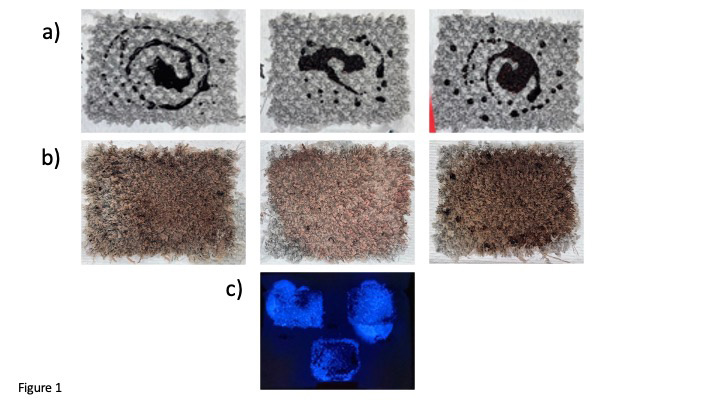
Figure 1: Results from Treatment 1 -2 Hour Samples: Blood Was Applied To The Carpet, A: And Allowed To Dry For 2 Hours Until Subjected To Treatment. B: Which Consisted Of Either Water (Left), Soap And Water (Center) Or Coca-Cola (Right). The Carpet Samples Were Scrubbed And Allowed To Dry. The Samples Were Analyzed With Luminol. C: To Detect The Presence/ Absence Of Blood. All The Carpet Samples Containing Fresh Or Aged Blood Were Highly Fluorescent When Viewed With Luminol. Carpet Samples Containing Blood And Cleaned With Soap And Water (Top Right) Were The Most Fluorescent With The Carpet Samples Containing Blood And Rinsed With Coca-Cola Were The Least Fluorescent (Bottom).
When analyzed with Luminol, carpet samples from Treatments 3 and 4 appeared to have moderate to high fluorescence suggesting that the blood stain was not significantly affected (Figure 4). Treatment 3 samples had moderate to high fluorescence in the same pattern as the blood stain. The 30-minute Coca-Cola sample (Treatment 3) had the lowest fluorescence of all the samples tested in Treatment 3. Phenolphthalein tests, a presumptive test for blood (Table 1a), of Treatment 3 samples produced a faint positive response. For Treatment 3, one sample (i.e., the 30-minute scrub) produced a negative response. Leucomalachite green, another presumptive test for the presence/absence of blood (Table 1b), of Treatment 3 samples were positive, with an intense positive 2-hour rinse for 1 day. Faint positives results were observed for all of the scrub samples.
| Phenolphthalein Results | |||||
|---|---|---|---|---|---|
| 30 M | 2 H | 1 D | 2 D | ||
| Treatment 3 | Rinse | + | + | + | ++ |
| Scrub | - | + | + | + | |
| Treatment 4 | Rinse | ++ | + | ++ | ++ |
| Scrub | + | + | + | + | |
| Treatment 5 | Water | - | - | - | - |
| Coke | + | - | - | - | |
| Treatment 6 | Water | - | + | + | Omit |
| Coke | + | ++ | + | Omit | |
| Treatment 6 Repeat | Water | - | - | - | Omit |
| Coke | - | + | + | Omit | |
| LCG Results | |||||
| 30 M | 2 H | 1 D | 2 D | ||
| Round 3 | Rinse | ++ | +++ | +++ | ++ |
| Scrub | + | + | + | + | |
| Round 4 | Rinse | +++ | + | +++ | ++ |
| Scrub | ++ | + | ++ | + | |
| Round 5 | Water | ++ | - | + | - |
| Coke | - | - | - | - | |
| Round 6 | Water | - | ++ | + | Omit |
| Coke | ++ | ++ | +++ | Omit | |
| Round 6 Repeat | Water | - | - | - | Omit |
| Coke | - | + | + | Omit |
Table 1b Table 1: Results From Presumptive Blood Tests. Phenolphthalein A: And Leucomalachite Green (LCG); B: Were Used To Detect The Presence/Absence Of Blood After Carpet Samples Were Subjected To Treatment (Soak, Scrub, And/Or Rinse). Results Were Indicated As Followed: Negative Results “-”, Faint Positive “+”, Positive “++”, And Intense Positive “+++”.
Treatment 4 samples appeared to have fluorescence (Figure 2) at the blood stain in addition to a lesser fluorescence around the area of the blood stain. Samples from 30 minute and 2-hour appeared to fluoresce the same and progressively increased in fluorescence the longer the blood remained on the carpet before treatment. Phenolphthalein (Table 1a) was positive for all Treatment 4 samples. All scrub samples and the 2-hour rinse sample resulted in a faint positive when analyzed by phenolphthalein. The LCG test results (Table 1b) indicated a faint positive for both the 2-hour rinse and scrub sample, and the 2-day Coca-Cola sample. There was also a faint positive response for the 2-day rinse, the 30-minute scrub, and the 1-day scrub. An intense positive response was observed for the 30 minute and 1 day rinse samples.
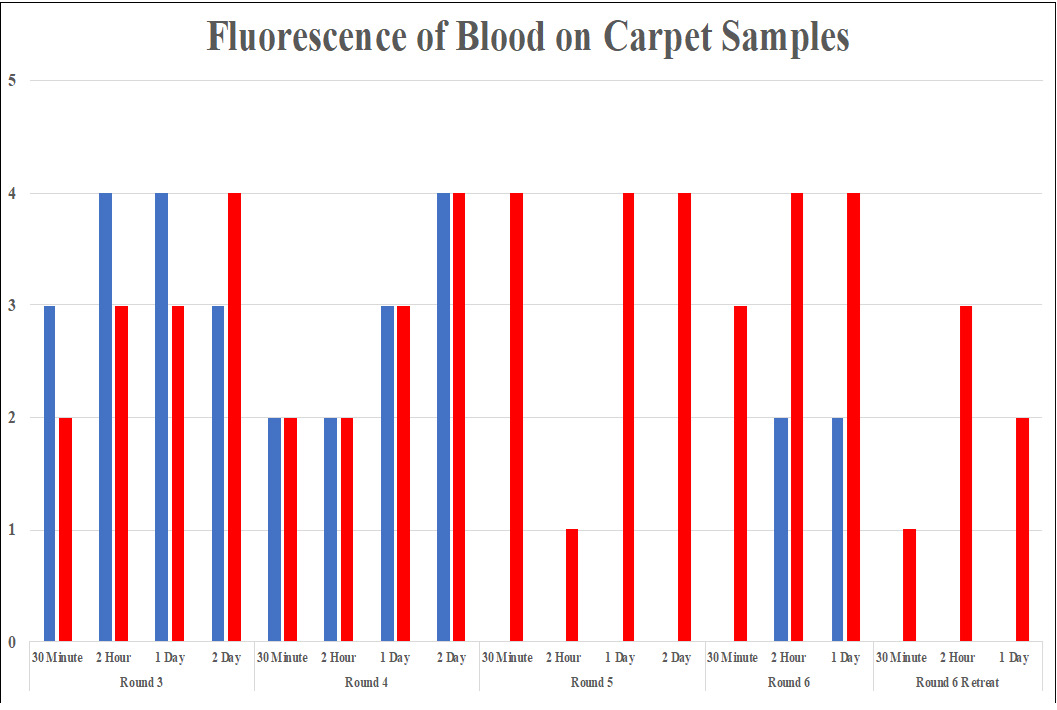
Figure 2: Luminol Results from Treatments 3-6. Samples Were Analyzed With Luminol After Treatment To Detect If Blood Remained On The Carpet Samples. The Blue Line Shows Results From Samples Soaked In Coca-Cola And Subjected To A Rinse Only (Treatments 3-4) Or Samples Soaked In Water Followed By A Scrub And Rinse (Treatments 5-6). The Red Line Shows Results From Samples Soaked In Coca-Cola Followed By A Rinse Only (Treatments 3-4) Or A Scrub And Rinse (Treatments 5-6). The Level Of Fluores-cence Ranged From 0-5: With 0-No Fluorescence, 1 – A Very Low Fluorescence Or Only A Small Spot Fluoresced, 2 - A Few Spots On The Carpet Fluoresced, 3 - Entire Carpet Sample Had A Light Fluorescence, 4 – A Bright Fluorescence Cov-ered The Entire Carpet, And 5 – A Very High Fluorescence Covered The Entire Carpet.
Blood was applied to the Treatment 5 and 6 carpet samples (Figure 3a), soaked in Coca-Cola (Figure 3b), followed by a rinse (Figure 3c), allowed to dry, and analyzed with Luminol (Figure 3d). Treatment 5 water samples did not fluoresce when analyzed with Luminol (Figure 2). The Treatment 5 samples, soaked in Coca-Cola fluoresced when analyzed with Luminol with the (2-hour sample demonstrating the lowest fluorescence. Phenolphthalein was negative for all samples except for the 30-minute scrub which was a faint positive (Table 1a). Leucomalachite green tests were negative for all Coca-Cola, 2 hour and 2-day water samples (Table 1b). A faint positive response resulted from the 1-day water sample and a positive result for the 30-minute water sample. Treatment 6 samples, analyzed with Luminol resulted in no fluorescence for the 30-minute water sample (Figure 2). A faint response was visualized on the 2-hour water and 1 day water samples. The entire carpet fluoresced for all Treatment 6 Coca-Cola samples. Phenolphthalein (Table 1a) and LCG (Table 1b) indicated positive results for all treated samples except for the 30-minute water (Figure 4a & 4b), which appeared negative. Treatment 6 samples were subjected to retreatment to determine if multiple treatments would assist in the removal of the blood stains. No fluorescence appeared on the water samples and a decrease of fluorescence was observed on the Coca-Cola samples. All samples, except the 2 hour and 1 day Coca-Cola samples, were negative when subjected to phenolphthalein (Table 1a) and LCG (Figure 1b) tests.
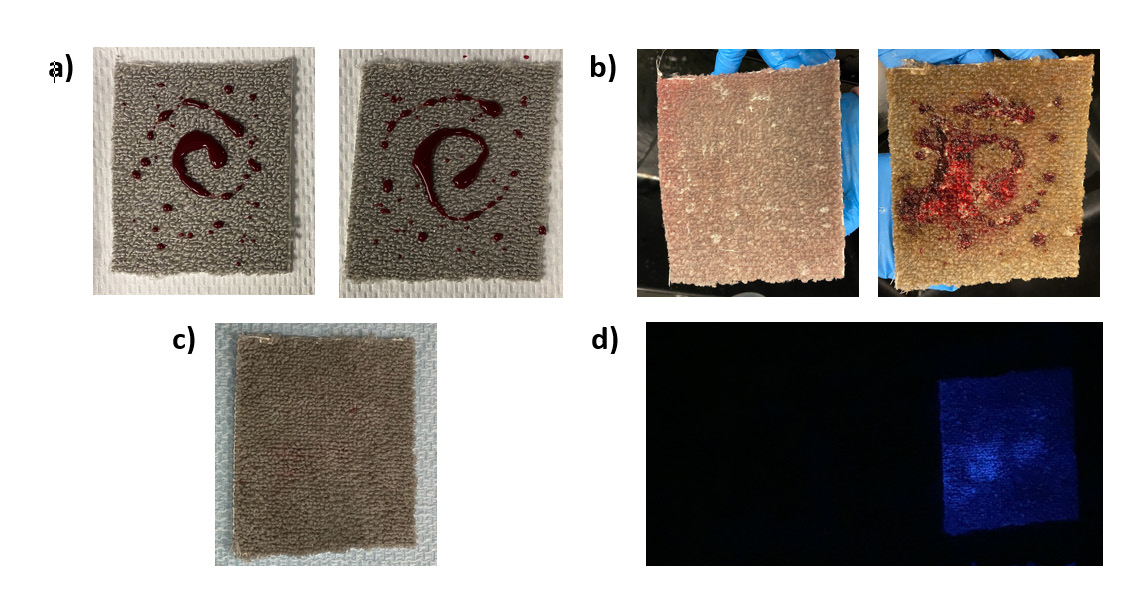
Figure 3: Results from Treatment 6-30 Minute Samples. Photographs Were Taken Of Carpet Samples Containing Fresh And Aged Blood After Treatment (Scrubbing And Rinsing) And Analyzed With Luminol. Blood Was Applied To The Carpet Samples A: And Allowed To Dry For 30 Minutes, And Soaked In 300 Ml Of Water (Left – B) Or Coca-Cola (Right B). After 2 Hours, The Carpet Samples Were Removed From The Liquid, Then Subjected To Treatment (C) Scrub Followed By A Rinse Under A Steady Stream Of Water. The Carpet Samples Were Then Analyzed With Luminol (D) After The Samples Were Dried.
A positive control was conducted by treating a carpet sample with blood, dried, and analyzed with Luminol. The positive control was highly fluorescent. A negative control was established with 2 samples by treating carpet samples with Coca-Cola and not rinsed and another carpet treated with in 300ml of Coca-Cola for 2 hours, rinsed for 20 seconds, and dried before being analyzed with Luminol. No fluorescence was observed with the negative controls.
Discussion
During the trial of Jens Soering (Commonwealth of Virginia v. Soering) in 1990, Elizabeth Haysom, the co- defendant, testified that Soering told her to go downstairs to the parking lot, find the car, and take a bottle of Coca-Cola and clean the blood in the car. This statement occurred after Soering allegedly had driven to Boonesboro, VA to kill Haysom’s parents and then returned to Washington D.C. in which Soering, wrapped in a blood-soaked sheet, and the 1985 rented vehicle were covered with blood. Haysom stated that she went down to the car and cleaned various parts of the car. After cleaning the car Haysom went back to the hotel room and Soering asked if she remembered to clean the mirrors. Haysom said that she did not clean the mirrors, so she went back to the parking lot and cleaned the car [1].
The prosecution had summoned Chuck Reid, one of the lead seasoned investigators from the Bedford County Sherriff’s Office, to possibly testify because he had treated the interior of the Chevette, approximately 3 months after the rental car was returned, with Luminol, a highly sensitive chemical that can detect blood at very low levels even when the blood has been diluted 1:5,000,000 [7, 9]. Reid sprayed Luminol everywhere, from the steering wheel of the rental vehicle to the crevices on the gas and brake pedals and swabbed all those areas for testing for the presence or absence of blood. Not a speck of blood was detected in the vehicle. To Reid, the lack of blood suggested that another car and, therefore, at least one other person had to have been involved in the murder of Haysom’s parents. But prosecutors never put Reid on the stand to hear this evidence, so jurors never heard that blood was not detected in the Chevrolet Chevette, the rental vehicle [10]. Nor did the jurors hear that the rental agency, when interviewed, stated that the Chevette was very clean upon its return. No reason was given as to why the prosecution did not put Reid on the stand to testify.
Although no blood or remnants were observed in the rented vehicle using Luminol this research focused on the effect of Coca-Cola on the removal of fresh and aged blood stains from carpet by varying the times of exposure to Coca-Cola. The initial tests (Treatments 1 and 2) placed blood on pieces of carpet, rinsed with water, and dried. All treated samples contained a visually obvious stain that was dispersed throughout the carpet. These treated samples also had the same amount of fluorescence when analyzed with Luminol. This observation suggested that this simple treatment using Coca-Cola was not sufficient to remove the blood stains. Due to the inability to decrease the fluorescence more rigorous treatments were explored.
The next treatments (Treatments 3 and 4) consisted of soaking the blood-stained carpets with a larger volume of Coca-Cola (150 ml versus 50 ml) and soaked in the product for one hour or for 2 hours. Both treatments showed a positive response for the presence of blood when analyzed by Luminol. Thus, adding a larger volume of Coca-Cola did not simply wash away the blood or even necessarily reduce the amount on the carpet.
Treatments 5 and 6 consisted of soaking the carpets with blood for varying periods of time, soaked in 300ml Coca-Cola for 3 or 2 hours, followed by a scrub, a rinse, and time to dry. In each instance, blood was detected when analyzed by Luminol. These results were consistent with those observed for Treatments 3 and 4. One sample in Treatment 5 showed a reduction in the fluorescence of blood when analyzed by Luminol. Again, Coca-Cola was not acting as a washing agent but could possibly act as an interferant.
Treatments 3 through 6 were also analyzed for the presence of blood using presumptive blood tests such as phenolphthalein and leucomalachite green. For the phenolphthalein tests, the results for Treatments 3 and 4 were similar in that the presence of blood was detected. One outlier was in Treatment 3 where the carpet was soaked in blood for only 30 minutes, scrubbed with water, and subjected to phenolpthalein. A negative response was observed with this sample. The remaining samples were negative for the presence of blood when tested with phenolpthalein. The results for Treatment 5 showed that water could effectively alter the detection of blood when analyzed with phenolphthalein and/or interfere with the chemical reactions. Phenolphthalein was able to detect blood in the one sample that was exposed to fresh blood for 30 minutes and rinsed with Coca-Cola for 3 hours. Most of the samples in Treatment 6 were positive for the presence of blood when tested with phenolphthalein. The one exception was the sample that was exposed to blood for 30 minutes and rinsed with Coca-Cola for 2 hours.
For the leucomalachite green tests, the results were consistent with the results observed for Treatments 3 and 4 when analyzed with phenolpthlalein. Each of the samples in Treatments 3 and 4 were positive for the presence of blood when tested with leucomalachite green. For Treatment 5, the results indicated that Coca-Cola and water could effectively eliminate the detection of blood when analyzed by leucomalachite green. Treatment 6 showed that soaking the blood-stained carpets for 2 hours (versus 3 hours in Treatment 5) did not eliminate the detection of blood when analyzed with leucomalachite green.
Treatment 6 samples were subjected to retreatment to determine if a second treatment would assist in the removal of the blood stains. No fluorescence was observed in the samples that were rinsed for a second time; however, there was a decrease in fluorescence when the samples were scrubbed and rinsed for the second time. It should be noted that when Coca-Cola was tested by itself (with no blood) no fluorescence was observed indicating that there were no false positives.
Conclusion
This project was initiated to determine the effects of Coca-Cola on the detection of fresh and aged blood stains on carpet using Luminol and presumptive chemical blood tests specifically phenolphthalein and leucomalachite green. The results demonstrated that soaking carpet samples in Coca-Cola that had been exposed to blood and allowed to dry over several time intervals was the most effective method of reducing the presence of blood and thus, a decrease in fluorescence. However, Coca-Cola alone did not remove blood from the carpet samples. Scrubbing the carpet samples and rinsing with water was shown to be an effective method when compared to samples that where only subjected to rinsing to remove the blood from the carpet.
Acknowledgments
The authors would like to extend their sincere appreciation to the Department of Biology and Chemistry for their support. This project was made possible by an ILLUMINATE Grant sponsored by the Liberty University Center for Teaching Excellence.
References
-
Commonwealth of Virginia v. Jens Soering (1990) Courtroom Testimony.
-
Commonwealth of Virginia v. Elizabeth Haysom (1987) Courtroom Testimony.
-
Bettex KD, Glynn C (2018) The Impact of Antioxidant Beverages on the Chemiluminescent Detection of Bloodstains at Crime Scenes.
-
Martin T (2018) How to Clean with a Can of Coke. https://www.cnet.com/pictures/things-you-can-clean- with-coke/10/.
-
Graves L (2024) Cleaning Hacks with Coke: Unexpected Uses around your home. https://www.homeperch.com/ cleaning-hacks-with-Coke.
-
Li Y, Schellhorn HE (2007) New developments and novel therapeutic perspectives for vitamin C. Journal of Nutrition 137(10): 2171-2184.
-
Carr AC, Frei B (1999) Toward a New Recommended Dietary Allowance for Vitamin C based on antioxidant and Health Effects in Humans. The American Journal of Clinical Nutrition 69(6): 1086-1107.
-
McClintock JT (2014) Exercise 3: Detection of Blood. In: Forensic Analysis of Biological Evidence: A Laboratory Guide for Serological and DNA Typing. CRC Press, pp: 28-30.
-
Robinson EM, Brown K, Watkins D (2016) Ultraviolet, Infrared, and Fluorescence. In: Crime Scene Photography. 3rd Ed., Academic Press.
-
The Chuck Reid Report on the Haysom/Soering Case (2023) Gallip, Verlag and Media, Stuttgart, Germany.
- Forensic Implications of Adverse Drug Reactions in Schizophrenia A Case Series
- Narcotics and Digital Forensics: Bridging Crimes in the Digital Age
- Ethics in Forensic Psychiatry: Principles, Dilemmas, and Human Rights
- Impact of Acute Stress on Attentional Orienting to Social Cues
- Head Injury and Intracranial Hemorrhage in Western Region of Libya
- A Forensic Study on Handedness: Examination of Handwriting Features in Right and Left Handed Writers