
Solutions of the Bloch Equations without Relaxation for a Sin Cos Pulse Using the Wei-Norman Formalism
The Wei-Norman Formalism is applied to the problem of finding exact solutions to the Bloch Equations without relaxation for the Sin-Cos Pulse. Derivations of the solutions and comparison with numerical results are presented. The agreement is excellent. The method may be applicable to find the solution of the Bloch equations without relaxation for any amplitude and frequency offset functions.
Introduction
The Bloch equations have played a pivotal role in the development of the field of Nuclear Magnetic Resonance. Because of their importance there has been a great deal of interest in analytic solutions of the system of equations for the magnetization. The case where the radiofrequency pulses are time independent has received a great deal of attention. The case where the RF is intrinsically time dependent has been treated far less in publications probably because the topic is more difficult to deal with.
In this contribution, we outline a method to obtain an almost exact solution to the Bloch equations without relaxation for the case of time dependent RF. This method is based on the seminal work known in the Physics Literature as the Wei-Norman Method after the authors of the work. The group of Sanctuary [1] introduced this Solutions of the Bloch Equations without Relaxation for a Sin Cos Pulse Using the Wei-Norman Formalism method to the NMR Community. Here we apply the method specifically, to the Sin-Cos pulse which has been of great interest for NMR applications. Although not explicitly shown, the author has applied the derived method to the HS1 pulse and Gaussian pulse and found also to be exactly solvable by the methods in this paper. It is tempting from this and a careful examination of the equations to postulate that the method will work for any RF pulse, Amplitude/ Frequency- offset pair, but this must be verified by further work.
There has been interest in solutions of the Time Dependent Bloch equations. The Russian Group of Prants, et al. [2] applied group theoretic methods to the problem, but did not apply this method to the Sin-Cos pulse. Hioe’s Group [3], attacked the problem and presented exhaustive results for many types of pulses but did not consider the Sin-Cos pulse. We have been unable to find a specific treatment of the Sin Cos pulse in the extant literature available to us.
Int J Nuclear Med Radioactive Subs
Theoretical Development
We start with the Schroedinger equation governing the time evolution of the propagator:
$$\frac{dZ[t]}{dt} = -iH[t]Z[t]$$
(1)
Here $Z[t]$ is the Propagator Operator and $H[t]$ is the Hamiltonian of the system. Following the Formalism of Wei-Norman as explained in their seminal paper from the 60’s we express the propagator as the product of exponential Rotation Operators, where the operators form a group [1] and the arguments of the Rotation Operators are elements of a Lie Algebra [1]. For the typical case in NMR considered here the Lie Algebra is fairly straight forward and consists of the angular momentum operators for spin $\frac{1}{2}$ particles. This makes calculations considerably easier to deal with.
$$Z(t) = \exp\left[g_{1p}[t]I_x\right]\exp\left[g_{2p}[t]I_y\right]\exp\left[g_{3p}[t]I_z\right]$$
(2)
Here the $g_{ip}[t]$ (i=1, 2, 3) can be complex quantities. For the case of spin $\frac{1}{2}$ particles such as used in proton Nuclear Magnetic Resonance (NMR), we can simply define the Rf Hamiltonian as:
$$H(t) = w[t]I_x + \Delta w(t)I_z$$
(3)
Here the nomenclature of NMR calls $\omega[t]$ the pulse amplitude and $\Delta \omega[t]$ the frequency offset. So now let us substitute the defined quantities in Eq (1).
$$\frac{dZ(t)}{dt} = g_{1p}[t]I_xZ(t) + \exp\left[g_{1p}[t]I_x\right]g_{2p}[t]I_y\exp\left[g_{2p}[t]I_y\right]\exp\left[g_{3p}[t]I_z\right]$$
(4)
Now we find we can define the inverse of the Propagator as the adjoint of $Z[t]$ as:
$$Z(t)^{-1} = \exp\left[-g_{3p}[t]I_z\right]\exp\left[-g_{2p}[t]I_y\right]\exp\left[-g_{1p}[t]I_x\right]$$
(5)
So we multiply both sides of Eq(4) from the right by Eq(5) to obtain:
$$\dot{g}_{1p}[t] + i\Sinh\left[g_{2p}[t]\right] = -i\omega[t]$$
$$\dot{g}_{2p}[t]\Cosh\left[g_{1p}[t]\right] - i\Cosh\left[g_{2p}[t]\right]\Sinh\left[g_{1p}[t]\right] = 0$$
$$\dot{g}_{3p}[t]\Cosh\left[g_{2p}[t]\right]\Cosh\left[g_{1p}[t]\right] + i\dot{g}_{2p}[t]\Sinh\left[g_{1p}[t]\right] = -i\Delta \omega[t]$$
We need to evaluate the rotation operators. We use the following general relation which can be derived by expanding the exponential operators and collecting terms:
$$\Exp[\lambda A]BExp[-\lambda A] = \Cosh[\lambda A] + [A, B]\Sinh[\lambda]$$
(7)
We can use this expression to evaluate the rotation operators in Eq (6) as:
$$\Exp\left[g_{1p}[t]I_x\right]\I_y\Exp\left[-g_{1p}[t]I_x\right] = \Cosh\left[g_{1p}[t]I_x\right] + iI_z\Sinh\left[g_{1p}[t]\right]$$
We can evaluate the next set of rotation operators as follows $I_y$ to $I_z$:
$$\Exp\left[g_{1p}[t]I_x\right]\Exp\left[g_{2p}[t]I_y\right]\I_z\Exp\left[-g_{2p}[t]I_y\right]\Exp\left[-g_{1p}[t]I_x\right]$$
$$\Exp\left[g_{2p}[t]I_y\right]\I_z\Exp\left[-g_{2p}[t]I_y\right] = \Cosh\left[g_{2p}[t]\right]I_z + iI_z\Sinh\left[g_{2p}[t]\right]$$
We can evaluate the next set of rotation operators around $I_x$:
$$\Exp\left[g_{1p}[t]I_x\right]\Exp\left[g_{2p}[t]I_y\right]\I_z\Exp\left[-g_{2p}[t]I_y\right]\Exp\left[-g_{1p}[t]I_x\right]$$
$$\Cosh\left[g_{2p}[t]\right]\Cosh\left[g_{1p}[t]\right]I_z - iI_y\Cosh\left[g_{2p}[t]\right]\Sinh\left[g_{1p}[t]\right] + i\Sinh\left[g_{2p}[t]\right]I_x$$
We now substitute into Eq (6):
$$\dot{g}_{1p}[t] + i\Sinh\left[g_{2p}[t]\right] = -i\omega[t]$$
$$\dot{g}_{2p}[t]\Cosh\left[g_{1p}[t]\right] - i\Cosh\left[g_{2p}[t]\right]\Sinh\left[g_{1p}[t]\right] = 0$$
$$\dot{g}_{3p}[t]\Cosh\left[g_{2p}[t]\right]\Cosh\left[g_{1p}[t]\right] + i\dot{g}_{2p}[t]\Sinh\left[g_{1p}[t]\right] = -i\Delta \omega[t]$$
Copyright© Dennis J Sorce.
International Journal of Nuclear Medicine & Radioactive Substances
$$ \mathrm {E} = \frac {1}{2} \mathrm {A} ^ {2} + \mathrm {B} ^ {2} $$
ω =− − [ ] [ ] Sinh[ [ ]] 1 2
g t i t i g t p p
$$ \mathrm {E} = \mathrm {E} _ {1} + \mathrm {E} _ {2} + \dots + \mathrm {E} _ {n} $$ =− (8) [ ] Cosh[ [ ]]Tanh[ [ ]] 2 2 1 g t i g t g t p p p $$ \mathrm {E} = \frac {1}{2} \mathrm {A} ^ {2} + \mathrm {B} ^ {2} $$ ω =−Δ + [ ] [ ] Tanh[ [ ]] ^ 2 3 1 g t i t g t p p This system of equations can be solved numerically to find the time dependent coefficients for the rotation operators that make up the propagator.
Then the propagator can be applied to the angular momentum operators to find the time evolution of the magnetization for each angular momentum operator in the Rotating Frame.
We next apply Z[t] in Eq (2) to , , x y z I I I to obtain the time evolution of the magnetization for the pulse defined in Eq (3) where the amplitude has the form:
Sin[ ] 1 1_t_ ω ω
And the frequency offset is given by:
ω Cos[ω t] 1 1
For concreteness if we consider the time evolution of xI ,
we have:
† [ ] [ ] Z t I Z t x
Here † [ ] Z t is the Hermtian Adjoint. We can do the same for the other components of the magnetization. We can express the results in terms of normal trigonometric Sine, Cosine functions or using Sinh, Cosh functions. For the ease of the reader we will use the Sine, Cosine option. The function for the gi’s may be obtained by solving the system of equations in Eq (8). We find the result:
$$ I _ {x} [ t ] = \mathrm {R} _ {e} [ \operatorname {S i n} [ - i g _ {2} [ t ] ] $$ $$ I _ {y} [ t ] = R _ {e} [ \operatorname {S i n} [ - i g _ {1} [ t ] ] ] R _ {e} [ \operatorname {C o s} [ - i g _ {2} [ t ] ] ] $$ $$ I _ {z} [ t ] = R _ {e} \left[ \operatorname {C o s} \left[ - i g _ {1} [ t ] \right] \right] R _ {e} \left[ \operatorname {C o s} \left[ - i g _ {2} [ t ] \right] \right] $$
Results
In Figures 1a & 1b we see plots of a comparison of the Wei Norman Solution as derived above, with the corresponding numerical solution of the magnetization components from the Bloch equations without relaxation for a Sin Cos Pulse with the RF amplitude on x. The solutions of the system of first order differential equations in time were obtained using the Function ND Solve in the Mathematical platform vs 11.1 utilizing a Runge- Kutta method. As can be seen, the agreement between the two methods of solution as plotted in the figures is excellent. Not shown, was a similar numerical comparison between the two solution methods for the HS1 pulse [4]. There also the agreement was excellent.
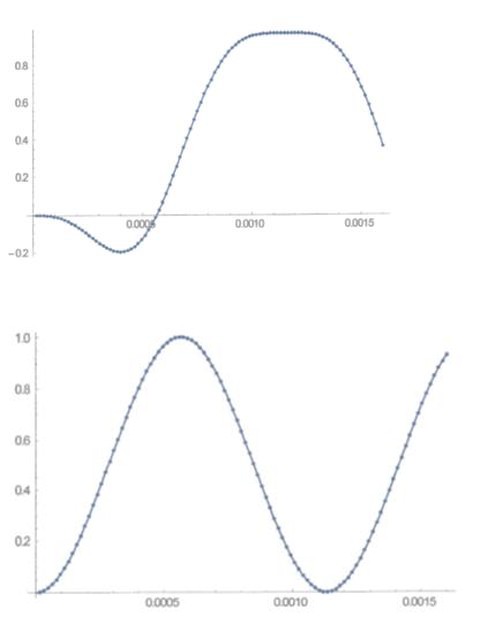
Figure 1a: ω1 = 2π625.0HZ. Dotted line the numerical solution of the bloach equations. Solid line the wei- norman solution for Ix.
Figure 1b: Same as 1A for Iy.
International Journal of Nuclear Medicine & Radioactive Substances
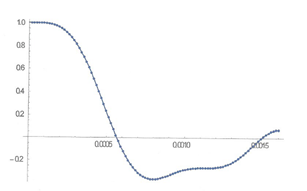
Figure 1c: Same as 1A for Iz.
Discussion
The Wei Norman method for solution of systems of differential equations was introduced into the NMR literature in a seminal paper from Sanctuary’s group [1]. There the detailed development of the formalism was given, which can be elaborate.
In contrast, the method we have detailed in this contribution is relatively straightforward. The reason for this is that for applications of the Wei Norman method to the solution of differential equations for rotations for a spin ½ nucleus using rotation operators is very “user friendly.” The application of the rotation operator product representing the Time Evolution Operator for the spin system uses standard methods commonly utilized within the NMR community.
Also, although not thoroughly tested and verified, for other pulse sequence combinations of RF amplitude and frequency offset functions, specifically for the HS1 and Gaussian pulses, the method also yielded exact agreement. This raises the possibility that the method can be used for any RF amplitude offset pair.
As alluded to in the introduction, there has been active interest in solutions of the Bloch equations with time dependent coefficients both with and without relaxation included. In the paper by Prants et al. [2], group theoretic methods were applied to the solution of the Bloch equations for classes of Rf functions. The Sin Cos Pulse was not treated. Hioe’s group [3], published an exhaustive compendium of solutions of the Bloch equations without relaxation using a method of solution completely different from the one employed in the paper we present here. The Sin Cos Pulse was not explicitly treated in the form we present. Rau [5], gave an exposition of a general method of attack for the unitary integration of Liouville Bloch equations, without treating a specific case.
In short, the method of solution of the Bloch equations without relaxation presented here, using a variant of the Wei Norman formalism has successfully been applied to the solution of the Bloch equations without relaxation for the Sin Cos pulse. The detailed method may have utility for a variety of RF amplitude and frequency offset pairs.
References
-
Campolieti G, Sanctuary BC (1989) The Wei Norman Lie algebraic technique applied to field modulation in nuclear magnetic resonance. J Chem Phys 91(4): 2108.
-
Prants SV, Yakupova LS (1990) Analytic Solutions to the Bloch equations for amplitude and Frequency modulated fields. Sov Phys JETP 70(4): 1140-1150.
-
Hioe FT, Carroll CE (1985) Two-state problems involving arbitrary amplitude and frequency modultions. Phys Rev A 32: 1541.
-
Garwood M, DelaBarre L (2001) The Return of the Frequency Sweep: Designing Adiabatic pulses for Contemporary NMR. J Magn Reson 153(2): 155-177.
-
Rau ARP (1988) Unitary Integration of Quantum Liouville Bloch Equations. Phys Rev Letters 81: 4785.
- Contribution of 18FDG PET in Atypical HORTON Disease
- Living Conditions, Healthy Practice and State of Households of a Town Rural in Colombia
- Background to the Health and Safety Regulation at Work in Colombia
- Risk Factors Psychology Workers Sena (Center for the Petrochemical Industry) Regional Bolívar, Colombia
- Diffuse Intense Pleural FDG Uptake with Smooth Thickening: A MARKER of Tuberculosis in Isolated Pleural Effusion
- Hypermetabolic Splenomegaly with Infarct in FDG PET/CT: A Clue to Scrub Typhus in PUO