
Dosimetric Comparison: Volumetric Modulated Arc Therapy (VMAT) and 3d Conformal Radiotherapy (3d-CRT) in High Grade Glioma Cancer Experience of Casablanca Cancer Center at the Cheikh Khalifa International University Hospital
Background: Intensity Modulated Radiation Therapy (IMRT) is currently employed as a major arm of treatment in multiforme glioblastoma (GBM). The present study aimed to compare 3D-CRT with IMRT to assess tumor volume coverage and OAR sparing for treatment of malignant gliomas. Materials and Methods: We assessed 22 anonymized patients datasets with High Grade Glioblastoma who had undergone post-operative Intensity Modulated Radiotherapy (IMRT) and 3D Conformal Radiotherapy (3D-CRT), This study will compare and contrast treatment plans Rapidarc and 3D-CRT to determine which technique improves significantly dosimetric parameters. Results: Plans will be assessed by reviewing the coverage of the PTV using mean, maximum and minimum doses while the OAR doses will be compared using the maximal doses for each, as set out in the QUANTEC dose limits. Conclusion: The use of IMRT seems a superior technique as compared to 3D-CRT for the treatment of malignant gliomas having the potential to increase dose to the PTV while sparing OARs optimally.
Introduction
Intensity Modulated Radiation Therapy (IMRT) and Three Dimensional Conformal Radiation Therapy (3D-CRT) are both very promising techniques for the treatment of brain tumors.
Purpose
We aimed to evaluate the dosimetric interest of Volumetric Modulated Arc Therapy (VMAT) using Rapidarc® the varian solution for the treatment of patients with multiforme glioblastoma near to organs at risk .We report the results of a retrospective study of 22 patients treated at the Casablanca Cancer Center of Cheikh Khalifa International University Hospital.
Materials and Methods
Through a retrospective study we assessed 22 patients with High Grade Glioblastoma who had undergone post- operative Intensity Modulated Radiotherapy (IMRT) and 3D Conformal Radiotherapy (3D-CRT) ,plans were generated and optimized for comparison after contouring crucial neuronal structures important for neurogenesis and neurocognitive function. Integral dose (ID), homogeneity index (HI), and inhomogeneity coefficient (IC) were calculated from dose statistics. Toxicity data were evaluated.
Results
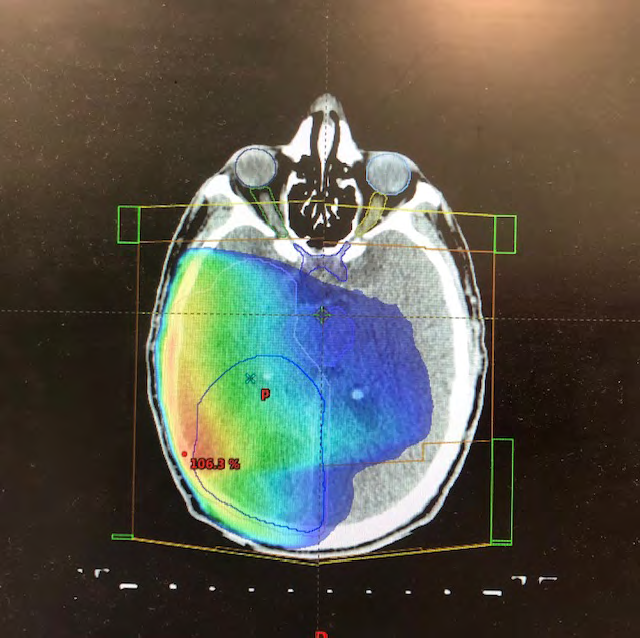
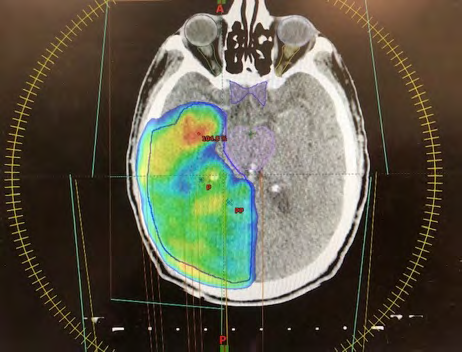
Were Based on the coverage of the predicted target volume (PTV), the compliance index (CI), the homogeneity index (HI) and on the dose-volume histogram (HDV) of the organs at risk both plans were compared. The dosimetric coverage of the predicted target volume (D95) generated by the two techniques was almost fixed for each patient with an average compliance index for the VMAT of 0.9884 ± 0.010 and of 0.9894 ± 0.011 for the 3D-CRT in order to have a significant comparison for other dosimetric parameters. The Average homogeneity index for the VMAT was 0.071 ± 0.021 and of 0.103 ± 0.023 for the 3D-CRT. VMAT showed significant reductions in mean dose delivered to the Brainstem, Optic chiasma and to the Optic Nerve (close to PTV) compared to 3D-CRTwith maximum average doses of 51.46Gy ± 5.91Gy respectively. Against 56.24 ± 5.63Gy, 36.39Gy ± 7.97Gy against 51.84Gy ± 5.77Gy and 38.16 ± 18.50Gy against 40.68Gy ± 21.49Gy. A statistically significant dose reduction to the healthy brain in favor of IMRT (Figure 1) was scored for normal brain; the mean volume receiving 60 Gy was greater in the 3D-CRT (Figure 2) plan compared to VMAT: 3.13% for 3D-CRT against 0.28% for VMAT.
Discussion
Postoperative Radiotherapy with chemotherapy has been standard treatment for newly diagnosed glioblastoma as it had showen significant survival benefits after surgery. Unfortunately HGG can develop in different sites of the brain, some lésions can be very proximal to several critical organs at risk (e.g. optical nerves, brainstem, chiasma and retina), that can cause late radiation toxicity including neurocognitive deficits and necrosis. Therefore the potential for using the best technique to insure maximal coverage of the predicted target volume and simultaneously reducing radiation dose to OAR is discussed. Our results indicate that, as compared with 3D-CRT, IMRT showed significant reductions in mean dose delivered to the brainstem, optic chiasma, normal brain and to the optic nerve, moreover IMRT also improved predicted target volume coverage and dose homogeneity over 3D-CRT. Studying a group of 5 patients, Chan et al. demonstrated that, as compared with 3D-CRT, IMRT delivered higher doses (in excess of 10 Gy) to the gross tumor while respecting the same normal-tissue constraints [1].
In the Narayana study Fifty-eight consecutive high- grade gliomas were treated with dynamic MLC IMRT [2] glioblastoma accounted for 70% of the cases, and anaplastic oligodendroglioma histology (pure or mixed) was seen in 15% of the cases. Surgery consisted of biopsy only in 26% of the patients, and 80% received adjuvant chemotherapy. IMRT did not significantly improve target coverage compared with Three-dimensional planning. However, IMRT resulted in a decreased. Maximum dose to the spinal cord, optic nerves, and eye by 16%, 7%, and 15%, respectively, owing to its improved dose conformity. The mean brainstem dose also decreased by 7%. Several comparison studies [3, 4] have been performed over the last years and nearly all, with few exceptions [4], suggest that IMRT techniques (static, volumetric, rotational) lea to a reduction of doses to OAR and to the healthy brain tissue [1] surrounding PTV, while maintaining target coverage without significant variations. MacDonald SM, et al. [5] and Zach L, et al. [6] highlighted no differences in terms of PTV V95%.
At the same time, in their comparative dosimetric study Wagner D, et al. [7] and Thilmann C, et al. [3] pointed out that IMRT achieved better target coverage with respect to 3D-CRT, scoring a V95% improvement of 13.5 and 13.1% respectively. This advantage was much more significant when PTV was in proximity of OAR [7]. MacDonald SM, et al. [5] compared the dosimetry of Intensity Modulated Radiation Therapy and Three Dimensional Conformal Radiation Therapy techniques in patients treated for high-grade glioma. A total of 20 patients underwent computed tomography treatment planning in conjunction with magnetic resonance imaging fusion. Prescription dose and normal-tissue constraints were identical for the 3D-CRT and IMRT plans .As compared with 3D-CRT, IMRT significantly increased the tumor control probability (p<or=0.005) and lowered the normal-tissue complication probability for brain and brainstem (p<0.033).
Intensity Modulated Radiation Therapy improved target coverage and reduced radiation dose to the brain, brainstem, and optic chiasma. With the availability of new cancer imaging tools and more effective systemic agents, IMRT may be used to intensify tumor doses while minimizing toxicity, therefore potentially improving outcomes in patients with high grade glioma. At the same time, in their comparative dosimetric study Wagner D, et al. [7] and Thilmann C, et al. [3] pointed out that IMRT achieved better target coverage with respect to 3D-CRT, scoring a V95% improvement of 13.5 and 13.1%, respectively. Recently most Radiotherapy technical platforms offer a choice among these different techniques, it is important to define the parameters which will guide the final decision adopted for the treatment, following a comparative dosimetric study. IMRT planning has demonstrated its superiority over Three Dimensional Conformal Radiotherapy with regard to the preservation of organs at risk.
Conclusion
IMRT seems a superior technique as compared to
3D-CRT, in our study it allows for a better target dose coverage and improves the homogeneity of the dose received by the predicted target volume while maintaining equivalent OARs sparing and reducing healthy brain irradiation.
References
-
Chan MF, Schupak K, Burman C, Chui CS, Ling CC (2003) Comparison of intensity modulated radiotherapy with three-dimensional conformal radiation therapy planning for glioblas-toma multiforme. Med Dosim 28(4): 261- 265.
-
Narayana A, Yamada J, Berry S, Shah P, Hunt M, et al. (2006) Intensity-modulated radiotherapy in high-grade gliomas: clinical and dosimetric results. Int J Radiat Oncol Biol Phys 64(3): 892-897.
-
Thilmann C, Zabel A, Grosser KH, Hoess A, Wannenmacher M, et al. (2001) Intensity-modulated radiotherapy with an integrated boost to the macroscopic tumor volume in the treatment of high-grade gliomas. Int J Cancer 96: 341-349.
-
Piroth MD, Pinkawa M, Holy R, Stoffels G, Demirel C, et al. (2009) Integrated-boost IMRT or 3-D-CRT using FET- PET based auto-contoured target volume delineation for glioblastoma multiforme-a dosimetric comparison. Radiat Oncol 4: 57.
-
MacDonald SM, Ahmad S, Kachris S, Vogds BJ, DeRouen M, et al. (2007) Intensity modulated radiation therapy versus three-dimensional conformal radiation therapy for the treatment of high grade glioma: a dosimetric comparison. J Appl Clin Med Phys 8(2): 47-60.
-
Zach L, Stall B, Ning H, Ondos J, Arora B, et al. (2009) A dosimetric comparison of four treatment planning methods for high grade glioma. Radiat Oncol 4: 45.
-
Wagner D, Christiansen H, Wolff H, Vorwerk H (2009) Radiotherapy of malignant gliomas: comparison of volumetric single arc technique (RapidArc), dynamic intensity-modulated technique and 3D conformal technique. Radiother Oncol 93(3): 593-596.
- Contribution of 18FDG PET in Atypical HORTON Disease
- Living Conditions, Healthy Practice and State of Households of a Town Rural in Colombia
- Background to the Health and Safety Regulation at Work in Colombia
- Risk Factors Psychology Workers Sena (Center for the Petrochemical Industry) Regional Bolívar, Colombia
- Diffuse Intense Pleural FDG Uptake with Smooth Thickening: A MARKER of Tuberculosis in Isolated Pleural Effusion
- Hypermetabolic Splenomegaly with Infarct in FDG PET/CT: A Clue to Scrub Typhus in PUO