
The Art of Remote Sensing for Nuclear Medicine
Remote sensing can play crucial role in the evolving nuclear medicine sector in Egypt. As the number of national medical centers that use Positron Emission Tomography (PET)/ Computed Tomography (CT) scans and radioactive isotopes for diagnostics and therapeutic services of cancer patients, is increasing. Remote sensing also copes with the worldwide efforts of having specific cyclotron together with radio pharmacy and clinic on-site. The paper presents an integrated remote sensing solution for nuclear medicine facilities, to detect radiation exposure, and contamination in the production, diagnostic and therapeutic areas. The system allows economic and reliable autonomous monitoring, it helps reducing the cost, enhancing production quality, increasing number of treated patients, improving the patient remedy, assuring the staff safety, and complying with regulatory requirements. Four communication technologies ZigBee, Bluetooth, Wi-Fi, and Z-Wave, have been investigated, and compared in context of network parameters (data rate, coverage, power constrains and bandwidth) and success factors (cost, reliability, ease of deployment and security). The ZigBee technology seems to be the best candidate for the proposed system. Results demonstrate the feasibility of using remote sensing for nuclear medicine and promise the efficient performance of the national facilities.
Introduction
Radionuclides are unstable isotopes produced in a cyclotron and attached to biological tracer, they have excess neutrons or protons that cause radioactively decay, in the form of emission of gamma rays or subatomic particles. The cyclotron accelerates particles to very high speeds and focusing them on a target substance where a reaction takes place to produces the desired short-lived radionuclide for industrial and medical purposes. Once produced in the cyclotron, the radioactive material is transferred to a shielded “hot cell” where it is run through sophisticated chemistry process to produce active tracers. These tracers can be used in medical imaging to more accurately diagnose, treat and prevent diseases. The most commonly used cyclotron- produced radionuclides in radio pharmacy are 11C, 13N, 15O, Tc-99m and 18F, their respective half-lives are 20.38, 9.96, 2.03, 360 and 109.7 min [1], the most commonly used tracer cancer diagnosis is the FDG based on F-18.
The PET scanner allows the study of physiological, biochemical and pharmacological functions on the molecular level. Illnesses such as cancer, cardiovascular diseases and even neurological disorders can be detected long before symptoms appear. The produced FDG has to be tested against TQM tools to assure that is highly reliable, and fully compliant with Good Manufacturing Practice (GMP) [2]. At the diagnostic & therapeutic side, before the PET scan take place, a small amount of FDG is injected into the patient by a qualified nurse, and because cancer grows at a faster rate than healthy tissue, cancer cells absorb more of the FDG that is concentrated in the tissue of interest.
Radiopharmaceuticals have special characteristics and require unique quality assurances described in numerous pharmacopoeias. The quality control includes testing for both chemical and radiochemical purity before the radiotracer is administered to the patient, there is a constant drive to reduce the time spent on quality control. From the point of view of protecting environment and public, a significant issue is the control of activity of volatile radionuclides released during irradiation or chemical synthesis of PET radiopharmaceuticals inside hot cells, or in case of target breaks or failure [1]. Therefore, effective radiation protection program in shall include fixed area and air monitoring in the controlled areas to evaluate dosage inside facility and activity estimation of radioactive gaseous species released through the stack to limit releases into the atmosphere. In addition, both workers and patients shall be monitored and it is necessary to reduce the risk within a reasonably achievable range for the patients receiving radiopharmaceutical. Generally, the patient may receive around 70 µSv/h in 1ml FDG (350 MBq) during the treatment, and his vital signs be monitored [3].
Proposed Nuclear Medical Facility
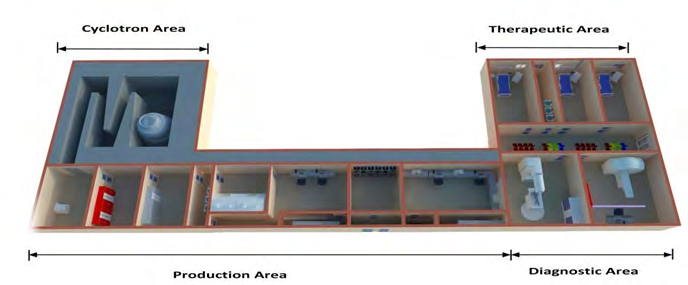
To meet the radiation protection program requirements, the facility shall have sophisticated radiation monitoring system with variety of radiation monitors, displaying and alarm units to offer effective control, data acquisition and information systems. Wireless Sensor Network (WSN) will ensure autonomous radiation monitoring and prevent personnel over-exposures of workers and patients. The cyclotron area designed with specific maze-style to hold any radioactive gases until they are decayed to non-radioactive elements. The walls, ceiling, and door of the cyclotron vault have thick concrete walls according to the shield calculations. Although in case of event, cyclotron cannot produce radioactivity without electrical power, gamma and positron detectors are installed and inside the stack duct to increase sensitivity.
The production area designed with radiochemistry laboratories that contain adequately shielded hot cells for the manipulation and dispense of radiopharmaceuticals, cleaning rooms, quality assurance laboratories, delivery rooms and central monitoring room in the middle as shown in Figure 1. Diagnostic area where the PET/CT scanners are installed while therapeutic areas where patients are prepared or receive treatments. Both areas are controlled areas with high exposure risks and require specific site planning and monitoring objectives.
Integrated Remote Sensing Solution
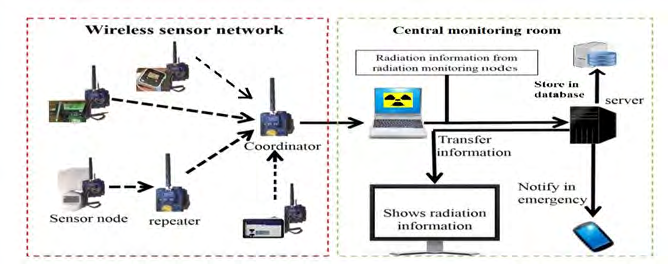
The Integrated Remote Sensing Solution (IRSS) is optimized to the specific needs of the proposed facility as shown in Fig. 1, with variety of radiation detectors for area, airborne, process and effluent monitoring that installed at fixed points to cover the different areas. All worker personal dosimeters connected to the system wirelessly and have visual and audible alarms that are generated as soon as a predefined threshold is exceeded on doses or dose rate. At the same time, it enables the collection, and sharing of multi variables of the patient condition including the dose received for oncology QA purposes, [3] and his vital signs for health care. IRSS managed by integrated software for sensing, processing, sending/receiving, storing, reporting, controlling alarms & interlocks, and supported by user friendly graphic interface. The data stored in the database can be accessed through software installed on any workstation in the network, it can be analysed shown in tables and graphs to facility the decisions taken by the workers or the nuclear medicine staff. It can also offer actuating audible, visual, and remote alarm notifications, by setting area monitors to conservative alarms levels and notify workers of increased area dose rates in real time.
diagnostic, and therapeutic areas, while due to the concrete shielding wired star topology network is installed with an access point at the vault exit door and connected to the WSN via a gateway. Radiation sensor nodes measure radiation levels in the surrounding environment and communicates the information gathered via the communication network, as shown in Figure 2. The WSN consist of sensor node, router, and server or base station. Each node has specific sensing unit and is equipped with wireless module to communicate the sensed data to the base station through routers that work as repeaters. Base station is connected to central PC in the central monitoring room via serial link.
System Configuration
The system consists of number of sensing nodes, centralized computer, and communication network. Wireless Sensor Network (WSN) is covering the production,
Three different sensing units with certain specifications, as described in Table 1, are to be installed in:
- The radiation detection unit, which is a multi-tasking unit, used for;
- Production monitor unit for the cyclotron area.
- Contamination monitor unit for radiochemistry & quality control laboratories, diagnostic and therapeutic areas.
- Air monitors unit to detect radioactive particulates in the air vented from the exhaust ducts to the atmosphere after passing through a HEPA and carbon filter.
- The dosimeter unit, which is used for the radiation monitoring of the dose collected by cyclotron workers or the medical staff in the diagnostic and therapeutic area.
- The health care unit, which is used in monitoring the dose rate for QA purposes and the vital signs of the patients during radioactive isotopes injection and scanning.
Detector type Measurement Range Min. units gamma detector (GM, NaI(Tl) scintillation) and neutron detectors gamma detectors (GM counters) gamma detectors (GM) electronic personal dosimeters biomedical sensor measure heart rate (HR), electrocardiogram (ECG), oxygen saturation (SpO2), and body temperature (T°) and QA oncology detector (Dual-Diode Dosimeter)
| Production-monitoringArea monitoringAir monitoring Dosimeterunit Health care unit | gamma detectors (GM) electronic personal dosimeters biomedical sensor measure heart rate (HR), electrocardiogram (ECG), oxygen saturation (SpO2), and body temperature (T°) and QA oncology detector (Dual-Diode Dosimeter) | 0.1mSv/h ~ 50mSv/h Fast & thermal neutron ~12Mev 0.1mSv/h ~ 50mSv/h 1 μSv/h ~10 m Sv/h 0.1mR/h -100R/h | 3121 (No. of ducts)20 (No. of workers)3 (No. of patients) |
Table 1: Specification of Different Sensing Units.
3 1 12 1 (No. of ducts) 20 (No. of workers) 3 (No. of patients)
0.1mSv/h ~ 50mSv/h Fast & thermal neutron ~12Mev 0.1mSv/h ~ 50mSv/h 1 μSv/h ~10 m Sv/h 0.1mR/h - 100R/h
Network Evaluation
Four communication technologies ZigBee, Bluetooth, Wi-Fi, and Z-Wave, have been investigated, results shown in Table 2. All the four technologies use the 2.4 GHz except for the Z-wave which reduce the possibilities of potential interference issues. Z-wave available data rates include 9600 bits/s and 40 kbits/s, which may limit the indoor transmission reliability for the complex environment as the medical centre. WiFi has the highest data rate (54Mb/s), while Zigbee is ideal for low data rate (250 kb/s), that suites the monitoring and control applications. Bluetooth and WiFi protocol is far more complex, resulting in longer development times, while Z-Wave uses simpler protocol which make it user friendly. Zigbee, WiFi and Z-wave security based on AES encryption IEEE 802.15.4 2.4 GHz 250 kb/s 30-100 m Ultralow AES-128 encryption. Not expensive Easy Monitoring & Control Up to 65000 node key with date protection of Cyclic Redundancy Check (CRC). Z-Wave is slightly more expensive than Zigbee as it is single company owned standard that manufacture the chipsets, while there are tons of WiFi, Bluetooth and Zigbee chipsets in the market from comparatives companies. The most significant factor in determining the network lifetime is radio power consumption per each node, Zigbee, Bluetooth and Z-wave radios consume milliamps compared to WiFi radios, and this very low-power operation can only be achieved by combining both low-power hardware components and low duty-cycle operation techniques. It was reported frequently that Zigbee had a total average sleep current of 6.5 µA (at 3.0V), it consumes approximately 23 mA during transfer and, small package takes around 10 ms to transfer [4].
Zigbee Bluetooth Wi-Fi Z-Wave
IEEE 802.15.4 9.6MHz 9.6- 40 Kb/s 30-100 m low AES-128 encryption Slightly expansive User friendly Smart homes 232 node
- IEEE Specifications
- Frequency
- Date Rate RF coverage
- Power Consumption
- Security
- Cost
- Ease of deployment
- Applications
- Scalability
- IEEE 802.15.4
- 2.4 GHz
- 1Mb/s 100m low
- ED Stream cipher More expensive Complex
- Cable replacement
- 8 nodes
Table 2: Zigbee, Bluetooth, Wi-Fi and Z-Wave Characteristics.
Bluetooth does not have the ability to mesh, like Z-Wave & Zigbee, therefore limiting its overall range that is around 100 m outdoor. WiFi is high-bandwidth network with non- line-transmission ability with RF range more than 300, it is primarily used for media streaming, browsing the web, and other data-heavy activity. Comparing WiFi and ZigBee both have their positive qualities, but they obviously come with negatives. What you gain in bandwidth with WiFi is lost in battery power and range and vice versa. Zigbee and Z-wave can extend its range use hop techniques, it has the ability to hop further than Z-Wave (30 hops as compared to 4). However, more hops means higher coverage range, it means more latency or dely in network. A single Zigbee based network can have a network size of up to 6500 nodes whereas Z-Wave network can have up to 232 nodes. Both Bluetooth and WiFi has very limited ability to add paired clients if compared to Zigbee; 8 and 30 nodes as shown in Table 2. Scalability is a key issue for monitoring applications; it means that no performance degradation is resulted when adding more sensor nodes to the network. With varying network size, as increasing numbers of workers and patients; Zigbee network could provide reliable performance with no degradation [5]. Zigbee- based Wireless Sensor Network (WSN) has the features of high bandwidth and typical data rate for monitoring application, with low cost, low power consumption, reasonable indoor coverage and ability of accommodating large number of nodes seems to be the best candidate for the proposed system. Planned deployment with practical site survey enhances the proper placement of the nodes and set the amount of infrastructure required to meet the network demands to overcome shielded wall of the production buildings.
Conclusion
The system allows economic and reliable autonomous monitoring, it helps reducing cost, enhancing production quality, increasing number of treated patients, improving the patient remedy, assuring staff safety, and complying with regulatory requirements. Results demonstrate the feasibility of using remote sensing for nuclear medicine and promise the efficient performance of the national facilities. IRSS provide real-time, remote dose rate monitoring which support effective radiation protection program. Zigbee technology with low power, defined rate of 250 kbit/s, low cost and high ability to scale best suited the proposed system.
References
-
(2010) International Atomic Energy Agency, Cyclotron Produced Radionuclides: Production and Quality Control of FDG, Technical Reports Series No. 11, IAEA, Vienna.
-
Mukherjee B (2002) A real-time positron monitor for the estimation of stack effluent releases from PET medical cyclotron facilities. Appl Radiat Isot 57(6): 899-905.
-
Ko J, Lu C, Srivastava MB, Stankovic JA, Terzis A, et al. (2010) Wireless sensor networks for healthcare. Proceedings of the IEEE 98(11): 1947-1960.
-
Kouche AE, Rashwan M, Hassanein H (2013) Energy consumption measurements and reduction of zigbee based wireless sensor networks. IEEE Globe Com pp: 557-562.
-
Granjal J, Monteiro M, Silva JS (2015) Security for the internet of things: A survey of existing protocols and open research issues. IEEE Communications Surveys Tutorials 17(3): 1294-1312.
- Contribution of 18FDG PET in Atypical HORTON Disease
- Living Conditions, Healthy Practice and State of Households of a Town Rural in Colombia
- Background to the Health and Safety Regulation at Work in Colombia
- Risk Factors Psychology Workers Sena (Center for the Petrochemical Industry) Regional Bolívar, Colombia
- Diffuse Intense Pleural FDG Uptake with Smooth Thickening: A MARKER of Tuberculosis in Isolated Pleural Effusion
- Hypermetabolic Splenomegaly with Infarct in FDG PET/CT: A Clue to Scrub Typhus in PUO