
Inferior Pedicle Mammoplasty for Complications of Free Silicone Injections to the Breast
This case report describes a healthy 39-year-old woman who presented with bilateral breast pain and enlargement after receiving silicone injections to her breasts 15 years ago. A mammogram showed dense breast tissue with focal asymmetries in both breasts. MRI revealed bilateral breast implants well-circumscribed yet irregular contour, it displayed diffuse outline signal alteration and showed multiple variable sized internal well-circumscribed cystic lesions displaying intermediate to hyper-intense signal intensity on T1 weighted images, intermediate to hypo-intense signal intensity on T2 weighted images and were suppressed on fat saturated pulse sequences, mostly lipophilic/oil cysts. Histologic examination revealed vacuolated histiocytes and innumerable cystic spaces containing material consistent with silicone. The patient underwent bilateral inferior pedicle mammoplasty with the removal of all the silicone and masses in both breasts. The case emphasizes the possibility of severe complications arising several years after the administration of free silicone injections, along with different approach to surgically managing these complications.
Farah Hussein Ali Al-Abbas* and Ali Khalid Mohammed Almoula
Keywords: Silicone Injections; Chronic Pain; Fibrotic; Pedicle Mammoplasty
Abbreviations
MRI: Magnetic Resonance Imaging; ACR: American College of Radiology; BI-RADS: Breast Imaging Reporting and Data System; RBCs: Red blood cells; FDA: U.S. Food and Drug Administration; HIV: Human immunodeficiency virus.
Introduction
Liquid silicone has been employed for nearly six decades to improve soft tissues via injection. This material offers numerous advantageous characteristics, making it a superb option for implantation. Notably, it is chemically inactive, non-cancer- causing, highly flexible, and does not encourage excessive bacterial growth.
Additionally, silicone injections are more economically viable than other alternatives, making them attractive to individuals desiring soft tissue augmentation [1]. However, the use of silicone injections has caused significant debate because of the various complications it can lead to. This case report presents the situation of a 39-year-old woman who suffered from breast pain and breast enlargement several years after undergoing free silicone injections for breast augmentation.
Case Report
A healthy 39-year-old female patient visited our clinic due to complaints of breast pain and bilateral breast enlargement. It is important to mention that she had previously received liquid silicone injections for breast augmentation in 2006. After conducting a thorough examination, we confirmed the presence of bilateral breast enlargement and multiple masses in both breasts (Figure 1).
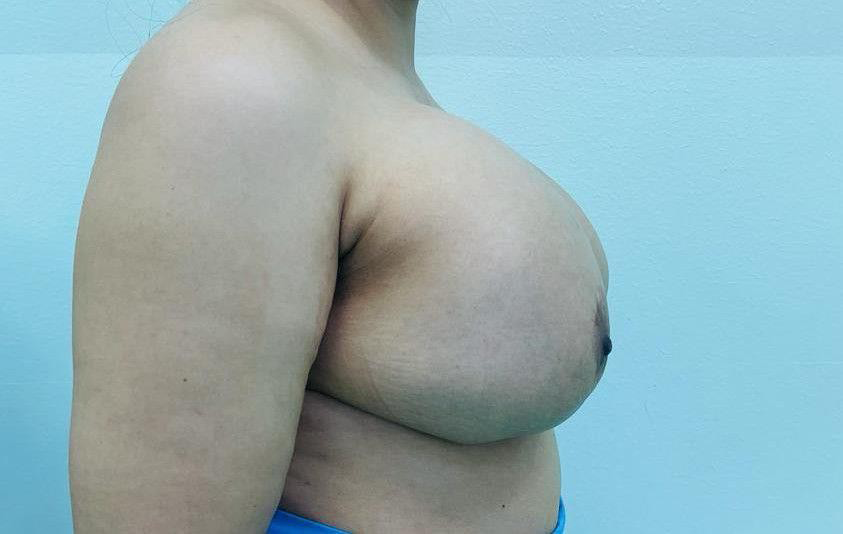
Mammogram revealed heterogeneously dense bilateral breasts parenchyma with focal asymmetries in both breasts with superimposing the parenchyma itself (ACR C, BI-RADS 0). The ultrasound was non-diagnostic due to poor penetration and artifact from silicone. MRI revealed bilateral breast implants well-circumscribed yet irregular contour, it displayed diffuse outline signal alteration and showed multiple variable sized internal well-circumscribed cystic lesions displaying intermediate to hyper-intense signal intensity on T1 weighted images, intermediate to hypo-intense signal intensity on T2 weighted images and were suppressed on fat saturated pulse sequences, mostly lipophilic/oil cysts. The appearance was consistent with soft tissue silicone injections.
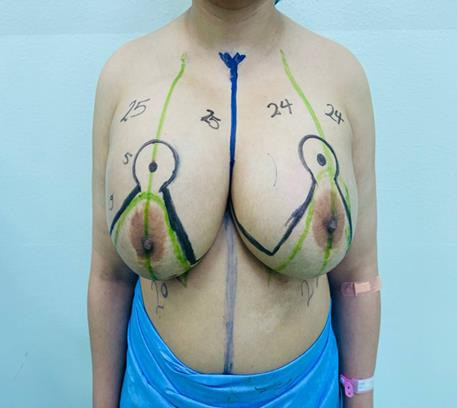
According to the patient’s medical history, physical examination, and diagnostic imaging results, it was determined that the cause of breast enlargement and multiple masses was the result of free silicone injections. Initially, the patient was presented with the option of nipple sparing mastectomy, but she declined due to the inconclusive nature of the imaging studies and instead desired a more aesthetically pleasing alternative. Therefore, she underwent inferior pedicle mammoplasty but her previous surgeon didn’t remove the silicone masses and abort the operation. We proposed two alternatives with either inferior pedicle breast reduction or breast amputation and free nipple graft, in addition to removal of most of the masses and abnormal tissues that present during the dissection of the breast tissues. The patient consented for the inferior pedicle breast reduction and rejected breast amputation and free nipple graft. Given the patient’s worsening chronic pain, it was agreed to repeat the bilateral inferior pedicle mammoplasty, and removing all the silicone and masses from both breasts (Figure 2).
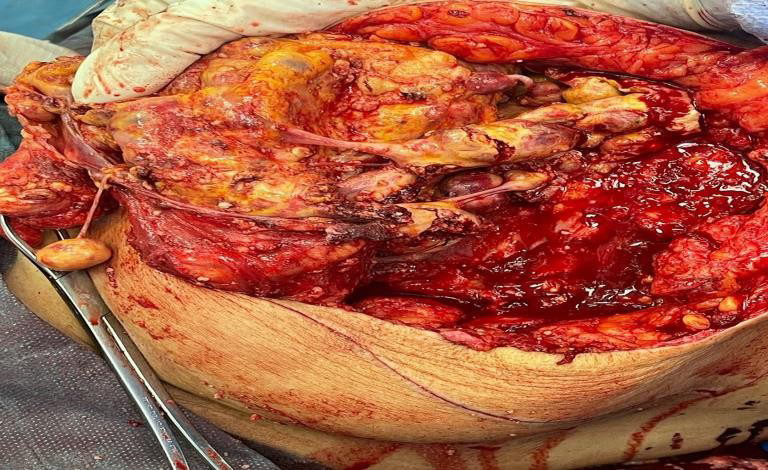
Intra-operatively, a wise pattern breast reduction approach was made. Nevertheless, we came across numerous pockets filled with liquid silicone within the breast tissue, leading to a severe inflammatory response. This resulted in the disruption of the usual tissue planes, thereby complicating and prolonging the dissection process. Throughout the procedure, we came across a substantial quantity of viscous yellow fluid that was extracted from the surgical area. Moreover, the silicone pockets with a checkered pattern were encompassed by fibrotic, extensively vascularized tissue, resulting in widespread seepage. Furthermore, a few of the masses were firmly attached to the chest wall (Figure 3).
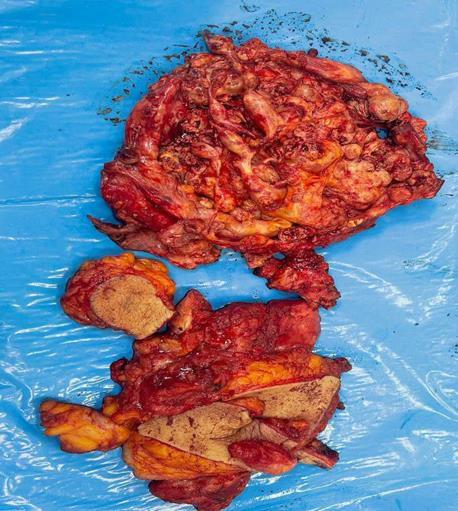
Pathology of bilateral breasts revealed vacuolated histiocytic and innumerable cystic spaces containing material consistent with silicone (Figure 4).
There was no evidence of atypia or malignancy. After removing all the abnormal tissue, the inferior pedicle flap was thin due to the extensive adherence of the silicone material and the intense inflammatory response. After raising the flap, closure in three layers proceeded (Figure 5).
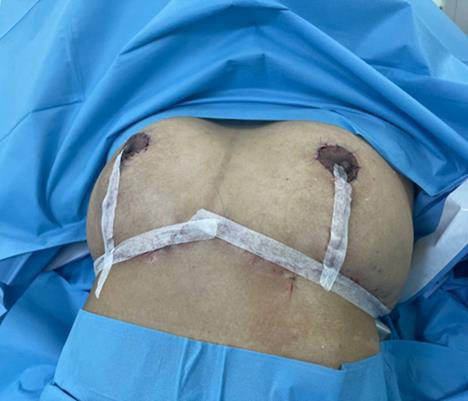
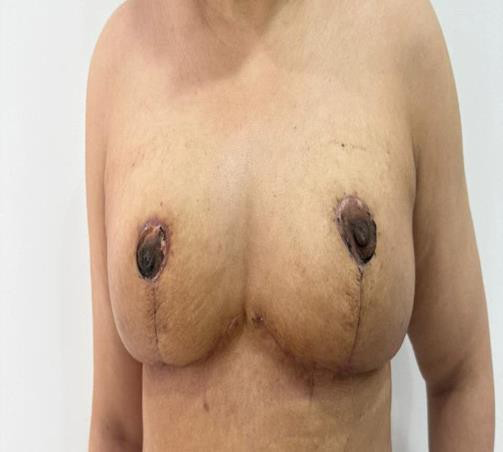
The patient’s postoperative course was uneventful apart from the low hemoglobin level for which she received 1 pint of packed RBCs. The nipple-areolar complex showed some epidermal necrosis at the edge. At the last follow-up, the patient was doing well, without any breast pain and palpable masses (Figure 6).
Discussion
Over the years, there has been significant debate surrounding the use of liquid injectable silicone. At present, the FDA has approved its use solely for ophthalmic purposes in treating retinal detachment. Nevertheless, it is commonly used off- label for enhancing the lips and nasolabial folds, as well as for treating flexible acne scars, HIV-associated lipoatrophy, and specific foot issues [2].
Despite being strictly contraindicated, the illegal practice of injecting free silicone for body contouring persists due to its appealing aesthetic results and affordability [3].
Minor complications that can arise from the use of injectable silicone include reactions at the site of injection, such as pain, redness, bruising, and swelling. These complications usually occur approximately 8-10 years after the silicone is administered, but can also manifest within a range of 6-36 years [4]. Additionally, there have been reports of severe complications including the formation of granulomas, migration, the development of nodules and cystic lesions, chronic cellulitis, pneumonitis, emboli, and even fatalities [5]. Severe complications frequently arise due to the administration of unregulated, intentionally modified, or contaminated silicone in large quantities by non- medical individuals in non-clinical environments. However, when purified medical-grade silicone is injected using the microdroplet technique by licensed and experienced physicians, the occurrence of complications is significantly reduced, approximately by 3 % [6]. The patient exhibited worsening mastodynia and multiple breast nodules 16 years after receiving free silicone injections in both breasts. The distribution of free silicone bilaterally made it difficult to interpret the imaging results, which also compromised future cancer screening. Given the patient’s considerable pain and palpable masses and her refusal for any kind of mastectomy, we decided to perform bilateral inferior pedicle mammoplasty to remove all the silicone and masses from both breasts and preserve the natural shape of the breast.
The traditional management of complicated free silicone injection to the breast include mastectomy and breast reconstruction (immediate or delayed) [7], but given the patient refusal to the mastectomy, we proposed two alternatives with either inferior pedicle breast reduction or breast amputation and free nipple graft, in addition to removal of most of the masses and abnormal tissues that present during the dissection of the breast tissues. The patient consented for the inferior pedicle breast reduction and rejected breast amputation and free nipple graft.
The limitations of inferior pedicle breast reduction were excessive bleeding and altered tissue planes and structures, in addition to the possibility of incomplete removal of the abnormal tissues given the limited access to preserve the inferior pedicle viability.
Conclusion
The case of a young woman is presented, who experienced pain and breast enlargement after receiving liquid silicone injections in both breasts. To address the issue, bilateral inferior pedicle mammoplasty was performed, involving the removal of silicone and masses from both breasts. It is important to recognize the prevalence of this practice in Iraq and raise awareness about the potential complications and delayed onset of these complications associated with use of free silicone injections to the breast.
References
-
Chasan PE (2008) The History of Injectable Silicone Fluids for Soft- Tissue Augmentation. Plastic and reconstructive surgery 120(7): 2034-2040.
-
FDA (1994) Press Release. Food and Drug Administration, pp: 94-95.
-
FDA (2017) FDA warns against the use of injectable silicone for body contouring and enhancement: FDA safety communication. United States Food and Drug Administration.
-
Ellis LZ, Cohen JL, High W (2012) Granulomatous reaction to silicone injection. J Clin Aesthet Dermatol 5(7): 44-47.
-
Narins RS, Beer K (2006) Liquid injectable silicone: a review of its history, immunology, technical considerations, complications, and potential. Plast Reconstr Surg 118(3Suppl): 77S-84S.
-
Ryu AJ, Glazebrook KN, Samreen N, Bauer PR, Yi ES, et al. (2018) Spectrum of Chronic Complications Related to Silicone Leakage and Migration. Am J Med 131(11): 1383-1386.
-
Bhardwaj P, Greenwalt I, Ko K, Sher SR, Tsiapali E (2020) Free Silicone Injections to the Breast: Delayed Complications and Surgical Management of Sequelae. Plast Reconstr Surg Glob Open 8(11): e3208.
- Reconstruction of Nasal Defect Using a Local Flap Based in the Nanoperforants Concept: A Case Report
- Transplant Tourism in Japan: Insights from Nationwide Surveys and Emerging Ethical Challenges
- The Challenge of Peritoneal Vaginoplasty in Transgender Women: Review Literature and Personal Perspectives
- Algorithmic Paternalism: Autonomy Versus Automation
- Dermatoscopy in Gorlin Syndrome: Avoiding the Disfigurement in Patients
- How Artificial Intelligence is Ushering in a New Era of Innovation in General and Plastic Surgery: A Short Communication