
Reconstruction of Nasal Defect Using a Local Flap Based in the Nanoperforants Concept: A Case Report
The nose is a complex structure, covered with multiple tissues, which requires great anatomical and topographic knowledge in aesthetic subunits for its adequate reconstruction. The following article reports the case of a nasal reconstruction of a wound with a coverage defect with involvement of the subunit of the left nasal wall, using a local flap taking as reference the flap with irrigation based on randomly located nanoperforants and the Keystone flap. The patient did not suffer complications or flap loss during the procedure, postoperatively, or during follow-up. For nasal reconstruction, it is necessary to use tissue similar in color, texture and thickness to that of the defect area, recovering the three-dimensional structure, which is especially difficult in traumatic wounds. The flap used provided adequate functional and aesthetic coverage in a large defect of traumatic origin, obtaining a hidden scar, without requiring a frontal pedicled flap, which has been the gold standard for many years.
Carreno AP¹*, Suarez COG² and Salazar LAT²
¹Plastic Surgeon, National university of Colombia, Colombia ²Physician, National university of Colombia, Colombia
Introduction
The nose is the central structure of the face with an important physiological role for olfaction, moistening and filtering the air, but it is also crucial for the normal appearance of the face [1], any defect can alter the aesthetics of the face, even impacting the patient’s quality of life [2]. It is a complex structure covered by skin, with a thin layer of subcutaneous tissue, muscles, supported by a pair of and cartilage [1, 3]. It presents multiple concavities and convexities with diverse ridges and valleys which give it an anatomical peculiarity [2, 4]. It is divided into subunits: tip, dorsum, columella, lateral walls, nasal alae and soft triangles; as Burget and Menick proposed for the first time in 1985, based on the characteristics of the tissues that make up the nose [2, 4].
For an adequate nasal reconstruction a good knowledge of the anatomy is required and some reconstructive principles must be taken into account. Currently there are several alternatives for the coverage of defects in the nose such as free flaps, local flaps, pedicled flaps, distant flaps at various times, and grafts, among others Joseph AW, et al. [2] and the choice between one or the other will depend on factors such as the characteristics of the defect, location and availability of adjacent tissue. Some authors suggest performing a strict reconstruction based on the subunits, and in case of loss of more than 50% in a single subunit, they propose resecting and completely reconstructing it [4, 5]; this can lead to greater morbidity, which is why other approaches have also emerged to take into account during nasal reconstruction [6, 7], which involve variables such as texture, color and contour in surgical planning, resulting in barely visible scars and associated with good aesthetic results [4]. We present a clinical case of nasal reconstruction in a patient with a significant defect secondary to trauma, applying the principle of subunits aesthetic and like-to-like, obtaining an excellent result.
Case Report
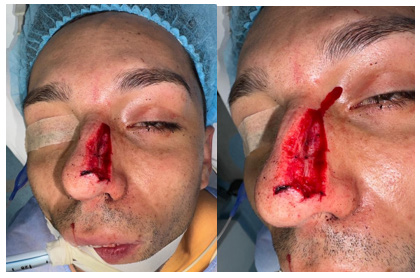
A 26-year-old male patient was admitted to the emergency department with nasal trauma secondary to an impact with a glass bottle, presenting a wound with a 4 x 2 cm defect at the level of the left nasal lateral wall subunit (Figure 1). He was taken to surgery, and after debridement of the wound, the defect was observed with areas of bone and cartilage exposure without primary closure being possible, so a flap was designed using the remnant of the subunit of the affected nasal lateral wall. and part of the skin of the malar region, respecting the limit of the nasal ala and nasal dorsum (Figure 2).
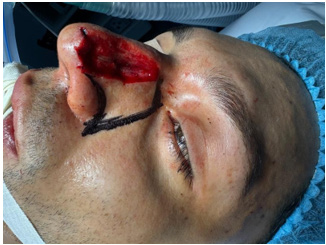
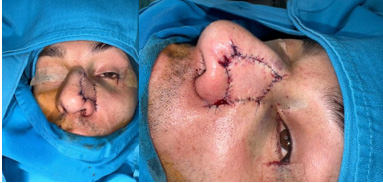
The design at the malar level was extended in such a way that when the flap was advanced, the lateral edge coincided with the natural limit of the nasal lateral wall. In the corners of the flap, a v-y advancement was performed as performed in Keystone flaps and the inferolateral incision was hidden in the nasolabial fold. After verifying tension-free closure, skin closure was performed with 6-0 nonabsorbable suture (Figure 3). No complications occurred during the procedure or postoperatively, the patient was discharged after anesthetic recovery and in the postoperative follow-up the flap showed no signs of suffering, nor partial or total loss of it.
Discussion
Nasal reconstruction has been constantly evolving since the beginning of civilization. From the first records and manuscripts of Susruta Samhita in India in 600 BC. and afterwards with Italian Method attributed to Gaspare Tagliacozzi in XVI century [8], the most optimal way to distribute and manipulate soft tissues with different techniques has always been sought to provide the best aesthetic and functional result, taking into account different factors [9, 10].
The main objective of any reconstruction should be to recover the original shape and appearance, so symmetry, geometry in three planes and concordance with adjacent structures must be taken into account, which is why the reconstruction of nasal defects is a demanding procedure due to the need to use tissue similar to the lost tissue, seeking that the color, texture and thickness are similar to the receptor area, and additionally recover the lost three- dimensional structure. On the other hand, trauma can add another difficulty to the procedure because the wounds are irregular in shape, and the tissues can be macerated and ischemic.
Although each case must be individualized, the concept of subunits is applicable to the entire population. Initially, Burget and Menick, within their subunit principle, proposed total resection of the subunit if 50% or more was compromised [4]. However, it is important to take into account the need to preserve as much of the original tissue as possible, because with excessive resections, normal tissue that would be useful for reconstruction could be lost, making coverage more difficult. Some authors have even proposed and designed algorithms taking into account both the skin phenotype, as well as making use of applied technology and physical principles such as spectroscopic reflectance that allows objectively comparing skin color and thickness to define the best site. donor for reconstruction [11].
In the present case, reconstruction of a nasal defect was achieved using a flap based on the concept of random localization ubiquitous nanoperforants introduced by Espinel DA, et al. [12] and the keystone flap developed by Behan FC, et al. [13], closing the corners of the V-Y flap, allowing an adequate advance of the flap. We obtained tissue of similar characteristics, leaving the incisions and scars hidden in the natural boundaries of the anatomical subunits of the nose, without morbidity in the donor area, nor scars in other anatomic regions, in a single surgical time and without the need to carry tissue at a distance as with the frontal flap considered the gold standard in nasal reconstruction [1]. We also considered the advantages of a single surgical procedure, by having fresh tissue, and giving a quick resolution to the patient’s problem while preserving its aesthetic appearance [14].
Conclusion
The flap we made to cover the defect in the nose, based on the concept of random ubiquitous nanoperforators and the reconstruction taking into account the nasal aesthetic subunits, allowed us to provide stable, functional and aesthetic coverage in a large defect of traumatic origin, hiding the scars adequately and without the need to perform a distant pedicled flap as the frontal flap.
Conflict of Interest
The authors declare no conflict of interest.
References
-
Phillips TJ (2019) Total nasal reconstruction. Current Opinion Otolaryngol & Head Neck Surgery 27(5): 420- 425.
-
Joseph AW, Truesdale, Baker SR (2019) Reconstruction of the Nose. Facial Plastic Surgery Clinics of North America 27(1): 43-54.
-
Menick FJ (2010) Nasal Reconstruction. Plast Reconstr Surg 125(4): 138e-150e.
-
Burget GC, Menick FJ (1985) The subunit principle in nasal reconstruction. Plastic and Reconstructive Surgery 76(2).
-
Cerci FB (2017) Usefulness of the subunit principle in nasal reconstruction. Brazilian Annals of Dermatology 92(5).
-
Singh DJ, Bartlett SP (2003) Aesthetic considerations in nasal reconstruction and the role of modified nasal subunits. Plastic and Reconstructive Surgery 111(2).
-
Rohrich RJ, Griffin JR, Ansari M (2004) Nasal reconstruction - Beyond aesthetic subunits: A 15-year review of 1334 cases. Plastic and Reconstructive Surgery 114(6).
-
Shaye DA (2021) The history of nasal reconstruction. Current Opinion in Otolaryngology and Head and Neck Surgery 29(4).
-
Losco L, Bolletta A, Pierazzi DM, Spadoni D, Cuomo R, et al. (2020) Reconstruction of the Nose: Management of Nasal Cutaneous Defects According to Aesthetic Subunit and Defect Size. A Review Medicina 56(12): 639.
-
Salzano G, Maffìa F, Vaira LA, Committeri U, Copelli C, et al. (2023) Locoregional Flaps for the Reconstruction of Midface Skin Defects: A Collection of Key Surgical Techniques. J Clin Medicine 12(11): 3700.
-
Gileva KS, Adamyan RT, Verbo E (2023) External nasal defect repair. Algorithm for choosing surgical approach and donor material considering the theory of nasal subunits. Plastic Surgery and Aesthetic Medicine 2023(1).
-
Espinel P, Alejandro A (2023) Randomized Ubiquitous Nanoperforator Flaps: Case Series. National University thesis.
-
Behan FC (2003) The Keystone Design Perforator Island Flap in reconstructive surgery. ANZ J Surgery 73(3): 112-120.
-
Castaneda JMN, Grozo SLC (2022) Surgical Treatment and Reconstruction of Nasal Defects According to the Aesthetic Subunits Principles. Indian Journal of Otolaryngology and Head and Neck Surgery 74(3).
- Transplant Tourism in Japan: Insights from Nationwide Surveys and Emerging Ethical Challenges
- The Challenge of Peritoneal Vaginoplasty in Transgender Women: Review Literature and Personal Perspectives
- Algorithmic Paternalism: Autonomy Versus Automation
- Dermatoscopy in Gorlin Syndrome: Avoiding the Disfigurement in Patients
- How Artificial Intelligence is Ushering in a New Era of Innovation in General and Plastic Surgery: A Short Communication
- Inferior Pedicle Mammoplasty for Complications of Free Silicone Injections to the Breast