
Pharmacognostic Evaluation of Platycerium bifurcatum (Cav.) C. Chr. (Polypodiaceae)
Ethnopharmacological relevance: Platycerium bifurcatum (CAV.) C. Chr., Commonly known as staghorn fern is an epiphytic plant with diverse medicinal uses, such as anti-ulcer remedy, treating oedema, coughs and hypertension. This research was aim at evaluating the pharmacognostic profile of P. Bifurcatum. Methods: The fresh and air-dried plant materials were evaluated for microscopic characters, ash values, extractive values, moisture content and phytoconstituents. Results: Pharmacognostic evaluation revealed two shape of leaves, one round and the other forked-like shape, dark and light green colour, slightly coarse texture at the abaxial surface and hairy due to the trichome at the adaxial surface, reticulate leaf venation and margin entire, presence non- grandular stellate trichomes at the lower epidermal layer, spongy mesopghyll, collenchyma cells, vascular bundles straight type of epidermal cell wall, anisocytes stomata. Moisture content of 6.283%, total ash value of 8.25% within the standard range, acid insoluble ash of 1%, water soluble of 6.0% and phytochemical screening analysis shows the presence of phenolic, saponins, glycosides and triterpenoid constituents. Conclusion: this study reports the first time the pharmacognostic properties of P. bifurcatum.
Introduction
Pharmacognostic study plays a major role in the assessment, criteria for standardization and quality control of medicinal plants [1]. It needs a systematic approach to herbal plants authentication and properly developed standardized methods [2]. The misuse of herbal medicines begins with the wrong identification of crude plants and this error is common with the vernacular of local name given to two or more different species of plants [3]. Another major problem with the use herbal medicine is adulteration or substitution of the original plant material with another plant material or intentionally adding any foreign substances to increase the weight or its potency or to decrease its cost. All this problem can therefore be solved by lay down pharmacognostic rules for the study of medicinal plants.
Free Radical is a molecule with a peculiar number of electrons which may exist both with organic and inorganic compounds [4]. As oxygen is the ultimate electron flow acceptor that generates ATP-like energy, a free radical may emerge when electron flow is uncoupled within the oxidation process [5].
When the organism is exposed to ionizing radiation, redox cycling medication or xenobiotics, which may liberate radical metabolites in situ, free radicals are created. Free radical cell risk objectives rely on the radical type including the location at which the radical occurs. Free radicals and oxidants are twice as harmful or helpful as toxic or beneficial substances within the body. The products come either from normal cell metabolism in situ, such as superoxide, nitric oxides and hydroxide, or from outside sources. While free radicals have beneficial impacts during energy and antibiotic production, overly high quantities of free radicals damage proteins from cells, membrane lipids and nucleic acids [6, 7]. This free radical cannot be removed and its accumulation results in oxidative stress. This is a significant role in chronic and degenerative diseases such as cancer, cardiovascular and neurological problems, ageing, cataract and autoimmune [7]. Several diseases are linked to oxidative stress and this serves as the basis of antioxidant therapy, natural antioxidants are very appealing to prevent oxidative cell damage. Free radicals and reactive oxygen species, mostly generated endogenously, cause oxidative damage [8]. Plants polyphenols defend themselves from these diseases since they are highly antioxidants.
Platycerium bifurcatum, commonly known as staghorn fern is an epiphytic plant, belong to the family Polypodiaceae [9, 10] with diverse medicinal uses, such as anti-ulcer remedy [11], treating oedema, coughs, and hypertension [12], the leaves are mashed with red onion and Foeniculum vulgare, which are given as a poultice to heal fever within the belly [13]. P. bifurcatum is also good for environmental conditions, such as indoor artificial heating [14]. This study, investigates the pharmacognostics profile of Platycerium bifurcatum.
Materials and Methods
Plant Material
P. bifurcatum’s fresh whole plant was taken from Abuja Park in Choba, Port Harcourt University, Rivers State. South Nigeria and authorized by curator; Dr. Chimezie Ekeke, Department of Plant Science and Biotechnology, Harcourt Herbarium University, with the voucher number UPH/P/257. The plants were cleaned, air-dried at room temperature, powdered and preserved for further use.
Plant Extraction
The pulverised plant material (200 g) was macerated with 70% aqueous ethanol for a period of five days. The extract was filtered and evaporated en vacuo in a rotary evaporator at 40℃, weighed and used for screening.
Phytochemical Screening
Phytochemical screening was performed on extracts to detect the presence of secondary metabolites using standard procedures [15, 16].
Macroscopy and Microscopy of the Leaves
The descriptive and organoleptic features of the fresh leaves were examined. The diagnostic features of the leaf’ epidermal (upper and lower) layer and transverse sections were examined using described procedures (Table 1).
| Parameter | Features |
|---|---|
| Stomata type | Anisocytic |
| Trichomes | Non-grandular Stellate |
| Epidermal cells | Straight, collenchyma, vascular bundles, pith was observed |
| Palisade cells | Observed |
| Calcium oxalate | Not observed |
Table 1: Microscopy of _Platycerium bifurcatum_.
Determination of Ash Content
Total Ash
To measure the total ash content, 4 g of P. bifurcatum powder was weighed precisely, put into a crumb and burned. The sample was distributed uniformly in a layer and progressively raised temperature to 500-600 ºC in an already lit oven until the ash was taken including the white carbon-free. The obtained ash was cooled and weighed within a desiccator. Total sample ash collected in mg per gram of air-dried plant sample was computed. This was done three times.
% Ash content = W3−W2 × 100 W3−W1
Where, W1= empty platinum crucible weight, W2 = platinum crucible weight and pre- burning sample weight, and W3= crucible weight and insoluble acid ash.
Acid Insoluble Ash
In order to assess its acid-insoluble content, a 25mL solution of hydrochloric acid (70g/L) was added to a crucible containing the total ash produced above. The solution was covered in a watch glass and allowed to boil gently at low heat for 5 minutes. The glass was washed with 5ml of hot water before it was placed within the crucible for testing. The insoluble particles have been collected on ash-free filter paper and washed with warm water until the filtrate was neutral. The filter paper that held the insoluble material was moved to a hot plate to dry it and burnt until the weight was stable. The residue was dried for 30 minutes within the desiccator. The measurement was taken immediately. In each gram of powdered plant material, the quantity of acid- insoluble ash was measured in milli grams per gram of plant.
Water Soluble Ash
To estimate the quantity of water-soluble ash contained within the total ash, 25ml of water was added to the total ash and boiled for 5 minutes. The insoluble material was then collected in an ashless filter paper, completely washed with hot water, and then burnt at a temperature of 4500ºC in a crucible for 15 minutes. The weight of the residual sample obtained in mg was subtracted from the total ash weight. The quantity of water-soluble ash within the sample was measured in milligrams per gram per gram of air-dried material.
Determination of Extractive Values
A 10 g of the powdered Platycerium bifurcatum was weighed transferred to a stoppered flask containing 100 ml of water. This was placed on a magnetic stirrer for 4 hours. The mixture was filtered and 50ml of the filtrate was transferred into a tarred flat -bottomed crucible and placed in a water bath, evaporated to dryness and weighed, the water-soluble extractive value was calculated from the weight of the residue as a percentage of the powdered sample. This protocol was repeated using absolute Ethanol and chloroform respectively [17].
Determination of Moisture Content
A 2g weight of powdered Platycerium bifurcatum was put into a previously tarred flat -bottom glass dish and placed in an oven at 150ºC for 1 hour. The glass dish was cooled, weighed and further placed in the oven at the same temperature for another 1 hour. It was cooled and reweighed. The drying and weighing were repeated until there was no further loss of weight after which the moisture content of the crude drug was determined [17].
Results
(SE-Straight Epidermal cell, GC-Guard Cell, SC-Subsidiary Cell, VB- Vascular Bundles, C-cuticles, S-stomata)
Discussion
The findings of the phytochemical examination as seen in Table 2 showed the presence of tannins, triterpenoids, saponins and cardiac glycosides while alkaloids and athraquinones were absent. However, contrary to Omeje’s findings that reported the presence of alkaloids [18].
The host of epiphytic ferns are known to affect the constituents of secondary metabolites which could suggest the presence of triterpenoids in P. bifurcatum since they are one of the major constituents of Azadirachta indica.
| Screened Phytochemicals | P. bifurcatum |
|---|---|
| Alkaloids | - |
| Anthraquinones | - |
| Carbohydrates | - |
| Cardiac Glycosides | + |
| Flavonoids | - |
| Tannins | + |
| Saponins | + |
| Triterpenoids | + |
Table 2: Phytochemical screening of _Platycerium bifurcatum_. Key: + means Present; - means Absent The macroscopic and organolept
Table 2: Phytochemical screening of Platycerium bifurcatum. Key: + means Present; - means Absent The macroscopic and organoleptic profile of a medicinal product shows the characteristics of the plant components. Table 3 reveals the macroscopic features of P. bifurcatum as reveal in this study shows two type of leaves shape, one being fork-like, and the other round located at the base.
| Parameters | Characters |
|---|---|
| Colour | Ranges from dark green to light green |
| Texture | Upper surface is slightly coarse Lower surface is hairy |
| Shape of leaf | Two types; fork-like and round leaf |
| Leaf venation | Reticulate |
| Margin | Entire |
Table 3: Macroscopy of _Platycerium bifurcatum_. Key: + means Present; - means Absent.
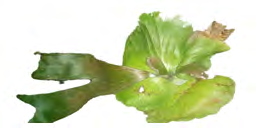
Hence, this is typical of the genus Platycerium as some of the species of this genus usually exhibit two type of leaves (frond) shape [19]. The colour ranges from dark green to light green, the forked-like shape being deep green, the round shape is light green and powdered crude drug showed ash-green colour.
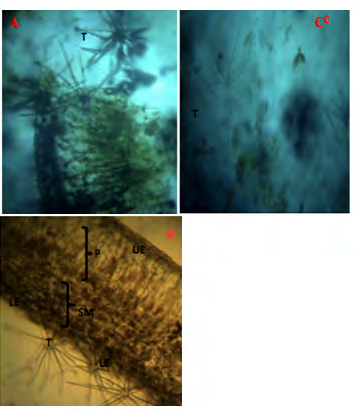
Texture of the plant exhibits slightly coarse at the abaxial side of the leaf and hairy at the adaxial side of the leaf and this is due to the presence of abundance of trichomes as shown in Figure 2. The leaf venations are reticulate, and margin is entire.
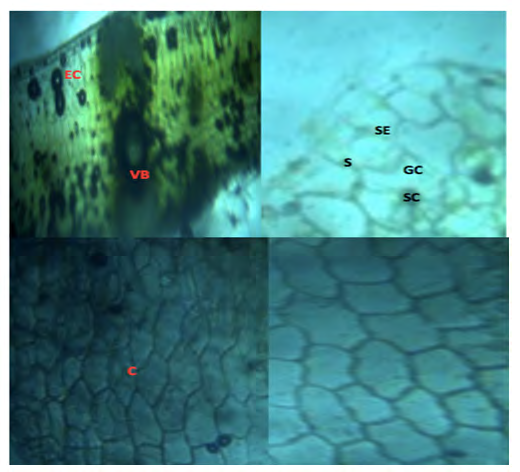
The microscopic evaluation shows the anatomical components of the plant that are not visible to the human eyes. The research focused on the properties of the plant, such as epidermal cells, stomatal type, vascular bundles trichome, and calcium oxalate. However, the dried powdered leaf was examined. This is the foundation for the correct identification of herbal products in phytomedicines. The microscopic examination showed aniocytes type of stomata, trichomes is non-grandular stellate, epidermal cell walls are straight, the collenchyma, vascular bundles and pith was observed. Palisade cells are observed directly after the epidermis and are elongated just before the spongy mesophyll cell.
Extractive value is also a useful qualitative assessment for the evaluation and estimation of certain solubility components in various solvents. It is also used to assess purity, quality and detection of adulteration as a result of undue wrongly processed drugs. This finding indicates that chloroform has the highest yield then followed by ethanol and n-hexane as presented in Table 4.
| Parameters | Composition value (%) w/w |
|---|---|
| Moisture content | 6.28 |
| Ethanol | 2.60 |
| Chloroform | 7.70 |
| N-hexane | 2.80 |
| Total ash value | 8.25 |
| Acid insoluble ash | 1.00 |
| Water-soluble ash | 6.00 |
Table 4: Moisture content, extractive and ash values of _Platycerium bifurcatum_. This means that more phytoconstituents are acce
Table 4: Moisture content, extractive and ash values of Platycerium bifurcatum. This means that more phytoconstituents are accessible in chloroform which supports the presence of anthraquinones in its phytoconstituents. From the extractive values, TLC fingerprinting can be developed for identification and semi- quantitative analysis of the extracts.
In medicinal plants, the ash value of indicates that Carbonate, phosphate, oxides, silicate and silica are present in the crude, while the total ash of a raw medicinal products measures the residue gotten after incinerating the part of the plant, and it reflects the purity and authenticity of raw and processed medicines. The acid-insoluble measure the amount of silica present and it’s in form of sand. Table 5 shows the ash value characteristics of P. bifurcatum leaf with considerable amount of total ash value of 8.25%, acid insoluble ash of 1%, and water-soluble of 6.01% which are in the range prescribed by World Health Organisation. Finding can be implored as parameter for quality control to evaluate P. bifurcatum drug for any adulteration.
The moisture level of herbal medications is the total water content that remains after processing in an herbal product. The moisture content is one of the criteria used for the characterisation and first stages in checking the quality of herbal medicines. It is anticipated that the moisture content would be minimal and that excess water in herbal goods will lead to microbial development, degradation of products and hydrolysis. This finding investigated the P. bifurcatum leaves’ moisture content as described in Table 4 is 6.2%.
Saponins which occurs selectively in plants as triterpene glycosides are bitter testing, identify by their foaming capacity in water and of high molecular weight. Literature has shown that anti-inflammatory, antibacterial, anticancer, cytotoxic, and molluscide-related actions are hemolytic [19]. have shown the clinical significance of triterpenoid saponin in the preventive and treatment of metabolic and vascular disorders. A potential plant to be studied is P. bifurcatum containing saponin.
Conclusion
Finally, Platycerium bifurcatum pharmacognostic characteristics were studied. It indicates that the cellular components, ash levels and moisture content of the plant are all within the allowed standard. Some of the plant’s phytochemicals, such as phenolic compounds, have been shown to have antioxidant properties and have a significant antioxidant activity.
Acknowledgement
We want express our profound gratitude to the Curator of University of Port Harcourt Herbarium, the entire staff of Central Research Laboratory for Phytomedicine, Faculty of Pharmaceutical Sciences, University of Port Harcourt, and Port Harcourt, Nigeria.
Conflict of Interest
The authors declare no conflict of interest
References
-
Chanda S (2014) Importance of pharmacognostic study of medicinal plants An overview. J Pharmacogn Phytochem 2(5): 69-73.
-
Bratt D, Kh J, Pate S, Zaveri M (2016) Role of oxidative stress in breast cancer. J Pharm Pharm Sci 5(11): 366- 379.
-
Kumar CD (2007) Pharmacognosy can help minimize accidental misuse of herbal medicine. Curr Sci 93(10): 1356-1358.
-
Freeman BA, Crapo JD (1982) Biology of disease free radicals and tissue injury. Lab Invest 47(5): 412-426.
-
Davies MJ, Fu S, Dean RT (1995). Protein hydroperoxides can give rise to reactive free radicals. Biochem J 305(2): 643-649.
-
Fang YZ, Yang S, Wu G (2002) Free radicals, antioxidants and nutrition. Nutri 18(10): 872-879.
-
Asres K, Gibbons S, Bucar F (2006) Radical scavenging compounds from Ethiopian medicinal plants. EPJ 24(1): 23-30.
-
Pham Huy LA, He H, Pham Huy C (2008) Free radicals antioxidants in disease and health. IJBS 4(2): 89-96.
-
Bode SO, Oyedapo OO (2011) Biological activities and phytoconsitutents of the lower plant Platycerium angolense Welwex Hook. J Med Plant Res 5(8): 1321- 1329.
-
Hennipman E, Roos MC (1982) A monograph of the fern genus _Platycerium bifurcatum_ polypodiaceae Verhandelingen der Koninklijke Nederland’s Akademie van Wetenschappen Afdeling Natuurkunde. Tweede Reeks 80(1): 1-126.
-
Pemberton RW (2003) The common staghorn fern _Platycerium bifurcatum_ naturalises in Southern Florida. American Fern Journals 93(4): 203-206.
-
Okali RI, Aigbe O, Obado O, Mensah JK (2007) Medicinal Herbs used for managing some ailments among Esan people of Edo State Nigeria. Pakistan Journal of Nutrition 6(5): 490-497.
-
Flora IN, Ubah C O (2006) In Hand book on Herbs and your Health.
-
Hoshizaki BJ, Price MG (1990) Platycerium update. Am Fern J 80(2): 53-69.
-
Sofowara A (1993) Medicinal plants and traditional medicine in Africa. 2nd(Edn.), Spectrum Books, pp: 289.
-
Harbone JB (1998) A Guide to Modern Techniques of Plant Analysis. 3rd(Edn.), Phytochemical Methods, Springer, Chapman and Hall London.
-
WHO (2011) Quality control methods for herbal materials pp: 9-36.
-
Omeje EO, Adikwu MU, Esimone CO, Obonga WO, Okide GB, et al. (2007) Characterisation of Polysaccharides from the fern _Platycerium bifurcatum_ with expected biological activity. JOPAT 12: 66-75.
-
Schneider H, Peter Kreier H (2006) Phylogeny and biogeography of the staghorn fern genus Platycerium Polypodiaceae Polypodiidae. Am J Bot 93(2): 217-225.
- Potential Medicinal Herbs and Secondary Metabolites in Combating Corona Virus
- Monkeypox and its Clinical Implications in Pregnancy
- Pharmacognostical Analysis of the Leaves of Important Nervine Medicinal Plant: Strychnos Nux-Vomica L
- Assessment of Antibacterial Activity of Various Solvent Extracts of Dictyota Dichotoma Against Multidrug Resistant Bacterial Strain
- An Insights of Bioactive Elements on Malignancy: Mechanistic Avenues
- Advances and Future Directions in Pharmacognosy and Chinese Medicine