
Development and Characterization of Enteric Coated Diclofenac Sodium Tablet
Tablets of the drug diclofenac sodium with an enteric coating are used to treat fever, discomfort, and inflammation. The pills are made to withstand the stomach’s acidic environment while dissolving in the small intestine’s alkaline environment. With this delayed release formulation, there is a lower chance of experiencing gastrointestinal adverse effects while also extending the duration of medication absorption and increasing medicinal efficacy. Enteric coated tablets are solid unit dose forms for oral administration that bypass the stomach and transport the medication straight to the small intestine. Given that the name “enteric” refers to the small intestine, enteric coatings prevent the release of medication before it reaches this organ. A coated surface that is stable at the stomach’s very acidic pH is how most enteric coatings work.
Introduction
Diclofenac sodium is a synthetic, nonsteroidal anti- inflammatory, and analgesic compound Figure 1.
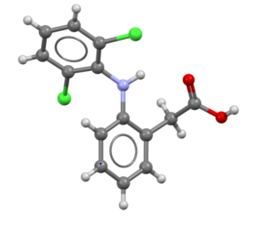
New chemical synthesis techniques and enhanced analytical and screening technologies have sparked the development of new nonsteroidal anti-inflammatory medication (NSAID) drugs in recent decades [1, 2, 3, 4, 5]. Recent developments in NSAID pharmaceutics have concentrated on the creation of solutions to deal with severe dose-dependent GI, CV, and renal adverse effects (AEs) related to the use of NSAIDs [6, 7, 8, 9, 10, 11, 12, 13]. One of the most often used nonsteroidal anti- inflammatory medicines (NSAIDs), diclofenac (DCF), also known as 2-(2-((2,6-dichlorophenyl) amino) phenyl) acetic acid, has both antipyretic and analgesic characteristics [14]. Since 1974, research has shown that DCF is quite effective for treating rheumatic symptoms, acute joint inflammation, and mild to moderate pain [15].
Identification of Drug
Ultraviolet Spectroscopy
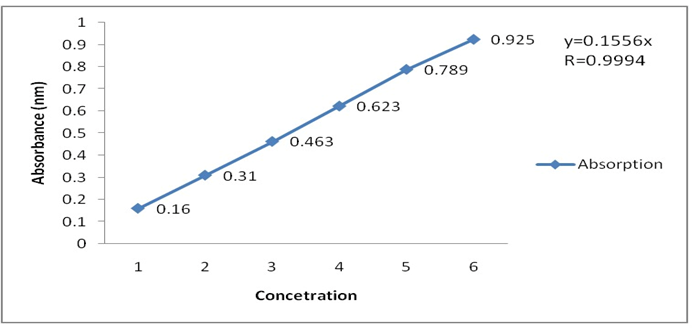
Using an appropriate medium, the samples were scanned for absorption maxima (max) in the 200–400 nm range by UV spectrophotometric analysis [16]. Fever, pain, and inflammation are treated with enteric-coated tablets of the medication diclofenac sodium. The tablets are designed to survive the acidic environment of the stomach while dissolving in the alkaline environment of the small intestine. With this delayed release formulation, the risk of suffering gastrointestinal side effects is reduced, and the duration and effectiveness of drug absorption are both increased. Solid oral dosage forms called enteric coated tablets avoid the stomach and deliver medication directly to the small intestine. Considering that “enteric” is the name of the small intestine, before the medication reaches this organ, enteric coatings stop the release of the medication. Most enteric coatings function by stabilizing the coated surface at the extremely acidic pH of the stomach Figure 2.
Development of NSAID and Diclofenac
Salicylic acid, a historically used therapeutic medicine made from the active ingredient in willow bark salicin, has antipyretic, analgesic, and anti-inflammatory actions. Salicylic acid was utilised globally in the late nineteenth century for a number of diseases .There was a need for new, better chemical derivatives of salicylic acid due to its bitter taste and accompanying gastrointestinal discomfort. In order to create a mildly acidic acetylsalicylic acid with a more pleasing taste, Felix Hoffman and Arthur Eichengrun acetylated the salicylic acid molecule in 1897. Bayer (Berlin, Germany) patented this compound as aspirin in 1899 [17, 18, 19].
The Geigy Corporation (Basel, Switzerland) produced a novel molecule with significant anti-inflammatory and uric acid excretion-promoting properties in the early 1950s. This substance created water-soluble salts of aminophenazone [20, 21].
Excipient
- Diluents, binders or granulating agents, glidents and lubricants to ensure efficient tableting;
- Disintegrates: to promote tablet break up in the digestive tract;
- Sweeteners or flavours: to enhance the taste;
- Polymer coating: it is applied to make the tablet smoother and easier to swallow, to control the release rate of the active ingredient, to make it more resistant to the environment.
There are three methods by which tablets are manufactured;
- Wet granulation
- Dry granulation
- Direct compression
Wet Granulation
- It is most commonly used method for the manufacturing of tablets.
- Water is frequently used as the granulation fluid (and heat is employed to dry the formed granules), it is important to ensure that the therapeutic agent is chemically stable during the granulation process.
- The wet granulation exhibit sufficient mechanical properties to be subsequently exposed to other unit operations, Eg: film coating.
- Tablet quality is directly affected by the choice and concentration of binder and the type and volume of granulation fluid. Due to the number of unit operations to the required, the manufacture of tablets by wet granulation is not as efficient as other methods. Eg: direct compression.
Methodology
Preparation of Tablet
Diclofenac sodium was used as a model drug in the formulations, while HPMC 100 cps and NaCMC were used as rate-controlling polymers Figure 3. Magnesium stearate or talc were utilised as lubricants, while lactose monohydrate was used as a compression assist. In all tests, all formulation ingredients other than magnesium stearate and talc were dry mixed and subsequently granulated by adding water Figure 4. Then a 20-mesh screen was used for wet screening.
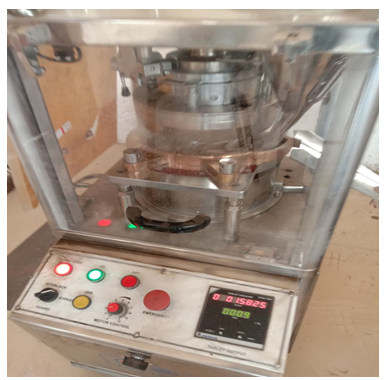
Granules were dried for one hour at 50 C. The dried granules were lubricated by combining them with talc and magnesium stearate. A single-punch hand/motor-operated tablet press (Cadmach, Ahmedabad, India) equipped with 13-mm concave punches was used to compress the tablets Figure 5. Lists the several formulations that were created together with information on their compositions, hardnesses, and average weights [22] Figure 6.
Preparation of Granuals
The wet granulation process involves several steps, including
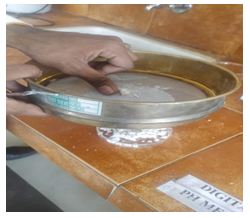
Weighing and mixing of formulation ingredient
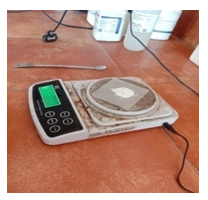
Preparing the dump mass
![Figure 5: Lists the several formulations that were created together with information on their compositions, hardnesses, and average weights [22] Figure 6.](/fulltextimages/10787/fig_5.png)
Wet screening/Screening the damped powder into pellets or granuals
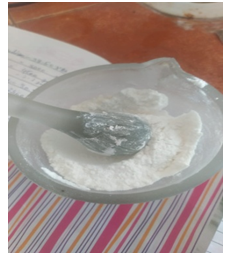
Drying of moist granuals
Sizing the granulation by dry screening Lubrication of granuals.
The preparation of the granulation mixture involves blending the active pharmaceutical ingredient with excipients such as binders, fillers, and lubricants. After the powder mixture is wetted with a binder solution, it is mixed to form a wet mass. The wet mass is then passed through a wet screen to break down any large aggregates before being dried. Finally, the dried granules are screened to obtain the desired particle size range.
Manufacture of Tablets Steps
- Mixing of the therapeutic agents with the excipients
- Granulation of the mixed powders (this is not performed in direct compression)
- Mixing of the powders or granules with other excipients (mostly lubricants)
- Compression into tablets
- The details of each of these steps will vary depending on the manufacturing method used Figure 7.
Method of Tablet Coating
One thousand millilitres (ml) of distilled water was weighed into a mixing bowl and swirled to create a vortex. A gentle, continuous stream of 300 g of Cellulose acetate phthalate white powder was introduced to the liquid vortex’s centre, preventing clumping and preserving the vortex. The mixing process went on for another 20 to 25 minutes. A 250 m screen was used to filter the cellulose acetate phthalate aqueous dispersion before the coating procedure began. Throughout the coating procedure, the aqueous enteric coating dispersion was kept under constant stirring. Both coating dispersions were made in accordance with Colorcon’s technical specifications and instructions [23].
Methodology of Entric Coating
A standard coating pan and one spray gun were used to coat the tablets. Alcohol 95% was formerly used to clean the coated pan. Diclofenac sodium core tablets in a batch size of 100 mg were chosen for coating. The coating pan was filled with the core tablets. Using a drier and air compressor tablet cores were pre-heated to a temperature of roughly 40 °C. Throughout the whole coating operation, warm air (up to 50–55°C) was blown into the coating pan. Cellulose acetate phthalate aqueous dispersionu was used in the spray cannon, which was operating at the correct flow rate.
Seal coating dispersion was sprayed into the moving pan. In the coating pan for minutes. After coating with Cellulose acetate phthalate, the core pills increased in weight by 102 percent. The coating conditions and parameters are listed in Tables 1 and Table 2 [23].
| Ingredient | Formulations (mg) | ||||
|---|---|---|---|---|---|
| F1 | F2 | F3 | F4 | F5 | |
| Diclofenac Sodium | 37.5 | 37.5 | 37.5 | 37.5 | 37.5 |
| Cellulose Microcrystalline | 31 | 30.75 | 30.75 | 32 | 30.75 |
| Magnesium Stearate | 4.35 | 4 | 4 | 3.5 | 3.5 |
| Mannitol | 51.25 | 51 | 52 | 52.1 | 53.1 |
| Lactose | 8.25 | 9.1 | 8.1 | 7.25 | 7.5 |
| Cellulose acetate phthalate | 20 | 20 | 20 | 20 | 20 |
| Total weight | 152.35 | 152.35 | 152.35 | 152.35 | 152.35 |
Table 1: Ingredient of Tablet.
| Evaluation Parameter | Formulations (mg) | ||||
|---|---|---|---|---|---|
| F1 | F2 | F3 | F4 | F5 | |
| Weight Variation | 0.52 | 0.3 | 0.41 | 0.49 | 0.53 |
| Evaluation Parameter | Formulations | ||||
| F1 | F2 | F3 | F4 | F5 | |
| Friability Test | 2% | 0.47% | 0.35% | 0.60% | 0.20% |
Table 2: Weight variation.
Evaluation of Formulated Tablets
Weight Variation Test
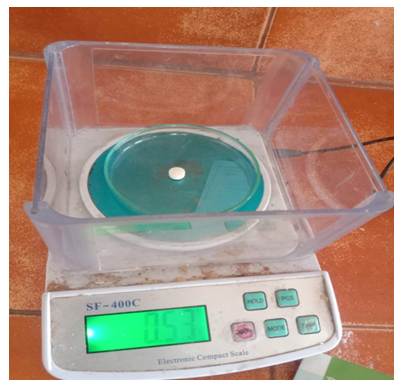
Twenty tablets were weighed separately for the IP weight variation test, and the average weight was computed and compared to the weights of the individual tablets against the average [24] Figure 8.
Friability Test
The laboratory friability tester (Roche Friabilator) uses a plastic container that rotates at 25 rpm while dropping the tablets at a distance of six inches with each revolution to test a variety of tablets to assess the combined effects of abrasion and shock. The friabilator is typically loaded with a pre- weighed tablet sample and run for 100 revolutions. The pills are then reweighed and dusted. Conventional compressed pills are often regarded as effective if they lose between 0.5 and 1% of their weight [24] Figure 9 and Table 3.
Hardness Test
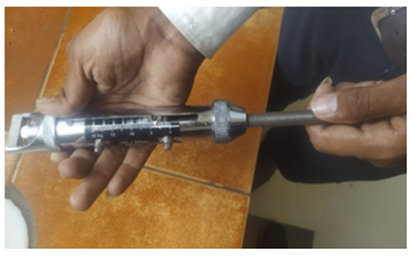
Tablet hardness was determined by Monsanto and Pfizer hardness tester Figure 10 and Figure 11. The reading was noted. The reading indicates the hardness of the tablet in kg/ cm2 [25] Table 4.
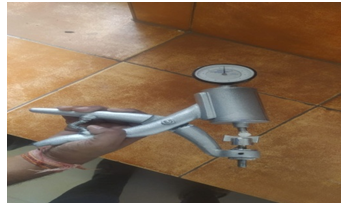
Figure10: Monsanto.
![Figure 11: The reading was noted. The reading indicates the hardness of the tablet in kg/ cm2 [25] Table 4.](/fulltextimages/10787/fig_11.png)
| Evaluation Parameter | Formulations | ||||
|---|---|---|---|---|---|
| F1 | F2 | F3 | F4 | F5 | |
| Hardness Test | 6 | 4.50 | 3.50 | 5 | 4 |
Table 3: Hardness Test.
Tablet Size and Thickness
Along with weight variation that exceeds the permitted limitations, variations in tablet thickness and diameter may pose issues with counting and packing Figure 12 and Figure 13.
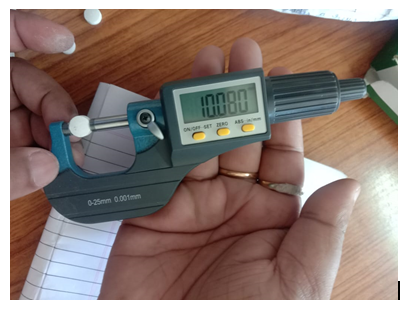
Tablet diameter and thickness should be kept to within 5% of a defined value. Using a Vernier aliper, (china) the tablet’s thickness and diameter were measure [25] Table 5 and Table 6.
| Evaluation Parameter | Formulations (Cm) | ||||
|---|---|---|---|---|---|
| F1 | F2 | F3 | F4 | F5 | |
| Diameter of Tablet | 10 | 10.10 | 10.57 | 10.60 | 10.08 |
Table 5: Diameter Test.
| Evaluation Parameter | Formulations (cm) | ||||
|---|---|---|---|---|---|
| F1 | F2 | F3 | F4 | F5 | |
| Thickness Of Tablet | 5 | 4.3 | 5.1 | 4 | 5.58 |
| Evaluation Parameter | Formulations (min.) | ||||
| F1 | F2 | F3 | F4 | F5 | |
| Dissolution Test | 62 | 54 | 52 | 48 | 65 |
Table 6: Thickness of Tablet
Disintegration Time in Vitro
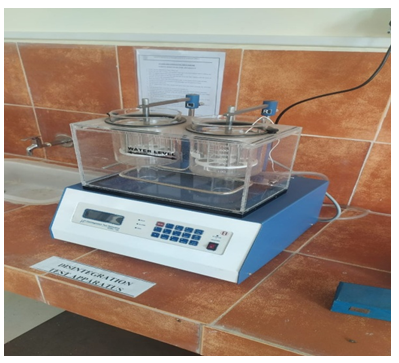
Six tablets were randomly chosen from each brand, one from each of the tubes in the basket-rack assembly of the disintegration device, and placed in each tube. At 370C, the assembly was placed in the artificial gastric fluid. After 120 minutes, take the basket-rack assembly out of the liquid and give it a gentle water rinse. Any enteric coated tablet that clearly displays signs of disintegration fails the test Figure 14. Now swap out the simulated stomach fluid with simulated intestinal fluid in the jar [26] Table 7.
![Figure 14: Now swap out the simulated stomach fluid with simulated intestinal fluid in the jar [26] Table 7.](/fulltextimages/10787/fig_14.png)
Figure14: Disintegration Apparatus.
| Evaluation Parameter | Formulations (Min.) | ||||
|---|---|---|---|---|---|
| F1 | F2 | F3 | F4 | F5 | |
| Disintegration Test | 9 | 17 | 11 | 14 | 15 |
Table 4: Disintegration time.
Dissolution Test
Drug release was assessed using equipment II to conduct an enteric coated tablet disintegration test in accordance with IP using method B. This approach utilised two distinct pH levels at two separate time periods. The tablets were submerged in 900 mL of 0.1 N hydrochloric acid in the USP dissolving bath for the first stage (pH 1.2), which was carried out at a temperature of 37 0.5o C. The 50 rpm paddle stirring speed was chosen. The device was filled with six tablets, and it was run for two hours. Following the procedure described above, a fluid sample was taken and evaluated for the presence of DFS discharged. The acid phase must not have more than 10% DFS dissolved, according to the standard. The vessel was then emptied of acid, and pH 6.8 phosphate buffer was added. This final buffer was made by combining 0.20 M tribasic sodium phosphate (3:1) with 0.1 M hydrochloric acid.
At various times throughout this buffer phase, sample aliquots were taken out and the amount of DFS dissolved was measured. The buffer phase must dissolve at least 80% of the medication after 90 minutes. The samples were analysed using the HPLC technique at a wavelength of 254 nm [27]
Table 8 and Table 9.
| S. No. | Evaluation Parameters | Values | Marketed Tablet |
|---|---|---|---|
| 1 | Hardness of Tablet(kg/cm2) | 4 kg/cm2 | 4kg/cm2 |
| 2 | Friability Test ( ≥1% ) | 0.20% | >1% |
| 3 | Thickness of Tablet | 5.58mm | 3.5mm |
| 4 | Dieameter of Tablet | 10.08mm | 8-10 mm |
| 5 | Dissolution Test | 65 Min. | 1hr. |
| 6 | Disintegration Time | 15 min. | 15 min. |
| 7 | Average weight in mg (within the limit ±5%) | 469mg | 200-400 mg |
Table 7: Dissolution Test.
Tablet 9: Tablet Comparison with Marketed Product.
Conclusion
To sum up, making enteric-coated diclofenac sodium tablets is a challenging procedure that demands close attention to detail and adherence to precise instructions. The pills’ ability to withstand the stomach’s acidic environment and transfer the drug to the small intestine, where it may be efficiently absorbed, is due to the employment of specialized coating processes. The resultant delayed release formulation has demonstrated efficacy in lowering fever, discomfort, and inflammation while lowering the possibility of gastrointestinal adverse effects. The creation and improvement of enteric- coated diclofenac sodium tablets is a big step forward in the treatment of a variety of inflammatory disorders and can greatly enhance patient outcomes. Additional investigation is required to fully investigate this formulation’s potential and to discover explore the full potential of this formulation and to identify other potential applications in clinical practice.
References
-
Langner M, Kozubek A (2006) Pharmacokinetic modulation with particulate drug formulations. In: Mozafari MR (Ed.), Nanocarrier Technologies. Frontiers of Nanotherapy. Springer, Dordrecht, pp: 113-138.
-
Carlson TJ, Fisher MB (2008) Recent advances in high throughput screening for ADME properties. Combinatorial chemistry high throughput screening 11(3): 258-264.
-
Bernardo PH, Tong JC (2012) In silico design of small molecules. In: Zanders ED (Ed.), Chemical Genomics and Proteomics Reviews and Protocols. Humana totowa, NJ, 800: 25-31.
-
Kodadek T (2011) The rise fall and reinvention of combinatorial chemistry. Chemical communications 47(35): 9757-9563.
-
Jones HM, Mayawala K, Poulin P (2013) Dose selection based on physiologically based pharmacokinetic PBPK approaches. AAPS J 15(2): 377-387.
-
Brater DC (2002) Anti-inflammatory agents and renal function. Seminars in arthritis and rheumatism 32(3 Supply 1): 33-42.
-
Bhala N, Emberson J, Merhi A, Abramson S, Arber N, et al. (2013) Vascular and upper gastrointestinal effects of non-steroidal anti-inflammatory drugs meta-analyses of individual participant data from randomised trials. Lancet London England 382(9894): 769-779.
-
Kuo HW, Tsai SS, Tiao MM, Liu YC, Lee IM, et al. (2010) Analgesic use and the risk for progression of chronic kidney disease. Pharmacoepidemiology and drug safety 19(7): 745-751.
-
Lewis SC, Langman MJ, Laporte JR, Matthews JN, Rawlins MD, et al. (2002) Dose response relationships between individual nonaspirin nonsteroidal anti inflammatory drugs NANSAIDs and serious upper gastrointestinal bleeding a meta analysis based on individual patient data. British journal of clinical pharmacology 54(3): 320-326.
-
Castellsague J, Riera-Guardia N, Calingaert B, Varas- Lorenzo C, Fourrier-Reglat A, et al. (2012) Individual NSAIDs and upper gastrointestinal complications a systematic review and meta-analysis of observational studies the SOS project. Drug safety 35: 1127-1146.
-
Salvo F, Fourrier‐Réglat A, Bazin F, Robinson P, Riera‐Guardia N, et al. (2011) Cardiovascular and gastrointestinal safety of NSAIDs a systematic review of meta‐analyses of randomized clinical trials. Clinical Pharmacology Therapeutics 89(6): 855-866.
-
Salvo F, Fourrier‐Réglat A, Bazin F, Robinson P, Riera‐Guardia N, et al. (2011) Cardiovascular and gastrointestinal safety of NSAIDs a systematic review of meta analyses of randomized clinical trials. Clinical Pharmacology Therapeutics 89(6): 855-866.
-
McGettigan P, Henry D (2011) Cardiovascular risk with non-steroidal anti-inflammatory drugs: systematic review of population-based controlled observational studies. PLoS medicine 8(9): 1001098.
-
Altman R, Bosch B, Brune K, Patrignani P, Young C (2015) Advances in NSAID development evolution of diclofenac products using pharmaceutical technology. Drugs 75(8): 859-877.
-
Moreno MM, Garidel P, Suwalsky M, Howe J, Brandenburg K (2009) The membrane activity of Ibuprofen Diclofenac and Naproxen A physic chemical study with lecithin phospholipids. Biochimica et Biophysica Acta Biomembranes 1788(6): 1296-303.
-
Rao P, Knaus EE (2008) Evolution of nonsteroidal anti-inflammatory drugs NSAIDs cyclooxygenase COX inhibition and beyond. Journal of pharmacy pharmaceutical sciences 11(2): 81-110.
-
Maclagan T (1876) The treatment of rheumatism by salicin and salicylic acid. British Med J 1(803): 627.
-
Stricker S (1876) On the results of treating polyarthritis rheumatica with salicylic acid. Berl Klin weekly, 13: 1-2.
-
Sneader W (2000) The discovery of aspirin a reappraisal. BMJ 321(7276): 1591-1594.
-
Brune K, Hinz B (2004) The discovery and development of anti inflammatory drugs. Arthritis Rheumatism 50(8): 2391-2399.
-
Domenjoz R (1960) The pharmacology of phenylbutazone analogues. Annals of the New York Academy of Sciences 86(1): 263-291.
-
Madhusudan RY, Veni JK, Jayasagar G (2001) Formulation and evaluation of diclofenac sodium using hydrophilic matrices. Drug development and industrial pharmacy 27(8): 759-766.
-
Badwaik H, Tripathi DK, Alexander A, Thakur D, Parveen N, et al. (2021) In vitro evaluation of commercially available enteric coated tablet containing diclofenac sodium. Inflammation 3(2): 875-881.
-
Chhater S, Rajesh K, Kshitij A, Nema RK (2009) Development and evaluation of enteric coated tablet containing diclofenac sodium. International journal of pharmaceutical sciences and nanotechnology 2(1): 443- 449.
-
Pharmacopoeia I (1996) Controller of publications. New Delhi, India, 2: 764.
-
Zaid AN, Qaddomi A (2012) Development and stability evaluation of enteric coated Diclofenac sodium tablets using Sureteric. Pakistan journal of pharmaceutical sciences 25(1): 59-64.
-
Malviya V, Thakur Y, Gudadhe SS, Tawar M (2020) Formulation and evaluation of natural gum based fast dissolving tablet of Meclizine hydrochloride by using 3 factorial design 2. Asian Journal of Pharmacy and Pharmacology 6(2): 94-100.
- Potential Medicinal Herbs and Secondary Metabolites in Combating Corona Virus
- Monkeypox and its Clinical Implications in Pregnancy
- Pharmacognostical Analysis of the Leaves of Important Nervine Medicinal Plant: Strychnos Nux-Vomica L
- Assessment of Antibacterial Activity of Various Solvent Extracts of Dictyota Dichotoma Against Multidrug Resistant Bacterial Strain
- An Insights of Bioactive Elements on Malignancy: Mechanistic Avenues
- Advances and Future Directions in Pharmacognosy and Chinese Medicine