
Pharmacognostical and Phytochemical Study of Hibiscus rosasinensis Linn.
Adulteration or substituting the drug with sub-standard quality leads to reduced efficacy and undesired therapeutic effect. So, it is needed to ensure proper identification and standardization of pharmacognostical and phytochemical parameters of natural drugs. It will help in reproducible efficacy of herbal medicine and will be able to contribute to the authenticity and efficacy of herbal medicines. This study focuses on the pharmacognostical and phytochemical analysis of the leaves of Hibiscus rosa-sinensis Linn., which is a widely used medicinal plant. In addition to its anti-cancer effects, it is utilized as analgesics, antipyretics, anti-asthmatic and anti-inflammatory medicine. Additionally, its leaves and flowers are utilized to enhance hair growth and assist in the recovery of ulcers. Blossoms possess a proven efficacy in managing hypertension and exert a notable antifertility impact. Epidermal Micromorphology, Physical and Physicochemical constants like determination of extractive value, solubility, qualitative phytochemistry, pH value at 1% and 10%, bulk density and UV- fluorescence study have been employed for pharmacognostical evaluation and the obtained data statistically is analyzed following standard methods. Microscopic studies of leaves of selected test drug revealed the presence of anomocytic stomata surrounded by irregular-shaped epidermal cells on both the surface of leaves; stomatal index was found to be 18.03-18.05%. Various physicochemical parameters were done and recorded. Also, qualitative phytochemical analysis was conducted to characterize the chemical variability of the substance. UV-fluorescence study was also done. This research article can contribute to the accurate identification and authentication of adulterants as well as chemical constituents found in specific medicinal plants, including Hibiscus rosa-sinensis Linn.
Introduction
Herbal remedies have been used throughout history, dating back to the ancient time. Herbs have been utilized in ancient Chinese, Greek, Egyptian, Indian medicine for a variety of ailments. In spite of the progress that has been made in molecular science, consumers are increasingly turning to medications that are made from natural ingredients. A growing number of individuals are turning to herbal remedies once more, despite the advances in scientific molecular biology. As natural drugs are claimed to be safer, as compared to the synthetic pharmaceuticals producing many undesirable effects. Increased use of botanicals also has led towards commercial exploitation. Either the drug is substituted with lower standard drug or it is adulterated with the different sample. So, in recent years there has been a rapid rise in getting the drug standardized before its use. Proper identification and quality control of the raw material are crucial preconditions for guaranteeing the consistent quality of herbal medication, which in turn will enhance its safety and consistent effectiveness. Accurate identification and verification of plant material can be accomplished by standardized processes that involve step-by-step pharmacognostical and phytochemical investigation [1].
Hibiscus rosa-sinensis Linn. belong to the family Malvacacae is a conspicuous, ornamental, evergreen woody, glabrous, showy shrub 1.5 to 2.4 m high. It is native of China and cultivated throughout India up to 1200 m in the hills [2]. The plant does well in a wide variety of soils. It can be propagated by cutting, ideally from mature wood of current development. Throughout the year, it blooms, and it is seldom cultivated to produce seeds [3].
Its stem is erect, woody, herbaceous at upper part, branched and glabrous. Inflorescence is solitary axillary. Flowers are pedicellate, actinomorphic, pentamerous and complete, cyclic, hypogynous. An Epicalyx of five or more, free, and green and five green, gamosepalous, campanulate, valvate sepals make up the calyx. The five-petaled corolla is adnate, with an obovate form and a sinuous, twisted, and red edge; it is polypetalous but united at the base. An abundance of red stamens creates the andromecium. The anthers are reniform, joined transversely to the filament, and extrorse; they are monoadelphous and epipetalous; the staminal tube is merged with the corolla. Composition of the gynoecium includes five styles that are connected below but free at their points, five stigmas that are capitate and colored, a large number of ovules in each locule, and placentation that is axile. The endospermic seeds are tiny, and the fruit is a loculicidal capsule with five valves. From July to December, they flower and bear fruit [4].
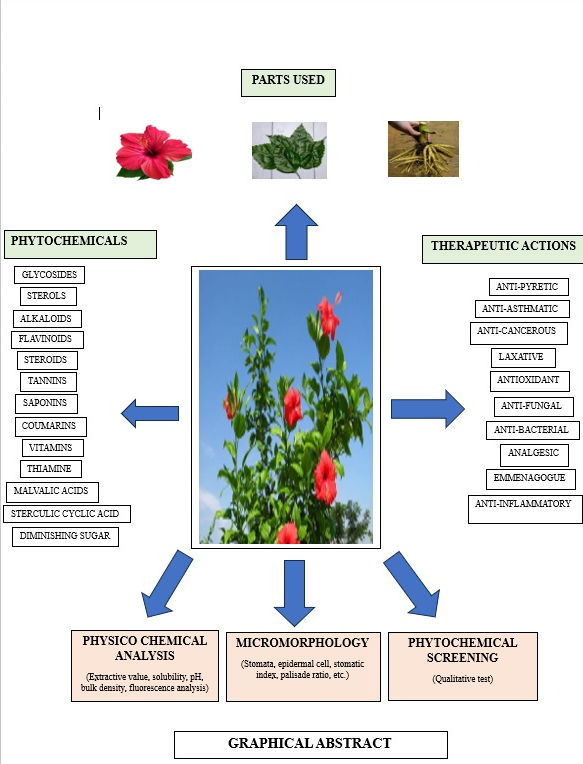
Traditionally it is utilized as analgesics, antipyretics, anti-asthmatics and anti-inflammatory medicine, as well as is having anti-cancerous effect. Numerous studies have demonstrated that Hibiscus flowers have antibacterial, antifungal, and antioxidant properties. Aside from helping with ulcer healing, its leaves and petals are also used to encourage hair development. It is well-known that blossoms effectively heal blood vessel disease, high blood pressure, and significantly reduce infertility [5]. Flowers are also considered as demulcent, refrigerant, aphrodisiac and emmenagogue. Its paste is applied externally on swelling, boils and its decoction are used in bronchial catarrh.
Leaves of the selected test drug are used as emollient, aperient, anodyne and laxative. Its decoction is used as a lotion in fevers. The roots decoction is used for venereal diseases and fevers. Fresh root juice is given for gonorrhea and powdered root for menorrhagia. The root is used in indigenous medicine and sold in markets as a substitute or adulterant of the root of Althaea officinalis Linn [3].
Alkaloids, resins, glycosides, diminishing sugars, greasy materials, sterols, are found to be present in different extracts of Hibiscus rosa sinensis Linn. whereas tannins and saponins are found to be absent. In the leaves, steroids, triterpenes, flavonoids, tannins, saponins, coumarins are found. The stem found to be consisted of β-sitosterol, taraxeryl acetate, cyclicacids sterculic and malvalic acids. The greasy liquor, unsaturated-fats, and hydrocarbon content, Malvalic and sterculic cyclic acids were also found in leaves of Hibiscus. Vitamins, ascorbic acid, flavonoids, riboflavin, niacin, thiamine, and cyaniding di-glucosides are reported to be present in flowers of Hibiscus. Also, 3-7-di-glucoside, cyanidin-3-sophoroside-5-glycosides, 3-7-di-glucoside, Quercetin-3-diglucoside, cyanidin-3, 5-diglucoside, 3-7-di- glucoside have been separated from yellow color flowers of hibiscus [5, 6].
The leaves are rich in active phytochemicals and are used in diverse ailments. So, the present study is designed to determine macroscopic, microscopic, physical and physicochemical, pharmacognostical and phytochemical properties for correct identification and to minimize the chances of adulteration as these plants are widely used in indigenous system of medicine.
Materials and Methods
Collection of Plant Material and Identification
The fresh leaves of Hibiscus rosa-sinensis Linn. were collected from the herbal garden of the department of Ilmul- Advia (Unani Pharmacology), Ajmal Khan Tibbiya College, Aligarh Muslim University, Aligarh. Identification was carried out in the pharmacognosy lab of the department; sample was submitted under Voucher No. SC – 402/24 for future reference after correlating it with the ethno-botanical literature and detailed morphological study.
Botanical Characters
Hibiscus rosa-sinensis Linn. is a conspicuous, ornamental, bearing red color flowers, evergreen, glabrous, showy shrub 1.5 to 2.4 m in height with tap root system. The leaves are simple, deltoid in shape, 8 to 12 cm in length, having acuminate apex and cordate base with serrate margins, alternate phyllotaxy and reticulate venation, stipule present, petiole present and 5 to 8 cm in length. The leaves are dark green dorsally and comparatively light green ventrally and mucilaginous in taste and rough and hairy in texture (Figures 1a and 1b).
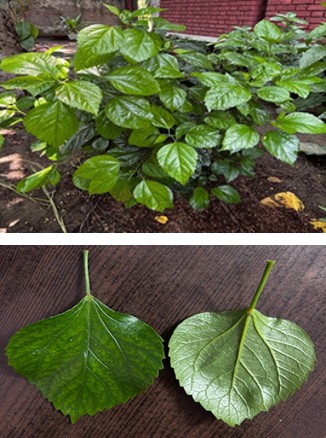
Figure 1a: Hibiscus rosa sinensis Linn.
Figure 1b: Leaves of Hibiscus rosa sinensis Linn. showing adaxial and abaxial surfaces.
Foliar Epidermal Micromorphology
The transverse sections of fresh leaves of Hibiscus rosa-sinensis Linn. were stained with safranin, mounted with glycerin and were observed under compound light microscope and the following microscopic features were observed like epidermal cells, its number, stomata type, shape, its number, stomatic index, stomatic length, ostiolar length, palisade ratio, vein islet number and suitable photographs were taken by OPTIKA binocular digital microscope B-290 using appropriate magnification. Measurements were recorded with the help of camera lucida, stage micrometer.
Physicochemical Analysis
Following collection, the leaves of Hibiscus rosa-sinensis Linn. were rinsed with water, subsequently cut into small pieces, and dried in a shady location. The dried leaves samples were powdered using electric grinder, sieved and stored in the air-tight containers. Physico-chemical parameters like extractive value determination, water and alcohol soluble contents, pH values, bulk density, fluorescence analysis, phytochemical screening were studied following the standard methods.
Determination of Extractive Values
The reflux method was used to determine the non- successive extractive values of the test medication in various solvents, including distilled water and ethanol. For extraction 2g of crude drug powder and 100ml of the solvent was taken. Each solvent was heated on a heating mantle for six hours. Depending on the solvents used for extraction, the heating mantle temperature was kept constant. Following solvent evaporation, the filtrate was tested for extractive values, and the proportion of extracts relative to the air-dried medicine was computed [7, 8].
Determination of Water and Alcohol Soluble Contents
For 24 hours, a conical flask with a glass stopper was used to mix 2 grams of the air-dried powdered medicine with 100 milliliters of distilled water. The mixture was given a thorough shaking on an electric shaker for six hours before being let to rest for eighteen hours. After filtering, the solution was heated on a plate to evaporate until it was completely dry. After evaporation, the remaining material was heated to 105°C until it reached a consistent weight, and then cooled in a desiccator for 30 minutes before being weighed. Using the quantity of air-dried medication, the percentages of water-soluble and alcohol-soluble components were determined [7].
Determination of pH Value
A synchronic digital pH meter (Model no.335) with a combination electrode was used to determine the pH. Before the experiment, the device was calibrated by utilizing buffer solutions with pH values of 4.0, 7.0, and 9.20 to determine its accuracy. Aqueous solutions of the powdered medication were tested for pH levels ranging from 1% to 10%. Dissolve 1 gram and 10 grams of powdered medication in 100 ml of distilled water, respectively, in conical flasks that had been precisely measured. The contents were then left to stand overnight. After filtering, the pH of both the 1% and 10% solutions was measured at a certain temperature using a pH meter. The process was repeated until the two readings agreed to within +0.02 unit [7, 8].
Bulk Density
After weighing, the powdered drug was poured in the measuring cylinder and the initial powder volume was observed and then, mechanically tapped the measuring cylinder and volume readings were taken until little or no further volume change is observed. The poured and tapped density is represented in grams per milliliter, where milliliters and cubic centimeters denote the same volume. The term “tapped density” refers to the increased bulk density that is achieved by mechanically tapping a graduated measuring cylinder that contains the powder test medication [9].
( ) ( ) gm Weight of powdered drug Bulk Density of drug = Vol. of cylinder ml
Phytochemical Screening
The preliminary screening for the presence or absence of various primary and secondary metabolites was revealed by qualitative test following standard methods [1, 10].
Fluorescence Analysis
Fluorescence Analysis of Powdered Drugs
In this study, different chemicals were mixed with the powdered drug and observed distinctive color changes under UV-light and in daylight. Distinct color changes were recorded [11, 12].
Fluorescence Analysis of the Successive Extracts of the Test Drugs
Successive extracts of the test drugs viz. Petroleum ether, Diethyl ether, Chloroform, Benzene, Alcohol, Water were observed in daylight and UV lights [11, 12].
Observations and Results
Micromorphology
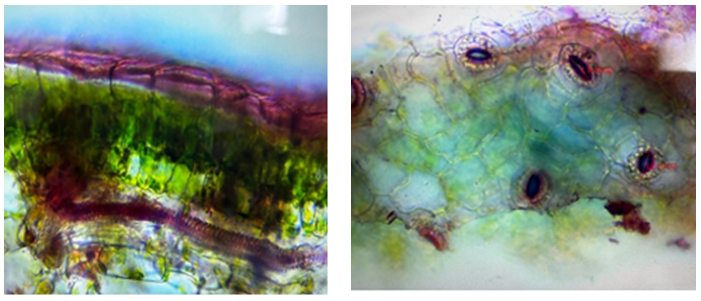
Microscopy of Hibiscus rosa-sinensis L. reveals presence of anomocytic type; kidney shape surrounded by three to four subsidiary cells of stomata in leaves beneath irregular epidermal cells (Figure 2). At 40X magnification average stomatal number was found to be 22-28/mm2, the epidermal cells are found to be 100-110/mm2, stomatal index 18.03- 18.05%, stomatal length 0.03µm, ostiolar length 0.02µm, vein islet number 11-12 and palisade ratio is within the range 10-11 and are found beneath the epidermal cells (Table 1).
| Analysis | |
|---|---|
| Epidermal no. (No./mm2) | 100-110 |
| Stomatal type | Anomocytic |
| Stomatal length (μm) | 0.03 |
| Stomatal index (%) | 18.03-18.05 |
| Stomatal number (No./mm2) | 22-28 |
| Vein islet number | 11-12 |
| Ostiolar length (μm) | 0.02 |
| Palisade ratio | 10-11 |
| Epidermal shape | Irregular |
Table 1: Quantitative Leaf Microscopy of Hibiscus rosa-sinensis Linn.
Physico-Chemical Parameters of the Powdered Drug
extractive values, solubility, bulk density, tapped density, pH values as presented in the (Table 2).
- The physico-chemical analysis of powder drugs viz. the
- Qualitative
- Phytochemical
- Screening of
- Powdered Drug
- Qualitative phytochemical tests of leaf powder of Hibiscus rosa-sinensis Linn. revealed presence of some important
- S.no.
- Test for
- Test/Reagent
- Hibiscus rosa-sinensis Linn.
- 1
- Alkaloid
- Dragendroff’s reagent
- +
- 2
- Carbohydrates
- Fehling’s solution test
- +
- 3
- Proteins
- Biuret test
- -
- Million’s test
- -
- 4
- Flavonoids
- 10% NaOH
- +
- 5
- Glycoside
- NaOH test
- +
- 6
- Phenols
- Lead acetate test
- +
- 7
- Starch
- Iodine test
- +
- 8
- Resins
- Acetic anhydride
- -
- 9
- Tannins
- 10% aq. Pb-acetate
- +
- Salkowskii reaction
- -
- 10
- Terpens
- Libermann’s reaction
- -
- Moleschott’s reaction
- -
Table 2: Qualitative analysis of the phytochemicals present in Hibiscus rosa-sinensis Linn.
| S. No. | Parameters | Hibiscus rosa-sinensis Linn. | |
|---|---|---|---|
| 1 | Extractive Value | Alcoholic (%) | 15 |
| Aqueous (%) | 31 | ||
| 2 | Solubility | Ethanol (%) | 10 |
| Water (%) | 35 | ||
| 3 | Density | Poured density (gm/ml) | 0.33 |
| Tapped density (gm/ml) | 0.4 | ||
| 4 | pH value | 1% Aq. Sol. | 6.02 |
| 10% Aq. Sol. | 5.8 |
Table 3: Qualitative analysis of the phytochemicals present in Hibiscus rosa-sinensis Linn.
phytochemicals which have possible therapeutic effects. The + sign indicates the presence of the specific phytochemical group and – sign indicated the absence of phytochemical group (Table 3).
Fluorescence Analysis
The leaf powder of Hibiscus rosa- sinensis L. give distinct color changes when seen under normal visible and UV- lights for short & long wavelength when treated with chemical reagents and various successive extracts. Fluorescence analysis of the powdered drug sample for different chemical reagents like Conc. Hcl, Conc.H2SO4, Conc.HNO3, 2%Iodine, 10%NaOH, 5%FeCl (Table 4) and successive extracts like Petroleum ether, Diethyl ether, chloroform, distilled water (Table 5) shows the specific fluorescent green color under short UV light.
| S.No. | Powdered Drug (P. D) | Day light | UV SHORT | UV LONG |
|---|---|---|---|---|
| 1 | P. D + Conc.HNO 3 | Black | Dark green | Greenish black |
| 2 | P. D + Conc.HCl | Black | Bright green | Greenish black |
| 3 | P. D + Conc.H SO 2 4 | Black | Green | Greenish black |
| 4 | P. D + 2% Iodine solution | Black | Dark green | Greenish black |
| 5 | P. D + Acetic acid | Black | Dark green | Greenish black |
| 6 | P. D + 10%NaOH SOL. | Black | Bright green | Greenish black |
| 7 | P. D + Acetic acid + H SO 2 4 | Black | Green | Greenish black |
| 8 | P. D + 10% NaOH + Few drops of CuSO sol. 4 | Black | Very light green | Greenish black |
| 9 | P. D +10% NaOH + few drops of lead acetate | Black | Green | Greenish black |
| 10 | P. D + acetic acid + 5%FeCl + H SO 2 4 | Black | Green | Greenish black |
| 11 | P. D + 5% FeCl | Black | Bright green | Greenish black |
| 12 | P. D + H O 2 | Black | Dark green | Greenish black |
| S.NO. | Extracts | Day light | UV SHORT | UV LONG |
| 1 | Petroleum ether | Black | Green | Dark greenish black |
| 2 | Diethyl ether | Black | Green | Dark greenish black |
| 3 | Chloroform | Black | Green | Dark greenish black |
| 4 | Benzene | Black | Bright green | Dark greenish black |
| 5 | Alcohol | Black | Green | Dark greenish black |
| 6 | Water | Black | Green | Dark greenish black |
Table 4: Fluorescence Analysis of Powdered Drug of Hibiscus rosa-sinensis Linn.
Discussion
In recent years, the demand for plant derived products has been on increasing pace around the world. Standardization is a very important tool to ensure the quality of these plant derived products. In present study, various pharmacognostical and phytochemical characters of leaves of Hibiscus rosa-sinensis L. have been studied. According to WHO (1998), the macroscopic and microscopic evaluations of plants are the basic and reliable criterion for identification and purity confirmation [13].
Taxonomically and pharmacognostically the study of stomata type, stomata index is important to identify the medicinal plants [14]. Leaves of H. rosa-sinensis L. were found to have epidermal cells irregular in shape. The palisade ratio and vein islet no. found to be in the range 10-11 and 11-12. The type of stomata was found to be anomocytic and stomatal index found to be 18.03-18.05.
Extractive value and Solubility play a crucial role in establishing the standard of any drug and in the identification of the quality and chemical constituents of any medicinal plant. The extractive value for H. rosa-sinensis L. was found to be 15% in ethanol and 31% in water and solubility in ethanol was found to be 10% and in water as 35%. Bulk density is an important parameter that helps in the identification of the herbal drugs. It was determined in terms of the poured and tapped density [9]. The poured and tapped density was found to be 0.33 and 0.40. The variation in pH impacts flavor, consistency and shelf life of the drug and helps in determining the receptor-site interaction and kinetics to some extent [7]. pH values of 1% and 10% solution were found to be 6.02 and 5.80.
Preliminary phytochemical analysis shows that Hibiscus rosa-sinensis L. contains Alkaloids, carbohydrates, flavonoids, glycosides, phenols, starch, tannins while proteins, terpenes and resins were absent. The phytochemicals are the naturally occurring chemical compounds having diverse therapeutic properties [15]. The fluorescence analysis is a precise, efficient & steady method as compared to many time- taking methods for the determination of various chemical constituents in the herbal drug. The herbal drugs and their chemical constituents emit specific color when they are treated with various chemical reagents and exposed to UV radiations. Therefore, in fluorescence analysis powdered drugs and successive extracts were treated with different chemical reagent and the changes in color were observed. As, fluorescence colors shows specificity for constituents present in the herbal drug its analysis can play an important role in distinguishing the genuine drug from the adulterated one. The constituents present in the herbal drugs can be correlated with their fluorescent behavior under different conditions. In UV short wavelength coumarins like hydroxyl amino acid derivatives appears yellow green in alkaline condition. Similarly, Flavonones appears light yellow in aqueous condition whereas in alkaline condition it appears bright yellow. Phytosterols when treated with H2SO4 appears green in color whereas sapogenin, terpenoids appears yellowish green in UV short wavelength. Likewise, Berberine, quinine, emetin, aconitin emits characteristic fluorescent colors. In the present study constituents present in the test drug found to be steroids, triterpenes, flavonoids, tannins, saponins, coumarins, phenols [16, 17].
Conclusion
The present pharmacognostical and phytochemical study on Hibiscus rosa-sinensis Linn. will be helpful in their correct identification and their differentiation from their closely related species and their authentication.
Conflict of Interest
There is no conflict of interest
References
-
Handral H, Jha PK, Shruthi SD (2010) Pharmacognostic and Phytochemical studies on the leaves of Murayya koenigii (L) Spreng. Pharmacophore 1(3): 231-238.
-
Gupta AK, Tandon N, Sharma M (2005) Quality standards of Indian medicinal Plants 1st (Edn.), Indian Council of Medical Research, New Delhi, India, pp: 142-145.
-
Sastri BN (1963) The Wealth of India. A dictionary of Indian raw materials and industrial products raw materials. Council of Scientific and Industrial Research, New Delhi, India, pp: 483.
-
Maulik G (2023) E-Flora of Gandhinagar. Gujrat Forestry Research Foundation, Gandhinagar, Gujrat, India.
-
Kumar N, Mani M (2022) Pharmacognostical evaluation and quantitative estimation of Hibiscus rosa sinenesis. Journal of Positive School Psychology 6(6): 2236-2248.
-
Sarje SK, Narwade S, Thakur M, Ghiware NB (2019) Pharmacognostic and Pharmacological review on Herbal Plant: Hibiscus rosa sinensis Linn. Int J Chem Technol Research 12(4): 266-270.
-
Anonymous (1968) British pharmacopeia. General Medical Council, Bloomsburry square London, UK, pp: 1285.
-
Jenkins GL, Kenevel AM, Digangi FE (2008) Qualitative pharmaceutical Chemistry.
-
Anonymous (2012) Bulk density and tapped density of powders 6th(Edn.), The international pharmacopeia, pp: 1-4.
-
Brain KR, Turner TD (1975) Practical evaluation of phytopharmaceuticals 1st(Edn.), Wright-Scientechnica, Bristol, England, pp: 144.
-
Chase CR, Pratt R (1949) Fluorescence of powdered vegetative drugs with particular reference to development of a system of identification. J Am Pharm Assoc 38(6): 324-331.
-
Kokoski CJ, Kokoski RJ, Sharma PJ (1958) Fluorescence of powdered vegetative drugs under ultra violet radiation. J Am Pharm Assoc 47(10): 715-717.
-
World Health Organization (1998) Quality control methods for medicinal plant materials.
-
Anonymous (1985) Indian pharmacopoeia 3rd(Edn.), Ministry of Health, Govt of India, India.
-
Minakshi B, Jharna D, Devi EC, Nayan T, Partha PK, et al. (2016) Phytochemical Analysis of Traditional Medicinal Plants and their antimicrobial Activity: An experience from North East India. J Pharm Res 1(1): 000104.
-
Mondal S, Rahaman CH (2020) Studies in Pharmacognostic Characters of the Climber Erycibe paniculate Roxb. Of Convolvulaceae. J Med Plants Stud 8(2): 112-125.
-
Gaikwad N, Kamble VV (2019) Fluorescence Analysis, Phytochemical, And Antioxidant Activities in Leaves and Stem of Embelia ribes Burm. F. Asian Journal of Pharmaceutical and Clinical Research 12(4): 225-229.
- Potential Medicinal Herbs and Secondary Metabolites in Combating Corona Virus
- Monkeypox and its Clinical Implications in Pregnancy
- Pharmacognostical Analysis of the Leaves of Important Nervine Medicinal Plant: Strychnos Nux-Vomica L
- Assessment of Antibacterial Activity of Various Solvent Extracts of Dictyota Dichotoma Against Multidrug Resistant Bacterial Strain
- An Insights of Bioactive Elements on Malignancy: Mechanistic Avenues
- Advances and Future Directions in Pharmacognosy and Chinese Medicine