
The Negative Implications of Using Cell Phones on Human Health and Environment
Mobiles are a part and parcel of our lives in the present age. They are an important source of communication and helps us to stay in touch with our friends, family and colleagues. Number of global smartphone users is increasing day by day because of its benefits, but little is known about the harms they cause to the people and the planet. Mobile phones have deleterious impacts not only on humans, flora and fauna, but on the environment as well. This short communication highlights the adverse impacts of mobiles on living things and the environment.
Introduction
In today’s world, mobile phones are ubiquitous, integrated into everyday life for their convenience in making and receiving calls. These devices, like other electronic items such as alarm systems, televisions, and computers, operate using radio frequencies and emit electromagnetic radiation, which is stronger than FM radio signals. The manufacturing process for cell phones involves several stages, and once a phone is used, it typically either ends up as waste or is recycled. This lifecycle, encompassing development, use, and disposal, impacts the environment at each phase. The amount of discarded phones entering landfills has been rising annually. For instance, in 2007, the US EPA reported that over 130 million phones ended up in landfills in the United States alone. With the increasing dependence on smartphones, this number is expected to rise significantly worldwide [1].
Environmental Degradation by Cell Phones’ Life Cycle
Production of cell phone is an ongoing and perpetual process and each phase of its production upsets the environment because more than one hundred million mobiles are replaced each year as per the enquiry. Some of those fetch up in landfills and if not disposed properly may affect the environment in a negative way as this electronic device contains toxic metals and other materials which are not suitable for the the well-being of the environment [2]. Typical composition of cell phone is given in Figure 1.
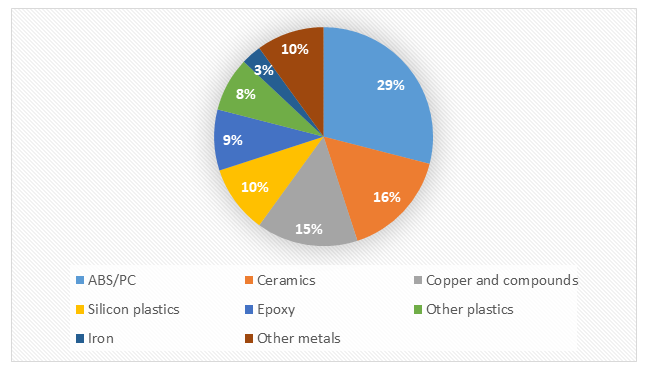
Circuitry and displays of mobile can contain toxic metals such as lead, cadmium, copper, arsenic and beryllium. Plastic shells encasing cell phones have also been treated combustible material. Over 60% proportion in e-waste includes iron, gold, copper, aluminum and other metals, while pollutants consists of 2.70%. Such contaminants are virulent in nature when processed, ignited or recycled in the environment [3, 4, 5]. During metal processing, elevated levels of carbon dioxide is released in the environment, which in turn, makes the ozone layer thinner [6].
Cell phones are also responsible for climate change. The reason is, manufacturing process of cell phones require energy which is obtained by burning fossil fuels. These fossil fuels on their burning releases huge amount of greenhouse gases into the atmosphere which are responsible for keeping the Earth’s surface warm because such gases are able to trap heat in the atmosphere leading to global warming [7]. A metal called cadmium is used in infrared detectors, chip resistors and semiconductors of cell phone and is persistent, toxic and bioaccumulative in nature. Another toxic metal found in cell phones is lead which has a tendency to accumulate in the environment and is associated with harmful effects on its biota. Consumer electronic gadgets may be accountable for 40% of this metal found in landfills. Discharge lamps, printed circuit boards and batteries contain mercury. When mercury finds its way into water ways, it leads to the deterioration of water quality. During assemblage and packaging of cell phones, plastic or paper boxes are used, which in turn, again destabilize the environment and spoils its resources by cutting trees to make paper boxes and discarding non- recyclable plastics [1].
Human Health Risks Associated with Recharge Cards and Continuous Use of Mobile Phones
Coated mobile recharge cards commonly known as scratch cards are metal coated. It has been reported by research studies that coatings of these scratch cards contain significant concentrations of toxic heavy metals such as silver, copper, chromium, cadmium, aluminium, zinc and nickel [8]. When an individual scratch the coating on recharge cards by nails, he gets exposed to heavy metals directly and this may lead to different health problems. Moreover, humans have remained at an elevated danger of occupational exposure to heavy metals (Fe, Ni, Cr, K, Ca, Sc, Ti, Zn and Cu, and Mn) found in the coatings of scratch cards which may put at risk the health of an individual [9]. For example, Titanium (Ti) and manganese (Mn) were determined in undesirable concentrations in coatings of recharge cards in a study conducted in Nigeria [10]. Recharge cards, when used, are either thrown on the roadsides or dumped in domestic waste bags which finally finds its way in waste-yard, landfills or open burning as a municipal solid waste. Although landfills are considered to be a safe disposal method of municipal solid waste, but this is accurate only for satisfactorily engineered landfill sites, otherwise, this may lead to soil and ground water contamination which in turn are responsible for causing oxidative stress and somatic alterations in living cells [11]. Thus, waste generated by cell phones (including scratch cards) have been classified as a hazard and the consumers are unaware of the dangers related with its usage [12].
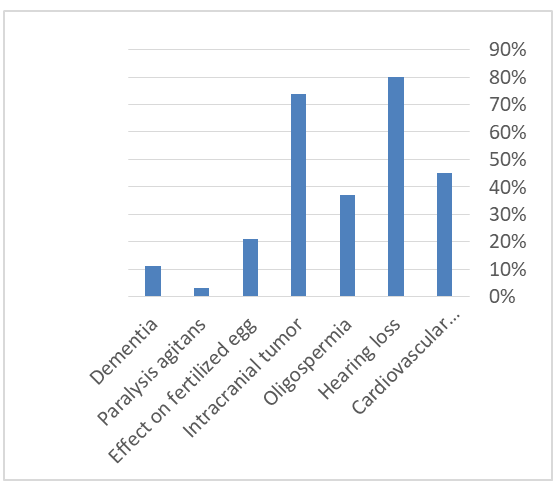
Neurological problems such as vertigo (sensation of spinning dizziness) and migraine (headache disorder) are associated with continuous usage of cell phones. The radiation that a mobile phone uses is also a part of the electromagnetic spectrum and it may adversely affect the human health in terms of heart, throat, ear and blood circulation problems [1]. Percentage of different diseases linked with mobiles are represented in Figure 2 [13].
Conclusion
The rapid advancement of wireless technology has led to a significant increase in cell phone use. While cell phones offer numerous advantages, such as quick communication, they also present notable drawbacks for both users and the environment. The electromagnetic radio frequency radiation emitted by these devices is linked to potential health risks. Additionally, the raw materials used in cell phone production can have severe environmental consequences due to their toxic properties. Adopting sustainable practices in cell phone usage can help mitigate these harmful effects on both people and the environment [13].
References
-
Bharodiya AK, Kayasth MM (2012) Impact of cell phones’ life cycle on human and environment: Challenges and recommendations. J Environ Res Dev 7: 530-536.
-
Lakshmi R, Nagan S (2010) Studies on concrete containing E plastic waste. Int J Environ Sci 1(3): 270.
-
Widmer R, Krapf DSHO, Khetriwal DS, Schnellmann M, Böni H (2005) Global perspectives on e-waste. Environ Impact Assess Rev 25(5): 436-458.
-
Kumar JS, Subbaiah KV, Rao PP (2010) Waste to Energy-A case study of Eluru city, Andhra Pradesh. Int J Environ Sci 1(2): 151.
-
Hernández-Soriano DC, Peña A, Mingorance MD (2011) Environmental hazard of cadmium, copper, lead and zinc in metal-contaminated soils remediated by sulfosuccinamate formulation. J Environ Monit 13(10): 2830-2837.
-
Soon W, Baliunas SL, Robinson AB, Robinson ZW (1999) Environmental effects of increased atmospheric carbon dioxide. Clim Res 13(2): 149-164.
-
Saravanan P, Prasad KA, Sudha G, Ilangovan P (2011) An assessment of environmental degradation: Case study of Avaniyapuram town panchayat, Madurai. Int J Environ Sci 1(7): 1504-1514.
-
Adediran YA, Abdulkarim A (2012) Challenges of electronic waste management in Nigeria. Int J Adv Eng Technol 4(1): 640.
-
Okunola OJ, Alhassan GG, Yebpella A, Uzairu AI, Tsafe ES, et al. (2011) Risk assessment of using coated mobile recharge cards in Nigeria. J Environ Chem Ecotoxicol 3(4): 80-85.
-
Adekunle AS, Oyekunle JA, Baruwa SO, Ogunfowokan AO, Ebenso EE (2014) Speciation study of the heavy metals in commercially available recharge cards coatings in Nigeria and the health implication. Toxicol Rep 1: 243- 251.
-
Bakare AA, Alabi OA, Gbadebo AM, Ogunsuyi OI, Alimba CG (2013) _In vivo_ cytogenotoxicity and oxidative stress induced by electronic waste leachate and contaminated well water. Chall 4(2): 169-187.
-
Babatunde OA, Eguma CA, Oyeledun BT, Igwilo OC, Awosanya OG, et al. (2014) Mobile phone usage and battery disposal in Lagos, Nigeria. Int J Appl Psychol 4(4): 147-154.
-
Suhag AK, Larik RS, Mangi GZ, Khan M, Abbasi SK, et al. (2016) Impact of excessive mobile phone usage on human. J Comput Sci Syst Biol 9(6): 173-17710.
- Plant Diversity, Regeneration Dynamics, and Socio-Ecological Impacts at the Forest-Savanna Transition Zone, Cameroon
- Bird Community, Feeding Guilds and Habitat Associations Along the Proposed River Dibombe Hydropower and Transmission Line Project in Nkam and Moungo Divisions, Cameroon
- Plant Diversity and Carbon Storage Potential Across Different Land Use Types in Infrastructure Development Landscapes in Cameroon: Implications for no Net Loss of Biodiversity
- Optimization and Modelling for the Remediation of Brilliant Green Dye and Ni2+ ions from Water Using Advanced gC3N4/PVA@ Alginate Bio-Polymeric Hydrogel Beads
- A Comprehensive Survey of Population Ecology in Insects
- Evaluation of Coiled Tubing Limitations to Drill Out Frac Plugs