
Bird Community, Feeding Guilds and Habitat Associations Along the Proposed River Dibombe Hydropower and Transmission Line Project in Nkam and Moungo Divisions, Cameroon
Cameroon is endowed with rich biological and natural resources with significant ecological, economic and cultural values. Its water resource has a huge potential for energy production, and the proposed Dibombe Hydropower project aims to add 64.2 megawatts of energy on the national grid contributing to the growth of the electricity sector. To implement this project, the biodiversity as a whole and the avian community in particular on the sites will be impacted. This study was thus designed to determine the baseline community of birds as well as their habitats within the project sites and to assess potential impacts of the projects on the bird community. Points transect counts and mist nets were used. A total of 155 bird species belonging to 39 families were recorded during the survey; 104 and 111 species at the proposed hydropower site and transmission line respectively. 140(90.3%) species were resident species, 12(7.7%) were resident but partially migratory species, 2(1.3%) were palearctic migrants and 1(0.65%) were vagrants. Two globally threatened species were recorded: Yellow-casqued Wattled Hornbill Ceratogymna elata (Vulnerable) and the African Grey Parrot Psittacus erithacus (Endangered). An overall estimate of 170±7 (CI=161.36-190.91) species was obtained from Chao species richness, with 143 species along the transmission line and 113 at the hydropower project site. Rarefaction curves reached near asymptote, indicating that most of the species were detected by the survey. Dominant species were recorded from the family Pycnonotidae (17 species) while 11 families recorded just one species; Phalacrocoracidae, Scopidae, Threskiornithidae, Anatidae, Phasianidae, Rallidae, Burhinidae, Psittacidae, Coliidae, Corvidae and Viduidae. The most dominant feeding guild was the omnivores (26%), while carnivores/insectivores (2%), and carnivores (2%) represented the least feeding guilds. Given that the site is already under severe pressure from anthropogenic activities mainly agricultural encroachment, the proposed hydropower project and transmission line presents additional cumulative impacts, mainly fragmentation and loss of habitat for terrestrial birds while the dam impoundment is likely to attract more aquatic birds. Future monitoring to determine impacts and trends during and after the execution of the project is strongly recommended.
Introduction
There is an ongoing challenge in balancing economic development and environmental protection. Environmental and Social Impact Assessment thus plays a crucial role in promoting a safe environment and ensuring sustainable development. Most international financial institutions have also embraced the ESIA to ensure that their projects contribute to ‘sustainable development’. In essence, for major projects above a certain funding threshold (currently US$10 million), Equator Principal finance institutions must ensure that an impact assessment appropriate to the scale and nature of the project is provided by the applicant [1].
Economic development in Cameroon is partly hindered by insufficient supply of electrical energy despite its rich biological and natural resources with significant ecological, economic and cultural values. Its water resource has a huge potential for hydropower generation, and the proposed Dibombe Hydropower project aims to add 64.2 MW of energy on the national grid contributing to the growth of the energy sector. Hydropower generation is a renewable energy which offers excellent merits against the negative factors of carbon dioxide and other flue gases which contaminate our environment. It’s the least costly way of storing large amounts of electricity, with low cost of operation as advantages. Nevertheless, hydropower implementation comes with social, economic and ecological impacts. From an ecological point of view, the construction and operation of hydro dams and transmission lines can affect avian biodiversity in many ways, among which are habitat degradation and fragmentation, changes in hydrology, introduced species, hunting and harvesting enabled by rights-of-ways (transmission line corridor) and construction of roads.
Overhead power lines are said to have negative impacts on bird populations, mainly through collision and electrocution [2, 3]. On the other hand, power lines may provide benefits for several bird species (e.g. storks, raptors, corvids), as wires and pylons may be used as perches, hunting, solitary resting and communal roosting and nesting sites [4, 5, 6, 7]. This creates a paradox for conservation, since positive and negative impacts on the use of power lines co-exists and the estimation of impacts of these structures at population level will have to take these trade-offs into account. Also, electromagnetic pollution related to power lines has been suggested to decrease reproductive success in several species, from small passerines to storks [8].
Hydroelectric dams can block non-Volant and aquatic animal migratory pathways, introduce alien species and flood surrounding lowland habitat [9, 10]. Furthermore, dam impoundments disrupt wildlife by altering the original environment, thereby hindering wild animals and plants from thriving due to the degradation or loss of habitat [11]
ESIA is a multidisciplinary study involving several taxa amongst which are birds. Birds are good indicator species because they are ecologically versatile and thrive in all kinds of habitat as herbivores, carnivores and omnivores. Their presence is an indication of healthy ecosystem or habitat. The diet of bird species represents a fundamental aspect of its ecological niche and dietary adaptations play an important role in understanding the ecology and evolution of communities [12]. Birds also play an important role in ecosystems as potential pollinators, scavengers and bio- monitors in controlling insect pests and also as excellent ecological indicators [13].
Cameroon like many other countries around the world has institutionalized the ESIA process. As part of the process, baseline data collection is crucial in understanding the existing environmental conditions before a project is implemented. This study was thus designed to establish a baseline of the avian community, their feeding guilds and habitat associations within the project sites and to highlight potential environmental effects of the proposed project on the avian communities which are vital at the outset, for potential impacts can be earmarked and mitigation measures considered.
Materials and Methods
Study Site
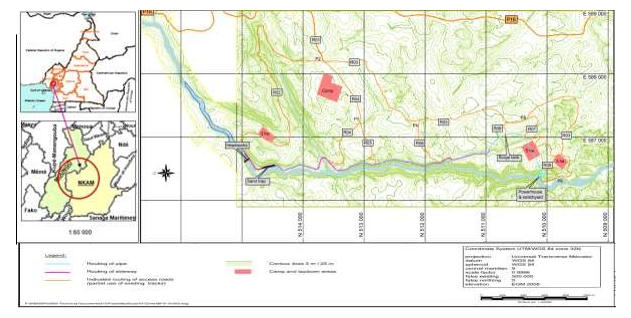
Berkley Energy Cameroon has proposed to construct and operate a run-off-river Hydro Power Plant (HPP) on the Dibombe River found in Sole village, Yabassi subdivision in the Littoral region of Cameroon. The site is located between latitude N: 514870 and longitude E: 586590 at an altitude of 101 m to latitude N: 510000 and longitude E: 589000 at an average altitude of 144 m along the river bank to the Mabombe bridge located 8.5 km from the power house location. The proposed transmission line runs from the power house location downstream in Sole village through a corridor of 10.8 km long and 50 m wide to the SONATREL (Société Nationale de Transportation de l’Electricite) substation in Njombé-Penja in the Mungo division. The vegetation around the study area falls within the lowland evergreen rainforests zone of the Congo Basin, consisting of a mosaic of patches of intact forests, secondary forest and plantations. The forest type belongs to the Lower Guinea region of endemism or phytochoria with abundance of leguminous trees (Fabaceae).
The climate in this area is equatorial with eight months of rainfall (April to November) with an average monthly rainfall > 600 mm and four months of dry season with little or no rainfall (December to March) with an average monthly rainfall < 100 mm. Average annual rainfall is 3702 mm while the average annual temperature is 26.5 °C. Agriculture is the main source of subsistence for the local population alongside fishing in the Dibombe River. Some of the crops cultivated in Solé village and other villages along the proposed transmission line include; Palms, cocoa, banana, white pepper and food crops. The soil of the study area is very high in sand and clay contents Figure 1.
Sampling Design
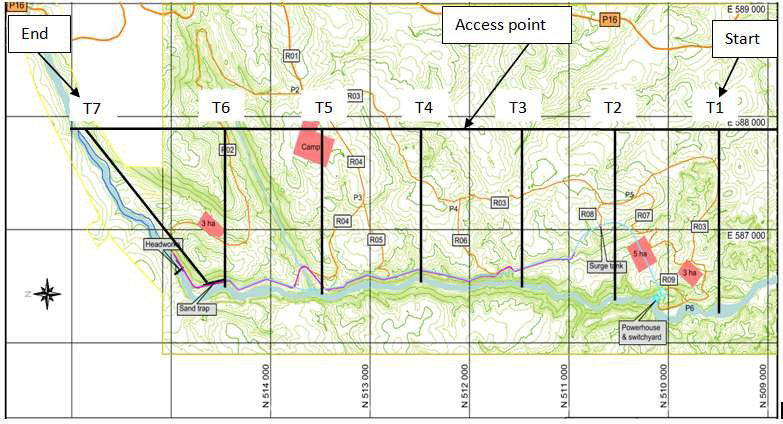
Six transects where established perpendicular to the River, from the downstream power house location to the intake location and labelled T1 to T6 (Figure 2). The transects were set 1 km apart and each varied between 1 to 1.2 km long depending on the meandering of the river. Another transect labelled T7 extended along the river bank from the intake location to the main road at Mabombe bridge measuring approximated 3.5 km (Figure 2). The transects cut across different habitat types such as farmlands, plantations (cocoa, palms, white pepper, plantains), farm bushes and secondary riverine forest all the way to the river. A transect of 11 km was established along the transmission line corridor, from the power house location to the existing SONATREL substation in Njombé-Penja. Sampling stations were located 200 m apart along each transect. Transects and survey stations were established using a GPS Garmin 60C. Figure 2 below illustrates the sampling design used in this study.
Point Transect Count: Field work was conducted in March 2021 at the proposed hydropower construction site and in August 2021 along the proposed transmission line. Surveys were carried out during early mornings from 7:00 am to 11:30 am and later in the evening from 2:30 to 5:30 pm. At each station all birds seen or heard within a radius of 50 meters were identified and recorded for ten minutes duration. In addition, opportunistic observations of birds while walking between stations were added to make a comprehensive checklist of birds for the study area. The abundance of each species per station was also recorded. Binoculars (Verano 10X42 BGA, PC OASIS WP Field 6.0°) were used to visualize details of physical characteristics (colour, shape and size) and the birds were identification using Borrow, et al. [14]. A GPS was used to record the coordinates at the start and end point of each transect as well as survey stations along the transects.
Mist Netting: Mist nets were used especially in forest areas along the established transects to target cryptic species that may be omitted during transect counts. Three mist nets (each 3 m high by 12 m long) of 16 mm mesh size, capable of trapping small and medium size birds were established towards the end of each transect within the river bank forest. Smaller branches and scrubs where sometimes cut in order to ease the installation of the mist nets along the transect. These nets where observed every 45 minutes from it set up time at 8:00 am right up to 5:00 pm when it was removed and the different bird caught where identified, recorded and photographed. The three nets were installed along one transect per day.
Feeding Guilds: The feeding guilds for this study follow Birds of Western Africa by Borrow and Demey (2014): carnivores (CV), carnivores/insectivores (CVIS), frugivores (FV), granivores (GV), insectivores (IS), insectivores/frugivores (ISFV), insectivores/granivores (ISGV), insectivores/piscivores (ISPV), nectarivores (NV) and omnivorous (OV).
**Statistical analyses**
Data was analysed using R software version 4.1.0 (R Core Team, 2021). The following add-ons packages were used: iNEXT (Hsieh et al., 2016) libraries for interpolating and extrapolating species diversity; readxl [15] libraries for reading excel files into R; prettyR [16] libraries for descriptive statistics; ggplot2 [17] for plotting graphs. Significant testing was done at 5% probability.
The avifauna diversities were computed and expressed in the most unified diversity of the Hill numbers with orders (q=0, q=1, q=2) [18, 19], which integrate both species richness and relative abundance. This diversity is defined mathematically [20] as:
$$q^D = \left( \sum_{i=1}^{s} p_i^q \right)^{1/(1-q)}$$
Where, S is the number of species in the assemblage, and the relative abundance of the $i^{th}$ species is Pi (i=1, 2, ..., S). The parameter q is an integer (0≤q≤2) determining the sensitivity of the measure to the relative frequencies. When q = 0, 0D is simply species richness; as q tends to 1,1D is the exponential of the familiar Shannon index, known here as Shannon diversity:
$$1^D = \lim_{q \to 1} q = \exp\left(-\sum_{i=1}^{s} p_i \log p_i\right)$$
When q = 2, 2D becomes the inverse of the Simpson diversity:
$$2^D = 1/\sum_{i=1}^{s} p_i^2$$
With q=0, the diversity is of all the species; with q=1 the diversity is of “typical” species; and with q=2, the diversity is of abundant species.
We also assessed species diversity from how equitably or evenly the relative abundances of species were distributed (Carlo H. R. H, 1998) using the Pielou’s evenness or equitability (J) index given as (Carlo H. R. H, 1998):
$$J = H/\ln(S)$$
Where, S is the number of species and H is the Shannon–Weaver index (H)
**Results**
A total of 155 bird species belonging to 39 families were recorded during the survey; 104 species at the proposed hydropower construction site and 111 species along the proposed transmission line. Overall, the most dominant species were recorded from the family Pycnonotidae (17 species, 10%) while 11 families recorded just one species; Phalacrocoracidae, Scopidae, Threskiornithidae, Anatidae, Phasianidae, Rallidae, Burhinidae, Psittacidae, Collidae, Corvidae and Viduidae representing 0.6% each. Two globally threatened species were recorded: African Grey Parrot *Psittacus erithacus* (Endangered) and the Yellow-casqued Wattled Hornbill *Ceratogymna elata* (Vulnerable). Of these species, 140(90.3%) species where resident species, 12(7.7%) species where resident but partially migratory species, 2(1.3%) species where palearctic migrants and 1(0.65%) where vagrants.
**Species Richness and Diversity of the Sites**
From the randomised rarefaction and extrapolation curve, the overall estimate of Chao species richness in the areas was 170±7 (CI=161.36 - 190.91), with 91% of the total species expected to be found in the study site caught by our sampling effort (observed richness =155). The curves for species richness (q = 0) reached asymptote for an estimated 113 species for the hydropower construction site and an estimated 143 species for the transmission line site (Figure 3). For an extrapolated random sample of 1000 individuals, both the rare species (indicated by q=0 curve) and common/typical species (indicated by q=1 and q=2 respectively) would all be detected in the project site, whereas only the common/typical species would all be detected in the transmission line site. Irrespective of the site, sampling was sufficiently adequate as the rarefaction curves have reached near asymptote; indicating, therefore, that most of the species were detected by the survey.
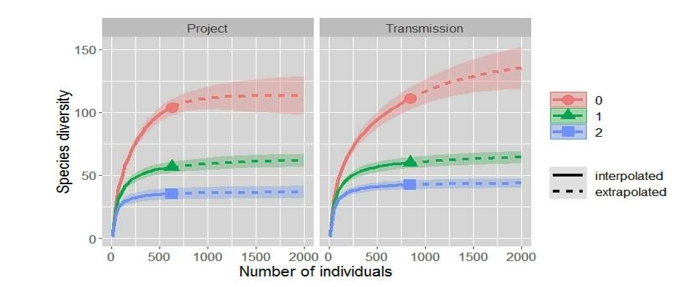
Figure 3: Average randomized rarefaction (solid line) and extrapolation (dotted line) curves showing species diversity, based on the three Hill measurements (q=0, richness; q=1, Shannon; and q=2, Simpson), for a unit increase in sample effort (number of individuals) in the two avifauna assemblages (Hydropower project site = Project; Transmission line corridor=Transmission), along with 95% confidence intervals based on a bootstrap method with 200 replicates.
Results on the Shannon and Simpson Indices for Both Sites
The relative abundances of bird species in both (project and transmission line) sites were similar and evenly distributed (JProject site = 0.870 and JTransmission line site = 0.869 respectively).
Relative Abundance of Feeding Guilds
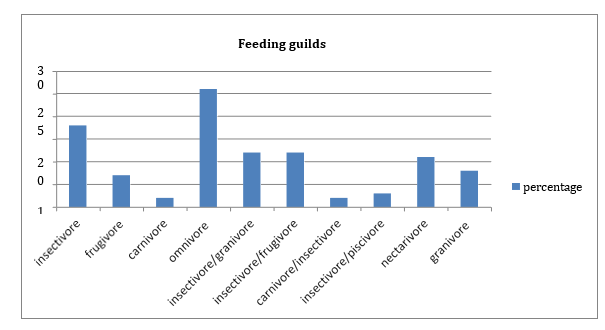
The major dietary guilds were insectivore (IS), carnivore (CV), omnivore (OV), nectarivore (NV), granivore and frugivore (FV). The other dietary guilds were carnivore/ insectivore (CVIS), insectivore/granivore (ISGV), insectivore/ frugivore (ISFV), insectivore/piscivore. The highly dominant dietary guild was omnivore (26%) followed by insectivore (18%) and directly by Insectivores/Granivores (ISGV) (12%) and Insectivorous/frugivores (ISFV) (12%) while the guild with the least number of species in the area were carnivores (CV) (2%), carnivores/insectivores (CVIS) (2%) and insectivores/piscivores (ISPV) (3%) Figure 4.
Habitat Associations
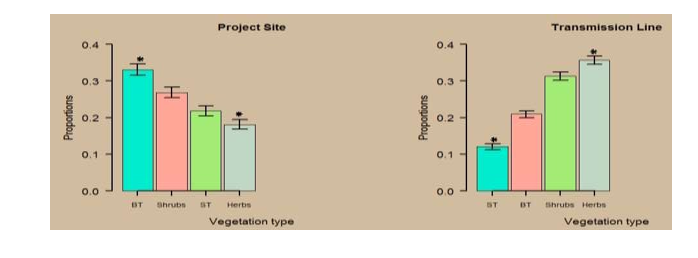
The vegetation structure was similar in both sites but with different composition; in the project site we had, big trees (33.1%, n=1195), shrubs (26.9%, n=970), small trees (21.9%, n=789) and herbs (18.1%, n=655); while in the transmission line site we had, small trees (12.1%, n=847), big trees (20.9%, n=1472), shrubs (31.3%, n=2200) and herbs (35.7%, n=2510).There was a significant difference in the abundance of the different vegetation types within both sites: Project site (𝑋2 = 182.05, df = 3, 𝑃 < 0.001) and transmission line corridor (𝑋2 = 951.82, df = 3, 𝑃 < 0.001) as a result a difference in avian richness and composition, with the project site being more diverse in species than the transmission line site since within the project site, big trees were the most abundant while herbs were the least vegetation type; conversely, herbs were the most abundant vegetation type in the transmission line site while small trees were the least abundant vegetation type as illustrated in Figure 5 below.
Three main ecologically degrading human activities were identified in the study area: farming, logging and bushfire, all of these activities directly affecting the intact forest through habitat lost, where up to 10% of the Dibombe river surrounding forest is affected by bushfire mainly done by farmers to facilitate farm clearings and another 7% by logging activities use for building houses and wood for cooking in traditional kitchens. Farming being the principal activity of the inhabitants surrounding these sites, 15% of the surrounding forest along the Dibombe river is lost to farming and 50% of the transmission line will be cutting across various individual farms like cocoa, plantains, white pepper, pawpaw, food crops and Banana plantation owned by PHP (plantation Haute Pendja). The diversity of the avifauna was significantly affected by local anthropogenic activities: the 95% confidence intervals for the corresponding rarefied- extrapolated curves do not overlap (See Figure 6). With the highest asymptote for the three Hill measurements (q=0, q=1 and q=2), the site with farming activities was the most diverse in species (richness=158±12.91, Shannon index=4.27, Simpson index=0.978) whereas the site with bushfire had significantly the least species diversity (richness=61±9.69, Shannon index=3.675, Simpson index=0.961)). Estimation for Logging was 111±13.66 species (Shannon index=4.227, Simpson index=0.977). Notwithstanding, bird detection (sampling effort) was more efficient in the farmland than elsewhere as indicated by the asymptote of the rarefaction curve.
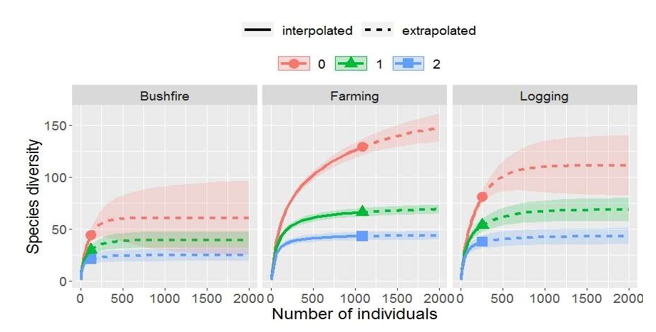
Figure 6: Average randomized rarefaction (solid line) and extrapolation (dotted line) curves showing species diversity, based on the three Hill measurements (q=0, richness; q=1, Shannon; q=2, Simpson), for a unit increase in sample effort (number of individuals) within the three avifauna assemblages (bushfire, farming and logging lands), along with 95% confidence intervals based on a bootstrap method with 200 replicates.
Discussion
The checklists generated at the end of the study (Table 1) shows a great diversity in terms of bird communities as well as the species population assessed in the two sites. Generally, 170 species of birds where encountered belonging to 39 families among which 86 of them falls within the Guineo-Congolian forest biome (Lowland Forests: LF). Of the 32 globally threatened bird species listed in Cameroon according to the IUCN status 2018, only three where observed within the designated study area during this survey representing 9.4%, consequently, considering criterion A1, this area can be qualified as an Important Bird Area (IBA) as it does harbor three globally threatened bird species. The sites does not qualify according to criterion A2, as it does not hold any of the restricted range species, i.e. species with a total world range less than 50.000 km2. And again, No congregational species was recorded during this survey thus the sites do not qualify under category A4 as an IBA.
| Family | Scientific Name | Common Name | IUCN | Distribution | Feeding Guild |
|---|---|---|---|---|---|
| Phalacrocoracidae | Phalacrocorax africanus | Long-tailed Cormorant | LC | RpM | CV |
| Scopidae | Scopus umbretta | Hamerkop | LC | R | ISPV |
| Threskiornithidae | Bostrychia hagedash | Hadada Ibis | LC | R | CVIS |
| Anatidae | Plectropterus gambensis | Spur-winged Goose | LC | RpM | ISPV |
| Accipitridae | Milvus migrans | Yellow-billed kite | LC | PM | CV |
| Gypohierax angolensis | Palm-nut Vulture | LC | R | CV | |
| Dryotriorchis spectabilis | Congo Serpent Eagle | LC | R | CV | |
| Polyboroides typus | African Harrier Hawk | LC | R | CV | |
| Accipiter tachiro | African Goshawk | LC | |||
| Accipiter castanilius | Chestnut-flanked Sparrowhawk | LC | R | CV | |
| Accipiter melanoleucus | Black Sparrowhawk | LC | R | CV | |
| Urotriorchis macrourus | Long-tailed Hawk | LC | R | CV | |
| Kaupifalco monogrammicus | Lizard Buzzard | LC | R | CV | |
| Buteo rufinus | Long-legged Buzzard | LC | R | CV | |
| Lophaetus occipitalis | Long-crested Eagle | LC | R | CV | |
| Stephanoaetus coronatus | Crowned Eagle | NT | R | CV | |
| Phasianidae | Francolinus squamatus | Scaly Francolin | LC | R | OV |
| Rallidae | Sarothrura pulchra | White-spotted Flufftail | LC | R | FV |
| Burhinidae | Glareola nuchalis | Rock Pratincole | LC | RpM | OV |
| Columbidae | Treron calva | African Green Pigeon | LC | R | FV |
| Turtur tympanistria | Tambourine Dove | LC | R | FV | |
| Turtur afer | Blue-spotted Wood Dove | LC | R | FV | |
| Streptopelia semitorquata | Red-eyed Dove | LC | R | FV | |
| Psittacidae | Psittacus erithacus | Grey Parrot | EN | R | FV |
| Musophagidae | Corythaeola cristata | Great Blue Turaco | LC | R | FV |
| Tauraco macrorhynchus | Yellow-billed Turaco | LC | R | FV | |
| Cuculidae | Cuculus solitaries | Red-chested Cuckoo | LC | RpM | OV |
| Cercococcyx olivinus | Olive Long-tailed Cuckoo | LC | R | OV | |
| Chrysococcyx cupreus | African Emerald Cuckoo | LC | R | OV | |
| Chrysococcyx klaas | Klaas’s Cuckoo | LC | R | OV | |
| Chrysococcyx caprius | Didric Cuckoo | LC | R | OV | |
| Ceuthmochares aereus | Yellowbill | LC | R | OV | |
| Centropus leucogaster | Black-throated Coucal | LC | R | OV | |
| Centropus senegalensis | Senegal Coucal | LC | R | OV | |
| Centropus monachus | Blue-headed Coucal | LC | R | OV | |
| Apodidae | Rhaphidura sabini | Sabine’s Spinetail | LC | R | IS |
| Neafrapus cassini | Cassin’s Spinetail | LC | R | IS | |
| Cypsiurus parvus | African Palm Swift | LC | R | IS | |
| Apus affinis | Little Swift | LC | R | IS | |
| Coliidae | Colius striatus | Speckled Mousebird | LC | R | FV |
| Alcedinidae | Halcyon malimbica | Blue-breasted Kingfisher | LC | R | ISPV |
| Halcyon senegalensis | Woodland Kingfisher | LC | R | ISPV | |
| Ceyx lecontei | African Dwarf Kingfisher | LC | R | ISPV | |
| Ceyx picta | African Pygmy Kingfisher | LC | RpM | ISPV | |
| Alcedo cristata | Malachite Kingfisher | LC | R | ISPV | |
| Ceryle rudis | Pied Kingfisher | LC | R | ISPV | |
| Meropidae | Merops pusillus | Little Bee-eater | LC | R | IS |
| Merops variegatus | Blue-breasted Bee-eater | LC | R | IS | |
| Merops albicollis | White-throated Bee-eater | LC | V | IS | |
| Coraciidae | Eurystomus gularis | Blue-throated Roller | LC | R | CVIS |
| Eurystomus glaucurus | Broad-billed Roller | LC | RpM | CVIS | |
| Bucerotidae | Tockus albocristatus | White-crested Hornbill | LC | R | OV |
| Tockus camurus | Red-billed Dwarf Hornbill | LC | R | OV | |
| Tockus fasciatus | African Pied Hornbill | LC | R | OV | |
| Ceratogymna fistulator | Piping Hornbill | LC | R | OV | |
| Ceratogymna albotibialis | White-thighed Hornbill | LC | R | OV | |
| Ceratogymna atrata | Black-casqued Wattled Hornbill | LC | R | OV | |
| Ceratogymna elata | Yellow-casqued Wattled Hornbill | VU | R | OV | |
| Capitonidae | Gymnobucco bonapartei | Grey-throated Barbet | LC | R | ISFV |
| Gymnobucco peli | Bristle-nosed Barbet | LC | R | ISFV | |
| Gymnobucco calvus | Naked-faced Barbet | LC | R | ISFV | |
| Pogoniulus scolopaceus | Speckled Tinkerbird | LC | R | ISFV | |
| Pogoniulus atroflavus | Red-rumped Tinkerbird | LC | R | ISFV | |
| Pogoniulus subsulphureus | Yellow-throated Tinkerbird | LC | R | ISFV | |
| Pogoniulus bilineatus | Yellow-rumped Tinkerbird | LC | R | ISFV | |
| Buccanodon duchaillui | Yellow-spotted Barbet | LC | R | ISFV | |
| Trachyphonus purpuratus | Yellow-billed Barbet | LC | R | ISFV | |
| Indicatoridae | Prodotiscus insignis | Cassin’s Honeybird | LC | R | IS |
| Indicator exilis | Least Honeyguide | LC | R | IS | |
| Picidae | Campethera cailliautii | Green-backed Woodpecker | LC | R | IS |
| Dendropicos fuscescens | Cardinal Woodpecker | LC | R | IS | |
| Dendropicos elliotii | Elliot’s Woodpecker | LC | R | IS | |
| Hirundinidae | Pseudhirundo griseopyga | Grey-rumped Swallow | LC | RpM | IS |
| Hirundo abyssinica | Lesser Striped Swallow | LC | RpM | IS | |
| Hirundo preussi | Preuss’s Cliff Swallow | LC | RpM | IS | |
| Hirundo smithii | Wire-tailed Swallow | LC | R | IS | |
| Hirundo aethiopica | Ethiopian Swallow | LC | RpM | IS | |
| Hirundo rustica | Barn Swallow | LC | PM | IS | |
| Motacillidae | Motacilla aguimp | African Pied Wagtail | LC | R | IS |
| Anthus leucophrys | Plain-backed Pipit | LC | R | IS | |
| Anthus pallidiventris | Long-legged Pipit | LC | R | IS | |
| Campephagidae | Coracina azurea | Blue Cuckoo-Shrike | LC | R | IS |
| Pycnonotidae | Andropadus virens | Little Greenbul | LC | R | OV |
| Andropadus gracilis | Little Grey Greenbul | LC | R | OV | |
| Andropadus ansorgei | Ansorge’s Greenbul | LC | R | OV | |
| Andropadus curvirostris | Cameroon Sombre Greenbul | LC | R | OV | |
| Andropadus latirostris | Yellow-whiskered Greenbul | LC | R | OV | |
| Calyptocichla serina | Golden Greenbul | LC | R | OV | |
| Baeopogon indicator | Honeyguide Greenbul | LC | R | OV | |
| Ixonotus guttatus | Spotted Greenbul | LC | R | OV | |
| Chlorocichla simplex | Simple Greenbul | LC | R | OV | |
| Thescelocichla leucopleura | Swamp Palm Bulbul | LC | R | OV | |
| Pyrrhurus scandens | Leaflove | LC | R | OV | |
| Phyllastrephus icterinus | Icterine Greenbul | LC | R | OV | |
| Phyllastrephus xavieri | Xavier’s Greenbul | LC | R | OV | |
| Bleda notatus | Lesser Bristlebill | LC | R | OV | |
| Criniger chloronotus | Eastern Bearded Greenbul | LC | R | OV | |
| Criniger calurus | Red-tailed Greenbul | LC | R | OV | |
| Pycnonotus barbatus | Common Bulbul | LC | R | OV | |
| Turdidae | Stiphrornis erythrothorax | Forest Robin | LC | R | OV |
| Alethe diademata | Fire-crested Alethe | LC | R | OV | |
| Alethe poliocephala | Brown-chested Alethe | LC | R | OV | |
| Neocossyphus poensis | White-tailed Ant Thrush | LC | R | OV | |
| Neocossyphus fraseri | Rufous Flycatcher-Thrush | LC | R | OV | |
| Turdus pelios | African Thrush | LC | R | OV | |
| Sylviidae | Bathmocercus rufus | Black-faced Rufous Warbler | LC | R | ISGV |
| Cisticola anonymus | Chattering Cisticola | LC | R | ISGV | |
| Apalis nigriceps | Black-capped Apalis | LC | R | ISGV | |
| Apalis rufogularis | Buff-throated Apalis | LC | R | ISGV | |
| Camaroptera brachyuran | Grey-backed Camaroptera | LC | R | ISGV | |
| Camaroptera superciliaris | Yellow-browed Camaroptera | LC | R | ISGV | |
| Camaroptera chloronota | Olive-green Camaroptera | LC | R | ISGV | |
| Macrosphenus flavicans | Yellow Longbill | LC | R | ISGV | |
| Macrosphenus concolor | Grey Longbill | LC | R | ISGV | |
| Eremomela badiceps | Rufous-crowned Eremomela | LC | R | ISGV | |
| Sylvietta virens | Green Crombec | LC | R | ISGV | |
| Sylvietta denti | Lemon-bellied Crombec | LC | R | ISGV | |
| Phylloscopus sibilatrix | Wood Warbler | LC | RpM | ISGV | |
| Hylia prasina | Green Hylia | LC | R | ISGV | |
| Muscicapidae | Muscicapa cassini | Cassin’s Flycatcher | LC | R | ISGV |
| Muscicapa adusta | African Dusky Flycatcher | LC | R | ISGV | |
| Muscicapa comitata | Dusky-blue Flycatcher | LC | R | ISGV | |
| Myioparus plumbeus | Lead-coloured Flycatcher | LC | R | ISGV | |
| Monarchidae | Erythrocercus mccallii | Chestnut-capped Flycatcher | LC | R | IS |
| Terpsiphone viridis | African Paradise Flycatcher | LC | R | IS | |
| Terpsiphone rufiventer | Red-bellied Paradise Flycatcher | LC | R | IS | |
| Platysteiridae | Dyaphorophyia castanea | Chestnut Wattle-eye | LC | R | IS |
| Platysteira cyanea | Scarlet-spectacled Wattle-eye | LC | R | IS | |
| Batis poensis | Bioko Batis | LC | R | IS | |
| Nectariniidae | Nectarinia coccinigaster | Splendid Sunbird | LC | R | NV |
| Anthreptes fraseri | Fraser’s Sunbird | LC | R | NV | |
| Anthreptes rectirostris | Green Sunbird | LC | R | NV | |
| Anthreptes collaris | Collared Sunbird | LC | R | NV | |
| Nectarinia olivacea | Olive Sunbird | LC | R | NV | |
| Nectarinia cyanolaema | Blue-throated Brown Sunbird | LC | RpM | NV | |
| Nectarinia fuliginosa | Carmelite Sunbird | LC | R | NV | |
| Nectarinia rubescens | Green-throated Sunbird | LC | R | NV | |
| Nectarinia adelberti | Buff-throated Sunbird | LC | R | NV | |
| Nectarinia chloropygia | Olive-bellied Sunbird | LC | R | NV | |
| Nectarinia minulla | Tiny Sunbird | LC | R | NV | |
| Nectarinia cuprea | Copper Sunbird | LC | R | NV | |
| Nectarinia superba | Superb Sunbird | LC | R | NV | |
| Oriolidae | Oriolus oriolus | European Golden Oriole | LC | PM | OV |
| Oriolus nigripennis | Black-winged Oriole | LC | R | OV | |
| Malaconotidae | Dryoscopus senegalensis | Black-shouldered Puffback | LC | R | FV |
| Nicator chloris | Western Nicator | LC | R | FV | |
| Dicruridae | Dicrurus atripennis | Shining Drongo | LC | R | IS |
| Dicrurus modestus | Velvet-mantled Drongo | LC | R | IS | |
| Corvidae | Corvus albus | Pied Crow | LC | R | OV |
| Sturnidae | Lamprotornis purpureus | Purple Glossy Starling | LC | PM | IS |
| Lamprotornis splendidus | Splendid Glossy Starling | LC | R | IS | |
| Ploceidae | Ploceus nigricollis | Black-necked Weaver | LC | R | IS |
| Ploceus ocularis | Spectacled Weaver | LC | R | IS | |
| Ploceus nigerrimus | Vieillot’s Black Weaver | LC | R | IS | |
| Ploceus cucullatus | Village Weaver | LC | R | IS | |
| Ploceus tricolor | Yellow-mantled Weaver | LC | R | IS | |
| Malimbus nitens | Blue-billed Malimbe | LC | R | IS | |
| Malimbus malimbicus | Crested Malimbe | LC | R | IS | |
| Malimbus scutatus | Red-vented Malimbe | LC | R | IS | |
| Malimbus rubricollis | Red-headed Malimbe | LC | R | IS | |
| Estrildidae | Parmoptila woodhousei | Red-headed Antpecker | LC | R | GV |
| Nigrita canicapilla | Grey-crowned Negrofinch | LC | R | GV | |
| Nigrita luteifrons | Pale-fronted Negrofinch | LC | R | GV | |
| Nigrita bicolor | Chestnut-breasted Negrofinch | LC | R | GV | |
| Nigrita fusconota | White-breasted Negrofinch | LC | R | GV | |
| Spermophaga haematina | Western Bluebill | LC | R | GV | |
| Estrilda melpoda | Orange-cheeked Waxbill | LC | R | GV | |
| Estrilda nonnula | Black-crowned Waxbill | LC | R | GV | |
| Lonchura cucullata | Bronze Mannikin | LC | R | GV | |
| Lonchura bicolor | Black-and-white Mannikin | LC | R | GV | |
| Viduidae | Vidua macroura | Pin-tailed Whydah | LC | R | GV |
Table 1: List of bird species, feeding guilds, distribution status and IUCN categorization along the proposed River Dibombe hydro
RpM= resident but partially migratory, PM= palearctic migrant, V= vagrant) Table 1: List of bird species, feeding guilds, distribution status and IUCN categorization along the proposed River Dibombe hydropower and transmission line project (LC= least concern, VU= vulnerable, EN= endangered, R=resident, While a total of 170 species of birds representing 17.6% of birds in Cameroon can be considered relatively low for a country like Cameroon with a bird species richness of 968, it should be noted that the area has no protected status and is heavily impacted by human activities thus the coming of the proposed hydropower project presents an additional cumulative impact of habitat loss for terrestrial bird and an additional habitat for aquatic birds after the construction of the dam, in a local area and within the lowland of Cameroon where avian species are unique but not particularly rich in diversity.
According to world commission on dams 2000, Hydropower is one of the most proficient technologies for energy generation, which is carbon free and produces energy continuously. Hydropower projects have impacts on the environment in general and birds in particular [21]. Change in water flow regimes, electrocution, collision, ecological differences, migratory barriers, fragmentation, degradation and loss of biodiversity are some of the identified potential ecological impacts of the proposed Dibombe HPP on bird communities within the sites while flow regulations, biotope amendment, noise reduction, use of bird friendly power lines, Flight diverters and construction of migration corridors are some of the alternative proposed actions for mitigating the negative impacts of the projects in the course of implementing Dibombe HPP. Therefore, to meet the increasing demands of energy and ensure sustainable development, the different mitigation and enhancement measures need to be incorporated at the early stage of the project lifecycle.
The effect of anthropogenic disturbance on avian communities has been highlighted in many studies [9]. From the assessment done in the project site and the transmission linecorridor on human activities, many bird species are of target to local hunters like Palm-nut Vulture (Gypohierax angolensis), African Fish Eagle (Haliaeetus vocifer), Great- blue turaco (Corythaeola cristata) and hornbills by villagers to supplement their protein source and the use of their body parts like feathers and bones for traditional purposes. Some of these species, especially hornbills, are frugivores, travelling long distances daily looking for fruiting trees, thus, placing them among the most important seed-dispersers of trees and lianas as confirmed by Holbrook, et al. [22]. This species rely heavily on intact tropical forest and large fruiting trees, their movements can expand significantly if this forest is fragmented with the transmission line corridor. Owing to the vulnerability of the hornbills to habitat fragmentation and occasional electrocution on power lines, we proposed that more fruiting trees should be planted dispersedly within the surrounding forest along the Dibombe River, and flight diverters installed all along the 10.8Km power line running from Sole village to the SONATREL substation in Njombe- penja. The loss of these species through over-hunting, bush fire, deforestation through logging, habitat fragmentation, through creation of access roads and habitat destruction for farm lands coupled with the coming of the proposed HPP and its transmission line corridor could have a significant effect on the regeneration of these sites. The direct threat to the communities of these birds is habitat degradation through farming, bush fire and logging. In areas where the degree of disturbance like the presence of plantations and farmlands was high, they were very poor in community composition of birds, A change in the vegetation on which these birds depends (that is from forest to plantations and farmlands) is been caused by clearing for agriculture and illegal logging, this is in line with Danjuma [23, 24, 25, 26, 27, 28, 29]. The neighboring villages to these sites like Sole, Mabombe, Lamba, Boneko, Njanga and Pendja depends on this forest for survival, they take advantage of the fertile soil for agriculture and also hunt some of these bird species and other animals therein for protein as well as cut down trees for building and energy. These first of all constitutes a threat for the bird communities within this area, thus the coming of the hydropower project and it’s transmission line is surfacing as a buster to further reduce this community of birds to their minimum. Insectivorous and nectarivorous birds that constitute 29% of birds on these sites decreases with an increase in the modification of their habita. This confirms that these groups of bird are vulnerable to deforestation and land use .This is the case under which the surrounding forest along the Dibombe River will be subjected tied with the coming of the hydropower project and its transmission line given that the area is already facing an enormous pressure as a result of farming and an additional pressure from poachers and loggers [30, 31, 32, 33, 34, 35].
The distribution of birds within these sites varies greatly between the project site and the transmission line corridor, just like the variation in terms of number of species and their composition, the transmission line is a linear infrastructure of 50m wide running for a distance of 10.8 Km from the intake to the SONATREL Substation in Njombe-Pendja, its cuts across so many habitats from forest to farmlands, grassland and plantations. The distribution of birds along this line is linear [36, 37, 38, 39, 40, 41]. An average of 20 bird species were recorded per station and a total number of 127 species were recorded all along the transmission line, thus as a result its implementation will warrant this birds to look for the next best available habitat along the line to ensure their continuity. With regard to the project site covering an area of almost 10.5Km², the distribution of birds within this zone is quite even and uniform holding to the fact of the uniform nature of the site too, from forest along the river back, to farm bushes, farmlands and finally to plantations. Birds within these zones have become adapted despite human disturbance in the said zone; a further disturbance by the project is simply coming as an addition to the already existing nuisance suffered by these birds and their habitats. A total of 154 resident bird species (R), 13 residents but partially migratory (RpM) species, 2 palearctic migrants (PM) and 1 vagrants (V) were recorded (Table 1). During the study period three species listed by IUCN Red List (2018) were recorded on the sites. Yellow-casqued Wattled Hornbill (Ceratogymna elata) under the ‘vulnerable’ category, Crowned Eagle (Stephanoaetus coronatus) under the “near threatened” category and Grey Parrot (Psittacus erithacus) under the ‘endengered’category, 167 of the remaining species where least concern (LC) [42, 43, 44, 45, 46, 47].
Conclusion
This study concludes that the present sites need more investigations and monitoring to bring out the complete biodiversity of birds in this area. The presence of endangered, near threatened and vulnerable birds species needs urgent monitoring to determine the trends. The findings of the present study indicate feeding guild pattern, diversity of avian fauna, their distribution status and IUCN categorization of birds within the sites. The results of this study showed that Dibombe river forest and the zone linking the forest to the SONATREL substation in Njombe-Penja is a highly productive habitat and harbors a wide range of bird species even though the area is not an intact forest crisscrossed by patches of cultivated lands at some areas by the local population for subsistence.
Acknowledgments
Authors are thankful to Pinnacle Group Cameroon for supporting the field work for this study. We are grateful to the local field guides for their collaboration and local knowledge of the site during the field work and lastly to the villagers at the site in Sole for their hospitality throughout the exercise.
References
-
Morgan RK (2012) Environmental impact assessment: the state of the art. Impact Assessment and Project Appraisal 30(1): 5-14.
-
Loss SR, Will T, Marra PP (2014) Refining estimates of bird collision and electrocution mortality at power lines in the United States. Plos One.
-
Ogada DL (2015) Another continental vulture crisis: Africa’s vulture collapsing towards extinction.” Cons. Lett. 9: 89-97.
-
Janss GFE (1998) Nests of white storks on electric utility towers. Wildlife Society Bulletin 26: 274-278.
-
Donázar JA, Palacios CJ, Gangoso L, Ceballos O, González MJ, et al. (2002) Conservation status and limiting factors in the endangered population of Egyptian vulture (Neophronpercnopterus) in the Canary Islands. Biological Conservation 107: 89-97.
-
Morelli F, Beim M, Jerzak L, Jones D, Tryjanowski P (2014) Can roads, railways and related structures have positive effects on birds?: A review. Transportation Research 30: 21-31.
-
Mainwaring MC (2015) The use of man-made structures as nesting sites by birds: a review of the cost and benefits. Nat Conserv 25: 17-22.
-
Doherty PF and Grubb TC (1998) Reproductive success of cavity-nesting birds breeding under high-voltage powerlines. American Midland Naturalist. 140: 122-128.
-
Lees AC, Peres CA, Fearnside PM, Schneider M, Zuanon JAS (2016) Hydropower and the future of Amazonian biodiversit. BiodiversConserv 25(3): 451-466.
-
Gibson L, Wilman EN, Laurance WF (2017) How green is ‘green’energy? Trends EcolEvol 32(12): 922- 935.
-
Mohd-Taib FS (2018) Impacts of inundation on bird assemblages in forests in and around a hydrodam in Terengganu, Malaysia. Sains Malays 47(8): 1645-1656.
-
Johnsingh AJT, Joshua J (1994) Conserving Rajaji and Corbett National Parks – the elephant as a flagship species. Oryx 28: 135-140.
-
Kumbar SM, Ghadage AB (2014) Preliminary study on avian fauna of the Krishna River basin Sangli District, Western Maharashtra, India. Journal of environmental biology / Academy of Environmental Biology India 35 1005-1011.
-
Borrow N, Demey R (2004) Field guide to the birds of Western Africa. birds of Western Africa. Christopher Helm, London.
-
Hardley W, Averick M, Bryan J, Chang W (2019) Welcome to the Tidyverse. Journal of Open Source Software 4: 1686.
-
Lemon J (2019) PrettyR: Pretty Descriptive Stats.
-
Wickham H (2018) Ggplot2: Elegant Graphics for Data Analysis. Springer- Verlag, New York.
-
Jost L (2006) Entropy and diversity. Oikos 113(2): 363- 375. .
-
Jost L (2007) Partitioning diversity into independent alpha and beta components. Ecology 88(10): 2427-2439.
-
Chao A, Gotell NJ, Hsieh TC, Sander EL, Ma KH, et al. (2014) Rarefaction and extrapolation with Hill numbers: a framework for sampling and estimation in species diversity studies. Ecological Monographs 84: 45-67.
-
Alona Bolonina, Comoglio C (2015) Strategis for mitigating the impacts of hydropower plants on the stocks of diadremous species in the Deugava River. International scientific conference. Environmental and climate Technologies’ CONECT , Riga, Latvia.
-
Holbrook KM, Smith TB (2000) Seed dispersal and movement patterns in two species of Ceratogymna hornbills in a West African tropical lowland forest. Oecologia 125: 249-257.
-
Danjuma DF, Mwansat GS, Manu SA (2014) The Effects Of Forest Land Use And Fragmentation On White- throated Mountain Babblers (Kupeornisgilberti) A Globally Threatened Bird Species On The Obudu Plateau, Southeast Nigeria. Ethiopian Journal of Environmental Studies & Management 7: 765 -779.
-
Andrews A (1990) Fragmentation of habitat by roads and utility corridors: A review. Australian Journal of Zoology 26: 130-141.
-
Askins RA (1994) Open corridors in a heavily forested landscape: Impact on shrubland and forest-interior birds. Wildlife Society Bulletein 22: 339-347.
-
Baker J, Goldingay RL, Whelan RJ (1998) Power line easements through forests: a case study of impacts on avifauna. Pacific Conservation Biology 4: 79-89
-
Benítez-López A, Alkemade R, PA Verweij (2010) The impacts of roads and other infrastructure on mammal and bird populations: A meta-analysis. Biological Conservation.
-
Berman ECL (1990) Development of chicken embryos in a pulsed magnetic field. Bioelectromagnetics 11: 169- 187.
-
Blumstein DT, Fernández‐Juricic E, LeDee O, Larsen E, Rodriguez‐Prieto I, et al. (2004) Avian risk assessment: Effects of perching height and detectability. Ethology 110: 273-285.
-
Heip CHR, Herman PMJ, Soetaert K (1998) Indices of diversity and evenness. Océanis 24(4): 61-87.
-
Catry I, Marcelino J, Franco AMA, Moreira F (2017) Landscape determinants of European roller foraging habitat: Implications for the definition of agri- environmental measures for species conservation. Biodiversity and Conservation 26: 553-566.
-
Fargallo JA, G Blanco, J Potti, J Viñuela (2001) Nestbox provisioning in a rural population of Eurasian kestrels: Breeding performance, nest predation and parasitism. Bird Study 48: 236-244.
-
Fernie KJ and Reynolds SJ (2005) The effects of electromagnetic fields from power lines on avian reproductive biology and physiology: A review. Journal of Toxicology and Environmental Health 8: 127-140.
-
Hsieh TC, Ma KH, Chao A (2020) iNEXT: iNterpolation and EXTrapolation for species diversity. R package
-
Williams JH (2003) International best practices for assessing and reducing the environmental impact of high voltage transmission lines. Third Workshop on Power Grid Interconnection in Northeast Asia, Vladivostok, Russia.
-
Järvinen O, Väisänen RA (1979) Climatic Changes, Habitat Changes, and Competition: Dynamics of Geographical Overlap in Two Pairs of Congeneric Bird Species in Finland. OIKOS 33(2): 261-271.
-
Kmetova E, Zhelev P, Mechev A, Gradev G, Ivanov I (2012) Natural colonies of lesser kestrel (Falcon aumanni) in European Turkey and discussion on the chances of natural re-colonization of the species in Bulgaria. ActaZoologicaBulgarica 4: 45-52.
-
Moller AP, Nielsen JT, Garamszegi LZ (2006) Song post exposure, song features, and predation risk. Behavioral Ecology 17: 155-163.
-
Morelli F, Mróz E, Pruscini F, Santolini R, Goławski A, et al. (2016) Habitat structure, breeding stage and sex affect hunting success of breeding red-backed shrike (Laniuscollurio). Ethology Ecology and Evolution 28: 136-147.
-
Ogada D, Shaw P, Beyers RL, Buij R, Murn C (2010) Raptor and corvid response to power distribution line perch deterrents in Utah. Journal of Wildlife Management 74: 796-800.
-
Rich AC, Dobkin DS, Niles LJ (1994) Defining forest fragmentation by corridor width: The influence of narrow forest-dividing corridors on forest-nesting birds in southern New Jersey. Conservation Biology 8: 1109- 1121.
-
Strevens TC, Puotinen ML, Whelan RJ (2008) Powerline easements: ecological impacts and contribution to habitat fragmentation from linear features. Pacific Conservation Biology 14: 159-168.
-
Sutherland WJ (2006) Ecological Census Techniques a handbook. Cambridge University Press, New York.
-
Thiollay JM (1999) Responses of an avian community to rain forest degradation. Biodivers Conserv 8: 513-534.
-
Tryjanowski P, Sparks TH, Jerzak L (2014) A paradox for conservation: electricity pylons may benefit avian diversity in intensive farmland. Conserv Lett 7: 34-40.
-
Tryjanowski P, Kosicki JZ, Kuźniak S, Sparks TH (2009) Long-term changes and breeding success in relation to nesting structures used by the white stork, Ciconiaciconia. Annales Zoologici Fennici 46: 34- 38.
-
Wickham H (2016) Ggplot2: Elegant Graphics for Data Analysis.
- Plant Diversity, Regeneration Dynamics, and Socio-Ecological Impacts at the Forest-Savanna Transition Zone, Cameroon
- Plant Diversity and Carbon Storage Potential Across Different Land Use Types in Infrastructure Development Landscapes in Cameroon: Implications for no Net Loss of Biodiversity
- Optimization and Modelling for the Remediation of Brilliant Green Dye and Ni2+ ions from Water Using Advanced gC3N4/PVA@ Alginate Bio-Polymeric Hydrogel Beads
- The Negative Implications of Using Cell Phones on Human Health and Environment
- A Comprehensive Survey of Population Ecology in Insects
- Evaluation of Coiled Tubing Limitations to Drill Out Frac Plugs