
Anthropometric Study of Canthal Index among Yorubas of Owo Origin in Ondo State, Nigeria
The canthus is the angle where the upper and lower eyelids converge. The terms "inner canthus" and "outer canthus" refer to the medial and lateral canthuses, respectively. The aim of this study is to determine the inner, and outer canthal distance as well as canthal index between males and females of Owo origin in Ondo State, Nigeria. This study adopted the descriptive cross-sectional survey of the quantitative design. For each subject, the inner canthal distance and outer canthal distance was measured and recorded while the canthal index was calculated. Data obtained for this research was analysed using descriptive statistics (Mean and Standard deviation) to test the hypotheses of this study and inferential statistics (t-test) to describe the nature of the data. The statistical test was done with the aid of the Statistical Package for Social Science (SPSS version 24.0). Results showed that in the outer canthal distance, the mean value in male was statistically significantly greater than in females (p<0.05). Results also showed that in the inner canthal distance, the mean value in male was statistically significantly greater than in females (p<0.05). It was concluded that there was a significant sexual dimorphism in canthal parameters among Owo males and female population.
Abbreviations
CI: Canthal Index; OCD: Outer Canthal Distance; ICD: Inner Canthal Distance.
Introduction
Anthropometry is the measurement of body weight, height, subscapular skin-fold, triceps skin-fold, belly circumference, calf circumference, mid-arm muscle circumference, and elbow breadth [1]. In forensic anthropology, which is a subfield of physical anthropology, skeletal remains are examined for mediolegal purposes [2]. When identifying a person from their skeletal remains, the forensic anthropologist is frequently asked to provide information that could help confirm or aid in the process. This could be at the scene of a homicide, suicide, or large- scale disaster [3]. Craniofacial anthropometry is defined as the measurements of medial (inner), lateral (outer) canthal distance and canthal index. It is very important for the study of human growth variation in different races for clinical diagnosis and treatment as described by Poswillo [4].
The canthus is the angle where the upper and lower eyelids converge. The terms “inner canthus” and “outer canthus” refer to the medial and lateral canthuses, respectively. An essential component of craniofacial anthropometry is the canthal index (CI), which contains the outer canthal distance (OCD) and inner canthal distance (ICD). According to Anibor, et al. [5], measurements of the canthal distance can be utilized to diagnose a variety of systemic disorders and in reconstructive technologies. It aids in the diagnosis of naso-orbitoethmoid damage, traumatic telecanthism, and hypertelorism [6]. A straightforward quantitative way to evaluate the corner of the eyes is to measure soft tissue with an anthropometric tool. The medial and lateral portions of the superior and inferior eyelids make up the inner canthus (also known as the nasal canthus) whereas the superior and inferior eyelids’ lateral portions make up the outer canthus (also known as the temporal canthus) [7]. According to Osunwoke, et al. [8], the inner inter-canthal distance (ICD) is the distance between the medial canthi of the eyes and the outer canthal distance (OCD) is the distance between the lateral canthi of the eyes.
According to Kasai, et al. [9], individuals with various genetic backgrounds who are exposed to vastly varied environmental effects have various craniofacial morphologies. According to Oladipo, et al. [10] the canthal index for male Ijaws and Igbos was 37.04 and 35.15, and for female Ijaws and Igbos, it was 33.11 and 32.59. Similar experiments were conducted in Turkey by Cem E, et al. [11]. He noted that Turkish men’s inner, outer, and canthal distances were 28.33 mm, 81.74 mm, and 34.66 mm, respectively, while Turkish women’s values were 28.14, 81.17, and 34.6 mm, respectively. Despite having the largest population in Africa, Nigeria has little reports on craniofacial anthropometry. Numerous authors have taken on the task of documenting normative values that may serve as references in the index population because these parameters differ depending on age, sex, and ethnic background. As a result, canthal distances have been studied in participants from Taiwan [12], China [13], Mexico and Japan [14]. This study therefore was done to determine the inner, and outer canthal distance as well as canthal index between males and females of Owo origin in Ondo State, Nigeria.
Materials and Methods
This study consisted of 260 subjects comprising 130 males and 130 females. The simple random sampling technique was used. The study population was Owo origin of Ondo State State, Nigeria between the ages of 18-50. Subjects with the deformed face were excluded from the study. For each subject, the inner and outer corners of each eyes while the outer canthal distance (OCD) was measured and recorded from the lateral angle of the left eye to the lateral angle of the right eye. The canthal index was calculated using the following equation (Nasal Index = inner canthal/ outer canthal X 100). Data obtained for this research was analysed using descriptive statistics (Mean and Standard deviation) to test the hypotheses of this study and inferential statistics (t-test) to describe the nature of the data. The statistical test was done with the aid of the Statistical Package for Social Science (SPSS version 24.0).
Results
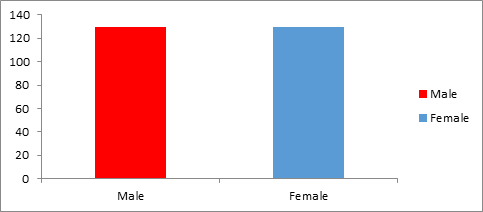
Figure 1 shows the number of subjects used for the study. Out of two hundred and sixty (260) subjects that participated in the study, 130 (50.0%) were males while 130 (50.0%) were females. Results showed that in the outer canthal distance, and inner canthal distance, the mean value in male was statistically significantly greater than in females (p<0.05) (Tables 1 & 2). From the study, it showed that in the canthal index, the mean value in male was statistically significantly greater than in females (p<0.05) (Table 3).
| Parameter | Group | Min | Max | Mean±SD | P-value |
|---|---|---|---|---|---|
| Outer canthal distance | Male | 120.2 | 124.9 | 122.79±0.79 | 0 |
| Female | 117.5 | 123.9 | 120.06±1.52 |
Table 1: Comparison of outer canthal distance between males and females.
Min=minimum; Max=maximum; SD= standard deviation. Table 1: Comparison of outer canthal distance between males and females.
| Parameter | Group | Min | Max | Mean±SD | P-value |
|---|---|---|---|---|---|
| Inner canthal distance | Male | 26 | 31.9 | 30.18±1.34 | 0 |
| Female | 20.1 | 25.9 | 21.93±1.40 |
Table 2: Comparison of inner canthal distance between males and females. Min=minimum; Max=maximum; SD= standard deviation
| Parameter | Group | Min | Max | Mean±SD | P-value |
|---|---|---|---|---|---|
| Canthal index | Male | 21 | 35.6 | 24.68±1.75 | 0 |
| Female | 16.4 | 21 | 18.22±1.18 |
Table 3: 3: Comparison of canthal index between males and females.
Min=minimum; Max=maximum; SD= standard deviation Table 4.3: Comparison of canthal index between males and females.
Discussion
The angle where the upper and lower eyelids converge is known as the canthus. The medial and lateral canthuses are referred to as the “inner canthus” and “outer canthus,” respectively. The canthal index (CI), which includes the inner canthal distance (ICD) and outer canthal distance (OCD), is a crucial part of craniofacial anthropometry. Anibor, et al. [5] state that measurements of the canthal distance have applications in reconstructive technologies as well as in the diagnosis of various systemic disorders. It facilitates the diagnosis of traumatic telecanthism, hypertelorism, and naso- orbitoethmoid damage [6].
Study results revealed sexual dimorphism in the population, which is consistent with earlier research on Yorubas and Hausa conducted by Yadav, et al. [15]. According to Cem, et al. [11] in Turkey, Turkish men had higher canthal indices, outer canthal distances, and inner canthal distances than females. In addition, Radha, et al. [16] conducted an anthropometric analysis of South Indians’ canthal distances and canthal index and found evidence of sexual dimorphism. Adhikari and Ambekar’s study also revealed a similar pattern [17]. Similar findings were obtained by Kingsley, et al. [18] in their study on canthal parameters among the Annang Tribe in Nigeria’s Akwa Ibom State. Males in the current study have greater values for the canthal index, outer canthal distance, and inner canthal distance than females. Once more, we were found to be substantially higher in every parameter. This study showed that the males have a higher mean value compared to the females in their canthal parameters of Owo population. This finding agrees with previous studies conducted by Oria, et al. [19], Ogoun, et al. [20], Abdallah, et al. [21] and Ehizokhale, et al. [22] Okoro, et al. [23], Okoro, et al. [24].
Conclusion
The results of the study indicate that genetics, environment, geography, gender, and ethnicity can all be factors in differences in a number of craniofacial anthropometry parameters. However, this research indicates that the males had larger canthal parameters than the females. The present investigation is extremely important to medical, forensic, and genetic anthropology. Canthal anthropometry, which serves as the foundation for typical data in Owo origin, can also benefit from it.
Source of Fund
Nil
Conflicts of Interest
Nil
References
-
Gilbert SJ, Weiner DE (2014) National kidney foundation primer on kidney diseases. Elsevier Inc, Boston, Massachusetts.
-
Dayal MR, Kuykeendali KL (2008) Stature estimation from bones of South Africans Whites. South-African Journal of Science 104: 124-128.
-
Scheuer L (2002) Application of osteology to forensic medicine. Clinical anatomy 15(3): 297-312.
-
Pryor HB (1969) Objective measurement of interpupillary distance. Paediatrics 44: 973-977.
-
Anibor E, Omokaro E, Ofere F (2024) Variations in canthal index of the Isokos in Delta state. Int J Basic applied Innovative Res 3(4): 143-146.
-
Egwu OA, Ewunonu EO, Eteudo AN, Ovuoba KN, Njoku CO (2008) Normal values of inner and outer intercanthal distances in a student population in Southeast Nigeria. Int J Biol Chem Sci 2(3): 355-358.
-
Adhikari N, Ambekar MN (2916) An anthropometric comparison of inner canthal distance, outer canthal distance and canthal index in the Indian and Nepalese undergraduate students of Nepalgunj Medical College. J Nepal Med Coll 14(2): 12-14.
-
Osunwoke EA, Elekwa A, Bob-Manuel IF, Ojeka SO (2010) A study on the normal values of inner canthal, outer canthal, canthal index, interpupillary distance and head circumference of 23 - 42 years Igbos. African Journal Online 9(182): 43-48.
-
Kasai K, Richards LC, Brown T (1993) Comparative study of Craniofacial Morphology in Japanese and Australian Aboriginal Populations. Human Biol 65: 821-834.
-
Oladipo GS, Olotu EJ, Gwurineama IU (2008) Anthropometric comparison of canthal indices between the Ijaw and Igbo tribes. Scientia Africana 7(1) 141-144.
-
Evereklioglu C, Yakinci C, Er H, Doganay S, Durmaz Y (2001) Normative values of craniofacial measurements in idiopathic benign microcephalic children. Cleft Palate Craniofac J 38(3): 260-263.
-
Wu KH, Tsai FJ, Li TC, Peng CT, Wang TR (2000) Normal values of inner –canthal distances, interpupillary distances and papebral fissure length on normal Chinese children in Taiwan. Acta Paediatrica Taiwanic 4(91): 22- 27.
-
Quant JR, Woo GC (1992) Normal values of eye position in the Chinese population of Hong Kong. Optom Vis Sci 69(2): 152-158.
-
Laestadius ND, Aese JM, Smith DW (1969) Normal inner canthal and outer dimension. J Pediatr 74(3): 465-468.
-
Yadav SK, Malla BK, Srivastaava AK, Kumar A (2019) Anatomical study of the canthal index: The morphometrical study. Journal of Kathmandu Medical College 8(3).
-
Radha K, Srinivasan KR (2021) Anthropometric Assessment of Canthal Distances and canthal Index of South Indian Region: A Cross-Sectional Study. Medico- legal Update 21(1).
-
Adhikari N, Ambekar MN (2018) An anthropometric comparison of inner canthal distance, outer canthal distance and canthal index in the Indian and Nepalese undergraduate students of Nepalgunj Medical College. J Nepal Med Coll 14(2): 12-14.
-
Kingsley AO, Eno-obong IB, Gabriel DE, Iboro EE, Okesina BA (2021) Craniofacial Morphometric Study of Annang Tribe in Akwa Ibom State, Nigeria. Asian Journal of Basic Science & Research 3(2): 24-33.
-
Oria RS, Enun CE, Bassey E, Osadim EM (2018) Evaluation of canthal dimensions among adults of Ejagham ethnic group in Cross river state, Nigeria. Asian Journal of Science and Technology 9(5): 8234-8236.
-
Ogoun TR, Tobias PS, Aye TT (2021) A Comparative Analysis of Canthal Index of Ekowe Indigenes, Bayelsa State. World Journal of Current Medical and Pharmaceutical Research 3(6): 157-159.
-
Abdallah S, Ali E, Osman M (2020) Ethnic comparison of inner and outer canthal distance among adult Sudanese. Open Journal of Stomatology 10: 189-198.
-
Ehizokhale ES, Godswill OO, Cynthia NI, Ernest EO (2023) Anthropometric Study of the Canthal Parameters among the Hausa and Yoruba Ethnic Groups in Nigeria. IJMRHS 12(5): 48-51.
-
Godswill OO, Mega OO, Udi OA, Igben Vincent-Junior IO, Owhefere OG (2023) Morphometric study of the asterion in adult dry human skulls of Nigerian origin. International Journal of Human and Health Sciences 7(1): 31-34.
-
Godswill OO, Nwaokoro IC, Owhefere OG, Felicia AT, Ebeye OA (2022) Stages of Epiphyseal Fusion at the Distal End of Radius and Ulna in Nigeria; A Radiological study. International Research in Medical and Health Sciences 5(5): 1-6.
- Pattern of Breast Lesions in Ovu Inland, Delta State, South Southern Nigeria
- Morphometric Analysis of the Human Femur: Exploring Platymetric and Robusticity Indices Among the Nigerian Population
- Anatomical Variation of Arteria Lusoria: Clinical Implications for Dysphagia Lusoria and Surgical Risk
- Morphometric Study of the Vertebral Body and Pedicle of Typical Cervical Vertebrae Using Radiological Image
- Epigenetic Mechanisms Driving Human Evolutionary Changes
- Neuroprotective Effects of Ginkgo Biloba Extract on Bilateral Common Carotid Artery Ischaemic Stroke Induced in Wistar Rat