
Biochemical Effects of the Saharan Myrtle
The first aim of this study is to evaluate the in vitro antimicrobial activity of the essential oil and two extracts of Saharan myrtle: Myrtus nivellei Batt & Trab. For this purpose, paper disc-diffusion method and micro-dilution test were used. As far as the antimicrobial activity is concerned the essential oil exhibited higher ones against S. epidermidis (MIC=0.28mg/ml), S. typhi (MIC=0.56mg/ml), E. coli (MIC=1.125mg/ml) and S. aureus (MIC=1.125mg/ml). However, the alcoholic extracts exhibited a good antimicrobial activity against S. aureus (MIC=2.25mg/ml) and C. albicans (MIC=4.5mg/ml). The samples were also subjected to screening for their possible free radical scavenging activity by using DPPH-test and β carotene-linoleic acid assays. In the first case, the free radical scavenging activity of ethanolic extract (IC50=0.59mg/ml),) was superior to the methanolic one (IC50=0.98mg/ml), while the oil was less effective. In the case of the linoleic acid system, oxidation of the linoleic acid was effectively inhibited by both the alcoholic extracts, but the ethanolic extract was the best with 93.5% inhibition, that is close to the synthetic antioxidant BHT used as positive control.
Introduction
In recent years, there has been a considerable interest on the secondary metabolites obtained from many plants which gained a big scientific interest. Many plants have been used for different purposes, such as food, drugs and perfumery [1]. Researchers have been interested in biologically active compounds isolated from plant species for the elimination of pathogenic microorganisms because of the resistance that microorganisms have built against antibiotics [2]. Since synthetic antimicrobial agents and food additives can cause a number of adverse effects, there is a growing interest from consumers in ingredients from natural sources. Medicinal plants, such as Myrtus nivellei Batt & Trab are a source of new compounds which can be used in both the food industry and for medical purposes. Myrtus nivellei is an endemic Saharan plant which grows in scattered populations, in rocky and sandy wades where subterranean water points exist, and generally at an altitude above 1800m [3]. It is a shrub up to 2m, with rough bark, leaves lanceolate, thick and linear (4 to 5cm), five white petals, indeterminate stamens and the fruits are black berries [4, 5]. It’s known under the names of “Tafeltest” in Tamahaq and “Raihane Essahara El Wousta” in Arabic. Very little is known about the phytochemistry Journal of Natural & Ayurvedic Medicine
and biological activities of Myrtus nivellei. To our knowledge there is only few papers reporting the phenolic compounds and its antioxidant activity and there is none about the potential activities of Myrtus nivellei essential oil and extracts [6, 7]. The aim of the paper is to consider the traditional medicinal uses and the lack of scientific studies on their biochemical activities, the present study was designed to elucidate both the antimicrobial and the antioxidative activities of its essential oil and alcoholic extracts.
Materials and Methods
Plant Material and Essential Oil Isolation
Aerial parts of Myrtus nivellei were collected in July 2016 during the flowering stage. Samples were isolated from plants harvested near Tamanrasset city (Hoggar massif, altitude: 1900 m, latitude: 22°38, longitude: 5°37). The myrtle was identified as Myrtus nivellei at the department of Botany INA-El Harrach (Algeria).samples of aerial parts (leaves and stems) of M. nivellei was submitted to hydrodistillation using a Clevenger type apparatus during 3h. The essential oil obtained was dried over anhydrous sodium sulfate, filtered, and stored in dark glass bottles at +4°C until use.
Fractionation of the Essential Oil
The GC/MS analysis was performed on an HP 5972 mass spectrometer (Agilent technologies, Palo Alto, California, USA) with electron impact ionization (70 eV). An HP-5MS capillary column (30m, 0.25mm coated with 5% phenyl methyl silicone, 95% dimethylpolysiloxane, 0.25µm film thickness) was used. Oven temperature was programmed to rise from 50 to 240°C at a rate of 5°C/min, transfer line temperature was 250°C. The carrier gas was Helium with a flow rate of 1.2 ml/min and a split ratio of 60:1. Scan time and mass range were 1 s and 40–300m/z, respectively. The identification of volatile components was assigned by comparison of their retention indices (RI) with those of literature or with those of authentic compounds available in the authors’ laboratory. Further identification was made by matching their recorded mass spectra with those stored in the Wiley/NBS mass spectral library of the GC/MS data system and other published mass spectra [8].
Preparation of Polar Extracts
A portion (100 g) of dried plant material was extracted with 1l of methanol (MeOH), in a Soxhlet apparatus, the solvent was evaporated using a vacuum evaporator [9]. The ethanolic extract was prepared by macerating 10g of dried plant material with 100ml of ethanol (EtOH) for 72h with intermittent shaking. The solvent was evaporated using a vacuum evaporator. The dry residues were stored until use.
Antimicrobial Activity
Microbial Strains: The essential oil and extracts were individually tested against a panel of microorganisms, including Staphylococcus aureus (ATCC 25923), Staphylococcus epidermidis (ATCC 12228), Streptococcus pneumoniae (ATCC 49619), Moraxella catarrhalis (ATCC 49143), Bacillus cereus (ATCC 11778), Acinetobacter lwoffii (ATCC 19002), Enterobacter aerogenes (ATCC 13043), Escherichia coli (ATCC 25922), Salmonella typhi (ATCC 4404540), Shigella flexineri (ATCC 25936), Klebsiella pneumoniae (ATCC 13883), Proteus mirabilis (ATCC 7002), Pseudomonas aeruginosa (ATCC 27853), Clostridium perfringens, Mycobacterium smegmatis (CMM 2067), Candida albicans (ATCC 10239) and Candida krusei (ATCC 6258). Bacterial strains were cultured overnight at 37°C in Mueller Hinton agar (MHA), with the exception of S. pneumoniae (MHA containing 50 ml citrate blood/l). Yeasts were cultured overnight at 30°C in Sabouraud dextrose agar. Antimicrobial Screening: Two different methods were employed for the determination of antimicrobial activities: agar well-diffusion method for the extracts and disc diffusion method for the essential oil [10]. The MICs of the essential oil and the alcoholic extracts against the test microorganisms were determined by the broth micro-dilution method [11]. All tests were performed in triplicate. Disc Diffusion Method: The agar disc diffusion method was employed for the determination of antimicrobial activities of the essential oil in question [11]. Briefly, a suspension of the tested microorganism (0.1 ml of 108 cells/ml) was spread on the solid media plates. Filter paper discs (6 mm in diameter) were impregnated with 15 μl of the oil and placed on the inoculated plates. These plates were incubated at 37°C for 24 h for bacteria and, at 30°C for 48 h, for yeasts. The diameters of the inhibition zones were measured in millimetres. All tests were performed in triplicate. Determination of Minimum Inhibitory Concentration: A broth micro-dilution assay was used, as recommended by NCCLS, for the determination of the MIC [10]. All tests were performed in Mueller Hinton Broth (MHB; BBL)
Journal of Natural & Ayurvedic Medicine
supplemented with Tween 80 detergent (final concentration of 0.5% (v/v), with the exception of the yeasts (Sabouraud dextrose broth-SDB + Tween 80). Bacterial strains were cultured overnight at 37°C in MHB and the yeasts were cultured overnight at 30°C in SDB. Test strains were suspended in MHB to give a final density of 5 × 10⁵ cfu/ml and these were confirmed by viable counts. Geometric dilutions, ranging from 0.036 to 72.0 mg/ml of the essential oil and the alcoholic extracts were prepared in a 96-well microtitre plate, including one growth control (MHB + Tween 80) and one sterility control (MHB + Tween 80 + test oil). Plates were incubated under normal atmospheric conditions, at 37°C for 24 h for bacteria, and at 30°C for 48 h for yeasts. The bacterial growth was indicated by the presence of a white “pellet” on the well bottom.
Assay for Total Phenolics Amount
Total phenolic constituents of the two extracts were determined by the literature methods involving the Folin– Ciocalteu reagent and gallic acid as standard [12]. 100µl of extract solution, containing 1mg extract, was taken in a volumetric flask, 46 ml distilled water and 1 ml Folin- Ciocalteu reagent was added, and the flask was shaken thoroughly. After 3 min, 3 ml of a solution of 2% Na2CO3 were added and the mixture was allowed to stand for 2h with intermittent shaking. Absorbance was measured at 760 nm. The same procedure was repeated for all standard gallic acid solutions.
Antioxidant Activity
DPPH Assay: The hydrogen atom or electron donation abilities of the corresponding extracts and some pure compounds were measured from the bleaching of the purple-coloured methanol solution of 2,2′- diphenylpicrylhydrazyl (DPPH). This spectrophotometric assay uses the stable radical DPPH as a reagent [13]. Fifty microlitre of various concentrations of the extracts in methanol were added to 5 ml of a 0.004% methanol solution of DPPH. After a 30 min incubation period at room temperature, the absorbance was read against a blank at 517 nm. Inhibition of free radical by DPPH in percent (I%) was calculated in following way:
𝐼% = [(𝐴𝑏𝑙𝑎𝑛𝑘−𝐴𝑠𝑎𝑚𝑝𝑙𝑒)/𝐴𝑏𝑙𝑎𝑛𝑘 ]𝑥100 Where A_blank is the absorbance of the control reaction (containing all reagents except the test compound), and _A_sample is the absorbance of the test compound. Extract concentration providing 50% inhibition (IC50) was calculated from the plot of inhibition percentage against extract concentration. Tests were carried out in triplicate. β_-Carotene-linoleic acid assay: In this assay, antioxidant capacity is determined by measuring the inhibition of the volatile organic compounds and the conjugated diene hydroperoxides arising from linoleic acid oxidation [14]. A stock solution of β-carotene-linoleic acid mixture was prepared as follows: 0.5 mg β-carotene was dissolved in 1 ml of chloroform (HPLC grade) and 25 μl linoleic acid and 200 mg Tween 40 were added. Chloroform was completely evaporated using a vacuum evaporator. Then, 100 ml distilled water saturated with oxygen (30 min 100 ml/min) were added with vigorous shaking. 2.5ml of this reaction mixture were dispensed into test tubes and 350 μl portions of the extracts, prepared at 1 g/l concentrations, were added and the emulsion system was incubated for 48 h at room temperature. The same procedure was repeated with synthetic antioxidant, BHT, as positive control, and a blank. After this incubation period, absorbances of the mixtures were measured at 490 nm. Antioxidative capacities of the extracts were compared with those of BHT and blank.
Results and Discussion
Chemical Composition of the Essential Oil
About 32 compounds, representing 99.821% of the essential oil (EO), were identified. GC/MS analyses revealed that the major constituents of the oil were δ- elemene (15,687%), ρ-menthenol (12.945%), Eucalyptol (12.062%) and β-Citral (7.762%) as listed in Table 1.
| N° | Rt* (min) | Components | Percentage (%) | ||||||||
| 1 | 2.85 | 3-Pentanone | 0.026 | ||||||||
| 2 | 6.35 | α-pinene | 1.268 | ||||||||
| 3 | 11.07 | Eucalyptol | 12.062 | ||||||||
| 4 | 12.43 | Trans-linalyl | 0.054 | ||||||||
| 5 | 13.13 | Benzen, methyl(1-methylethenyl | 0.13 | ||||||||
| 6 | 14.16 | 1,6-octadien-3-ol, 3,7-dimethyl | 2.415 | ||||||||
| 7 | 16.13 | carène | 0.336 | ||||||||
| 8 | 17.98 | Terpinen-4-ol | 0.239 | ||||||||
| 3-cyclohexen-1-ol, 4-methyl-1-(1- | |||||||||||
| 9 | 18.41 | 0.274 | |||||||||
| methylethyl) | |||||||||||
| 10 | 20.34 | α-Terpineol | 6.455 | ||||||||
| 11 | 21.44 | ρ-menthenol | 12.945 | ||||||||
| 12 | 27.78 | linalool | 0.527 | ||||||||
| 13 | 30.27 | δ elemene | 15,687 | ||||||||
| 14 | 32.53 | β- Citral | 7.762 | ||||||||
| 15 | 33.31 | α- Citral | 3.902 | ||||||||
| 16 | 33.69 | Benzendimethoxy-4-propenyl | 0.903 | ||||||||
| 17 | 33.94 | Bicyclonone,2-methylene | 0.722 | ||||||||
| 18 | 34.77 | 1-Tetradecyl acetate | 1.257 | ||||||||
| 19 | 35.68 | cycloundecatriene | 1.702 | ||||||||
| 20 | 36.55 | 1,4-Benzenediamine | 2.39 | ||||||||
| 21 | 37.13 | Ermophylene | 0.46 | ||||||||
| 22 | 38.66 | 1,2-Benzenediol,3,5-Dimethylethyl | 5.361 | ||||||||
| 23 | 39.16 | α-Farnesene | 2.508 | ||||||||
| 24 | 40.99 | 1,6- Dodecatriene-3-ol | 0.936 | ||||||||
| 25 | 41.43 | Quinoline | 5.613 | ||||||||
| 26 | 43.16 | azulene | 6.182 | ||||||||
| 27 | 43.57 | Alpha patcoulène | 2.873 | ||||||||
| 28 | 44.58 | Bulnesol | 3.049 | ||||||||
| 29 | 47.36 | 3-Oxabicycloheptan-2-one | 0.062 | ||||||||
| 30 | 47.74 | dodecatriene | 0.157 | ||||||||
| 31 | 48.73 | Nonadecane | 0.086 | ||||||||
| 32 | 49.5 | Isophytol | 1.748 | ||||||||
| TOTAL | 99.82% |
Journal of Natural & Ayurvedic Medicine
Table1: Components of the essential oil isolated from aerial parts of M. nivellei. * Retention time (as minutes). Various oxygenated monoterpenes were present at appreciable contents: eucalyptol: 12.062%, α-terpineol: 6.455% and bulnesol: 3.049%. The sesquiterpenes are also represented by δ-elemene: 15.687%, azulene: 6.182%, α-patcoulene: 2.873% of the whole composition. The chemical profile of this EO should be classified in the chemo type group of δ-elemene/ ρ-menthenol. However, this chemical composition differs from the EO of M. nivellei harvested in Tassili N’ajjer, reported in previous studies [15, 7]. However, the chemical composition of this EO differs also from the various compositions of EOs isolated from Myrtus communis growing wild all around the Mediterranean basin [15, 3, 16]. It could be due to a number of factors, including the geo-climatic locations and growing conditions, including concentration of nutrients, temperature, humidity, soil type, day length, climate, altitude, amount of available water, ect. The chemical composition also depends on season or vegetative period of plant. According to these factors, plant biosynthetic pathways can change the relative proportion of the primary oil components. These variations in chemical composition led to the notion of chemotypes, which are generally defined as a distinct population within the same species that produces different chemical profiles for a particular class of secondary metabolites [17]. Thus, the same species of plant can produce a similar essential oil, but with different chemical composition and therapeutic activities. Essential oil composition also depends on the plant parts used for oil preparation.
Antimicrobial Activity
As can be seen in Table 2, EO exhibit strong antimicrobial activity, especially against S. epidermidis (43.00±1.13) and S. typhi (24.00±1.30), it didn’t exhibit any antimicrobial activity against four microorganisms (M. catarrhalis, A. iwoffii, E. aerogenes and C. krusei). However this activity was moderate for the other strains. The alcoholic extracts were found to have a good activity against S. epidermidis, S. pneumoniae, E. coli, S. Typhi and S. Flexineri, especially against S.aureus. Five strains (M. catarrhalis, A. iwoffii, K. pneumonia, P. mirabilis and C. perfrengens) were resistant to these extracts.
| Diameter of inhibition zone (mm)* | ||||||||||
|---|---|---|---|---|---|---|---|---|---|---|
| Microorganisms | Extracts | |||||||||
| EO | MIC* | MeOH | MIC | EtOH | MIC | |||||
| Staphylococcus aureus | 20.67±1.30 | 1.125 | 19.33±3.63 | 2.25 | 19.00±2.99 | 2.25 | ||||
| Staphylococcus epidermidis | 34.00±1.13 | 0.28 | 13.67±1.72 | 18 | 14.60±1.30 | 9 | ||||
| Streptococcus pneumoniae | 14.67±0.50 | 9 | 15.33±0.33 | 4.5 | 13.33±0.65 | 18 | ||||
| Moraxella catarrhalis | NA* | - | NA | - | NA | - | ||||
| Bacillus cereus | 13.50±1.13 | 18 | 11.00±0.32 | 36 | 12.50±0.50 | 36 | ||||
| Acinetobacter iwoffii | NA | - | NA | - | NA | - | ||||
| Enterobacter aerogenes | NA | - | 11.37±2.35 | 36 | 11.67±1.20 | 36 | ||||
| Escherichia coli | 20.66±0.65 | 1.125 | 16.00±1.72 | 4.5 | 14.50±0.24 | 9 | ||||
| Salmonella typhi | 24.00±1.30 | 0.56 | 17.33±0.47 | 4.5 | 14.33±2.35 | 18 | ||||
| Shigella flexineri | 16.00±1.13 | 4.5 | 17.67±0.65 | 4.5 | 13.50±1.13 | 18 | ||||
| Enterococcus phaecalis | 19.33±1.30 | 2.25 | 11.67±1.35 | 36 | 11.33±1.72 | 36 | ||||
| Klebsiella pneumoniae | 12.50±0.20 | 36 | NA | - | NA | - | ||||
| Proteus mirabilis | 13.00±0.62 | 18 | NA | - | NA | - | ||||
| Pseudomonas aerogenosa | 15.33±0.65 | 4.5 | 11.33±0.65 | 36 | 11.00±1.13 | 36 | ||||
| Clostridium perfrengens | 13.00±0.50 | 18 | NA | - | NA | - | ||||
| Mycobacterium smegmatis | 14.00±1.67 | 9 | 10.00±2.61 | 72 | 11.00±0.56 | 36 | ||||
| Candida albicans | 17.00±1.96 | 4.5 | 17.66±0.65 | 4.5 | 15.00±1.20 | 4.5 | ||||
| Candida krusei | NA | - | 12.33±0.24 | 36 | 12.00±0.20 | 36 |
Table 2: Antimicrobial activity of various extracts of M.
Table 2: Antimicrobial activity of various extracts of M. Nivellei using agar well diffusion and MIC methods. NA: not active *Diameter on inhibition zone including well diameter of 9mm. MIC: Minimun Inhibitory Concentration, values given as mg/ml for the essential oil and the alcoholic extracts. Results obtained from disc diffusion method, followed by measurements of MIC, indicate that S. epidermidis, is the most sensitive microorganism tested, with the lowest MIC values (0.07 mg/ml) in the presence of the EO of M. nivellei (Table 2). S.aureus, S. Typhi, C. albicans and E. phaecalis were other sensitive ones against the oil with Journal of Natural & Ayurvedic Medicine
MICs values included between 0.28 and 2.25mg/ml. A moderate activity was observed against three gram- negative microorganisms (E. coli, P. mirabilis and P. aeruginosa) known for their resistance to many antibiotics.As far as our literature survey could ascertain, there was only two reports on the antifungal activity of the EO of M. nivellei. As far as this report is concerned, a moderate antifungal activity was observed against some yeasts and dermatophytes including C. albicans and C. krusei [15]. These results support the use of this species in traditional medicine for the treatment of dermatophytosis. Moreover, moderate activities of the alcoholic extracts could also be attributed to the presence of several types of compounds belonging to different classes, such as sterols and their derivatives, flavones and flavonoids in dichloromethane extract and more polar thermolabile and/or thermo-stable phenolics in the hydrophobic subfractions of methanol extract [18, 19].
Amount of Total Phenolics
The determination of the total phenolic amount is based on the absorbance values of the various extracts analysed, reacting with Folin–Ciocalteu reagent and compared with the standard solutions of gallic acid equivalents, as described above, results of the colorimetric analysis of total phenolics are given in Table 3. Total phenolics was highest in the ethanolic extract (784,3 µg eq/mg), followed by the methanolic extract (398,3 µg eq/mg).The lowest amount of total phenolics was recorded in the essential oil (95.4 µg eq/mg). These results agree with those of the DPPH test, the highest amount of total phenolics in the ethanolic extract exibits an important free radical scavenging activity.
| Total phenolic amount(µg | |||||
|---|---|---|---|---|---|
| Extracts | |||||
| eq/mg) | |||||
| EO | 95.4a±0.458b | ||||
| Methanolic extract (MeOH) | 398,3±0,425 | ||||
| Ethanolic extract (EtOH) | 784,3±0,167 |
Table 3: Amounts of total phenolic compounds in _M._ _nivellei._
aValues are the mean of three replicates bStandard derivation
Antioxidant Activity
The essential oil and the alcoholic extracts were subjected to screening for their possible antioxidative activity. Three positive controls were used (Vitamin C, Quercetione and Vitamin E). Complementary test systems, namely DPPH free radical scavenging and β- carotene/linoleic acid systems were evaluated. Free radical scavenging capacities of the extracts, measured by DPPH assay, are shown in Fig.1. The reaction followed a concentration-dependent pattern. The free radical scavenging activity of ethanolic extract (IC50=0.59mg/ml) was superior to methanolic extract (IC50=0.98mg/ml). Polar extracts exhibited stronger free radical scavenging activity than the EO of M. nivellei (IC50= 12.06mg/ml).
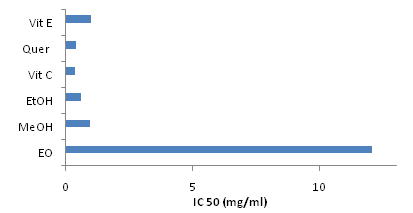
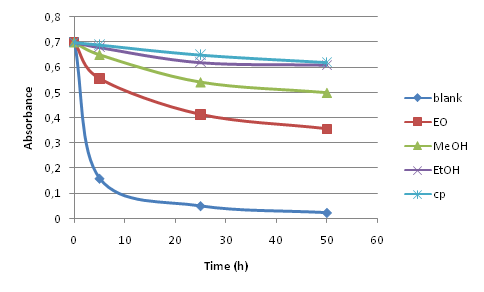
Figure1: Free radical scavenging of the extracts measured in DPPH essay. The ethanolic extract is more effective than Vitamin E but still less than Vitamin C and Quercetine used as positive controls. Activity should be related to its phenolic content. In the β-carotene/linoleic acid system, oxidation of linoleic acid was effectively inhibited by the ethanolic extract (Figure 2) while the oil was less effective. MW extract shows 93.5% inhibition that is close to the synthetic antioxidant reagent BHT. Antioxidants minimize the oxidation of lipid components in cell membranes or inhibit the volatile organic compounds and the conjugated diene hydroperoxides, arising from linoleic acid oxidation, that are known to be carcinogenic. Alcoholic extracts exhibited stronger activity than essential oil, indicating that polyphenols or flavanones and flavonoids may also play important roles in the activity [3]. .
Journal of Natural & Ayurvedic Medicine
Conclusion
This paper reported the antimicrobial and the antioxidative activity of the essential oil and polar extracts isolated from Myrtus nivellei growing wild in Hoggar mountains. δ-elemene and ρ-menthenol were the major components. The polar extracts exhibit high amounts of polyphenolics. The resultants demonstrate the efficacy of both the essential oil and the extracts against many bacteria and yeasts. These results demonstrate the efficacy and safety of Myrtus nivellei and support its use by the Touaregs in Saharan traditional medicine. The extracts were also potentially rich in polyphenolic compounds and could be considered as a very important source of natural components used to eradicate free radicals responsible of many diseases. Similarly, it would be interesting to consider the use of these natural resources to replace synthetic antioxidants widely used in food and pharmaceutical industry.
References
-
Heath, Henry B (1981) Source Book of Flavours. Westport: Avi pp: 890.
-
Essawi T, Srour M (2000) Screening of some Palestinian medicinal plants for antibacterial activity. J Ethnopharmacol 70(3): 343-349.
-
Touaibia M (2011) Contribution à l’etude de deux plantes medicinales: _Myrtus communis_ L et _Myrtus_ _nivellei_ Batt & Trab. Obtenus in situ et in vitro. These de magister. Saad Dahleb university. Algeria, pp: 221.
-
Battandier JP, Trabut L (1911) Contribution à la flore du pays desTouaregs, Bulletin de la Société Botanique de France.
-
Ozenda P (2004) 3rd (Edn.), Flore et végétation du Sahara, CNRS, Paris, pp: 662.
-
Rached W, Benamar H, Bennaceur M, Marouf A (2010) Screening of the antioxidant potential of some Algerian Indigenous plants. Journal of Biological Sciences 10(4): 316-324.
-
Touaibia M, Chaouch FZ, Chaouia C, Hamida Cherif (2014) Caractérisation phytochimique de l'espèce saharo-endémique _Myrtus nivellei_ Batt & Trab (Myrtaceae). Algerian Journal of Natural Products 2(1): 27-34.
-
Adams RP (2007) 4th (Edn.), Identification of essential oil components by Gas Chromatography/Mass Spectrometry, Allured Publishing Corporation, Carol Stream, IL, USA, pp: 804
-
William BJ (2007) The original of the soxhlet extractor. J chemical education 84(12): 1913-1915.
-
NCCLS (National Committee for Clinical Laboratory Standards) (1999) Performance standards for antimicrobial susceptibility testing. 9th International Supplement. M100-S9, Wayne, PA.
-
NCCLS (National Committee for Clinical Laboratory Standards) (1997) Performance standards for antimicrobial disk susceptibility test. 6th ed. Approved Standard. M2-A6, Wayne, PA.
-
Slinkard K, Singleton VL (1977) Total phenol analysis: automation and comparison with manual methods. American Journal of Enology and Viticulture 28: 49- 55.
-
Burits M, Bucar F (2000) Antioxidant activity of _Nigella sativa_ essential oil. Phytother Res 14(5): 323- 328.
-
Dapkevicius A, Venskutonis R, Van Beek TA, Linssen PH (1998) Antioxidant activity of extracts obtained by different isolation procedures from some aromatic herbs grown in Lithuania. Journal of Science Food and Agriculture 77(1): 140-146.
-
Bouzabata A, Bazzali O, Cabral C, Gonçalves MJ, Cruz MT, et al. (2013) New compounds, chemical composition, antifungal activity and cytotoxicity of Journal of Natural & Ayurvedic Medicine the essential oil from _Myrtus nivellei_ Batt. & Trab., an endemic species of Central Sahara. J Ethnopharmacology 149(3): 613-620.
-
Bazzali O, Tomi F, Casanova J, Bighelli A (2012) Occurrence of C8-C10 esters in Mediterranean _Myrtus_ _communis_ L. leaf essential oil. Flavour and Fragrance Journal 27(5): 335-340.
-
Djilani A, Dicko A (2012) The therapeutic benefits of essential oils. In: Bouayed J, (Ed.) Nutrition, well- being and health. In Tech pp: 155-178.
-
Guillen MD, Manzanos MJ (1998) Composition of the extract in dichloromethane of the aerial parts of a Spanish wild growing plant _Thymus vulgaris_ L. Flavour and Fragrance Journal 13(4): 259-262.
-
Sokmen A, Jones BM, Erturk M (1999) The in vitro antibacterial activity of Turkish medicinal plants. J Ethnopharmacol 67(1): 79-86.
- Management of Ear Keloid with Ksharsutra: A Case Study
- Yoga and Global Sustainability: A Holistic Path to One Earth, One Health
- Autoimmune Diseases in Ayurveda: A Narrative Review with Classical and Modern Perspectives
- Management of Cluster Headache Associated with Pituitary Apophysitis by CERT (Chakrasiddh Energy Release Technique): A Case Report on Energy Rebalancing
- Zygophyllum Geslini Coss : Biochemicals and Antioxidant Activity
- Observations of a Beginner Vaidya