
Antimicrobial Properties of Ethanolic Leaf Extract of Lantana camara (L) and its Effect on the Powdery Mildew of Coccinia grandis (L)
The growing population of human beings is demanding more food from the land under cultivation. It means that the cultivators use better varieties which will give higher yields per unit land. Secondly it has become a practice to do Integrated Disease Management to protect the crop from many diseases (especially of fungal origin). Synthetic chemicals are no doubt being used for this purpose, but these pose a threat to the biodiversity of the environment by their residual effect. Scientist is now looking at biological alternative for this purpose. One such disease is the mildew on various vegetable, fruit and flowering plants. These are very difficult to manage once these are seen. These diseases spread like wild fire and put the plant under severe stress by reducing their photosynthetic activities. One such weed – Lantana camara (L) has been studied for its antimicrobial properties. Methodology: The leaves of the plant were collected and dried in shade. These were pulverized and then extracted in deionized water and ethanol. The anti-microbial properties were studied using the agar well method. Finally field trials were carried out by spraying the extracts on infected leaves. Results: The ethanolic extracts showed marked antifungal properties against Aspergillus niger and Rhizopus oryzea whereas the aqueous extract were showing some anti-bacterial properties. The field trials showed that the ethanolic extract could clear more than 50% of the leaf surface with improved photosynthesis. Conclusion: The leaf extract of Lantana camara has the potential to be used as an anti-fungal agent against diseases like powdery mildew.
Introduction
Nature has existed as a source of almost all drugs for many years and natural products were the only source of medicine for mankind ever since the ancient period. Herb based products play an important role in primary human healthcare as the majority (80%) of the global population relies on traditional medical practices. Most of the modern drugs are derived either from plant sources or from their derivatives for various therapeutic uses and are extensively used in the pharma industry. In addition to the prevailing health problems, emerging infectious diseases and disorders have seriously caused the world population to suffer with a high mortality rate. It is reported that about 50% of all fatality occurring in tropic countries is mainly due to the current infectious diseases [1]. Recent surveys prove it to be the second major cause of death worldwide and third major reason in developed countries.
One of the major therapeutic agents used in modern medicines are different antibiotics (either semi synthetic or synthetic) to treat microbial diseases. Today clinicians are faced with a big problem of handling microbes which are resistant to many of these antibiotics. This is serious problem in developing countries but is spreading like a wild fire in developed nations. Such a situations has led to discovery of newer drug molecules (mostly synthetic or semisynthetic) to cope with the rapid development of One major limitation of efficacy of antibiotics is development of resistance in microbes and this resistance is spreading all over the world. As a result cases of therapy failure are increasing. Likewise increasing costs is another limitation to the use of most modern antibiotics [2]. Some medicinal plants known to owe their curative potential to certain biologically active substances which exist in part of plant [3]. Medicinal plant represent an important source of medicinally important compounds, in last few decades, many of traditionally known plants have been extensively studied by advanced scientific techniques and reported for various medicinal properties viz. anticancer activity, anti-inflammatory activity, anti-diabetic activity, antibacterial activity, antifungal activity, anti-oxidant activity, hepatoprotective activity, larvicidal activity, etc [4]. These reports indicate possible use of plants for the development of new therapeutic compounds [5].
A similar situation exists in agriculture, with respect to crop diseases. The most common type of pathogen responsible for many of the major crop diseases, the world over are the ones cause by different fungi. In order to save the crop yield the cultivators apply different fungicides which are mostly synthetic in nature. In many nations the government subsidizes the cost of thse to the farmers, by recovering it ever rising cost from the other tax-payers. More than the cost of the fungicides, the residual concentrations have proved to be highly ecotoxic where in these have shown significant health hazardous effect on other non-target members of the biodiverse system. This again is due to indiscriminate and non prescriptional methods of application (by expecting rapid and short term results).This too has lead to the development of resistant strain in pathogen populations. One of the methods to overcome such problems is to find better specific fungicides (which will not act on non- target organisms) and yet be effective in disease management. The only alternative is the biologically active substances have been reported to be present in various plants. Some of these plant derived substances have recently become of great interest owing to their versatile applications as they also show significant pesticide activity. Active constituents of the medicinal and aromatic plants have been found to be less phytotoxic, more systemic and easily biodegradable [6]. Lantana camara Linn is medicinal plants that belongs to the family verbenaceae and occur in most part of the world as an evergreen notorious weed species. In some parts of the world it is all considered as ornamental garden plant [1].
It is an important ethanomedicinal plant with several medicinal properties and used widely traditional medicinal system to cure a variety of disease viz. influenza, cough, mumps, incessant high fever, malaria, cervical lymphnode tuberculosis, dermatitis, eczema, prutitus, rheumatism, sprain, wound, contusions, tetanus, toothaches, ulcer and swelling. In the last decade Lantana camara has been extensively studied for its medicinal properties by scientific methods [2].
Materials and Methods
Collection of Plant Material
Lantana camara Linn plant was collected from local area of Sangli city and authentication was done by one of the botanists of our institute - Dr. S. S. Wadkar.
Preparation of Plant Extract
Plant leaves were collected, washed with, dried in shade to prevent degradation of any bioactive components in plants due to sunlight, and stored for bioassay and phytochemical analysis. The dried leaves were ground into the fine powder and used for further use [7].
Aqueous extract
Aqueous plant extract were prepared by cold maceration method. 10g of dried plant part of, *Lantana camera* L was added to 100 ml of distilled water and were shaken on an orbital shaker for 6 days. The extracts were centrifuged and the supernatants were concentrated by evaporation in water bath at 40-50°C. The extracts were stored in refrigerator at 4°C for further use to detect antifungal activity [3].
Ethanol extract
Ethanol extract were prepared by Soxhlet extract method as described by Lique de Castro and Garcia Ayuso [8]. In this method, 10gm of powder sample were extracted with 100ml of ethanol at 78.5°C for 7 to 8 hours. This was dried for 3 days at 3 days [7].
Organisms Used
Two Gram positive and Gram negative bacteria were used:
Gram positive bacterial strains
- *Bacillus subtilis* NCIM5433
- *Staphylococcus aureus* NCIM 5257
Gram negative bacterial strains
- *Escherichia coli*
- *Pseudomonas aeruginosa*
Two fungal strains were used as follows
- *Aspergillus niger* NCIM1317
- *Rhizopus oryzae*
Culture Preparation
For antibacterial activity cultures were grown on nutrient agar media at 37°C for 24 hours and for antifungal activity cultures were grown on Sabourauds Dextrose Agar (SDA) media at 37°C for 2-3 days and maintained at 4°C on respective slant. The cultures were subcultured at monthly intervals. The organisms from culture were suspended in saline and these suspensions were used to inoculate the plate. [2, 3]
Preliminary Phytochemical Analysis
The preliminary phytochemical screening was followed by medicinal chemistry:
Tests for tannins and phenolic compounds: About 0.5 g of the dried powdered sample was boiled in 20 ml of water in a test tube and then filtered. A few drops of 0.1% FeCl₃ was added and observed for brownish green and blue black coloration.
Test for alkaloids
• *Dragendroff’s Test*: To 2 mg of ethanol extract 5ml of distilled water is added, 2ml HCl was added until an acid reaction occurred. To this 1ml of Dragendroff’s reagent was added. Formation of orange or orange red precipitate indicated the presence of alkaloid.
Test for detection of terpenoids
• *Salkowski Test*: 5 ml of each extract was mixed in 2 ml of chloroform, and concentrated H₂SO₄ (3 ml) was carefully added to form a layer. A reddish brown coloration of the inter face was formed to show positive results for the presence of terpenoids.
Tests for saponins
About 2 g of the powdered sample was boiled in 20 ml of distilled water in a water bath and was filtered. 10ml of the filtrate was mixed with 5 ml of distilled water and shaken vigorously for a stable persistent froth formation. The frothing was mixed with 3drops of olive oil and shaken vigorously, then observed for the formation of emulsion.
Tests for Flavonoids
Three methods were used to determine the presence of flavonoids in the plant sample. 5 ml of dilute Ammonia solution was added to a portion of the aqueous filtrate of each plant extract followed by addition of concentrated H₂SO₄. A yellow coloration observed in each extract indicated the presence of flavonoids. The yellow coloration disappeared on standing.
Tests for Phlobatanins
Aqueous and alcoholic extract of plant material was boiled with 1% aqueous HCL. The sample was observed for the formation of red precipitate which indicates the presence of phlobatanins.
Test for Phytosterols
50 mg of extract was dissolved in 2 ml of acetic anhydride, to this few drops of concentrated sulphuric acid was added slowly along the sides of the test tubes. An array of color changes showed the presence of phytosterols [5].
Determination of Antifungal and Antibacterial Activity
The antifungal and antibacterial screening was done by agar well diffusion method. Plant extracts were dissolved in ethanol for ethanol extract and then aqueous and ethanol plant extracts with different concentration were prepared. Sabouraud’s Dextrose Agar (SDA) for fungus and nutrient agar for bacteria were used for the agar well diffusion method. The culture medium was inoculated with the respective strains. A total of 8 mm diameter wells were punched into the agar and filled with plant extracts and solvent blanks (Distilled water and ethanol). This is followed by incubation of fungal plate’s at 30°C for 72 h and bacterial plates at 37°C for 24 hrs. The diameters of zone of inhibition observed were measured [3].
Statistical analysis
All the analysis was carried out in triplicate except in certain cases where it has been carried out 5 times to get reproducible results. The results show p<0.5.
Result and Discussion
Phytochemical Analysis
Preliminary phytochemical analysis of aqueous and ethanol extract of Lantana camara revealed the presence of tannins and phenolic compounds, terpenoids, phlobatannins, phytosterol, alkaloid and flavonoids in extract. The antifungal or antibacterial activity of Lantana camara can be attributed to the action of phytochemicals it contains. These are present in plants after extracting with the appropriate solvent as shown in Table 1
| Phytochemicals | Extract | |||||
|---|---|---|---|---|---|---|
| Aqueous | Ethanol | |||||
| extract | extract | |||||
| Tannins & phenolic compounds | + | + | ||||
| Terpenoids | + | + | ||||
| Phlobatannins | + | + | ||||
| Phytosterol | - | + | ||||
| Alkaoids | - | + | ||||
| Flavonoids | + | + |
Table 2: Presence or absence of different phytochemicals in extracts of _Lantana camara._ + = present, - = absent The table shows
Table 1: Presence or absence of different phytochemicals in extracts of Lantana camara. + = present, - = absent The table shows the presence of various phytochemicals in aqueous and ethanol extract except phytosterol and alkaloid was found to be absent in aqueous extract. In similar study performed by Das, et al. on phytochemical and antifungal analysis of methanol, ethanol and aqueous extracts of Lantana camara showed the presence of tannins, glycosides, terpenoids, saponins, flavonoids, alkaloids, and phlobtannins etc [3]. In this study phytosterol was obtained only in ethanol extract. Detection of saponin and glycoside were not carried out. The ethanol extract showed the presence of all the phytochemicals.
Antifungal activity
For antifungal screening two types of fungal strains were used viz. Aspergillus niger and Rhizopus oryzae. The result of antifungal screening of plant leaves revealed that both the aqueous and ethanol showed prominent antifungal activity as shown in Table 2.
| Organism | Extract (mg/ml) | Diameter of zone of inhibition(mm) | |||
|---|---|---|---|---|---|
| Aqueous extract | Ethanol extract | ||||
| Aspergillus niger | - | 10 | 10 | ||
| Rhizopus oryzae | 100 | - | 13 |
Table 1: Zone of inhibition of the fungal strains by the extracts of _Lantana Camara_.
Ethanol extract of plant showed antifungal activity against Aspergillus niger while aqueous extract showed zone of inhibition against Rhizopus oryzae and there was no effect of aqueous extract on Aspergillus niger. Inampudi found the antifungal activity of some wild plant extract including Lantana camara against certain fungal pathogens [7].
In this investigation observed that ethanol extract showed a zone of 10mm diameter against Aspergillus niger at 10 mg/ml concentration. The same was not true against Rhizopus oryzae. While the aqueous extract of plant showed the inhibition potential against Rhizopus oryzae at 100 mg/ml concentration and diameter of zone of inhibition obtained was 13 mm. These results revealed that Lantana camara plant possesses antifungal activity against Aspergillus niger and Rhizopus oryzae.
Antibacterial Activity
Antibacterial screening was carried out using two Gram positive organisms viz. Bacillus subtilis and Staphylococcus aureus and two Gram negative organisms viz. Escherichia coli and Pseudomonas aeruginosa. The result of antibacterial screening revealed that only ethanol extract had antibacterial activity as shown in Table 3.
| Organisms | Extract concentration (mg/ml) | Zone of inhibition (mm) | ||||||||||
|---|---|---|---|---|---|---|---|---|---|---|---|---|
| Aqueous | Ethanol | Aqueous | Ethanol | |||||||||
| Bacillus subtilis | 150 | 10 | - | 11 | ||||||||
| 200 | 12 | - | 12 | |||||||||
| 250 | 14 | - | 13 | |||||||||
| Staphylococcus aureus | 150 | 10 | - | 9 | ||||||||
| 200 | 12 | - | 10 | |||||||||
| 250 | 14 | - | 11 |
Table 3: This shows the antibacterial activity of the extracts of Lantana camara.
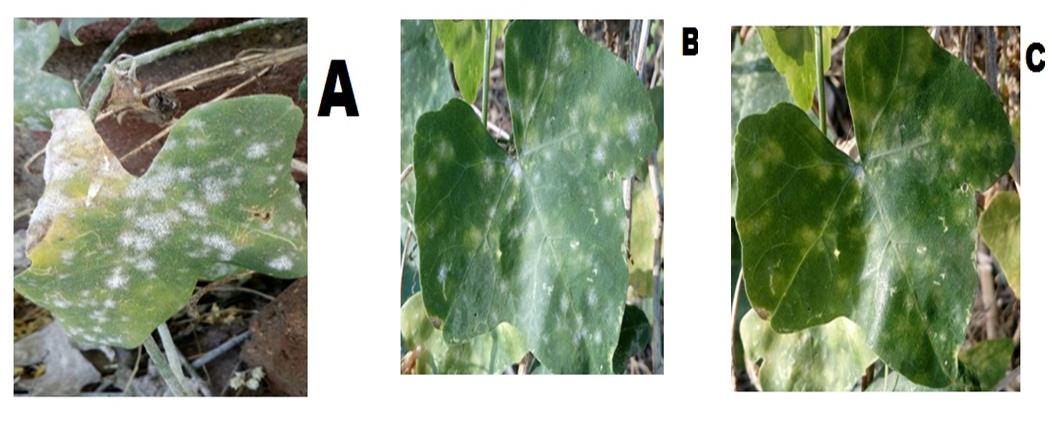
Field trials were conducted for analysis of antifungal activity. The ethanol extract of Lantana camara leaves were sprayed on plant Coccinia grandis which was infected with fungus Erysiphe cichoracearum.
After one week the surprising results were obtained as shown in below Figure 1:
Conclusion
It can be concluded from the above observation that the ethanolic extract of the leaves of Lantana camara was very active against the fungi Erysiphae cichoracearum causing powery mildew of leaves of Coccinia grandis. The decision to use it in such a field trial was based on the observation of the extract being strong antifungal when it inhibited fungi like Aspergillus niger and Rhizopus oryzae. Such an extract when used as a preventive measure has the potential to prevent the disease at all. It was found that, ethanol extract of Lantana camara L. showed the presence of phytochemicals as flavonoids, alkaloids, phytosterol, phlobatannins, tannins etc. and in all probability some of these chemicals is responsible for the antifungal properties.
Acknowledgement
The authors are grateful to the Department of Biotechnology, Smt. K. W. College, Sangli, India for giving the necessary laboratory facilities to successfully complete the work.
References
-
Swamy MK, Sinniah UR, Akhtar MS (2015) _In-vitro_ pharmacological activities and GC-MC analysis of different solvent extract of _Lantana camera_ leaves collected from tropical region of Malaysia. Evidence- Based Complementary and Alternative Medicine 2015: 1-9.
-
Rizvi ZF, Mukhtar R, Chavdhary MF, Zia M (2013) Antifungal and antibacterial activity of _Lawsonia_ _inermis_. Pak J Bot 45(1): 275-278.
-
Das L, Godbole S (2015) Antifungal and phytochemical analysis of _Lantana camera, Citrus_ _Limonum_ (Lemon), _Azadira chtaIndica_ (Neem) and _Hibiscus Rosasinenensis_ (China Rose). Journal of Pharmacy Research 9(7): 476-479.
-
Kalita S, Kumar G, Karthik L, Rao BKV (2012) A review on medicinal properties of _Lantana camera_ _Linn_. Research J Pharm and Tech 5(6): 711-715.
-
Kalita S, Kumar G, Karthik L, Bhaskara Rao KV (2011) Phytochemical composition and in-vitro haemolytic activity of _Lantana camera Linn. (Verbenaceae)_ leaves. Newsletter 1: 59-67.
-
Lakhey PB, Tandurkar U, Khudgi S (2016) Antifungal activity of _lantana camara_ L. leaves extract against plant pathogenic fungi. Department of plant resourses, pp: 85-90.
-
Inampudi S (2014) Antifungal activity of some plant extract against fungal pathogens. International journal of integrative medical sciences 1(2): 41-44.
-
de Castro L, Ayuso LEG (2000) Environmental application -Soxhlet Extraction.
-
Agrawal MK, Varma A, Goyal S (2012) Antibacterial screening of extract of the leaves of _Lantana camera_. Indian JL Sci 1(2): 97-99.
- Management of Ear Keloid with Ksharsutra: A Case Study
- Yoga and Global Sustainability: A Holistic Path to One Earth, One Health
- Autoimmune Diseases in Ayurveda: A Narrative Review with Classical and Modern Perspectives
- Management of Cluster Headache Associated with Pituitary Apophysitis by CERT (Chakrasiddh Energy Release Technique): A Case Report on Energy Rebalancing
- Zygophyllum Geslini Coss : Biochemicals and Antioxidant Activity
- Observations of a Beginner Vaidya