
The Effect of Dietary Calcium Loading on Some Heamorheological Parameters of Albino Wistar Rats
The effect of dietary calcium loading and it’s haemorheological changes in albino rats were determined using different methods, depending on the different haemorheological parameters studied. Westergren tubes was used to determine Erythrocyte Sedimentation Rate (ESR), microhaematocrit centrifuge was used in the determination of Pack Cell Volume (PCV), while Sahli Haemoglobinometer tube was used to determine the hemoglobin concentration (HB) of the blood. Blood samples were collected into EDTA bottles. 15 albino wistar rats of average weight of 300g were randomly divided into three groups of A, B and C, with each group containing five rats. Group B and C were feed on salt loading diet (2, 4, 6 and 8g calcium chloride diet) and their haemorheological parameters were compared to the control on normal rat diet for a period of eight weeks. Blood samples were obtained from the tail of the rats and the haematocrit, erythrocyte and packed cell volume were determined in both groups. Blood samples were analyzed within 2 hours of collection. The result showed significant increase in haematocrit value (PCV) and erythrocyte sedimentation rate (ESR), although not too significant. There was a significant increase in hemoglobin concentration in rats on salt loaded diets compared to control (P
Introduction
Calcium is a divalent cation of the extracellular fluid compartment of the body; it is responsible for many physiological processes in the body especially, the formation of bones and teeth [1]. It is this ionized calcium The Effect of Dietary Calcium Loading on Some Heamorheological Parameters of Albino Wistar Rats that is useful in the physiological functions of the body for which calcium is responsible. The calcium level in plasma is regulated within very narrow limits mainly by parathyroid hormones, etc. The adult human body contains about 1200-1400g of calcium, about 20-25g/kg of free tissue and about 99% of this is within the extracellular matrices of hard tissue and most of the J Nat Ayurvedic Med
remaining 1% is located intracellularly with less than 1.5g present in the extracellular fluid [2]. The daily dietary calcium in human subject varies greatly, but is usually within the range of 0.5-1g/day [3]. Calcium has been experimentally proved to be a growth stimulant in infants and children [4, 5]. It is the fifth abundant and also the most structured element occurring in combination with phosphate in bone and teeth [6, 7], but also with phospholipids and proteins in cell membranes, where it plays a vital role in the maintenance of membrane integrity and in controlling the permeability of the membranes to many ions including calcium itself. It’s widely involved in many physiological and biological processes throughout the body including the coagulation of blood, coupling of muscle excitation and contraction, the regulation of nerve excitability, motility of spermatozoa, fertilization of ova, cell production and control of many enzyme reactions, etc [8, 9, 10, 11, 12]. Since calcium is necessary for both reproduction and growth in humans, it is an essential nutrient, because of its importance, since many mechanisms have evolve to preserve the body store of the ion and to ensure a sufficient supply to the organism so that it can maintain a relative constant concentration of the body intracellular and extracellular calcium. It is so vital to the body normal function that if the plasma level of ionized calcium falls below 0.6- 0.7mmol/L then the neuromuscular system ceases to function normally as bone fails to mineralizes properly. On the other hand, Abnormally high concentration of ionized calcium (> 1.6mmol/L), are toxic to many enzyme systems so that the level must be kept below this critical upper limit to ensure continuance of normal cellular function [13, 14, 15]. Therefore the universality of calcium within the various organs and compartments of the body and the large variety of the roles which the cation seem to play, led to the intriguing question. Why it is that calcium is the only cation that plays this role and not one of the other biological cations?
Materials and Methods
Fifteen (15) albino wistar rats of about 10 weeks old were procured from the animal house of the Department of Physiology, University of Port Harcourt. These annals were placed in metabolic cages corresponding to their groups. The animals had tap water ad libitum. The cages were also lined with saw dust to absorb the rat dropping hence serve as beddings. This was changed regularly for hygienic purposes. The rats were allowed to acclimatize for a period of 3 weeks in a well-ventilated animal house. Throughout the period of acclimatization, the rats were feed with growers mash, produced by Bendel Feed and flour Mills limited.
Salt Loading
After the said period of acclimatization, rats were randomly divided into three groups. Group A were feed with normal growers mash. Rats in group B & C were feed on a salt loaded diet of (2, 4, 6 and 8g of calcium chloride diet) in 80g of the feed plus 50ml of deionized water. This lasted for a period of eight weeks.
Feeding Preparation
The feed which was given to the salt loaded rats were mixed/incorporated with the calcium salt. This was done by measuring the feed, which was about 80g. The salt was also measured and dissolved in 50mls of deionized water which was prepared in the Department of Biochemistry, University of Port Harcourt. After complete dissolving of the salt, the liquid was poured into a container that contained the feed and was thoroughly mixed until the feed has a marshy appearance. While that of the control group of rats were only mixed with deionized water. Each of the dose lasted for about 1week and 3 days.
Parameters Measured
Erythrocyte Sedimentation Rate (ESR) Hematocrit (PCV) Hemoglobin concentration (HB).
Ethical Approval
All authors hereby declare that principle of Laboratory animal care was followed. All animals have been examined and approved by the appropriate ethics committee.
Collection of Blood
Ten reagent and some plastic containers were washed and dried and had 0.8ml of anticoagulant introduced in them. The anticoagulant used was sodium citrate diluted to 0.032g/ml .Each rat was anaesthetized by placing in a well-covered jar containing diethyl ether stuffed in a mass of cotton wool. After about five minutes, the rat become norm and was placed on a clean table and the tail was cleaned with mentholated spirit, cut 3-4cm distally and 3.2ml of blood was allowed to flow into the container with 0.8ml of the anticoagulant. These volumes ensure the ratio of 4:1 of blood to the anticoagulant was properly mixed which was ensured by the number of inversions of the closed container. The container was labeled according to groups. The procedure was repeated for the ten rats.
Packed Cell Volume (PCV) Test
Plain capillary tubes, each, 75mm in length with an internal diameter of about 1mm were used. Blood from the reagent container was introduced into the capillary tube by capillary action. About 15mm of the tube was left unfilled. The thumb was temporary used to seal the unfilled end while cotton wool was used to clean off blood stains on the wall of the tube. The temporary sealing with the thumb was then transferred to the filled end. The dry unfilled end was sealed using plasticin. This procedure was repeated for each blood sample. The tubes was then placed on the centrifuge and covered and set to centrifuge for five minutes after which the tubes were collected and the packed cell volume of each sample of blood was read using the micro heamatocrit reader.
Erythrocyte Sedimentation Rate (ESR) Test
The westergren tubes were washed in water and rinsed with acetone, then allowed to dry before the onset of the experiment. Well mixed anticoagulant blood was introduced into the tube with the aid of a pipette to the 180mm mark but must often the anticoagulant blood was drawn by suction up the calibrated westergren tube to 180mm mark. This was repeated for the ten samples. The tubes were then kept in a vertical, undisturbed position in specially made racks with adjustable leveling screws. This set up was left for a period of one hour, after which the height of clear plasma about the upper limit of the column of sedimenting cells was read off to be nearest millimeter.
Hemoglobin Concentration
With the pipette, blood sample was collected and introduced into the haemoglobinometer tube which contains 0.1m HCL, which was added to the zero mark level of the tube. The purpose of the HCL was to lyse the red blood cell. The mixture of the HCL and blood in the haemoglobinometer tube was put into the sahli haemoglobinometer. Water was added in small quantities one after the other until color of the mixture matches with that of the standard on the sahli haemoglobinometer. The value of the hemoglobin was read from the graduations on the haemoglobinometer tube.
Statistical Analysis
All data obtained were analyzed by one way analysis of variance followed by post hoc student’s t-test using the SPSS computer programme. Results are presented as mean ± SEM and p value less than 0.05 was considered statistically significant.
Result
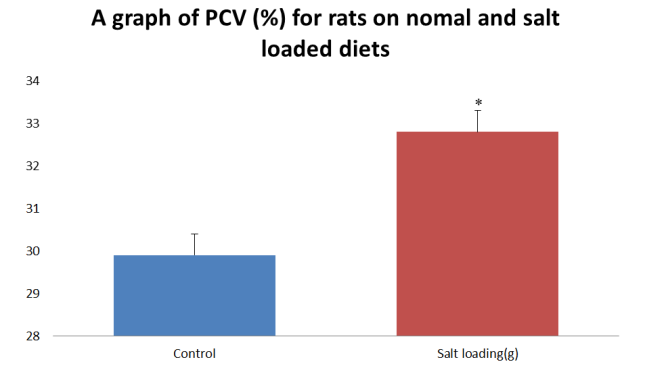
The pack cell volume (PCV) value obtained from the ten blood samples for rats on normal diet and does on salt loaded diet as illustrated below in the bar chart.
| Test | Control N=10 | Treated (Salt loaded) N=10 | T-Test | P-Value | ||||||||||
|---|---|---|---|---|---|---|---|---|---|---|---|---|---|---|
| PCV (%) | 29.8±3.30 | 32.8±3.55 | 1.366 | 0.05S | ||||||||||
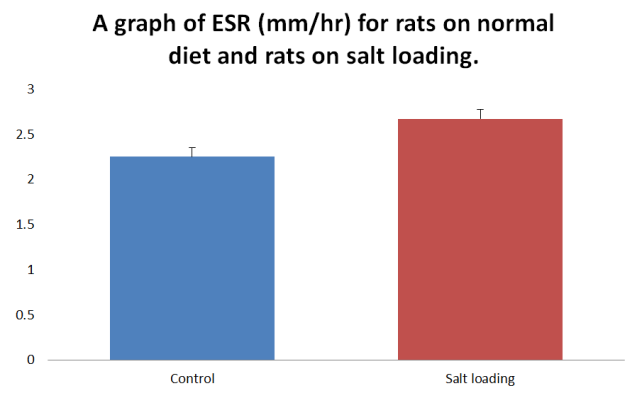
| ESR (mm/hr) | 2.25±0.5 | 2.67±0.82 | 0.441 | 0.05NS | ||||||||||
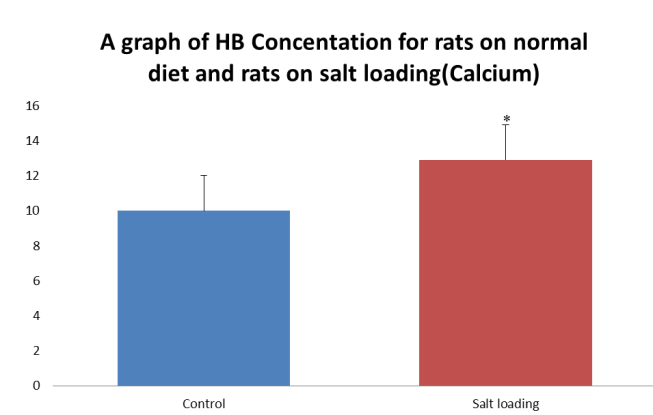
| HB, Conc.(mg/100ml) | 10.0±2.27 | 12.91±0.29 | 2.55 | 0.05S |
Table 1: Shows the mean values of haematocrit, ESR and Hemoglobin concentration obtained from both rats on normal and salt loaded
The mean value for salt loaded rats was 32.8 ± 3.55% while that of the control was 29.8 ± 3.30%.The comparison between the two groups was statistically significant at (p = 0.05). The mean value for the ESR for salt loaded rats was 2.67±0.82mm/hr while the mean value for the control was 2.25± 0.5mm/hr. The test rats were significantly different when compared to control at (p =0.05). The mean values for the hemoglobin concentration for salt loaded rats was 12.91 ± 0.29mg/00mls and 10.0 ± 2.27mg/00mls.The comparison between the groups showed that there was a significant difference at (p =0.05) (Table 1) (Figures 1-3).
Discussion
A number of factors affect hematological values. This include the sex, age, environment, physiological conditions under which the specimen are obtained, subject diet, techniques and timing of the specimen collection, transport and storage, and the variation of that analytical method used [16]. Furthermore, it is difficult to be certain in any survey of a population or group of samples for the purposes of obtaining from which normal ranges may be counted. Since the border line between health and ill health, so it is with hematological values, for the normal and abnormal undoubtedly overlap. That is why the ultimate goal for any experiment is to have data bank reference values which take account of the physiological variables mentioned above, so that an individual’s result can be expressed and interpreted relative to a comparable normal value. The effect of dietary calcium loading and its hematological change in albino rats were investigated in three haemorheological parameters (Pack cell volume, Hemoglobin concentration and Erythrocyte sedimentation rate).In relation to blood rheology, following chronic salt loading attained by substituting calcium chloride in the diet of albino rats. It was observed that there was a higher though not significant packed cell volume when compared to the control. Since calcium is needed for bone development, increase dietary calcium will enhance the development of bone marrows since healthy develop bone is synonymous with a healthy develop bone marrow. There will be an increase in red blood cell production from healthy bone marrow than that of a poorly developed bone. Therefore, increased production of red blood cell will lead to increased packed cell volume. Furthermore, relative polycythemia essentially is not the occurrence of only increased red blood cell. Any factor that will cause red blood cell to approximate together is synonymous with relative polycythemia. Participation of calcium in clothing formation relates to a condition in which the red cells approximate together. Therefore a local measurement of packed cell volume will increase as a result of increased calcium.
Considering the hemoglobin concentration, the mean values were higher in calcium loaded rats when compared to control. The reason has been that since most factors that affect packed cell volume are also related to the hemoglobin concentration. Therefore, if there is an increase in packed cell volume in salt loaded rats, thus hemoglobin concentration will also increase respectively. However, more studies will be required to prove this. The higher mean erythrocyte sedimentation rate value for salt loaded rats though not significant, suggest that calcium increases erythrocyte sedimentation rate, since calcium is an ion that tends to precipitate or sediment moieties. Therefore, increase in calcium loading or intake will increase the rate of sedimentation. It has been proven that many factors can affect the erythrocyte sedimentation rate, among which is temperature of the environments, type of anticoagulant used [17]. It is also dependent on the aggregation of erythrocyte to form rouleaux. This rouleaux formation depends on the protein composition of plasma, particularly in regard to fibrinogen and globulin, high fibrinogen increases rouleaux formation in which calcium plays a role.
Conclusion
This work has been a novel incursion in the study of the effects of dietary calcium loading in albino rats which affects haemorrheological parameters. Thus, the effect of dietary loading in albino rats has been noted to cause an increase on the packed cell volume, erythrocyte sedimentation rate and Hemoglobin concentration.
Conflict of interest
The authors declare no conflict of interest.
References
-
Beriven TN (2005) Neurayulusu: importance of calcium. Turk J Med Sc 35: 197-201.
-
Arielle K (2018) Role of calcium in the body function. J. American Board of Family Medicine, pp: 19-31.
-
Prentice A (1998) Calcium requirement for breast feeding mothers. Nutrition Reviews 56(4 Pt 1): 124- 30.
-
Moyed MA (2003) The potential benefit of dietary/supplementary calcium and vitamin D. Urooncol 21(5): 384-391.
-
Nordan BEC (1998) Calcium in Human Biology ILSI. Human Nutrition Reviews. London: Springer-Verlag.
-
Santella L, Lim D, Moccia F (2004) Calcium and fertilization: The beginning of life. Trends Biochem Sci 29(8): 400-408.
-
Whiting SJ, Wood RJ (1997) Adverse effects of high calcium diets in humans. Nutition Reviews 55(1): 1-9.
-
Gartner R (2003) Tetany. Iternist (Berl) 44(10): 1237-1242.
-
Squier TC, Biglow DJ (2000) Protein oxidation and age-dependent alteration in calcium homeostasis. Front Bio Sci 5: 504-526.
-
Prentice A (1997) Is nutrition important in osteoporosis? Proceeding of the Nutrition Society 56: 357-367.
-
Hamet P (1995) The evaluation of the scientific evidence for a relationship between calcium and hypertension. J Nutrition 125(25): 311S-400S.
-
Carafoli E (1988) Membrane transport of calcium: An overview. Methods in Enzymology 157: 3-11.
-
Blaustein MP, Lederer WJ (1999) Sodium/calcium exchange: its physiological implications. Physio Rev 79(3): 763-854.
-
British nutrition foundation (1989) Calcium: The Report of a Task force. London: British Nutrition Foundation.
-
Allen LH (1982) Calcium bioavailability and absorption: a review. American J Clinical Nutrition 35(4): 783-808.
-
Dacie JV, Lewis SM (1992) Practical hematology, 7th (Edn.), pp: 12-32.
-
Obi GO (1984) Normal values of hemoglobin, Packed cell volume and erythrocyte sedimentation rate in healthy Nigeria adults. Afican J Med Sci 13(1-2): 1-6.
- Management of Ear Keloid with Ksharsutra: A Case Study
- Yoga and Global Sustainability: A Holistic Path to One Earth, One Health
- Autoimmune Diseases in Ayurveda: A Narrative Review with Classical and Modern Perspectives
- Management of Cluster Headache Associated with Pituitary Apophysitis by CERT (Chakrasiddh Energy Release Technique): A Case Report on Energy Rebalancing
- Zygophyllum Geslini Coss : Biochemicals and Antioxidant Activity
- Observations of a Beginner Vaidya