
Antibacterial Activity of Cassia angustifolia Against Selected Pathogens
Cassia angustifolia is a medicinal plant under the family Caesalpinaceae. It is called Indian senna. In traditional medicine, it is used as one of the ingredient of Siddha Ayurvedic drugs to treat skin diseases. Leaves are ground as paste, and applied to various skin diseases. It has laxative properties. Antimicrobial activity of n-butanol, methanol and water extracts of leaves of this plant has been evaluated previously against Staphylococcus and Salmonella, klebsiella pneumonia and fungal species namely Aspergillus terreus, Aspergillus flavus and Aspergillus niger. The aim of the study was to evaluate the antibacterial activity and minimum inhibitory concentration (MIC) of decoction and methanolic extractact of C. angustifolia against Staphylococcus aureus NCTC 6571, Escherichia coli-NCTC -10418, Pseudomonas aeruginosa NCTC -10662 and five wild strains of Methicillin resistant S aureus (MRSA). Leaves of the plant were used to prepare decoction based on the rules of preparation method of the decoction. Methanolic extract was prepared using soxlet extractor. Antibacterial activity of these extracts were carried using cut well method,. MIC was determined using agar dilution method. Each experiment was carried out in three times. Decoction and methanolic extract of C.angustifolia showed activity against S. aureus and all tested five MRSA in cut well method as well as agar dilution method. Mean and SD of the diameter of inhibition zone of decoction of C.angustifolia against these organisms ( range from 18.5 ± 0.3 mm- 27±0 mm ) was greater than the diameter of the inhibition zone of methanolic extract of this plant (range from 16 ±0mm- 18± 0mm). In agar dilution method decoction showed activity against S aureus NCTC 6571 and five strains MRSA in 1/80 dilutions. The decoction of this plant did not show activity against Escherichia coli and Pseudomonas aeruginosa using the cut well method and agar dilution method. Although methanolic extract demonstrated activity against E coli and Pseudomonas aeruginosa in Agar dilution method .The MIC for S. aureus NCTC 6571 and five strains MRSA was 0.75 mg/ml. The MIC for E. coli and P. aeruginosa was 1.5 mg/ml. The demonstration of antibacterial activity by C.angustifolia may help to discover new antibiotic substances that could serve as agents for skin infectious disease. Further explorationof activity of the plant against a wider range of skin pathogens and toxicological investigations and further purification would be helpful. “Financial assistance by Ministry of Higher Education, (HETC Scholarship).
Introduction
The Indigenous Systems of Medicine consist of Ayurveda, Unani and Siddha. The crude form of medicinal plants is used to prepare Siddha drugs as single or combination. Cassia angustifolia is a medicinal plant under the family Caesalpinaceae It is a small shrub with long spreading branches, leaves alternative, pinnate leaflet opposite in 5-8 pairs and flowers are bright yellow. It is commonly known as Nilavagai (Tamil), Indian senna (English), Senehe (Sinhala) [1, 2]. The plant is beneficial for skin diseases and constipation. It has laxative properties. In traditional medicine this plant is used along with other ingredients for the treatment of skin diseases (Parankipaddai kudineer, Nimba katpam, Pirasanda sinthamani thailam) [3]. A Paste of the leaves is applied locally in skin diseases [1, 4]. Antimicrobial activity of n- butanol, methanol and water extracts of leaves of this plant has been evaluated previously against Staphylococcus, Salmonella, klebsiella pneumonia and fungal species namely Aspergillus terreus, Aspergillus flavus and Aspergillus niger [5].This plant extract has not been carried out against Methicilline resistant Staphylococcus aureus. The microorganisms have developed resistance to many antibiotics therefore the management of infectious diseases is limited. The screening of new antimicrobial agents from plants is essential. Therefore, in present study an attempt have been made to evaluate antimicrobial activity and Minimum inhibitory concentration of decoction and methanolic extracts of C.angustifolia against Staphylococcus aureus NCTC 6571, Escherichia coli-NCTC - 10418, Pseudomonas aeruginosa NCTC-10662 and five wild strains of Methicillin resistant S aureus (MRSA).
Methodology
Plant Collection
Leaves of C.angustifolia were purchased from Ayurvedic pharmacy at Katugastota Kandy, washed thoroughly and dried in the shade at room temperature. It was then pounded to produce a coarse powder.
Preparation of Decoction and Methanolic Extract of Fruit of C.angustifolia. a) Decoction 40g of coarse powdered C.angustifolia was added to 480 ml distilled water (12 times) and boiled until the volume was reduced to 60 ml (1/8 of initial volume,) [3]. b) Methanolic Extract 40 g of coarse powdered leaves of C.angustifolia was taken to extract with 200ml of Methanol using soxhelet extractor. After that the solvent was evaporated by rotavapour. Thick paste like extract was obtained and it was kept in freezer. c) Test Microorganisms The plant decoction and methanolic extract were assayed for antibacterial activity against eight bacterial isolates which were obtained from the Department of Microbiology, Faculty of Medicine, and University of Peradeniya. The bacteria included S. aureus-NCTC 6571, E. coli-NCTC -10418, P. aeruginosa-NCTC-10662 and five wild strains of Methicillin resistant S. aureus (MRSA).
Antibacterial Assay
The antibacterial activity of the decoction was evaluated using cut well method and agar dilution method. The methanolic extract was evaluated the activity using the cut well method. Agar dilution method was used to determine the Minimum inhibitory concentration (MIC) for each organism. All the experiments were carried out in three times and using standard aseptic techniques. Preparation of Bacterial Inocula- MacFarland 0.5 Series: Each isolated bacterial colony was taken separately to a sterile cotton wool plug. It was smeared on the inner wall of sterile Universal bottle, containing approximately 2 ml of sterile normal saline. Subsequently, the bottle was capped and vortexed for five seconds to dissolve the bacterial culture well. The turbidity of the liquid culture obtained, was made similar to that of the MacFarland 0.5 standard solution by dissolving more of the colony or diluting with more normal saline [4].
Cut Well Method
Mueller- Hinton Agar (MHA) was used for this bioassay. The MHA plate was inoculated with one milliliter of the liquid bacterial culture. The petridish was rotated to spread the liquid bacterial culture equally and excess culture was removed from the plate and allowed to dry at 37°C for 15 minutes. The wells with 12 mm in diameter and 4 mm in depth were bored into the MHA using a sterile cork borer and the well completely filled with the test extracts (decoction, Methanolic extract). The plates were left on the bench for 30 minutes for absorption of extract and then incubated at 37°C for 24h. The plates were examined for inhibition of growth around the well and diameters of the zones of inhibition were measured.
Agar Dilution Method
Dilutions were prepared in sterile universal bottles (1/10,1/20,1/40,1/80 ,1/160 &1/320. After capping and mixing the solutions, the medium was poured into sterile petridishes, which was marked into eight partitions. These partitions were labeled with the name of bacterial isolates. Liquid cultures of eight bacterial isolates with their turbidity equal to that of the standard MacFarland 0.5 solution was prepared. I ml of each suspension was transferred to 9 ml of sterile distilled water. 10 µl drop from prepared each bacterial liquid culture was placed on the corresponding partition. The plates were incubated overnight at 37°C. Three replicates were carried out for the entire procedure.
Results
Decoction and methanolic extract of C.angustifola showed activity against of S. aureus NCTC6571 and all five strains MRSA. These did not show activity against E.coli and P. aeruginosa. Mean and standard deviation of the diameter of the Inhibition zone of decoction was greater than the diameter of the zone of inhibition zone of methanolic extract of this plant (Tables 1 & 2, Figure 1).
| Organisms | Decoction | Methanolic Extract | ||||||
|---|---|---|---|---|---|---|---|---|
| S aureus-NCTC 6571 | 18.5 ± 0.3 | 18 ± 0 | ||||||
| E.coli-NCTC -10418 | - | - | ||||||
| P.auruginosa-NCTC-10662 | - | - | ||||||
| MRSA-PM 19 | 24 ± 0.6 | 18 ± 0 | ||||||
| MRSA-Pm 18 | 26 ± 0 | 17 ± 0 | ||||||
| MRSA-PM 15 | 21.66 ± 0.5 | 16 ± 0 | ||||||
| MRSA-PM 21 | 27 ± 0 | 17 ± 0 | ||||||
| MRSA-PM 16 | 23.66 ± 1.5 | 20 ± 0 |
Table 1: Mean and SD of Inhibition zone (mm) of decoction and methanolic extract of C.angustifolia of using the Cut well method.
| Organisms | Serial dilutions of decoctions | ||||||||||||||||||||||
|---|---|---|---|---|---|---|---|---|---|---|---|---|---|---|---|---|---|---|---|---|---|---|---|
| 5-Jan | 10-Jan | 20-Jan | Jan-40 | Jan-80 | 1/160 | 1/320 | |||||||||||||||||
| S.aureus-NCTC 6571 | - | - | - | - | - | + | + | ||||||||||||||||
| E.coli-NCTC -10418 | + | + | + | + | + | + | + | ||||||||||||||||
| P.auruginosa-NCTC-10662 | + | + | + | + | + | + | + | ||||||||||||||||
| MRSA-PM 19 | - | - | - | - | - | + | + | ||||||||||||||||
| MRSA-Pm 18 | - | - | - | - | - | + | + | ||||||||||||||||
| MRSA-PM 15 | - | - | - | - | - | + | + | ||||||||||||||||
| MRSA-PM 21 | - | - | - | - | - | + | + | ||||||||||||||||
| MRSA-PM 16 | - | - | - | - | - | + | + |
Table 2: Antibacterial activity of decoction of C.angustifolia using Agar dilution method. All the above organisms have grown in
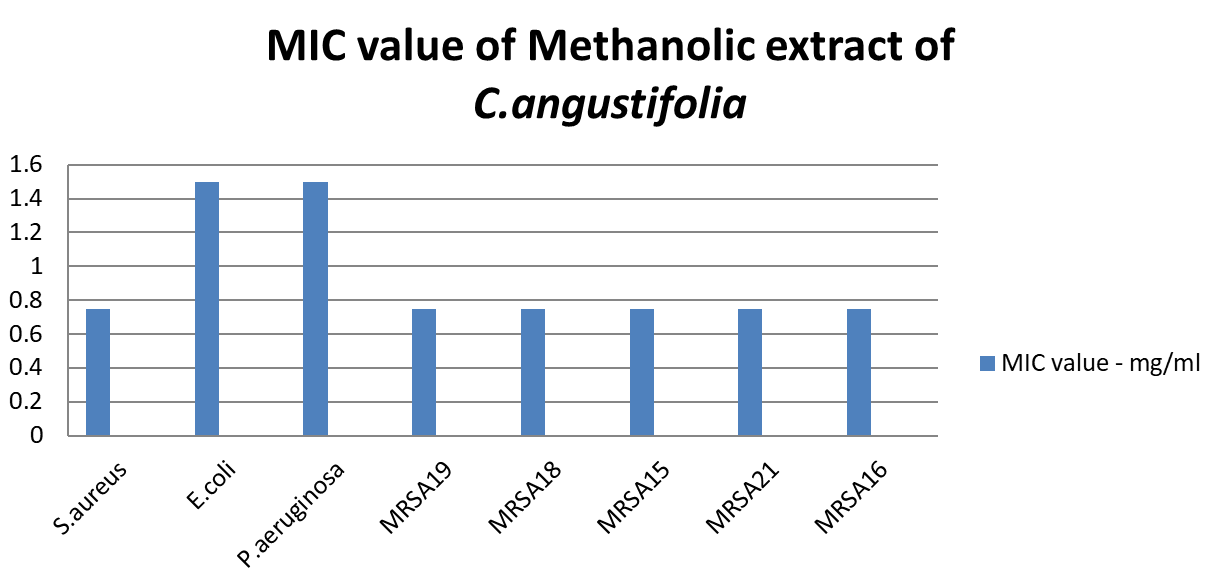
Methanolic extract showed different MIC value for against all tested Organisms 0.75mg/ml for S.aureus and all tested 5 MRSA and 1.5 mg/ml for E.coli and P. aeruginosa.
Discussion
- In Traditional medicine, this plant is used for infection of skin as decoction and paste.
- S. aureus is the commonest Organism, which causes skin infections. Although gram negative bacilli such as E.coli and Pseudomonas sp as known to contribute in some clinical practice.
- Using the cut well method, decoction and methanolic extract of leaves of C.angustifolia showed inhibitory activity against S. aureus and all 5strains MRSA.
- The diameter of the inhibition zone of decoction of leaves of C.angustifolia is greater than the diameter of the inhibition zone of methanolic extract. Because the activity of water extract was greater than the solvent extract.
- Decoction of leaves of C.angustifolia did not show activity against E.coli and P.aeruginnosa but methanolic extract showed activity against these organism in agar dilution method.
- Using Agar dilution method, decoction of leaves of C.angustifolia showed good activity against S. aureus and 5 MRSA up to one in eighty dilutions.
- Minimum inhibitory concentrations of methanolic extract are 0.75mg/ml for S.aureus and all tested MRSA and 1.5 mg/ml for E.coli and P. aeruginosa.
Conclusion
Decoction and methanolic extract of leaves of C. angustifolia showed activity against Staphylococcus aureus, 5 strains MRSA. The demonstration of antibacterial activity by leaves of C. angustifolia may help to discover new chemical classes of antibiotic substances that could serve as selective agents for skin infectious disease. Further exploration of activity of the plant against a wider range of skin pathogens and toxicological investigations and further purification would be helpful.
References
-
Arambewella L, Silva R (1999) Cassia angustifolia Sri Lanken medicinal plant, monographs and analysis, Industrial Technology Institute & NSF, Sri Lanka.
-
(1995) Siddha Maruththuvam Special, Thiagarajan, Indian medicine and Homiopathi, Chennai.
-
(1995) Pararajasekaram, Siroroganithanam, Kapalakarappan I, Ponnaih, Sri Lanka.
-
Derek FJ, David M, Jane M (2001) BSAC Standardized disc susceptibility testing method: The Journal of Antimicrobiological chemotherapy 48: 44-45.
-
Gnanavel S, Bharathidasan R, Mahalingam R, Madhanraj P, Panneerselvam A (2012) Antimicrobial Activity of Strychnos nux-vomica Linn and Cassia angustifolia Linn. Asian Journal of Pharmacy and Technology 2(1): 8-11.
- Management of Ear Keloid with Ksharsutra: A Case Study
- Yoga and Global Sustainability: A Holistic Path to One Earth, One Health
- Autoimmune Diseases in Ayurveda: A Narrative Review with Classical and Modern Perspectives
- Management of Cluster Headache Associated with Pituitary Apophysitis by CERT (Chakrasiddh Energy Release Technique): A Case Report on Energy Rebalancing
- Zygophyllum Geslini Coss : Biochemicals and Antioxidant Activity
- Observations of a Beginner Vaidya