
Effects of Bee Bread Supplementation on Anaerobic Components in Male Athletes
Nutritional strategies are the common types of ergogenic aids used by athletes to enhance their sports performance. Scientific data on the ergogenic effects of bee products consumed at pre exercise on anaerobic sports performance is scanty. This study investigated the effects of 8-week bee bread supplementation at pre exercise on anaerobic components in male athletes. Twelve male athletes (age: 24.0 ± 1.8 years old; BMI: 22.3 ± 1.3 kg.m-2; VO2max: 52.0 ± 2.8 mL.kg-1.min-1) were recruited in this study. Participants consumed either bee bread at a dosage of 20 g.d-1 or placebo for 8 weeks prior to the experimental trial. Participants’ anaerobic components such as mean power, peak power, anaerobic capacity and anaerobic power was measured before and after 8 weeks of experimental period. Statistical analyses were performed using ANOVA with repeated measures. There were no significant different in mean power, peak power, anaerobic capacity and anaerobic power between placebo and bee bread trial at pre and post supplementation test. Supplementation of bee bread for 8 weeks at a dosage of 20 g daily didn’t enhance anaerobic components in male athletes.
and Mahaneem Mohamed3
Malaysia, Email: fadzel@ums.edu.my
athletes.
Keywords: Mean power; Peak power, Anaerobic capacity; Anaerobic power; Sports performance
Introduction
Bee products have been used thousand years ago as a healthy supplement. Bee products such as honey, bee pollen, bee bread and royal jelly can be used as potential ergogenic aid due to its nutrition content. To date, several studies found that bee products has anti-inflammatory [1, 2], antitumor [3], anti-allergic [4], antioxidant [5, 6, 7, 8], antimicrobial [9, 10, 11], anti-mutagenic [12], and antitumor [13] properties.
There are limited studies on effect of bee products supplementation on sports performance. For instances, Earnest, et al. [14] reported that supplementation of honey at a dosage of 15g every 16 km during a simulated 64-km cycling time trial was significantly faster to complete time trial in comparison with placebo trial. Shukri, et al. [15] found that ingestion of 500 ml of honey drink one hour before trial and 3 mL. Kg body weight-1 of cool honey drink every 20 minutes during the running trial was as good as a sports drink in improving running time trial performance and has similar effects on blood glucose in a hot environment. Nechaeva [16] reported that ingestion of 10 g of pollen for 15 days among Russian sport female students significantly improved viso-motoric reaction in comparison with the placebo trial. However, Abbey and Rankin [17] reported that acute supplementation of honey beverage at a dosage of 1g.kg body weight-1 before and during soccer- stimulation test did not significantly improve progressive shuttle-run (PSR) test to exhaustion in comparison with the placebo trial. However, no study has been carried out to investigate the possible beneficial effects of bee bread supplementation on anaerobic components. Therefore, the aim of this study was to investigate effects bee bread supplementation at pre exercise on anaerobic components in male athletes.
Methodology
Twelve male athletes were recruited in this study. Participants were asked to refrain from heavy exercise for 24 hours before the tests to ensure that they have adequate rest before the experimental trials. Their food diary and physical activity diary for the last 72 hours were also collected. Participants recorded their food intake for 3 days prior to the first trial and repeated the same diet over 3 days before the days of consecutive trials. This was done to minimize the differences in muscle glycogen between the trials.
Excalibur Sport Ergometer (Lode Groningen, Netherlands) was used to measure anaerobic components of the participants via the Wingate anaerobic test. Wingate anaerobic test is a 30 seconds all out exhaustive ergometer test. All participants were fully informed about the procedures of Wingate anaerobic test before performing this test. Participants familiarised with the Wingate test procedure before the actual trial. Body weight of participants were collected using an electrical body composition analyser (Tanita: Model TBF-410, Japan) prior the testing.
To begin the test, participants selected their optimal seat height on Excalibur Sport Ergometer. Particpants were required to warm up by pedaling up to 60 rpm for 5 minutes. After the warm up, participants were requred to maintain 1 minutes of cycling at 60 rpm and 10 second countdowm prior to 30 seconds of Wingate test. During the test, participants were required to pedal as fast as they could for 30 seconds. Similar verbal encouragement was given to the participants so that they tried their utmost best to complete the test. Once completed the subject were requested to cool down by pedalling without resistance for about 5 minutes.
All the statistical analyses were computed by using the Statistical Programme for the Social Sciences (SPSS) version 22.0 (SPSS Incorp, United States). The level of significance for all analysis was set at p<0.05. All the collected data were expressed in mean and standard deviation (SD). ANOVA with repeated measures was used to determine the differences of the measured anaerobic components parameters over time and between trials. Bonferroni adjustment for multiple comparisons was used to locate the differences when repeated measures analysis of variance revealed a significant main effect of time.
Results
The mean body mass index (BMI) of the participants was categorised as normal and healthy. Mean maximum oxygen consumption (VO2max) reflected that the participants had good cardio-respiratory fitness (Table 1).
| Physical characteristics and | Mean ± SD | ||
|---|---|---|---|
| anthropometry measurement | |||
| Age (years) | 24.0± 1.8 | ||
| Body mass (kg) | 67.4± 6.2 | ||
| Height (cm) | 173.7 ±6.1 | ||
| Body mass index (kg.m-2) | 22.3 ± 1.3 | ||
| VO (mL.kg-1. min-1) 2max | 52.0 ± 2.8 |
Table 1: Mean and SD of physical characteristics and anthropometry measurements of the participants
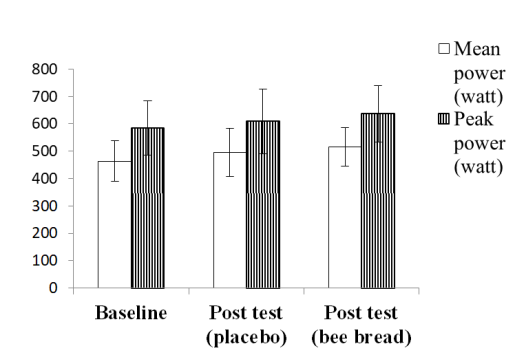
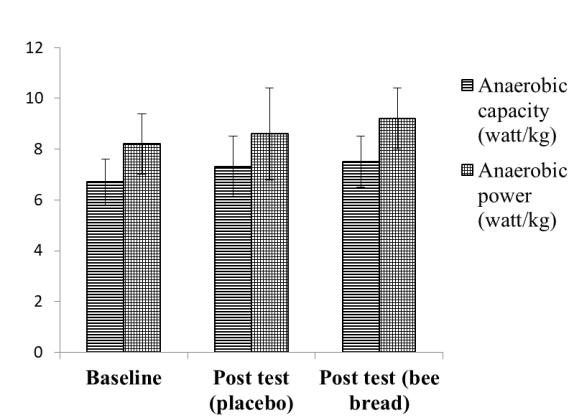
There was no significant difference in mean power, peak power, anaerobic capacity and anaerobic power between pre and post tests in both trials (p>0.05). Mean and SD of anaerobic mean power and peak power is shown in Figure 1 while anaerobic capacity and anaerobic power is shown in Figure 2.
Discussion
This present study found that mean power, peak power, anaerobic capacity and anaerobic power after 8 weeks supplementation in the bee bread trial was no significant difference compared to the placebo trial. This finding indicated that 8-week supplementation of bee bread did not significantly enhance anaerobic components compared to the placebo trial. This was the first study carried up to investigate bee bread supplementation on anaerobic components. This finding was in agreement with the previous finding reported that honey [18], carbohydrate [19], protein [20], whey protein and casein [21] and betaine [22] supplementation did not enhance anaerobic performance.
Woolfolk, et al. investigated the effect of honey on anaerobic performance among male collegiate soccer players. Participants ingested one of three different supplements i.e. 9.5 oz. of flavoured water, 9.5 oz. of PowerAde, and 1 tablespoon of honey mixed with 3 oz. of water for a week. During the tests, participants performed a repeated anaerobic sprint test (RAST). This previous study found that supplementation of honey at the prescribed dosage did not significantly improve anaerobic performance compared to the flavoured water. In another study, Pritchett, et al. demonstrated that supplementation of an energy bar containing 20 g of carbohydrate, 12 g of protein and 4.5 g of fat at 60 minutes before cycling on Wingate test did not significantly increase anaerobic power in comparison with the placebo trial.
Bee bread has high content of protein and the present finding was similar with the previous findings which also reported that protein supplementation did not enhance anaerobic exercise performance [20, 21, 22]. Kerksicket, et al. found supplementation of 40 gram of whey protein and 8 gram of casein did not significantly increase anaerobic power compared to the placebo group. Another study by Hoffman et al. reported that participants of supplemented group who consumed protein at 24% from total energy intake per day for 12 weeks did not show any significant increase in peak power and mean power compared to the placebo group. Hoffman, et al. demonstrated that 15 days of Betaine supplementation, which it is a trimethyl derivative of the amino acid glycine at a dosage of 1.25 g per day did not significantly enhance mean power and peak power measured via Wingate test compared to the participants in the control group.
The present study found that bee bread supplementation at a dosage of 20 g per day for 8-week did not contribute ergogenic effect on anaerobic components. It is speculated that bee bread supplementation did not enhance creatine phosphate storage in the skeletal muscle and did not seem to contribute to the phosphagen system or adenosine triphosphate-creatine phosphate (ATP-CP) system to produce energy during the anaerobic power exercise. The phosphagen system is the predominant energy system for anaerobic exercise and limited storage of creatine phosphate in skeletal muscle will lead to the fatigue.
Although bee bread contains glucose, protein, free fatty acid, multi vitamin and mineral [5, 6], it did not seem to exert any ergogenic effect on anaerobic exercise performance. Phosphagen system is an oxygen- independent to re-synthesis and regeneration of adenosine triphosphate (ATP), and neither carbohydrate, protein nor fat is used in this phosphagen system to produce adenosine triphosphate (ATP) during anaerobic exercise performance. Specific training methodologies such as speed, power and strength training are very important factors to enhance the anaerobic components of the athletes. In the present study, participants did not go through any specific training programme and may explain why no improvement in the anaerobic components was observed. Thus, bee bread supplementation alone without any specific training programme did not affect the contractile properties of the muscles that may improve the anaerobic components of the participants.
Conclusion
Supplementation of bee bread for 8 weeks at a dosage of 20 g daily didn’t enhance anaerobic components compared to the placebo in male athletes.
Conflict of Interest
The author declare no conflict of interest
References
-
Cooper RA, Molan P, Krishnamoorthy L, Harding K (2001) Manuka honey used to heal a recalcitrant surgical wound. Europ J Clinic Microbio Infect Disease 20(10): 758-759.
-
Maruyama H, Sakarmoto T, Araki Y, Hara H (2010) Anti-inflammatory effects of bee pollen ethanol extract from Cistus sp. Of Spanish on carrageenan- induced rat hind paw edema. J Med 10(30): 1-11.
-
Yang XP, Guo D, Zhang JM, Wu MC (2007) Characterization and antitumor activity of pollen polysaccharide. Int Immunopharma 7(4): 401-408.
-
Medeiros KC, Figueiredo CA, Figueredo TB, Freire KR, Santos FA, et al. (2008) Anti-allergic effect of bee pollen phenolic extract and myricetin in ovalbumin- sensitized mice. J Ethnopharmacol 119(1): 41-46.
-
Nagai T, Nagashima T, Myoda T, Inoue R (2004) Preparation and functional properties of extracts from bee bread. Nahrung Food 48(3): 226-229.
-
Nagai T, Sakai M, Inoue R, Inoue H, Suzuku N (2001) Antioxidative activities of some commercially honeys, royal jelly and propolis. Food Chem 75(2): 237-240.
-
Nagai T, Nagashima T, Suzuku N, Innoue R (2005) Antioxidant activity and angiotensin I-converting enzyme inhibition by enzymatic hydrolysates from bee bread. Z Naturforsch C J Biosci 60(1-2): 133-138.
-
Nakajima Y, Tsuruma K, Shimazawa M, Mishima S, Hara H (2009) Comparison of bee product based on assays of antioxidant capacities. BMC complement Alter Med 9(4): 1-9.
-
Abouda Z, Zerdani I, Kalalou I, Faid M, Ahami MT (2011) The antibacterial activity of Moroccan bee bread and bee-pollen (fresh and dried) against pathogenic bacteria. Res J of Microbiol 6(4): 376-384.
-
Lusby PE, Coombes AL, Wilkinson JM (2005) Bactericidal activity of different honeys against pathogenic bacteria. Arch Med Res 36(5): 464-467.
-
Sherlock O, Dolan A, Athman R (2010) Comparison of the antimicrobial activity of Ulmo honey from Chile and Manuka honey against methicillin-resistant Staphylococcus aureus, Escherichia coli and Pseudomonas aeruginosa. BMC Comp Alter Medic 10(47): 321-328.
-
Wang XH, Andrae L, Engeseth NJ (2002) Antimutagenic effect of various honeys and sugars against Trp-p-1. J Agri Food Chem 50(23): 6923- 6928.
-
Tomasin R, Cintra Gomes-Marcondes MC (2011) Oral administration of Aloe vera and honey reduces walker tumour growth by decreasing cell proliferation and increasing apoptosis in tumour tissue. Phytotherapy Research 25(4): 619-623.
-
Earnest CP, Lancaster SL, Rasmussen CJ, Kerkisck CM, Lucia A, et al. (2004) Low Vs high glycemic index carbohydrate gel ngestion during stimulated 64 km cycling time trial performance. J Strenght Cond Res. 18(3): 466-472.
-
Shukri N, Ooi FK, Chen CK, Sirajudeen KNS (2011) Effects of acacia honey drink supplementation compared to sports drink on blood glucose and running performance in the heat. Proceeding of 16th National conference on Medical and Health Sciences, Kelantan, Malaysia.
-
Nechaeva N (2009) Changes of functional and sport medicine after intake of bee products. RyazanState Medical University Ryazan.
-
Abbey EL, Rankin JW (2009) Effect of ingesting of honey sweetened beverage on soccer performance and exercise induced cytokine response. Int J Nutr Metab 19(6): 659-672.
-
Woolfolk KG (2012) Effect of honey on anaerobic performance in male collegiate soccer players. Electronic theses and dissertations. Georgia Southern University.
-
Pritchett K, Bishop P, Pritchett R, Kovacs M, Davis JK, et al. (2008) Effects of timing of pre-exercise nutrient intake on glucose responses and intermittent cycling performance. S Afr J Sports Med 20(3): 86-90.
-
Hoffman JR, Ratamess NA, Kang J, Falvo MJ, Faigenbaum AD (2007) Effects of protein supplementation on muscular performance and resting hormonal changes in college football players. J Sports Sci Med 6(1): 85-92.
-
Kerkiscket CM, Rasmussen CJ, Lancaster SL, Magu B, Smith P, et al. (2006) The effects of protein and amino acid supplementation on performance and training adaptations during ten weeks of resistance training. J Strength Cond Res 20(3): 643-553.
-
Hoffman JR, Ratamess NA, Kang J, Rashti SL, Faigenbaum AD (2009) Effect of betaine supplementation on power performance and fatigue. J Int Soc Sports Nutr 6(7): 1-10.
- Management of Ear Keloid with Ksharsutra: A Case Study
- Yoga and Global Sustainability: A Holistic Path to One Earth, One Health
- Autoimmune Diseases in Ayurveda: A Narrative Review with Classical and Modern Perspectives
- Management of Cluster Headache Associated with Pituitary Apophysitis by CERT (Chakrasiddh Energy Release Technique): A Case Report on Energy Rebalancing
- Zygophyllum Geslini Coss : Biochemicals and Antioxidant Activity
- Observations of a Beginner Vaidya