
Clinical Effect of Raktamokshan W.S.R. to Shiravedha in Vatakantaka: A Case Report
Vatakantaka is one among Vatananatmaj vaydhis mentioned by Acharya Sushruta. It is a Painful condition of heel caused by improper placement of foot on the ground. Plantar fasciitis has similar pathology and clinical presentation like of Vatakantaka. It is common cause for pain in heel region which occurs in about 10% of general population. Women are twice as likely as men to get plantar fasciitis. The pain of Vatakantaka is so severe that it causes hindrance in daily routine life. As per mentioned in our classics by Acharya Bhavmishra, Vatakantaka can be efficiently managed by Raktamokshan. A 51 years old female patient complaining of pain in the left heel and other associated symptoms was treated with Raktamokshan by the Shrivedha method along with Eranda Taila Pana and Kaishore Guggulu, showed significant results after treatment. It is the need of today’s era to focus on such modalities which yield good results and are much adaptable. The Sign and symptoms pain, Tenderness, Swelling, Burning sensation, Redness are significantly reduced to from score 3, 2 to 01, and 00 in first seating and second sitting respectively.
Introduction
The word Vata denotes the movement and it is the main cause for action. Kantaka means the point of the needle like thorn which is troublesome and produces sharp stinging pain. Similarly Vatakantaka is one of the clinical condition which is considered as a Vatavyadhi by Acharya Sushruta [1] and Acharya Vagbhata [1]. It is mainly caused due vitiation of Vata Dosha occurring due to improper placement of heel while walking, running etc or by frequently walking on uneven surfaced. Due to which aggravated Vata gets seated in Gulfa Sandhi which causes pricking pain [2].
Plantar Fasciitis has similar pathology and clinical presentation like Vatakantaka. It is a chronic inflammation of plantar fascia caused by collagen degeneration associated with repetitive micro trauma to the plantar fascia [1]. The development of these painful disorders occurs in people who have a sedentary life style, wear high heeled shoes, have unusually high or low arches in the feet or have tight calf muscles or tight Achilles tendon (the tendon that attaches the calf muscles to the heel). People whose occupation involve long standing and walking on hard surface are more prone to develop plantar fasciitis. It is also common among runners and dancers.
Patients suffering from plantar fasciitis feel a great deal of pain, often while placing weight on the foot after waking up in the morning which eventually gets worsened on walking or running and after period of rest. Pain is radiating in nature from bottom to the heel towards the toes. Some people even have burning pain along the inside border of sole while walking. As a part of treatment physical therapy and splinting at night are employed which helps to stretch the calf muscles and fascia during bed rest. Non invasive measures include use of adhesive strapping or arch supporting warps, cold and ice pack massages, use of non steroidal anti-inflammatory drugs (NSAIDs) and frequent corticosteroid injections. Now a day’s extracorporeal pulse activation therapy (EPAT) is been used for the treatment in which pressure waves of sound are applied on heel which stimulates the blood circulation and helps in healing [1]. Plantar Fasciotomy Surgery is reserved for chronic Sufferers [2, 3].
Acharya Bhavmishra has advice Raktamokshan, Eranda Taila Pana and Agnikarma for Vatakantaka [1] Raktamokshan is one among five Karma described for purification of the body which includes various methods but among them Shiravedh and Jalaukavacharna are commonly practice. Raktamokshan is indicated specially when Rakta is mainly involved as Dushya in Samprapti Ghataka [1]. According to the reports presented pain gets relieved locally immediately after the Raktamokshan and gives long term effect. Therefore Ayurveda provides better promising treatment for the absolute relief of pain.
Vatakantaka (Planter Fasciitis) is a common cause of heel pain which is caused due to vitiation of Vatadosh. Vata is vitiated due to walking on irregular or uneven surface, excessive strain on heels and get accumulated in Khudukapradesha (Ankle joint) and causes pain as if pricked by a thorn [4].
Planter Fasciitis is one of the most common conditions of painful heel. Almost 80 percent patients of heel pain are diagnosed as planter fasciitis [5] the clinical features of Vatakantaka can be correlated with the symptoms of Calcaneal spur where there is involvement of Kaphavruta Vayu [6]. Vatakantaka caused mainly due to the vitiation of Vata Dosha occurring due to walking on an uneven ground frequently, placing the feet improperly [7]. As the reference of Acharya Sushruta suggests the disease chronic plantar fasciitis can be correlated with Vatakantaka. Vatakantaka is Snayu Asthi Sandhi Aashrita [8].
Materials and Methods
Case History
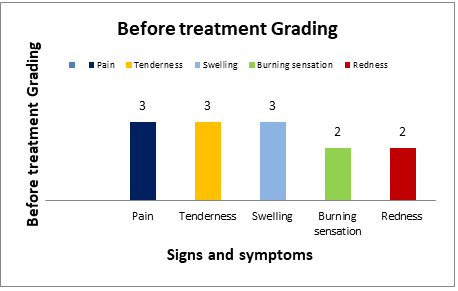
A 51 years old female, house wife, visited OPD in Krishna Ayurved medical college, Vadodara with chief complaints of pain in left heel region which was radiating in nature towards the toe along with redness, tenderness and pricking pain at the heel. Pain was severing in the morning hours and patient would be unable to walk and it caused hindrance in day to day life. She was diagnosed as Vatakantaka. Patient was suffering from Vatakantaka since last 6 months and was taking non inflammatory medication which would give her Symptomatic relief. But symptoms would aggravate again after some days. Patient is k/c/o Hypothyroidism and is on her medication. No other past history of any major illness was noted (Tables 1 & 2 and Figure 1).
On Examination
- Weight- 68kgs
- Height- 5ft
- B.P- 128/80 mm of hg
- Jivha-Samyka
- Shudha- Madhyam
- Mala- Samyka
- Mutra- Samyka
- Agni- Visham On palpation the heel was tender and swollen, hot on touch.
| Grades → | 0 | 1(+) | 2(++) | 3(+++) | |
|---|---|---|---|---|---|
| Sign and symptom↓ | |||||
| 1 | Pain | No Pain | Mild | Moderate | Severe pain |
| 1 | Pain | No Pain | (Not disturbing daily routine activity and pain only during morning hours) | (Continuous pain in the morning hours and walking after rest) | (Pain throughout the day and disturbing daily routine) |
| 2 | Tenderness | No Tenderness | Pain on deep pressure | Pain on slight pressure | Pain on touch |
| 3 | Swelling | No Swelling | Mild swelling | Moderate swelling | Severe swelling |
| 4 | Burning sensation | No burning Sensation | Mild burning Sensation | Moderate burning Sensation | Severe burning Sensation |
| 5 | Redness | No redness | Mild redness | Moderate redness | Severe redness |
Table 1: Assessment Criteria [1].
| Signs and symptoms | Before treatment Grading | |
|---|---|---|
| 1 | Pain | 3 |
| 2 | Tenderness | 3 |
| 3 | Swelling | 3 |
| 4 | Burning sensation | 2 |
| 5 | Redness | 2 |
Table 2: Showing Gradation of Signs and Symptoms before Treatment.
Treatment Protocol
Poorva Karma: Proper counseling and written consent was taken. Stanik Abhyanga was done with Tila Taila applied to left foot for 10 minutes and followed by Nadi Swedana for 10
Observation and Results
minutes. Then medial side of left foot was cleaned thoroughly with antiseptic solution to maintain hygiene.
Pradhana Karma: B.P. cuff was tied just above the ankle to maintain the pressure. The most tender or painful point on the medial side of the heel was marked and with help of 20 no needle vein was punctured and 10ml of blood was expelled out (Figure 2).
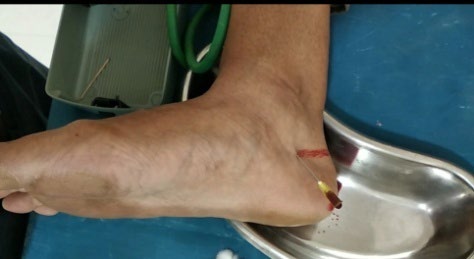
Paschat Karma: With help of cotton manual pressure was given on the side of puncture to stop the bleeding. After 5 minutes blood was stopped, bandaging was done and patient was asked to walk around. • Second sitting was scheduled after 5 days at morning.
Oral Medication
- Eranda Taila Pana-15 ml early in the morning at 5 am for 5 days
- Kaishore Guggulu-2 tablets of 500mg twice a day after food for 5 days. During this period she was advised to take Lagu Supachya Ahara only.
| Treatment Follow-up | Ml of blood | Colour of blood | Signs and symptoms | |
|---|---|---|---|---|
| 1 | 1st sitting | Approximately10 ml | Dark red | 1. Immediate relief in pain and burning sensation |
| 1 | 1st sitting | Approximately10 ml | Dark red | 2. Gradual reduction in swelling and tender |
| 1 | 1st sitting | Approximately10 ml | Dark red | 3. Mild redness was still visible |
| 1 | 1st sitting | Approximately10 ml | Dark red | 4. Lightness in the heel |
| 2 | 2nd sitting | Approximately10 ml | Red | 1. Mild pain |
| 2 | 2nd sitting | Approximately10 ml | Red | 2. Other symptoms were absent |
| 2 | 2nd sitting | Approximately10 ml | Red | 3. Moderate improvement in crack in heels |
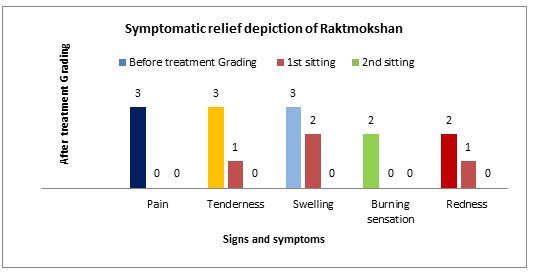
| Sr.no | Signs and symptoms | Before treatment Grading | After treatment Grading | |
| Sr.no | Signs and symptoms | Before treatment Grading | 1st sitting | 2nd sitting |
| 1 | Pain | 3 | 0 | 0 |
| 2 | Tenderness | 3 | 1 | 0 |
| 3 | Swelling | 3 | 2 | 0 |
| 4 | Burning sensation | 2 | 0 | 0 |
| 5 | Redness | 2 | 1 | 0 |
Table 3: Observations.
Results
On Observation of sign and symptoms pain, Tenderness, Swelling, Burning sensation, Redness are significantly reduced to from score 3, 2 to 01, and 00. On first seating and second sitting respectively (Tables 3 & 4 and Figure 3).
Discussion
Vatakantaka is one of the common happening conditions of foot. It can be clinically correlated with plantar fasciitis [9]. Here a single case study was been done in which 2 sittings of Raktamokshan were done with the help of Shiravedh method. On the 1st sitting showed significant relief in pain and burning sensation and gradual relief in tenderness, redness and swelling as shown in Table 1, and Table 2. During 2nd sitting patient had negligible pain and burning sensation and similar results were seen with associated symptoms? Here in the Samprapti of Vatakantaka, Sotha and Araktavarnata clearly mentions the obstructions in the channels of Rakta due to which Snayu and Rakta Dushti takes place which causes pain, tenderness, redness etc symptoms. The severe pain in the morning hours soon after walking up suggest the association of Kapha or Ama Dosha with Vayu and Rakta. Samprapti due to Vataprakopaka Nidana and Samprapti due to Dhatukshayakara Nidana [10].
This pathogenesis is broken by Raktamokshan [11].
Abhyanga and Swedana before Raktmokshan does Vilayan of Dushit Doshas due to which during Shiravedha Doshas easily follows out. Through Shiravedh Dushit Rakta is expelled out due to which obstruction is released. Dushit Rakta along with Ama follows out and Prakrut Vayu and Rakta gains normalcy and starts proper circulation, in results pain along with other symptoms is relieved. As the Vatakantaka is associated with Ama, Eranda Taila Pana and Kaishore Guggulu are selected for oral medications as shown in Figure 3.
Therefore it can be safely concluded that this modality helps in reducing pain, tenderness and burning sensation. It provides resulting relief in the symptoms but sometimes symptoms may reappear for which more regular sittings of Raktmokshan should be done [11]. Raktamokshan is gaining popularity across the globe. Siravedhana Karma physician can demolish the pathogenesis of Vatarakta and should manage the disease [12].
Conclusion
Vatakantaka is a disease which comes under Vatavyadhi Vikar. Pathogenesis and management as per the classics treatment was planned accordingly and case was successfully managed with Ayurvedic treatment. Therefore this demonstrates that this modality in Ayurveda has ability to deal with painful condition without NSAIDs and surgery. Management of pain and tenderness was reduced after the treatment by Raktamokshana [13], Raktamokshana is a treatment modality which helps to treat Vatakantaka, hence a successful attempt was made to incorporate Raktamokshana in the form of Cupping Therapy was adopted in this case [14].
References
-
Shastri KA (2012) Edition reprint, Sushruta Samhita of maharsi Sushruta by, Chaukhambha Sanskrit Sansthan, Varanasi, Part 1 Nidansthana 1/79, pp: 304.
-
Murthy KRS (2010) First Edition, Astanga Samgraha of Vagbhata, , Chaukhamba Oriental, Varanasi, Vol II Nidansthan 15/55, pp: 248.
-
Shastri KA (2012) Edition reprint, Sushruta Samhita of maharsi Sushruta by, Chaukhambha Sanskrit Sansthan, Varanasi, Part 1 Nidansthana 1/78, pp: 304.
-
Sadhana M (2017) Agnikarma in the management of Vatakantaka (Planter Fasciitis). Journal of Indian System of Medicine 5(2): 126.
-
Badwe Y, Rokade B, Paliwal A (2019) Comparative study of agnikarma and intralesional steroidal injection in vatakantaka wsr plantar fasciitis. International Journal of Scientific Research 8(10): 1-2.
-
Kuchanur S, Santosh YM (2014) Innovative Practice of Agnikarma in Vatakantaka. Journal of Ayurveda 8(4).
-
Maragalawaththa SK, Goyal M, Chandimarathne PB (2017) Efficacy of Sri Lankan Traditional Paste on Vatakantaka with special reference to Calcaneal spurs-A Case Report. International Journal of AYUSH Case Reports 1(2): 20-24.
-
Shekokar AV, Borkar KM (2013) Role of Agnikarma in the management of chronic plantar fasciitis. International Journal of Ayurvedic Medicine 4(4): 421-425.
-
Rao VG, Nischitha MS (2013) IJAM Ayurvedic management of Vatakantaka (Plantar Fasciitis). International Journal of Ayurvedic Medicine 4(1): 43-49.
-
Belavadi SN, Patil SP (2019) Vivid analysis on vatavyadhi. Pijar 4(2): 10-20.
-
Sathish HS, Baghel MS, Bhuyan C, Vaghela DB, Narmada MG, et al. (2013) Outline of researches on Raktamokshana. International Journal of Research in Ayurveda and Pharmacy 4(5): 661-664.
-
Jayantkumar SD, Bhatnagar V (2016) Mechanism of siravedhana karma in vatarakta (gout): a critical review. Journal of Biological & Scientific Opinion 4(4): 661-664.
-
Patil A, Toshikhane H, Grampurohit PL (2014) Management of Pain in Vatakantaka by Raktamokshana and Ishtika Sweda: A Case Report. Indian Journal of Ancient Medicine and Yoga 7(3): 171.
-
Sajan DN (2020) Paryeshana International Journal of Ayurvedic Research 5(3): 16-23.
- Management of Ear Keloid with Ksharsutra: A Case Study
- Yoga and Global Sustainability: A Holistic Path to One Earth, One Health
- Autoimmune Diseases in Ayurveda: A Narrative Review with Classical and Modern Perspectives
- Management of Cluster Headache Associated with Pituitary Apophysitis by CERT (Chakrasiddh Energy Release Technique): A Case Report on Energy Rebalancing
- Zygophyllum Geslini Coss : Biochemicals and Antioxidant Activity
- Observations of a Beginner Vaidya