
A Review Article on the Management of Childhood Obesity in Ayurveda
Childhood Obesity is a serious medical condition that occurs when a child is having weight above the normal weight for his/her age and height. Numerous factors like sedentary lifestyle, improper dietary habits, day sleeping etc can worsen this disease. This disease does not only affect children`s physical health but also disturb their academic performance and social life. In classical texts of Ayurveda, obesity is mentioned as Sthaulya. In Ayurveda, Sthaulya has been included in medoroga (accumulation of excess fat in body) and counted as santarapanajanya vikara and rasapradoshaja vikara. Sthaulya is a condition in which abnormal and excessive accumulation of medodhatu occurs in various body parts like abdomen hips etc. Sthaulya is mainly caused by continuous intake of kapha and medo vardhak ahara and vihara viz. atiguru, atisnigdha, atisheeta, atinidra, atiaasana etc. which vitiate rasa dhatvagni, medodhatvagni, kaphadosha and vatadosha consequently. Now this is the need of time to take effective steps to control obesity or Sthaulya along with improvement in general health. Ayurveda provides effective management of obesity.
Introduction
In Ayurveda, Brihatrayi and Laghutrayi have described obesity as sthaulya. Sthaulya is a medoroga (a disorder of meda dhatu), santarapanajanya vikara [1] (an overnutritional disorder) and rasanimiatja vikara [2] (a disorder of lymph or plasma). Acharya Kashyapa has considered sthaulya as one of the aprashasta (not appreciable) sharira during explaining the anthropology [3]. Acharya Sushruta has considered it as darun (typical) vyadhi and has established relation of sthaulya and karshya (emaciation) with quality and production of rasa dhatu_. Bhela_ Samhita has described it as medovyapattijanya roga [4]. Acharya Charaka has described Sthaulya roga among the astaunindita (not appreciable) purusha [5], santarapanajanya vikara, kapha nanatmaja diseases [6] and samsodhana yogya vyadhi [7].
WHO defines childhood obesity as one of major public health problem of 21st century [8]. Obesity means excess accumulation of fat in body [9]. In childhood period if child is significantly overweight for his or her age and height, he/ she suffers from childhood obesity. The estimation of weight can be done with the help of BMI (body mass index). Weight is earliest parameter used for definition of obesity; weight appropriate for height is defined as body mass index (BMI) [10].
Obesity can occur too due to many reasons including diet habit, sedentary lifestyle, genetic factors, and sedentary lifestyle during pregnancy and use of certain medications. Prevalence of Obesity among children and adolescent is still too high that is children and adolescents aged 2-19 years the prevalence of obesity was 18.5% and affected about 13.7 million children and adolescents as observed in survey in 2017-2018 [11].
Acharya Charaka defined [12] sthaulya as “Owing to an excessive increase of fat and muscle tissue particularly in the breast, buttock and abdomen become pendulous and strength thereof is rendered disproportionate with the physical growth.
Etiopathogenesis
In Ayurveda, obesity begins with imbalance of doshas (especially Vata and Kapha), dhatus (especially rasa and meda), agni (digestive fire) and shrotas (microcirculatory channels). This gross imbalance further interferes with the formation of tissues or dhatus and leads to a tissue imbalance (as overweight). According to Ayurveda the main causes of sthaulya behind are intakes of Madhura, Sheeta, Snigdha, Guru ahaara, atiahaara_, Avyayama, Diwvaswapna, _Beeja dosha etc.
Because of consuming various above nidana, improper digestion of food takes place resulting in the formation of vitiated rasa dhatu. This vitiated rasa dhatu circulating throughout the body further produces excessive medas because of similar property of unctuousness of vitiated Rasa Dhatu, this in turn leads to too much of obesity [13]. This can be explained as follows
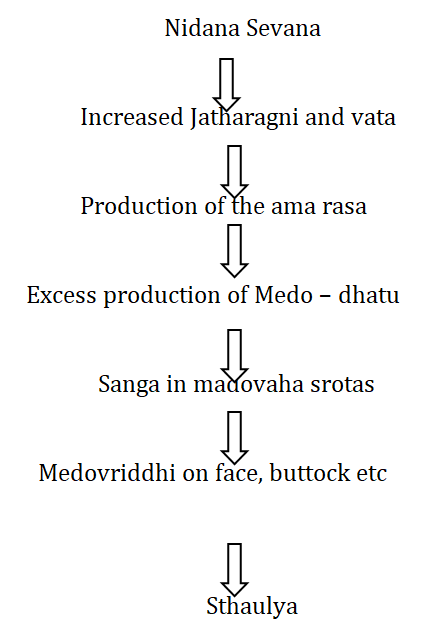
Samprapti Ghataka
- Udhbhav sthan - amashaya
- Adhisthan – sarv sarira specially abdomen, buttock
- Dosha – tridosha specially kapha and vata
- Dushya – rasa, meda, mansa dhathus
- Srotas – medovaha
- Type of the Srotas dushti – sanga
- Agni – initially mandagni, later on tikshnagni
- Vyadhi svabhav – darun
Clinical Features
Obese child becomes incapable of all activities due to excess and disproportionate collection of fat in certain body parts viz buttocks, breasts, face, waist etc. Breast, buttock, abdomen and waist become large in size, bulky and pendulous and strength thereof is rendered disproportionate with the physical growth. Chin of obese child appears like double chin. Anthropological parameters like weight, height, mid arm circumference are observed excess to their normal limits. Laziness, restricted body movements, lethargy on little physical work, increased sleep hours, excessive hunger are among other features of obesity. Obstruction of the channels /srotas by kapha and meda, further worsens the condition as remaining other dhatus do not receive sufficient nourishment resulting in poor strength and stamina of the body resulting in decreased performance in all activities like outdoor games, swimming, walking, exercise etc. Child may also be suffered from diabetes, fever, abscess, diseases of vata origin and such other diseases (as intensity of all diseases may be severe in 11prevailing condition of obstruction of medo dhatu). This results in declined immunity due to obstruction of channels (Srotas).
Management of Childhood Obesity in Ayurveda
Ayurveda explains two main therapies for the treatment of sthaulya viz: Shamshodhana & Samshamana with nidan- parivarjana.
- Samshamana Therapy
- This is main treatment for sthaulya is to alleviate vata and kapha and which can reduce fat. In this therapy we use the medicine.
- Administration of bilvpapanchmula [14] with honey_, _takrarista and haritaki [15] with honey etc.
- Triphla, guggulu, gomutra, silajatu (mineral pitch), loharaja, rasanjana [16] (_best drug for obesity according to _acharyas), koradusaka, syamaka etc.
- Guduchi (tinospora cardifolia miers), musta (cyperus rotundus linn), haritaki (terminaliya chebula linn.), amalaka (emblica officinalis gaertn.) Should be intake_._
- Intake of prasatika (setaria italicas beauv.), priyarigu(aglaia roxburghiana mig.), mudga(phaseolus mango linn.), kulattha (dolichos biftorus linn.), seeds of adhaki (cajanus cajan millsp.), patola(trichosanlhes cucumerina linn.), vidanga (embelia ribes burm. F.) [17]
- Samshamana includes some medication like Amrutadi guggulu, Navak guggulu, Dashang guggulu [18] etc_._
- Charaka has given single mahakashaya of 10 drugs (Lekhaniya mhakashaya) [19] which is include in medhohara drugs, while Sushruta [20] have mentioned 8 and 10 Ganas respectively varunadi gana, shalasaradi gana, lodhradi gana, arkadi gana, mushkakadi gana, nyagrodhdi gana, tryushana gana, usgakadi gana.
Shamshodhana Therapy
- Shamshodhana includes Panchkarma therapy.
- In obesity langhana therapy indicated. Langhana refers to the procedure which brings about lightness in the body langhana therapy includes emesis, purgation, niruha basti, nasya etc.
- Drugs are used in enema hot, sharp, ununctuous drugs use which is called lekhaniya basti [21].
Nidan-parivarjana
The nidan-parivarjana is best way for reduce weight. So All cause which produce obesity should be avoided.
Ahara
- Madhura, Sheeta (Cold drinks and cold food), Snigdha (oily food), Guru ahaara(heavy food), Atiahara sought be avoided.
- Avyayama and Diwvaswapna after intake of food sought are avoided.
- Before meal drink water (lukewarm water) beneficial for obese person according to Acharya sushruta [22].
- After taking food sought not drink water within half hour due to its diluted digestive enzymes.
- Fiber rich fruits and food are beneficial for obese person e.g: salad, papaya, apple, orange, soybeans, pulses, yava, wheat, mudga, koradusaka, syamaka etc.
Anupana
Lukewarm water, honeywater, triphala kwatha with honey, takra, cumin water and juice of aginimanth (clerodendrum philomidis [23] linn. F) and alcoholic preparations that help to reduce fat, kapha like-cumin preparation, dasmularista etc that help to reduce fat and kapha.
Vihara
- Healthy lifestyle is beneficial for all health problems. Vyayama offers relief in obese condition but children should not perform very tough exercise.
- Physical and mental exercises should be gradually increased.
- The dynamic series of Asanas. i.e. Surya Namaskar (Sun salutation) is the best way to burn calories and reduce weight in obesity and other way are running outdoor games, swimming
Divaswapna
Day time sleep increases kapha dosha also imbalances agni which increases medha dhatu or body fat [24]. Day time sleep, excessive sleep, stress should are avoided.
Discussion and Conclusion
Ayurveda is a science which deals about the life. There are three causes described in Ayurveda that is asatmyaindiyaartha, prgyaapradha and parinam. In simple language we can say it's as aharinya, viharjinya and Kalaja causes. Health and diseases depend upon above these. If we use them in adequate quantity and quality, we shall be healthy. Obesity is a lifestyle disorder and have numerous treatment options in modern system of medicine but they reduce the patients’ weight partially in sometime. Beside in Ayurveda we can treat them on Ayurvedic principles which is not only reduce weight but also maintain it forever.
In classical texts of Ayurveda Obesity is mentioned as Sthaulya. Sthaulya has been included by asthtauninditiya purusha, medoraga (excess fat accumulates in body), santarapanajanya vikara and rasapradoshaja vikara. Sthaulya is abnormal and excess accumulation of medadhatu in various body parts. Obesity means having too much body fat.
In modern system of medicine, treatment for obesity is however available but has limitations. Clinical study of childhood obesity is the need of time for protection from various health hazards caused by the obesity. So children and parents prefer Ayurvedic management. Ayurveda explain two main therapies for the treatment of Sthaulya viz: Shamshodhana & Samshamana with nidanprivarjana.
References
-
Shastri K, Chaturvedi G (2011) Charak Samhita, Vidhyotini hindi commentary, Published By Chaukhamba Bharti Academy, Varanasi, Sutra Sthan, Adhyaya 23: 436.
-
Shastri AD (2017) 1st (Edn.), Vol-1, Sushruta Samhita of Sushruta, sutrasthana sthan Chapter 15, verse 32-33. Varanasi: Chaukhambha Sanskrit Santhan, pp: 81.
-
Samhita K, Tanta VJ, Sharma PH (2018) Vidhyotini Hindi commentary, published by Chaukhambha Sanskrit Series, Varanasi, chapter 28 pp: 80.
-
Krishnamurthy KH (2000) Bhela samhita English commentary by chaukhambha visvabharati Varanasi (India) Editor Prof. priya vrat Sharma.
-
Shastri K, Chaturvedi G (2011) Charak Samhita, Vidhyotini hindi commentary, Published By Chaukhamba Bharti Academy, Varanasi, Sutra Sthan, Adhyaya 21: 407.
-
Shastri K, Chaturvedi G (2011) Charak Samhita, Vidhyotini hindi commentary, Published By Chaukhamba Bharti Academy, Varanasi, Sutra Sthan, Adhyaya 20: 404.
-
Sharma RK (2011) _Charak smhita_ English commentary based on Cakrapani datta’s _ayurveda dipika_ by chokhamba Sanskrit studies vol. XCIV in _sutrasthana_ capter 21.
-
(1946) World Health Organization constitution of the World Health Organization as adopted by the international health conference, New York by the representatives of 61 states.
-
Gupta P (2020) PG Textbook of pediatrics 2nd (Edn.), The Health Science Publisher New Delhi/London/ Philadelphia/Panama chapter 4.
-
Gupte S (2020) The short text book of pediatrics 12th (Edn.), The Health Science Publisher New Delhi/ London/ Philadelphia/Panama chapter 4, pp: 75.
-
https://www.cdc.gov/obesity
-
Sharma RK (2011) _Charak smhita_ English commentary based on Cakrapani datta’s _ayurveda dipika_ by chokhamba Sanskrit studies vol. XCIV in _sutrasthana_ capter 2, pp: 18-19.
-
Murthy SKR (2010) _Susruta samhita_ English commentary by chokhamba orientalia, _sutrasthana_ capter 15, pp: 107
-
Shastri K, Chaturvedi G (2011) _Charak Samhita_, _Vidhyotini_ hindi commentary, Published By Chaukhamba Bharti Academy, Varanasi, _Sutra Sthan, Ashtonindityam_ _Adhyaya_ 21: 415.
-
Shastri K, Chaturvedi G (2011) Charak Samhita, Vidhyotini hindi commentary, Published By Chaukhamba Bharti Academy, Varanasi, Sutra Sthan, Santarpaniyam- Adhyaya 23: 437.
-
Shastri K, Chaturvedi G (2011) Charak Samhita, Vidhyotini hindi commentary, Published By Chaukhamba Bharti Academy, Varanasi, Sutra Sthan, langhanbranghniya- Adhyaya 22: 427.
-
Shastri K, Chaturvedi G (2011) Charak Samhita, Vidhyotini hindi commentary, Published By Chaukhamba Bharti Academy, Varanasi, Sutra Sthan, Adhyaya 21: 415.
-
Sankara Misra BSBP (2001) Bhavaprakasa with Vidyotini hindi commentary by Chaukhambha Sanskrit Sansthan Varanasi 221001, Shouly Adhikar chapter 39, pp: 30.
-
Shastri K, Chaturvedi G (2011) _Charak Samhita_, _Vidhyotini_ hindi commentary, Published By Chaukhamba Bharti Academy, Varanasi, _Sutra Sthan_ 4: 72.
-
Murthy SKR (2010) Susruta samhita English commentary by chokhamba orientalia, _sutrasthana_ capter 38.
-
Shastri AD (2017) 1st (Edn.), Vol-1, Sushruta Samhita of Sushruta, _sutrasthana_ _sthan_ Chapter 15, verse 32-33. Varanasi: Chaukhambha Sanskrit Sansthan, pp: 82.
-
Shastri AD (2017) 1st (Edn.), Vol-1, Sushruta Samhita of Sushruta, _sutrasthana_ _sthan_ Chapter 46/444, verse 32- 33. Varanasi: Chaukhambha Sanskrit Sansthan, pp: 281.
-
Sharma AP (2009) Dravya guna second part, Chowkhmbha Bharti academy Varanasi.
-
Shastri K, Chaturvedi G (2011) _Charak Samhita_, _Vidhyotini_ hindi commentary, Published By Chaukhamba Bharti Academy, Varanasi, _Sutra Sthan, Ashtonindityam_ _Adhyaya_ 21/44, pp: 419.
- Management of Ear Keloid with Ksharsutra: A Case Study
- Yoga and Global Sustainability: A Holistic Path to One Earth, One Health
- Autoimmune Diseases in Ayurveda: A Narrative Review with Classical and Modern Perspectives
- Management of Cluster Headache Associated with Pituitary Apophysitis by CERT (Chakrasiddh Energy Release Technique): A Case Report on Energy Rebalancing
- Zygophyllum Geslini Coss : Biochemicals and Antioxidant Activity
- Observations of a Beginner Vaidya