
Phytochemical Screening, in Vitro Evaluation of Antifungal Activity and Acute Toxicity of Extracts of Vitellaria Paradoxa C.F. Gaertn (Sapotaceae) on The Strain of Candida Albicans
In sub-Saharan Africa, the bark of Vitellaria paradoxa C.F. Gaertn (Sapotaceae), commonly known as Karité, is used in the treatment of many skin and digestive ailments. In order to justify this traditional use, the present study was undertaken to evaluate the method of preparation, the antifungal activity, the chemical composition and the acute toxicity of the bark of Vitellaria paradoxa on Candida albicans. Total aqueous (LeA) and 70% ethanolic (LeE) extracts of the bark of Vitellaria paradoxa were prepared and tested in vitro. Ethanolic extract (LeE) showed the highest yield (55.5%) and was found to be more effective on the growth of Candida albicans with a minimum fungicidal concentration (CMF) value of 1.56 ± 0.02 mg / ml and a 50% inhibitory concentration (IC50) of 0.39 ± 0.21 mg / ml, certainly justifying the use of the plant in traditional medicine. At the end of the acute toxicity assessment test, the LD50 was estimated to be greater than 2000 mg / Kg orally. The phytochemical screening of the various extracts showed the presence of chemical compounds which justify their antifungal activities by the use of Vitellaria paradoxa. This work has provided a scientific basis for the use of Vitellaria paradoxa in traditional pharmacopoeia, particularly in the treatment of fungal pathologies.
Introduction
Many diseases affect people and animals. Indeed, those caused by pathogenic fungi as a result of circumstances favorable to their multiplication, have increased in recent years given the increase in deep mycotic, visceral and septicaemic locations.
Certain species of genera such as Candida have a high frequency in human pathology, in particular in fungal infections, allergies and poisoning [1, 2]. It is a normally saprophytic and harmless filamentous yeast which can become pathogenic when the host organism presents favorable conditions. This results in the development of an infection called candidiasis [3]. Candida is responsible for candidiasis, 54.3% of which is due to the species Candida albicans [4].
Current treatment for vaginal candidiasis aims to reduce the rate of morbidity, mortality and serious infections or complications from certain diseases. In general, wealthy populations have recourse to modern medicine in the event of this pathology by taking antibiotic drugs, injections, examinations and clinical diagnoses. However, some of these antifungal molecules present on the market and used in therapy have lost their effectiveness due to resistance phenomena. These difficulties also take into account the high cost of modern medicines, which is therefore out of reach for low-income African populations [5]. As a result, these populations are increasingly using medicinal plants to treat themselves. According to the annual report of the World Health Organization (WHO), about 80% of this population use plants for self-healing [6, 7]. But the misuse of these plants exposes them to various accidents because in addition to the active ingredients, traditional medicines contain other molecules, some of which have toxic effects.
Vitellaria paradoxa C.F. Gaertn is a Sudano-Zambezian species distributed in the dry regions of the savanna belt of West Africa, west of Senegal to eastern Sudan and Ethiopia. Vitellaria paradoxa C.F. Gaertn belonging to the Sapotaceae family, is a small to medium-sized tree, 10 to 15 m high, very branched, dense, spreading, round with a hemispherical crown. Commonly called «shea», it has many applications in traditional medicine. In some African countries, the aqueous extract of Vitellaria paradoxa stem bark is commonly used for the treatment of certain conditions such as diarrhea, dysentery, human neutrophils as well as on other immune cells [8]. The neutrophil is one of the immune cells responsible for killing different types of intracellular or extracellular pathogenic agents in tissues by oxidation or non-oxidation [9]. One study reported that prolonged administration of Vitellaria paradoxa stem bark extract would decrease the number of white blood cells [10].
Although antimicrobial studies have been carried out on this plant, it should be noted that those relating to antifungal activities are rare, in particular on Candida albicans. To remedy this, the present study therefore proposes to study the methods of preparation of the bark of Vitellaria paradoxa, to evaluate its antifungal activity in vitro on Candida albicans, to carry out the phytochemical screening and to study the toxicity of extracts of this plant in vitro partially validates its use in traditional medicine.
Material and Methods
Material
Plant Material: The plant material was a plant powder obtained from the bark of Vitellaria paradoxa. Fungal Material: The biological material consisted of a strain of Candida albicans (an opportunistic fungus responsible in large part for candidiasis) and rats (Rattus norvegicus, Muridae. The strain of Candida albicans was provided to us by the Diagnostic and Research Center on AIDS (CEDRES) at Treichville University Hospital (Abidjan, Côte d’Ivoire) It was isolated from a patient coming from the infectious diseases department.
Animal Material
As for the animal material, it consisted of the WISTAR strain of rats Rattus norvegicus (Muridae). These 6-8 week old rats are nulliparous and non-pregnant with a weight between 120 and 140 g, used for acute oral toxicity testing. These animals from the vivarium of the Normal Higher School (ENS) of Abidjan were acclimatized at least 5 days before the start of the experiment. The choice of this animal species was based on the availability and its strong use in toxicology and pharmacology. The room temperature was 26-30°C, humidity 40-60%, and the lighting was 12 hours light and 12 hours dark. They had free access to food (bakery bread, corn, fish and FACI® pellets) and had tap water in baby bottles.
Methods
Ethnobotanical Survey
The ethnobotanical investigations were carried out in nine (9) sub-prefectures (Bassawa, Boniérédougou, Dabakala, Foumbolo, Niéméné, Sokala-Sobara, Satama-Sokoro, Satama- Sokoura, and Yaossédougou) of the Department of Dabakala located in Center-North of the Ivory Coast. The survey method was a semi-structured interview based on a survey form. It was done in the local language (Djimini) with the help of a guide-interpreter. It allowed to determine the importance of the use of the barks of Vitellaria paradoxa in the medicinal recipes of the matrons for various infections.
Plant Collection
This specimen was collected in September 2018, in the Department of Dabakala (Hambol region). The identification of this plant was made using the flora of Aké-Assi [11, 12] and Arbonnier [13] and verification at the National Floristic Center (CNF). The taxonomic families of species have followed the APG IV classification [14]. After harvesting, the bark was freed from impurities, dried in the shade and in the open air for two to three weeks and then pulverized using an electric grinder (RETSCH GM 300, France). The resulting fine powder was stored in a glass jar to prevent mold.
Preparation of Extracts
The extracts were prepared according to the method developed by Zirihi, et al. [15]. Each ground material obtained was macerated at a rate of 100 g of powder in one liter of distilled water, using a mixer (Blender) for three times 3 min, according to the method of Zirihi, et al. [15]. The obtained homogenate was successively filtered twice through cotton wool and once through 3mm Wathman filter paper. The various filtrates collected were evaporated in an oven at 50°C. The powder thus obtained constitutes the total aqueous extract.
The previous operation is repeated but the solvent used here changes. In fact, the powder obtained in an amount of 100 g was dissolved in a liter of distilled water, using a mixer (Blender) for three times 3 min, according to the method of Zirihi, et al. [15]. The obtained homogenate was successively filtered twice through cotton wool and once through 3mm Wathman filter paper. The evaporate was collected as a powder which constituted the total ethanoic extract (eth). These extracts thus obtained were weighed with a view to evaluating their yield. They were then stored in sterile glass jars at -4°C for future use. In total, two plant extracts were produced.
Calculation of Yield
The yield is the amount of extract obtained from the vegetable powder. It is expressed as a percentage and calculated according to the following formula:
R = m / M x 100 R: extraction yield; m: mass of the extract; M: mass of fine powder
Phytochemical Screening
Phytochemical sorting was carried out in order to highlight some major chemical groups found in plants [16, 17].
Identification of Alkaloids
To five ml of extract concentrated (evaporate to dryness). The residue obtained was dissolved in 3 mL of HCl diluted to 2%. Then a few drops of Mayer’s reagent were added. The appearance of a precipitate or a white-cream color indicates the presence of alkaloids. To 2ml of plant extract, 5 drops of each reagent are added. Depending on the nature of the reagent, various colorations are obtained in the presence of alkaloids. Two of the three reagents were used to characterize the alkaloids. Those are:
- Dragendorff’s reagent (yellow-orange precipitate);
- Bouchardat’s reagent (brown-black, dull-brown or yellow-brown precipitate).
Demonstration of Flavonoids
The flavonoids were first identified by a general reaction to soda, then the different classes were characterized.
Soda Test (General Reaction)
In a tube containing 2ml of plant extract solution, a few drops of a 1/10 soda solution were added. The yellow- orange color made it possible to characterize the presence of flavonoids.
Characterization of Flavonoid Classes
In the presence of 1N NaOH, concentrated HCl and magnesium clippings, the flavonoids gave characteristic coloring reactions. 2 ml of plant extract was introduced into 3 test tubes. 1 ml of NaOH, 1ml of distilled water and 1ml of concentrated HCl and magnesium cups were respectively added to the test tubes. In the presence of flavonoids, the following colorations: red, yellow-reddish, red to purplish red, dark red to purple or blue, yellow and pink can be observed. These colors correspond respectively to anthocyanins, flavones, flavonols, flavonones, isoflavones and leucoanthocyanins.
Demonstration of Sterols and Polyterpenes
In a tube containing 2ml of plant extract solution, a drop of concentrated sulfuric acid and a triperpene solution in choroform were added. The appearance of a color that is first yellow, then dark red indicates the presence of sterols and polysterols.
Identification of Polyphenols
To 2 ml of each solution was added a drop of 2% alcoholic ferric chloride solution. Ferric chloride causes in the presence of polyphenolic derivatives. The appearance of a more or less dark blackish-blue or green color.
Highlighting Tannins
Reaction to Lead Acetate 10%
1ml of 10% aqueous lead acetate solution was added to 3ml of the extract. The formation of a blue, black-blue, whitish or brownish precipitate indicates the presence of tannins.
Reaction with Ferric Chloride 1%
To 1 ml of extract was added 2 ml of distilled water and then 1 to 2 drops of 0.1% ferric chloride were added. The appearance of a blue, blue-black or black coloration indicates the presence of gallic tannins, the green or dark green (or greenish-brown) coloration indicates the presence of catechetical tannins.
Identification of Quinones
To 1ml of extract was added 1ml of sulfuric acid concentrate (H2SO4). The appearance of a red coloration indicates the presence of quinones.
Demonstration of Saponins
We put 5ml of each of the aqueous extracts into a test tube. The tube was shaken vigorously for 15 seconds and then allowed to stand for 15-60min. A height of persistent foam, greater than 1cm, indicates the presence of saponins.
Preparation of Culture Medium
Forty-two (42) grams of powdered agar of Sabouraud Chloramphenicol Agar medium (HIMEDIA / Ref: Mn1067- 500G Lot 0000215703) were dissolved until complete homogenization in one thousand (1000) ml of distilled water, on a magnetic stirrer IKA-MAG RCT. The solution obtained constitutes the culture medium. The medium thus prepared is poured into series of 10 tubes numbered from 1 to 10 at a rate of 20 ml in tube T1 and 10 ml in the other tubes (ranging from T2 to T10). For these series, two control tubes are noted, each containing 10 ml of the culture medium. One tube serves as a control for the growth of germs and the other as a control for the sterility of the culture medium [5, 18].
Sterilization
The 12 tubes of each series were sterilized in the autoclave (PBI STEMATIC III) at 121°C for 15 minutes and then tilted with small pellet at room temperature to allow cooling and solidification of the agar.
Incorporation of Plant Extracts into the Agar
The incorporation of the plant extracts into the agar was carried out using the double dilution method in slanted tubes [15, 19]. Each series included 10 test tubes containing the plant extract incorporated into the culture medium and 2 control tubes, one without plant extract for the growth control of germs, the other without plant extract or germ for the control of the sterility of the medium. Culture. The test tubes contained decreasing concentration ranges of the extracts which varied from 50mg/ml to 0.097mg/ ml with a geometric bond of half. To achieve the double dilution, 1 g of plant extract was homogenized in 20 ml of Sabouraud agar previously prepared in tube T1 (bearing the highest concentration: 50 mg/ml). Then half the volume of this homogeneous mixture was transferred into the following tube (T2), containing 10ml of Sabouraud agar and homogenized beforehand. This operation was repeated successively for the other tubes up to tube 10 (T10), with the lowest concentration (0.097 mg / ml); for the latter half of the volume of the mixture is rejected. The tubes thus prepared were sterilized at 121°C in an autoclave for 15 minutes and tilted with a small pellet to laboratory temperature to allow cooling and solidification of the agar.
Carrying out Antifungal Tests
The inoculum was prepared from young cultures of Candida albicans (48 hours old). The stock suspension (called 100) concentrated at 106 cells/ml was first prepared by homogenizing a colony of Candida albicans in 10 ml of sterile distilled water. From suspension 100, a second suspension (10-1) was prepared by diluting 1 / 10th of the first. The latter was concentrated at 105 cells / ml. After solidification of the agar and preparation of the inoculum, all tubes (T1 to T10 and the growth control control) except the sterility control control were inoculated in transverse streaks with 10 μl of a suspension containing approximately 1000 cells. For each series, the tests are repeated 3 times, for greater reliability, then the tubes thus prepared were incubated at 30°C. for 72 hours.
Enumeration of Colonies
At the end of the incubation time, colonies were enumerated by direct counting. The growth of the germs in the different experimental tubes of each series was expressed as a percentage of survival, calculated relative to 100% of survival in the growth control control tube according to the formula [15, 20]:
S = n / N x 100 n = number of colonies in the test tube; N = number of colonies in the control tube; S = survival of germs (in%).
Antifungal Parameters Sought
Data processing enabled the following antifungal parameters to be determined : • MIC (Minimum Inibitory Concentration): this is the concentration of extract in the tube for which there is no growth visible to the naked eye.
• IC50 (Concentration for fifty percent inhibition): this is the concentration which gives 50% inhibition. It is determined graphically from the plot of the sensitivity curve of each extract on Candida albicans.
• Fungicidism (CMF or CFS): after 72 hours of incubation, the surface of the agar contained in the test tubes which have resisted Candida albicans is lightly removed, inoculated using a platinum loop on neutral agar then incubated for 72 hours at room temperature. Two cases can arise [18, 5]:
• presence of Candida albicans colonies, the extract is said to be fungistatic. The CFS (Fungistatic Concentration) is thus determined.
• absence of Candida albicans colonies, the extract is said to be fungicidal. This last observation makes it possible to determine the CMF (Minimum Fungicidal Concentration which gives 99.99% inhibition compared to the control growth control tube).
• The sensitivity curve: it represents the evolution of the sensitivity of Candida albicans according to variations in the concentration of the extract.
Criteria for Comparing the Activities of Extracts
The comparison of the activities of the extracts was made on the basis of the values of the CMF and / or IC50. Thus an extract was considered more active than the others if and only if the value of its CMF and / or IC50 was lower than those of the others [5].
Acute Oral Toxicity
This study was conducted in accordance with OECD guideline 423, established by the acute toxicity class (OECD, 2001). Fifteen nulliparous, non-pregnant, virgin rats 6-8 weeks old with a weight between (120-140) were used for acute toxicity testing.
Consistent with the lethal dose 50 greater than 5000mg/ kg bw indicated by the work of Mainasara et al. (2016), for this study, the initial dose limit of 2000mg/kg bw was chosen from the following doses: 5.50, 300 and 2000mg/kg bw. The rats were fasted the day before, while leaving free access to water. Weighed, they were divided into five (5) batches of three rattes including a control batch and treated batches. Control lot 1 received 1 ml of distilled water. On the other hand, the different batches ranging from 2 to 3 treated respectively received a single dose of each aqueous and ethanolic extract (70%) of Vitellaria paradoxa orally through a gastric tube.
A new dose of 2000mg/kg of bw was administered to the 4 and 5 groups of three rats in order to carry out a repetition as recommended by the OECD guideline 423. Each animal received for this purpose 1ml/ 100g of the dose of 2000mg/ kg of bw of the different types extracted orally using a gastric tube. Observations were made after 30 minutes, 4 hours, 24 hours, one week and two weeks. During the treatment, the animals were weighed every other day at the same time. They underwent the same protocols and observations as the previous batches. The lethal dose 50 or LD50 was assessed using the OECD method 423 [21].
Statistical Analysis
Data analysis focused only on descriptive statistics methods. The data relating to the quantitative characteristics were entered using an Excel spreadsheet and the XLSTAT 2014 software. All the experiments were carried out in triplicate. The results are expressed as mean ± SD. Statistics were compiled, followed by graphical representations. Phytochemical screening is a chemical analysis based on coloring and precipitation reactions.
Results and Discussion
Yield of Extracts
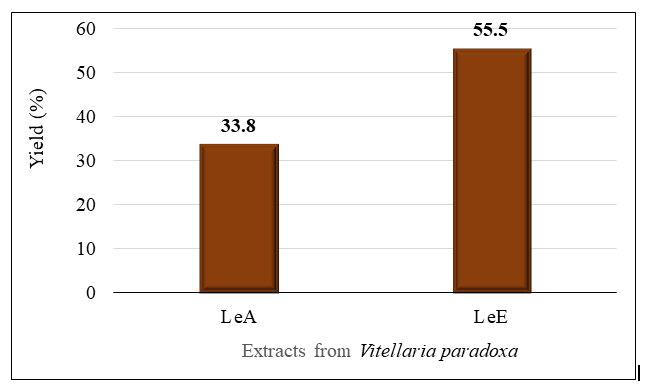
Extractions from the bark of Vitellaria paradoxa yielded extracts with variable colorations ranging from light brown to relatively dark brown with an average mass of 7g (total aqueous extract), 11g (ethanolic fraction). The values representing the average of the yields in percentage of the plant studied vary from 5 to 56.4% (Figure 1). These results show that the highest yield is observed with the 70% ethanolic fraction (56.4%) and the lowest yield with the aqueous extract (5%).
Acute Oral Toxicity
The administration of a high dose of 2000 mg / Kg of bw of the various extracts (aqueous and 70% ethanolic) of Vitellaria paradoxa did not cause any mortality in the treated animals. Observation of the animals (Table 1) after 30 min, 4 h, 24 h and regularly for 14 days showed no signs of toxicity (salivation, drowsiness, morbidity, coma, etc.). According to the globally harmonized classification system of the OECD, the LD50 would be greater than 2000 mg / Kg of pc.
| Observations | 30 min | 4h | 24h | 48h | 1 Week | 2 Weeks | ||||||
|---|---|---|---|---|---|---|---|---|---|---|---|---|
| C | T | C | T | C | T | C | T | C | T | C | T | |
| Fur | N | N | N | N | N | N | N | N | N | N | N | N |
| Eyes | N | N | N | N | N | N | N | N | N | N | N | N |
| Mucous | N | N | N | N | N | N | N | N | N | N | N | N |
| Salivation | N | N | N | N | N | N | N | N | N | N | N | N |
| Lethargy | - | - | - | - | - | - | - | - | - | - | - | - |
| Sleep | N | N | N | N | N | N | N | N | N | N | N | N |
| Coma | - | - | - | - | - | - | - | - | - | - | - | - |
| Convulsion | - | - | - | - | - | - | - | - | - | - | - | - |
| Tremor | - | - | - | - | - | - | - | - | - | - | - | - |
| Diarrhea | - | - | - | - | - | - | - | - | - | - | - | - |
| Morbidity | - | - | - | - | - | - | - | - | - | - | - | - |
| Mortality | - | - | - | - | - | - | - | - | - | - | - | - |
Table 1: Acute systemic toxicity outcome in rats after administration of a single dose of extract. Aq: Aqueous extract, eth : Eth
- T = Treated, N = Normal, - = Nothing, C = Control
- Phytochemistry of Selected Plant Extracts presence of several secondary metabolites (Table 2).
- The phytochemical screening carried out showed the
- Doses administered to 1 batch of 3 rats (mg/kg PC) and number of deaths
- Scientific names extracts administered
- 2000
- 2000
- Vitellaria paradoxa
- Aq
- 0
- 0
- Eth
- 0
- 0
Table 2: Acute systemic toxicity outcome in rats after administration of a single dose of extract.
Antifungal Activity of Extracts of Vitellaria paradoxa C.F. Gaertn
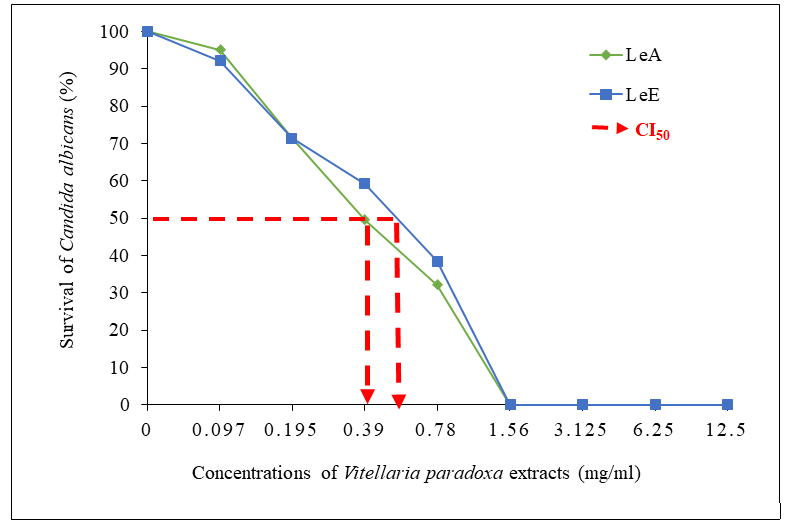
After 72 hours of incubation, clear and effective inhibitions were obtained at different concentrations depending on the extracts. We observed, compared to the control, a progressive decrease in the number of colonies in the different series as the concentration of each extract increased in the experimental tubes. From the colony count data, in the experimental tubes, the sensitivity curves of Candida albicans as a function of the concentration of the extracts of Vitellaria paradoxa were plotted (Figure 2). Overall, all the curves obtained show a decreasing pace, with more or less steep slopes depending on the extract. This reflects a clear antifungal activity of each extract of Vitellaria paradoxa. The curve of the antifungal activity of the 70% ethanolic fraction on Candida albicans has a relatively steep slope. It is followed by that of the total aqueous extract. The other 2 curves touch the x-axis at the same level. The antifungal parameters of the various CMF (Minimum Fungicidal Concentration) and IC50 (Concentration for 50% inhibition) extracts are summarized in Table 3. The lowest values of IC50 (0.39 mg/ml) and CMF (1.56) mg/ml) were obtained with the ethanolic fraction. This means that the LeE-coded ethanolic extract has better antifungal activity against Candida albicans. It is followed by the total aqueous extract denoted LeA with IC50 (0.58 mg/ ml) and CMF (1.56 mg / ml) (Table 4).
Alkaloids Sapono sides
- Types of Tanins
- Sterols and polyter penes
- Scientific names extract
- Poly phénols
- Flavo noids
- Types of flavonoids
- Tannins
- Quinones
- Cateche tical tannins
- Gallic tannins
- Drag
- Bou
- Vitellaria paradoxa
- LeA
- +
- +
- + isoflavones
- +
- +
- -
- +
- +
- +
- ++
- LeE
- +
- +
- + isoflavones
- +
- +
- -
- +
- +
- +
- NT
Table 3: Results of the phytochemical screening of crude aqueous and ethanolic extracts (70%) of Vitellaria paradox.
| Antifungal parameters (mg/ml) | ||||||
|---|---|---|---|---|---|---|
| Plants extracts | CMI | CMF S | CMF | CI 50 | Fungicide | |
| Vitellaria paradoxa | LeA | 1,56±1,25 | - | 1,56±0,15 | 0,58±1,00 | |
| LeE | 1,56±0,02 | - | 1,56±0,02 | 0,39±0,21 | Fungicide |
Table 4: Summary of the values of the antifungal parameters, extracts on Candida albicans. LeA : aqueous extract of Vitellaria pa
Discussion
Analysis of the results shows that apart from the aqueous extract of Vitellaria paradoxa (LeA), Candida albicans is sensitive to the 70% ethanolic extract of Vitellaria paradoxa (LeE) in a dose-response relationship. The inhibitory concentration values obtained attest that the extracts have more or less accentuated antifungal activities. In fact, these CMF values show that Candida albicans is sensitive to all the extracts tested. In general, extracts of Vitellaria paradoxa show a very interesting activity because they strongly inhibit the growth of Candida albicans. However, the comparison of the activities of the total aqueous extract and the ethanolic extract on the basis of the IC50, shows that the 70% ethanolic extract is more active than the aqueous extract. This could be explained by the fact that the active ingredients contained in the 70% ethanolic extract have a greater antifungal potential. In fact, the solvent of the hydroalcolic extract consisting of water and ethanol makes it possible to extract only small and medium-sized lipid compounds, polar, containing one or more oxygen atoms. On the other hand, water alone extracts only small amounts of lipid compounds, large and medium-sized sugars of varying complexity. This difference in the solvents of the extracts would explain the difference in the antifungal activity of our extracts [5]. By comparing the yields obtained during this study with those reported in the literature, we found that our results are different from those reported by Konan [22]. Indeed, this author has shown that the best yield is obtained with the extraction by aqueous maceration of the bark of Terminalia glaucescens. Differences in bark yield could be explained by where the species was harvested, when it was harvested and how long it dried. According to Bruneton [23], the extraction yields of plants are different depending on the species of the plant, the organ and the extraction solvent. The determination of the extraction yield makes it possible to evaluate the total extract of each species and organ of the plant, which makes it possible to estimate the quantity of the part of the plant to be harvested if necessary to allow the rational use of these plants species [24].
The phytochemical sorting carried out indicated the presence of alkaloids, polyphenols, tannins, sterols and polyterpenes, flavonoids and saponosides in the extract of the bark of Vitellaria paradoxa, which is similar to that of Assam. Indeed, these authors reported in studies that plant extracts whose compounds were composed of tannins, flavonoids and alkaloids would be endowed with fungicidal properties. Also, quinones are polyphenolic compounds known for their fungal properties (Bruneton, 2009) [23], which could justify the use of these plants for the treatment of the causes of female infertility or other bacterial diseases.
Alkaloids have several biological properties [25]. Our plant extracts are rich in alkaloids. According to Badiaga [26], alkaloids are highly sought after for their broad spectrum of biological activities including antibiotic, antiparasitic, anesthetic, antitumor, anticancer and analgesic, analgesic and spasmolytic properties. Their presence in these plants could help treat the causes of female infertility.
Thus, all the phytochemicals identified have interesting pharmacological properties and the use of the above- mentioned herbal drugs in the treatment of pathologies could be justified by their richness in these various elements. Indeed, the therapeutic action of plants results from the combination of these phytochemical elements or secondary metabolites synthesized by plants [27].
At the end of the acute toxicity assessment test, the LD50 was estimated to be greater than 2000 mg / Kg orally. According to the Globally Harmonized Classification System for the Labeling of Chemicals OECD [21], these extracts may be classified in Category 5 of low or no toxic substances or not classified. According to the Hodge and Sterner [28] toxicity scale, estimating the LD50 above 2000 mg/Kg shows that the above extracts are relatively harmless. The dose of 2000 mg/kg of bw would be below the maximum tolerated dose (MTD). Our results are similar to those obtained by Mainasara, et al. [29] who also showed that the LD50 of the methanolic extract of Vitellaria paradoxa bark was greater than 2000 mg / kg.
The efficacy of a substance in pharmacology is not sufficient to justify its possible introduction into therapy. Indeed, in addition to the effectiveness, there must not occur, for the active dose, toxic and harmful effects for the body. It is therefore necessary to define the benefit-risk ratio in the therapeutic indication of each substance [30]. This can only be achieved through two types of study which are, on the one hand, efficacy in animals (experimental pharmacology) and in humans (clinical pharmacology). On the other hand, it involves conducting a safety study in animals (toxicology) and in humans (adverse effects) [31, 32, 33, 34]. Toxicology therefore ensures the safety of medicinal plants. Ultimately, it must provide phytotherapy and the consumption of plants with a certain guarantee and a certain guarantee [30].
Conclusion
This study made it possible to demonstrate the antifungal potential and the toxic nature of Vitellaria paradoxa. She also revealed that Vitellaria paradoxa is mainly used as a decoction. We will retain that the 70% ethanolic extract gave the best in vitro anticandidosis activity of Candida albicans at 72 hours of incubation. The extraction method that combines the use of a 70% ethanol and 30% water solvent is the right combination that better concentrates the active compounds. In sum, the plant tissues of Vitellaria paradoxa contain secondary metabolites with antifungal activities and therefore constitute sources of natural bioactive molecules to fight against pathogens that cause diseases in plants and humans. In addition, further study by phytochemical, will allow us to isolate the active molecules of Vitellaria paradoxa in order to justify its multiple biological activities and its therapeutic indications in traditional medicine.
Conflicts of Interest
Not applicable
Acknowledgements
Our thanks go to the village chiefs, community counselors, community health workers (CHWs) as well as traditional birth attendants for their accessibility, availability and frank collaboration in this study. We also thank the NGO CASES (Center for Health and Social Studies) which was in favor of carrying out this study. Finally, we would like to thank Mr. late ASSI Yapo Jean, Botanist technician at the National Floristic Center, Félix HOUPHOUET-BOIGNY University for his contribution to the identification of the plants listed.
Funding
This study was funded by the NGO CASES (Center for Health and Social Studies) for the collection of data in the field.
References
-
Mogode DJ (2005) Phytochemical and pharmacological study of Cassia nigricans Vahl (Caesalpiniaceae) used in the treatment of dermatoses in Chad. PhD thesis in Pharmacy, University of Bamako, Mali, pp: 234.
-
Igor PLB (2003) Study of the biological activities of Fagara xanthoxyloids Lam. (Rutaceae). PhD thesis in pharmacy, Bamako, Mali, pp: 133.
-
Odds FC (2010) Molecular phylogeneticcs and epidemiology of Candida albicans. Future Microbiology 5(1): 67-79.
-
Dromer F, Lortholary O, Bretagne S, Hermosa GD, Ollivier DM, et al. (2013) National Reference Center for Invasive Mycoses and Antifungals. Annual activity report. Institut Pasteur France networks, pp: 49.
-
Ahon GM (2014) Evaluation and optimization test of the antifungal activity of extracts of Terminalia superba Engl. and Diels (Combretaceae) on the in vitro growth of Aspergillus fumigatus, Candida albicans and Cryptococcus neoformans. PhD thesis from Félix Houphouët-Boigny University, Abidjan, Côte d’Ivoire, pp: 117.
-
WHO (2003) Essential Drugs and Pharmaceutical Policies: Supporting Countries to Reduce Lack of Access to Medicines. WHO: Geneva, Switzerland, pp: 20
-
Elujoba AA, Odeleye OM, Ogunyemi CM (2005) Traditional medecine development for medical and dental primary health care delivery system in Africa. AJTCAM 2: 46-61.
-
Ambe ASA, Camara D, Ouattara D, Yapo CY, Soumahoro A, et al. (2016) Ethnobotanical study, in vitro evaluation of the antifungal and cytotoxic activity of extracts of Enantia polycarpa (dc) engl. and diels (annonaceae). International Journal of Biological and Chemical Sciences 10(1): 23-34.
-
Bhansali RS, Yeltiwar RK, Bhat KG (2013) Assessment of peripheral neutrophil functions in patients with localized aggressive periodontitis in the Indian population. J Indian Soc Periodontol 17(6): 731-736.
-
Ayakunle AA, Kalawole OT, Adesokan AA, Akiinbinn MO (2012) Antibacterial activity and sub chronic toxicity studies of Vittelaria paradoxa stem back extract. J of Pharm and Toxicology 7(6): 298-304.
-
Ake-Assi L (2001) Flora of Côte d'Ivoire 1&2, systematic catalog, biogeography and ecological. Conservatory and Botanical Gardens, Geneva, Switzerland 1: 139.
-
Ake-Assi L (2002) Flora of Côte d'Ivoire 1&2, systematic catalog, biogeography and ecological. Conservatory and Botanical Gardens, Geneva, Switzerland 2: 401.
-
Arbonnier M (2000) Trees, Shrubs and Lianas of the Dry Zones of West Africa. CIRAD: Paris, pp: 541.
-
APG IV (2016) An update of the Angiosperm phylogeny group classification for the orders and families of flowering plants: APG IV. Botanical Journal of Linnaean Society 181(1): 1-20.
-
Zirihi GN, Kra AM, Guina GF (2003) Evaluation of the antifungal activity of Microglossa pyrifolia (Lamarck) O. Kunze (Asteraceae) <<PYMI>> on the in vitro growth of Candida albicans. Pharmacopoeia and African Traditional Medicine 17: 11-18.
-
Kone WM, Atindehou KK, Tere H, Traore D (2002) Some medicinal plants used in traditional pediatrics in the region of Ferkessedougou (Ivory Coast). Proceedings of the international conference, Swiss Center of August 27-29, 2001, University Publishing of Côte d’Ivoire, BIOTERRE, Revue des Sciences de la Vie et de la Terre, Special issue, pp: 30-36.
-
Usman R, Khan A, Gul S, Rauf A, Muhammad N (2012) Preliminary anti-oxidant profile of selected medicinal plants of Pakistan. Middle-East Journal of Scientific Research 1(2): 24-27.
-
Coulibaly K (2012) Botanical, pharmacological and phytochemical studies of extracts of Terminalia ivorensis and Terminalia superba, two commercial woody species, medicinal antimicrobials from the forest of Mopri. Tiassale (south of the Ivory Coast). Thesis, Felix Houphouet-Boigny University, Abidjan, Côte d'Ivoire, pp: 200.
-
Ackah JAB, Kra AKM, Zirihi GN, Guina GF (2008) Evaluation and optimization tests of the anticandidosis activity of Terminalia catappa LINN (TEKAM3), an extract of combretaceae from the Ivorian pharmacopoeia. Bull Soc Roy Scien Liege 77: 120-136.
-
Ackah JA (2004) Anti-infective spectrum of MISCA-F3 on the in vitro growth of Candida albicans, Aspergillus fumigatus, Cryptococcus neoformans, Trichophyton mentagrophytes and Trichophyton rubrum. DEA thesis in biotechnologies, pharmacology-microbiology option. University of Cocody, Abidjan, Côte d’Ivoire, pp: 34.
-
OCDE (2001) Guidelines for the testing of chemicals, revised draft guidelines 423; acute oral toxicity-acute toxic class method, revised document, pp: 14.
-
Konan KF (2015) Antibacterial activity on extended spectrum beta-lactamase-producing Enterobacteriaceae, and in vitro antioxidant potential of Terminalia glaucescens Planch ex Benth. (Combretaceae), a West African medicinal plant. Doctoral thesis in biochemistry, specialty Pharmacology of Natural Substances from the University Félix Houphouët-Boigny, Abidjan, Côte d’Ivoire, pp: 183.
-
Bruneton J (2009) Pharmacognosy-Phytochemistry, Medicinal plants. Tec & Doc-International Medical Editions, pp: 1288.
-
Kpemissi A (2007) The Anacardiaceae of Togo: botanical, ecological studies and antifungal properties. Doctoral thesis from the Universities of Reims Champagne- Andenne and Lomé. Togo, pp: 80-83.
-
Okwu DE (2007) NMAP. Science and Biotechnology 1(1): 90-96.
-
Badiaga M (2011) Ethnobotanical, phytochemical and biological study of Nauclea latifolia Smith, an African medicinal plant collected in Mali. University of Bamako, pp: 136.
-
Lagnika L, Amoussa AMO, Adjileye RAA, Laleye A, Sanni A (2016) Antimicrobial, antioxidant, toxicity and phytochemical assessment of extracts from Acmella uliginosa, a leafy-vegetable consumed in Benin, West Africa. BMC Complementary and Alternative Medicine 16: 34.
-
Hodge HC, Sterner JH (1943) Determination of substances acute toxicity by LD B50B. Amer. American Industrial Hygiene Association 10: 93.
-
Mainasara AS, Oduola T, Musa U, Mshelia AS, Muhammed AO, et al. (2016) Hepatotoxicity Assessment in Wistar Rats Exposed to Vitellaria paradoxa Stem Bark Extract. European Journal of Medicinal Plants 13(3): 1-9.
-
Bounihi A (2015) Phytochemical screening, toxicological study and pharmacological valuation of Melissa officinalis and Mentha rotundifolia (Lamiaceae). Doctorate Thesis in Pharmacy. Mohammed V, Rabat University (Morocco), pp: 199.
-
Buenz EJ (2006) Hepatocytes detoxify Atuna racemosa extract. Exp Biol Med (Maywood) 231(11): 1739-1743.
-
APG III (2009) An update of the Angiosperm Phylogeny Group classification for the orders and families of flowering plants: APG III. Botanical Journal of the Linnean Society 161(2): 105-121.
-
Lagane C (2007) Role of il-13 and PPAR-γ ligands in the anti-infective response of murine macrophages and human monocytes against Candida albicans. Involvement of PPAR-γ. Doctoral thesis in Life and Health Sciences, discipline : immunopathology, oncogenesis and cell signaling. University of Toulouse III, France, pp: 151.
-
Martine J (2007) Mycology course 2nd year BTS ABM. Lycee Paul Eluard St Denis, France, pp: 53.
- Management of Ear Keloid with Ksharsutra: A Case Study
- Yoga and Global Sustainability: A Holistic Path to One Earth, One Health
- Autoimmune Diseases in Ayurveda: A Narrative Review with Classical and Modern Perspectives
- Management of Cluster Headache Associated with Pituitary Apophysitis by CERT (Chakrasiddh Energy Release Technique): A Case Report on Energy Rebalancing
- Zygophyllum Geslini Coss : Biochemicals and Antioxidant Activity
- Observations of a Beginner Vaidya