
A Systematic Review on Therapeutic Potential of Shwaskuthara Rasa
Herbomineral formulations in Ayurved are known for their potency in fewer doses. Shwaskuthara Rasa is one of the herbomineral formulations used very widely in practice. The systematic study was planned to explore the therapeutic potential of the Shwaskuthara Rasa based on Ayurvedic and contemporary assessment parameters from the clinical researches conducted previously with the help of various database. To review the clinical effects of Shwaskuthara Rasa in different diseases based on different assessment parameters, exact dose, duration, Anupana (vehicle) and it’s safety, the articles published in PubMed, Google scholar, Google and ClinicalTrials.gov database and AYUSH online research portal were searched, collected, segregated, analyzed and interpreted. It was observed that Shwaskuthara Rasa is safe and efficacious as a single as well as an adjuvant therapy. But the evidences are scanty to establish the clinical potential of Shwaskuthara Rasa as only seven researches are available with less sample size. Hence, studies are recommended in larger samples in comparison with the standard line of treatment in mild, moderate and severe cases so that it may be useful in emergency condition to treat attacks of Asthma.
Aim
The aim of the present study is to collect the scientific evidences proving the therapeutic efficacy of Shwaskuthara Rasa in different diseases.
Objective
To review the clinical effecacy of Shwaskuthara Rasa in different diseases based on different assessment parameters, exact dose, duration, Anupana (vehicle) and its safety.
Introduction
Ayurved is the one of the oldest and most widely practiced Indian system of medicine. According to WHO, up to 80% of the world’s population relies on traditional medicine for their health care needs with, 35% of developed countries populations reporting use of complementary and alternative medicines [1, 2, 3]. Ayurveda mainly aims to improve health through the use of effective rejuvenators, through proper diet and good quality medicine (Ayurvedic formulations). For this purpose Ayurveda has chosen all possible dravyas (materials) from three natural resources i.e. herbal, mineral and animal origin. Sometimes visha dravyas (Poisons) are also mentioned in Ayurvedic formulation. In Ayurvedic classics after proper shodhana (processing), many visha dravyas are used as Aushadha Dravya. According to Ayurved, shodhana is not only the process of detoxification, but also a process of samskara potentiating the therapeutic efficacy). Visha having following gunas ( properties) like, Laghu, Ruksha, Ashu, Vishada, Vyavayi, Tikshna , Vikasi, Sukshma, Ushna and Anirdeshya rasa [4]. According to Rasashastra, metals are prescribed in formulation with minimal doses because they are readily absorbable, adaptable, and non-toxic due to their ability to act as a catalyst, increasing metabolism at a cellular level, capacity for targeted and controlled drug delivery and immuno modulatory quality [5]. There are so many formulations given in classical texts which contain combination of vegetable poison, metals and minerals. Mercury, lead, Arsenic and Copper are the most widely used heavy metals for drug preparation in Ayurveda.
One of the herbomineral formulations Shwaskuthara Rasa, contains Purified Vatsanabha (Aconitum ferox Linn), Purified Parada (Mercury), Purified Gandhaka (Sulphur), Tankana (Borax), Purified Manahsila (Arsenic disulfide). Pippali (Piper longum Linn), Marich (Piper nigrum Linn), Shunthi (Zingiber officinalis Linn), It is one of the reputed Ayurvedic preparation mentioned in classical texts for the treatment of Cold, Asthma, Bronchitis, Anorexia, indigestion. According to Yogratnakar, Shwaskuthara Rasa is used in Kasa, Shwasa, Mandagni and diseases of Vat and kapha pradhan dosha dushti [6]. Review of literature revealed that Shwaskuthara Rasa, apart from treating asthma and allergy, is used for the cure of cough, laryngitis, tuberculosis, unconsciousness, mental disorders, coma, chest burn, and heart diseases [7].
Shwaskuthara Rasa is a khalveeya Rasayana mentioned in almost all classical texts. Shwaskuthara Rasa, Maha Shwasakuthara Rasa, Bruhat Shwasakuthara Rasa and Shwasari Rasa are the different names assigned to it. The Ingredients remain same in all texts, but the quantity of Maricha, Pippali and Shunthi varies from text to text. Maricha considered as a chief ingredient in maximum texts which varies from one part to ten parts. Pippali (Piper longum L), Shunthi (Gingiber officinale L), varies from one part each to six parts each. This is the safe and effective formulations indicated for Shwasa and Kasa. The name itself indicates that it is strong like an axe which eliminates the Shwasa vyadhi completely. The dose of Shwaskuthara Rasa varies from ½ Gunja (60mg) to 5 Gunja (600mg).
Most of the researches are conducted on pharmaceutical standardization of Shwaskuthara Rasa [8, 9, 10]. Among them, Shwaskuthara Rasa prepared by adding 8 parts of Maricha one by one showed increase in Piperine % and proved to be efficacious in low dose. Even it was proved more effective in protecting against histamine induced bronchospasm in experimental animal model. It has increased bioavailability to mercury and is found more efficacious in controlling the signs and symptoms of Shwasa. The formulation was found safe in acute and subacute toxicity studies [11]. It was proved effective against only three strains of Staphylococcus aureus [12]. Antitussive action of Shwaskuthara Rasa is proved in animal model [13]. The present study was planned to explore the therapeutic potential of the Shwaskuthara Rasa based on Ayurvedic and contemporary assessment parameters from the clinical researches conducted previously with the help of various database.
Materials and Methods
The articles published in PubMed, Google scholar, Google and ClinicalTrials.gov database and AYUSH online research portal were searched for this article with print journals, periodicals and reports. The key words used for database search were “Asthma and Shwaskuthara Rasa”, “Cancer and Shwaskuthara Rasa” and “clinical study of Shwaskuthara Rasa”.
Eligibility Criteria: 1. Eligible study type: Clinical trial study. Pharmacological and animal studies were excluded. 2. Eligible study participants: individuals of any age, gender or nationality. 3. Eligible study interventions: Shwaskuthara Rasa. 4. Type of outcome measures: Efficacy of Shwaskuthara Rasa in any disease.
Observation
This search process for systemic review was done as per “preferred Reporting Items for Systemic Review and Meta- Analysis guidelines”. All selected articles were screened finally by reading available matter and analyzed further.
Results and Discussion
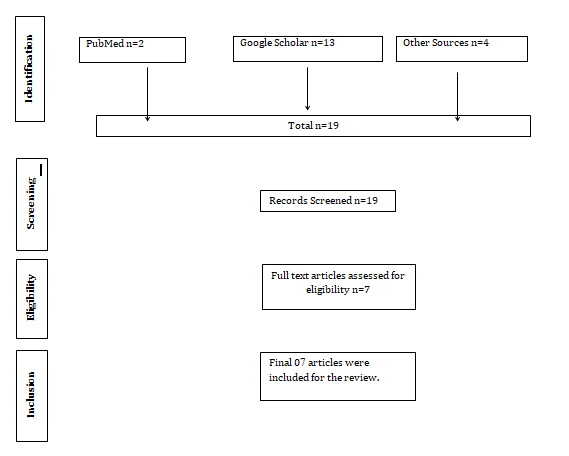
19 research articles related with Shwaskuthara Rasa were identified. 2 research papers were published in Pubmed journals out of which only one article was selected as it was related with clinical study of Shwaskuthara Rasa. Total 13 papers were published in Google scholar journals, out of which only 3 articles were selected as they fulfill the selection criteria. 4 research articles were published in other sources like online publishing media out of which 2 articles were selected for analysis. So at the end of screening 07 articles were selected for further analysis (Figure 1).
Role of Shwaskuthara Rasa in the Management of Tamaka shwasa
Jadav R, et al. [14] evaluated 20 patients of Tamaka shwasa within the age group of 18 to 60 years fulfilling the inclusion criteria and treated the patients with dose of 250mg of Shwaskuthar rasa with honey, three times a days after food for the period of 6 weeks. After study period they concluded that Shwaskuthar rasa showed 58.80% good result on signs and symptoms of Tamaka shwas and Shwaskuthar rasa was effective in Kapha pradhana samprapti [8]. As ingredients of Shwaskuthar rasa are Vat-Kaphashamak in nature with laghu, ruksha and ushna guna, it mostly acts on kapha dosha pradhan samprapti and due to its guna it is contraindicated in Pitta Pradhan samprapti. Decrease in AEC was statistically significant. (p < 0.01). There was an increase in the PEFR by 32.50% increase in AEC by 16.77%. Effect on other Hematocrits showed that ESR (14.27% ↓) and TLC (1.07% ↓) showed very good result on which was statistically significant, may be better in inflammatory condition.
Jadav R, et al. [15] in another study evaluated the effect of Shunthyadi Churna and compared it with Shwaskuthar rasa in the management of Tamaka shwasa with respect to Bronchial asthma. They evaluated total 46 patients (23 in each group) of Tamaka shwasa between the age group of 18 to 60 years, fulfilling the inclusion criteria and patients selected randomly and assigned to group. After study, they concluded that Shunthyadi churma and Shwaskuthara Rasa shows 60.74% and 58.80% good results respectively in signs and symptoms of Tamaka shwasa. But it was assumed that Sunthyadi churna had better effect in Vata pradhana samprapti while Shwaskuthar rasa had better effect in kapha pradhana samprapti [9].
In the study of comparative effect of Shwaskuthara Rasa and Shirishadi Kashaya in the patients of Tamaka shwasa, total 30 patients satisfying inclusion criteria were selected and randomly put into two groups. One group was treated with Shwaskuthar rasa in the dose of 250mg BD per day with boiled and cooled water, while another group was treated with Shirishadi Kashaya in the dose of 25ml BD per day for the (a) period of 42 days. They concluded that both the drugs were effective on dyspnea and cough, day of Asthma per week, frequency of asthmatic attacks per week and vital capacity of lungs. But Shirishadi Kashaya has significant effect on dyspnea and cough (P<0.01), significant reduction in days of Asthma per week (P<0.05) and highly significant in rising vital capacity (P<0.001) than Shwaskuthara Rasa [10]. As Tamaka shwasa is chronic disease and incurable in nature as per Ayurvedic principles it should be treated for longer duration and current study was done only for 42 days. So study for longer duration treatment is required for assessment of detail efficacy of Shwaskuthar rasa in Tamaka shwas. And also this study was done only on uncomplicated cases of Tamaka shwas, so use of Shwaskuthara Rasa in complicated patient not assessed in this study. Nephrotoxicity Study in Children Shinde RV et al evaluated whether Rasaaushadhi (Herbomineral formulations) causes nephrotoxicity in children or not. For this study they used five herbomineral drugs (one of the drug is Shwaskuthara Rasa) regimen in recurrent and reactive respiratory illness in children of age 4 to 14 years for 45 days at 15 days interval. To rule out Nephrotoxicity after use of Ayurvedic Herbomineral formulations, Kidney function test was done. Total 13 patient’s case series was observed. After study they concluded that the use of Ayurvedic herbomineral medicines in pediatrics patients was safe and there was no relation with nephrotoxicity or any obstructive renal pathology when used properly [11]. Use of herbomineral drugs in treatment always remains a most controversial issue not only in India but also in Western countries. The age group of this study was 4 to 14 years. The researcher did not found any toxic effect on the patients that means proper use of drugs which are properly processed as per Ayurvedic principles are safe in pediatrics age group also. But the sample size of this study was so small so as to confirm the safety of herbomineral formulations like Shwaskuthara Rasa. A longitudinal study in large sample is required.
Cancer and Shwaskuthara Rasa
Three case reports published by Bendale Y, et al. They used Ayurvedic principle of Rasayana therapies along with other medication (one of the interventional drug was Shwaskuthara Rasa) and they found good response in cancer patients [16, 17, 18]. In these case reports, main interventional medicine is Rasayana therapy containing Swarna bhasma, Hiraka bhasma, Rajat bhasma and Abhraka bhasma etc along with this other formulae mentioned in respiratory system diseases like Aarogyawardhini, Tribhuvankirti rasa, Shwaskuthara Rasa etc. were used. So due to the combine effect of all these drugs, cancerous growth may have been reduced. That’s why it is recommended that the studies with single Shwaskuthara Rasa should be done to assess efficacy in cancer.
| Sample Size | Age group (Yrs) | Dose | Duration | Anupana | Assessment parameters | |
|---|---|---|---|---|---|---|
| Non Randomized clinical trial | 20 | 18-60 | 250 mg TDS after meals | 6 weeks | Honey | CBC with Absolute Eosinophil count, PEFR, symptoms of Tamaka shwasa and cardinal symptoms of Bronchial asthma |
| Randomized controlled clinical trial | 46 (23 in each group) | 18-60 | 250 mg TDS after meals | 6 weeks | Honey | CBC with Absolute Eosinophil count, PEFR, symptoms of Tamaka shwasa and cardinal symptoms of Bronchial asthma |
| Randomized controlled clinical trial | 30 (15 in each group) | 250 mg BD after meals | 6 weeks | boiled and cooled water | Vital capacity of lungs, dyspnoea, cough, days of asthma per week, frequency of asthmatic attacks | |
| Case series | 13 | 14-Apr | Variable As per weight | 45 days | Honey | KFT |
| Case reports | 3 | 50 - 77 | 250 mg BD | variable | water | CT scan |
Table 1: Summarizing the interventional studies with Shwaskuthara Rasa.
From the scientific evidences collected in the study, it can be inferred that the evidences are scanty to establish the clinical potential of Shwaskuthara Rasa. The drug is studied as main drug only in Tamak shwasa. Less sample size and selection of only mild and moderate cases of Shwasa vyadhi are found to be some obstacles in the pathway of establishing the efficacy of Shwaskuthara Rasa [19]. The effect of the drug can also be assessed on oxygen saturation and arterial blood gases along with lung parameters in all mild, moderate and severe cases of Tamaka shwasa. Hence, the safety and efficacy of Shwaskuthara Rasa should be assessed in larger samples along with comparison with the standard line of treatment. Effect of Shwaskuthara Rasa as an adjuvant drug in Squamous Cell Carcinoma of lungs, larynx and stage I Nodular Lymphocyte Predominant Hodgkin Lymphoma (NLPHL) has added a feather of appreciation to the Ayurvedic treatment. Piperine present in Marich enhances the bioavailability of the Shwaskuthara Rasa [20]. It may be useful in emergency condition to treat attacks of Asthma. If it is established scientifically, it can also be used to treat the respiratory distress due to COVID 2019.
Conclusion
Shwaskuthara Rasa is one of the reputed herbomineral formulations described in various classical text of Ayurved. Classically the drug is used in diseases related with respiratory system like Asthma, Bronchitis, cough, dyspnea etc.
Though it is mentioned in number of classical texts but clinically on the ground of contemporary parameters, the efficacy of Shwaskuthara Rasa is not assessed as very little clinical research work is done. Shwaskuthar rasa contain heavy metals like mercury and arsenic so must be used after proper shodhana process and with prescribed dose. In our study we found some research work, which describes Shwaskuthar rasa is useful in cancer treatment also. So we conclude that there is a need of some more clinical research with larger sample size to prove the efficacy of Shwaskuthara Rasa.
Conflict Of Interest: No conflicts of interest.
References
-
Eisenberg DM, Davis RB, Ettner SL, Appel S, Wilkey S, et al. (1998) Trends in alternative medicine use in the United States, 1990-1997: results of a follow-up national survey. JAMA 280(18): 1569-1575.
-
(2002-2005) World Health Organization Traditional medicine strategy.
-
Ness J, Cirillo D, Weir D, Nisly NL, Wallace RB, et al. (2005) Use of complementary medicine in older Americans: results from the health and retirement study. The Gerontologist. 45(4): 516-524.
-
Joshi YG (2005) Visha Chikitsa. In: Chakrapanidatta. Charak Samhita 2nd (Edn.), Vaidyamitra publication, Pune, India pp: 507.
-
Sharma R, Prajapati PK (2016) Nanotechnology in medicine: Leads from Ayurveda. J Pharm Bioallied sci 8(1): 80-81.
-
Shashtri L (2009) Yogratnakar, Chaukhamba Surbharati Prakashan, Varanasi pp: 435.
-
Shastri AD (2005) Bhaishajya Ratnavali. 19th (Edn.), Chaukhamba SurbharatiPrakashan, Varanasi pp: 466.
-
Janadri S, Mishra AP, Kharya M, Kumar R, Shanmukh I, et al. (2005) Preparation and characterization of mercury- based traditional herbomineral formulation: Shwas kuthar rasa. J Ayurveda Integr med 6(4): 268-272.
-
Bhagyalakshmi BR, Galib R, Harisha CR, Shukla VJ, Prajapati PK, et al. (2015) Micromatrix and physico- chemical quality parameters of Shwasakuthara Rasa prepared by two different methods. Journal of Ayurvedic and Herbal Medicine 1(2): 35-39.
-
Suranagi DN, Patil M (2021) Pharmaceutico- analytical study of Shwasakuthara rasa prepared with three different media used in Gandhaka shodhana. Pharmaayurved 5(1): 1-10.
-
Bhagyalakshmi BR, Galib R, Prajapati PK (2015) Critical Review of Shwasakuthara Rasa-A Herbomineral Formulation. International Journal of Ayurvedic Medicine 6(3): 206-211.
-
Kumar DS, Deo YK, Dubey SD, Reddy KRC (2012) Anti- Microbial Study of Shwasakuthar Rasa: In Vitro Study. International Journal of Ayurvedic Medicine 3(2): 76-81.
-
Bhagyalakshmi BR, Galib R, Nariya M, Prajapati PK (2016) Anti-tussive activity of Shwasakuthara Rasa a Herbomineral formulation prepared with and without Kajjali (Black Sulphide of Mercury) in SO2 induced cough in Swiss albino mice. The Journal of Phytopharmacology 5(2): 50-52.
-
Jadav RA, Dave A, Varsakiya J (2018) Clinical study of Shwaskuthar rasa in the management of Tamaka shwas W.S.R to Bronchial Asthma; World J Pharm Res 7(13): 665-674.
-
Jadav RA, Dave A, Varsakiya J (2017) A Comparative Clinical Study of Shunthyadi Churna and Shwaskuthar rasa in the management of Tamaka shwasa W.S.R. to Bronchial Asthma. European Journal of Pharmaceutical and Medical Research. 4(9): 526-531.
-
Bendale Y, Bendale V, Birari Gawande BP, Kadam A, Gund P, et al. (2015) Laryngeal Squamous Cell Carcinoma successfully Treated with Rasayana Therapy -A Case Report. Rasamruta 7(6): 1-5.
-
Bendale Y, Bendale V, Gawande BP, Kadam A, Gund P, et al. (2015) Tumor regression with Ayurvedic Rasayana therapy in Squamous Cell Carcinoma of lungs A Case Report. Rasamruta 7(15): 1-5.
-
Bendale Y, Bendale V, Gawande BP, Kadam A, Gund P, et al. (2015) Tumor regression with Ayurvedic Rasayana therapy on patient with Stage I NLPHL A case Report. Rasamruta. 7(17): 1-6.
-
Chandra M, Upadhyay BN, Mishra J K (1996) Effect of SvasaKuthara rasa and Sirishadi Kashaya on Patients of Tamaka Svasa. Ancient science of life 15(3): 213-218.
-
Shinde RV, Ambad R, Adhav P, Fadanvis P, Chakole S, et al. (2020) Rasaushadhi (Herbomineral Formulations) Induced Nephrotoxicity in Children: Safety Concern Case Series. Indian J Forensic Med Toxicol 14(4): 7018-7022.
- Management of Ear Keloid with Ksharsutra: A Case Study
- Yoga and Global Sustainability: A Holistic Path to One Earth, One Health
- Autoimmune Diseases in Ayurveda: A Narrative Review with Classical and Modern Perspectives
- Management of Cluster Headache Associated with Pituitary Apophysitis by CERT (Chakrasiddh Energy Release Technique): A Case Report on Energy Rebalancing
- Zygophyllum Geslini Coss : Biochemicals and Antioxidant Activity
- Observations of a Beginner Vaidya