
Scientific Application of Bhasma Pareeksha
Even after Shodhana, the Rasadravya’s are not easily absorbable and assimilable because of their inorganic properties and non-homogeneity, so need to conversion of original metal / mineral into oxide or sulphide form to maintain of alkalinity and neutralizing the harmful acids. In Classics, Bhasma pareeksha are mentioned for the prepared bhasma before administration of the bhasma. These tests are considered as a basic quality control tests for Ayurvedic bhasmas. These tests are included many years ago but those tests having scientific base to assess particle size, lightness etc. By this it can be conclude with the modern parameters like Nano particle, chemical composition etc.
Introduction
Knowledge of use of metals, minerals was seen since ancient period in Indian history. Initially these were used for preparation of instruments etc. later Ayurvedic acharyas found therapeutic qualities of some of these metals and minerals specified in classics. After the resolution of Rasashastra, many pharmaceutical procedures were chronologically developed for process/ conversion of the naturally available therapeutically effective Metals, Minerals, Marine products, Gemstones, Animal products for internal administration. These procedures convert them into safe, medicinal form, and easy assimilation.
Naturally available drugs are not indicated therapeutically because of inorganic nature and heterogeneity. So conversion of drugs is needed to get drug into organic form, homogeneity, reduction of alkalinity and also nullification of poisonous effect of drug.
शॊधितान् लॊहधात्वादीं विमर्ध्यं स्वरसादिभिः l अग्निसंयॊगतॊ भस्मीकरणं मारणं स्मृतम् ll Bhasmikarana means shodita metals, minerals etc drugs are triturated with herbal juice etc liquids and specific heat is applied is bhasmikarana the procedure is called as Marana. The product is known as Bhasma/ Mrutaloha (killed one or physical and chemical change of original metal). As it was manufactured by metal/minerals and processed with herbs and specific heat falls under unique preparation of the Rasashastra (for the easy assimilation and bioavailability).
Significance of Bhasma
मृतानि लॊहानि रसीभवन्ति निघ्नन्ति युक्तानि महामयांश्च l अभ्यासयॊगाद् दृढदॆहसिद्धिं कुर्वन्ति रूग्जन्मजराविनाशम् ll RRS 5/139 The loha bhasma prepared with paarada is having the rasaayana guna on conjunction it will mix up with the rasa raktaadi dhaatu & it will act immediately. It destroys the disease and increases the strength of the body [1].
पुटाद् ग्राब्णॊ लघुत्वं च शीघ्रव्याप्तिश्च दीपनम् l RRS10/49
Puta causes laghuta in Bhasma because of this guna it quickly absorbs and spreads all over the body. It increases digestion capacity [2].
अल्पमात्रॊपयॊगित्वादरूचॆरप्रसङ्गत: l क्षिप्रमारॊग्यदायित्वादौषधॆभ्यॊSधिकॊ रसः ll रसॆन्द्रसार संग्रह 1/4, पारद नामानि The Bhasma is effective in lesser quantity, not having any taste, it cures disease very quickly and it is best among the chikitsa [3].
Different Methods of Bhasma Preparation
लॊहानां मारणं श्रॆष्ठं सर्वॆषां रस भस्मना l मूलीभिर्मध्यमं प्रायुः कनिष्ठं गन्धकादिभिः l अरिलॊहॆन लॊहस्य मारणं दुर्गुणप्रदम् ll RRS 5/14 It is the best to perform Marana of metal with the help of Parada Bhasma. The Marana of such metal carried out with the assistance of herbal drugs is supposed to be medium & with the help of Gandhaka, it is said to be inferior. However the Marana of the metal is performed with the help of arilohas caused bad effect [4].
Importance of Bhasma Pareeksha
Siddha lakshana’s (confirmatory features) are explained for all preparations in Ayurvedic classics. As Bhasma is one of the Ayurvedic unique dosages, Bhasma pareeksha procedure are described to know properly processed Bhasma.
The bhasma pareeksha’s are considered as quality control parameters of Bhasma. If Bhasma passes these pareeksha indicates it is safe, effective and fit for administration. The parameters preferred for Bhasma pareeksha by using sophisticated equipments are elemental analysis, characterization of bhasma, particle size and distribution of the particles, detection of free metals etc….are often looked in.
Methodology
Classical Parameters of Bhasma Pariksha
- Varna
- Rekhapurnatva
- Varitara
- Unnama
5. Amladadhi pareeksha 6. Nirutthikarana 7. Nirdhoom 8. Nishchandrikarana 9. Niswadu 10. Avami 11. Dantagre kachakachabhava
Varna
Varna (Color) is a basic and first criterion for the identification of any Bhasma. After the incineration of metals or minerals that has to be get the specific colour mentioned in classical text. Bhasma of specific metals or minerals should exhibit the same colour which is specified in classics. If it does not reach the specified colour indicates substandard in quality of ingredients /process.
Acharya Yogaratnakara Mentioned the Standard Colour For the Dhatu’s (Metals)
Swarnam champakavarnaabham krushnatwam taarataamrayoh l Kamsyam dhoosaravarnam syaannaagah paaraavataprabhah ll Vangam shubhratwaamaayaati tikshnam jambuphalopamam l Abhrakm cheshtikaabham syaaddhaatunaam varnanirnayah ll (Table 1)
| Dhatu | Varna | |
|---|---|---|
| S. No | ||
| 1 | Swarna | Champaka |
| 2 | Rajata & Tamra | Krushna |
| 3 | Kamsya | Dhoosara |
| 4 | Naga | Paaravata prabha |
| 5 | Vanga | Shweta |
| 6 | Tikshna loha | Jambu phala |
| 7 | Abhraka Bhasma | Ishtika varna |
Table 1: Colour of Bhasma for different Rasadravya [5].
Varitara
These tests are mainly indicated for the fineness and lightness of the particles.
मृतं तरति यत्तॊयॆ लॊहं वारितरं हि तत् ll RRS 8/26
Prepared Bhasma is sprinkled on the surface of stagnant water it floats on the surface of water [6].
Unnama
तस्यॊपरि गुरू द्रव्यं धान्यं चॊपनयॆद् ध्रुवम् l हंसवत्तीर्यतॆ वारिण्युत्तमं परिकीर्तितम् ll RRS 8/29 Unnama is a further step of Varitara by keeping dhanya on floating bhasma and observe for sink [7].
Hygroscopic Natured
These particles will not float for more duration. They absorb water and sink. Ex: Kasisa Bhasma
Rekhapurnatva
अङ्गुष्ठतर्जनीघृष्टं यत्तद्रॆखान्तरॆ विशॆत् l मृतलॊहं तदुद्धिष्टं रॆखापूर्णाभिधानतः ll RRS 8/27 Bhasma should be taken in between Angushtha (Thumb) and Tarjani (index) finger and rubbed. Then furrows of fingers should be observed for the particle size [8].
Nirutthikarana
रौप्यॆण सह संयुक्तं ध्मातं रौप्यॆण नॊ लगॆत् l तदा निरूत्थमित्युक्तं लॊहं तदपुनर्भवम् ll RRS 8/30 The piece of Rajata (Silver) is to be kept in a sharava containing bhasma and this should be subjected to heat. After cooling the Rajata is weighed. If the weight increases it shows apakwa bhasma preparation [9].
Amladadhi Pareeksha
This test mainly indicated for Tamra, Swarna makshika and Tutthha bhasma. Basma should be sprinkled on amla dadhi and observe for development of green colour around the dadhi, if color develops it indicates the apakwa bhasma.
Nirdhoom
Little quantity of bhasma sprinkle over the burning coal, properly prepared bhasma will not produce smoke.
Nishchandrikarana
Prepared Bhasma to be taken and observed in bright sunlight. If shining particles are present then it is consider as apakwa Bhasma.
Niswadu
This test is mainly indicated for sudhavarga. As Sudhavarga contain more kshareeyata, so puta should be given till it become tasteless.
Avami
Prepared Bhasma should not produce nausea or vomiting when administered internally.
Dantagre kachakachabhava
When the Bhasma is taken in mouth and press in between teeth it should not produce Kachakach sound? If Bhasma is not become finer then it produces sound. So further incineration to be done (Table 2).
| S. No | Bhasma | Pareeksha |
|---|---|---|
| 1 | Abhraka Bhasma | Nischandrikarana |
| 2 | Makshika , Tuttha and Tamra Bhasma | Amladadhi pareeksha |
| 3 | Haratal and Manashila Bhasma | Nirdhooma |
| 4 | Loha Bhasma | Varitara |
| 5 | Sudhavarga | Niswadu |
| 6 | Tamra / Rajat Bhasma | Apunarbhava |
Table 2: Specific Bhasma pareeksha for particular bhasma.
Modern Parameters
Nano Particles
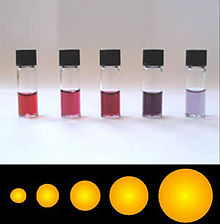
Colloidal gold [10] is a suspension of submicrometre – size particles of gold in a fluid, usually water. The liquid is usually either an intense red colour (for particles less than 100 nm) or blue/purple (for larger particles) (Figure 1).
Gold nanoparticles can be used to, • Optimize the bio distribution of drugs to diseased organs, tissues or cells, in order to improve and target drug delivery.
• It includes drug targeting of difficult, unstable molecules and delivery to the difficult sites.
• Nano drug delivery system ensures that the active drug is available at the site of action at correct time and duration.
• Diagnosis of the tumors.
• Gene therapy Swarna Bhasma (gold ash) has been characterized as globular particles of gold (56-57 nm). Mercury compound contains mercury sulfide (crystalline size 25-50 nm).
Bhasma VS Nanotechnology
Nanotechnology is a technology dealing with smaller dimension of material ranging of 1 – 100 nm. Reduction of particle size given most important to get assimilate in blood and increase of bioavailability. The development of Nanotechnology is made possible by analysis of material by different instrumental analysis like,
- Transmission Electron Microscope.
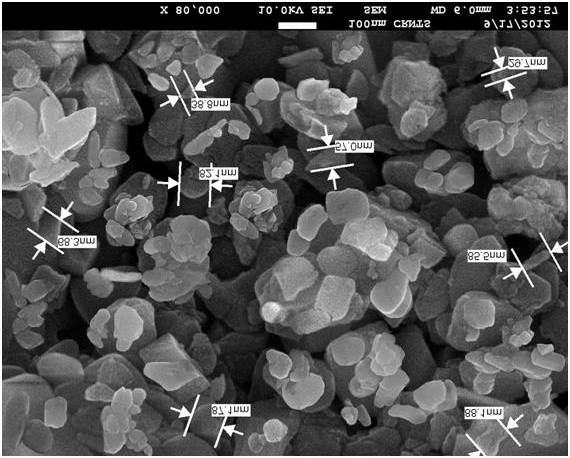
- Scanning Electron Microscope.
- Inductively Coupled Plasma Atomic Emission Sphectrometer.
- X – Ray Florescence.
Transmission Electron Microscope
Magnification is more than 10,000 than Electron microscope
- Micro structural analysis.
- Crystal structure.
- Small region elemental analysis.
Scanning Electron Microscope
Imaging at all directions through (3D) rotation of sample (Figure 2).
Inductively Coupled Plasma Atomic Emission Sphectrometer
- Most common techniques for elemental analysis.
- Its high specificity, multi-element capability and good detection limits result in the use of the technique in a large variety of applications.
X – Ray Florescence
- To identify the elemental abundances of the sample.
- Indentifies both major and trace elements.
Discussion
Even though many pareeksha’s mentioned in the classics but we are fail to standardise Bhasma only bases on these parameters. It may be due to faulty performances or not knowing exact method for testing.
Varna
The colour of the bhasma depends upon the active content of the bhasma. When the crude drug converted into oxide or sulphide forms it gives rise to colour of converted form.
Ex: Louha bhasma – Pakwa jambu phala Varna i.e brown brick red colour because of Ferrous oxide.
Tamra bhasma – Krishna Varna, Black colour due to cupric oxide and cupric sulphide.
Varitara and Unnama
Why Bhasma floats on the surface of water? [11]
- When the prepared bhasma is less dense than water then it floats on the surface of water.
- These tests are also based on surface tension. Surface tension is a contractive tendency of the surface of a liquid that allows it to resist an external force and the inward force at its surface cause’s water to behave as a stretched elastic membrane. Because of this the particles present over the surface floats on the surface.
- Flotation of objects denser than water occurs when the object is non-wet table and its weight is small enough to be borne by the forces arising from surface tension.
Niruttha
A demonstration of oxidation-reduction reactions involves placing a piece of copper wire into an aqueous solution of the Ag+ ion. The reaction involves the net transfer of electrons from copper metal to Ag+ ions to produce whiskers of silver metal that grow out from the copper wire and Cu2+ ions [12].
Cu(s) + 2 Ag+ (aq)
Cu2+ (aq) + 2 Ag(s)
$$ \longrightarrow $$ The Cu2+ ions formed in this reaction are responsible for the light-blue color of the solution. Their presence can be confirmed by adding ammonia to this solution to form the deep-blue Cu (NH3)4 2+ complex ion (Figure 3).
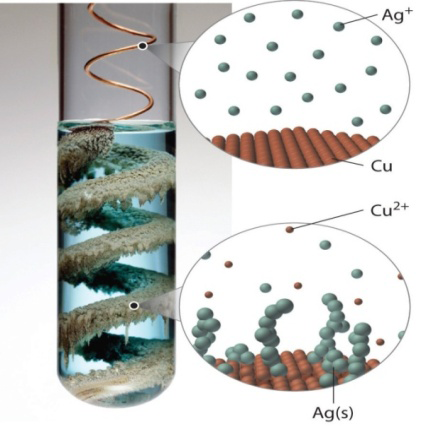
In Niruttikarana mentioned that heat should be given, how much temperature and duration is not mentioned, in modern they mentioned immediate reaction by changing the colour of aqueous solution. The form of silver is used in the test are different so standardisation is required.
Amladadhi Pareeksha
Curd contains Lactic Acid which reacts with the copper producing soluble copper salts [13].
Metal + acid Metal salt + hydrogen Copper salts are poison to human being when taken internally because when they react with water in the body, they produce copper oxide which is insoluble in water and organic solvents.
Nirdhoom
Bhasma (Calyx) is created by heating of metal / minerals to high temperatures in the absence of oxygen. When the metal / mineral put it in a sealed sharava (clay sausser) and heat it to about 1,000 degree Celsius. This process drives off all of the volatile organic compounds and leaves behind the carbon and the minerals (ash). When light the bhasma, what is burning is the pure carbon. It combines with oxygen to produce carbon dioxide, and which is an invisible finess of the particles depends upon the nature of the material, in some hygroscopic particles the softness feels early compared to drugs [14, 15].
Conclusion
- Bhasma pareeksha is one of the quality control parameter mentioned in the classics for the standardization of Bhasma.
- These tests are helpful in the assessment of safety and efficacy of the drugs.
- Modern parameters are helpful to analyses the partical size and distribution of particals qualitatively and quantitatively.
- The modern parameters give more accurate results in particle size compared to rekhapurnatva. So we have assessed Bhasma’s both classically and contemporarily.
References
-
Kulkarni DA, Samuchchaya R (1998) Vidnyanabodhini Hindi commentary. Meharchanda Lachhmandas Publications, New Delhi 5(139): 120.
-
Kulkarni DA, Samuchchaya R (1998) Vidnyanabodhini Hindi commentary. Meharchanda Lachhmandas Publications, New Delhi 10(49): 187.
-
Kulkarni DA, Samuchchaya R (1998) Vidnyanabodhini Hindi commentary. Meharchanda Lachhmandas Publications, New Delhi 5(14): 94.
-
Lakshmipatishastri, Yogaratnakara (2002) Vidyotini Hindi commentary. 7th(Edn.), Choukhamba Sanskrit Sansthan Varanasi, Sapta Dhatuvarna, pp: 128.
-
Kulkarni DA, Samuchchaya R (1998) Vidnyanabodhini Hindi commentary. Meharchanda Lachhmandas Publications, New Delhi 8(26): 148.
-
Kulkarni DA, Samuchchaya R (1998) Vidnyanabodhini Hindi commentary. Meharchanda Lachhmandas Publications, New Delhi 8(29): 148.
-
Kulkarni DA, Samuchchaya R (1998) Vidnyanabodhini Hindi commentary. Meharchanda Lachhmandas Publications, New Delhi 8(27): 148.
-
Kulkarni DA, Samuchchaya R (1998) Vidnyanabodhini Hindi commentary. Meharchanda Lachhmandas Publications, New Delhi 8(30): 148.
-
Surface tension.
-
Oxidation-Reduction Reactions.
-
GCSE Science/Acids & Bases, Salts and Electrolysis.
-
How Ghosts Work.
-
Pal D, Sahu CK, Haldar A (2014) Bhasma: The ancient Indian nanomedicine. J Adv Pharm Technol Res 5(1): 4-12.
- Management of Ear Keloid with Ksharsutra: A Case Study
- Yoga and Global Sustainability: A Holistic Path to One Earth, One Health
- Autoimmune Diseases in Ayurveda: A Narrative Review with Classical and Modern Perspectives
- Management of Cluster Headache Associated with Pituitary Apophysitis by CERT (Chakrasiddh Energy Release Technique): A Case Report on Energy Rebalancing
- Zygophyllum Geslini Coss : Biochemicals and Antioxidant Activity
- Observations of a Beginner Vaidya