
Comprehensive Ayurvedic Management of Calcaneus Spur- A Single Case Study
Agnikarma is an important para-surgical procedures mentioned in Ayurveda. It has emerged as integral part of the Ayurvedic therapeutics. Agnikarma is a thermal and minimally invasive procedure that induces controlled, pointed and therapeutic burns over the regions that are tender or painful. Acharya Sushruta has advised Agnikarma for Snayugata Vata and Asthigata Vata. Painful heel due to prolonged standing is relatively common foot problem in modern era and predominant cause of such pain is calcaneal spur. The calcaneal spur is a condition of pointed bony outgrowth of heel bone. Usually, it affects people day to day routine life and once manifested it becomes difficult to cure. It is caused due to deposition of calcium on underside of heel bone over a prolonged period of time. It is diagnosed by the radio-logical examination (X-RAY). As far as modern medicine is concerned there is no safe and cost-effective treatment available of calcaneus spur. Pharmacological treatment used are NSAID’s, analgesic drugs, steroid injections, and exercises. The surgical treatment is release of plantar fascia and excision of calcaneus spur but complications are incomplete relief of pain and nerve damage. In Ayurveda Agnikarma is one of the competent treatments of calcaneus spur. Agnikarma is carried with special instrument called Pancha Dhatu Shalaka. This Shalaka is made up of five metals (Copper, Iron, Zinc, Silver and Gold). A patient successfully treated with Agnikarma therapy is presented in this case study.
Introduction
In today’s era there are certain group of disease which does not respond to medicine very well. If they respond, after sometime there is high chances of recurrence. In Ayurveda many minor para-surgical procedures are explained in substitute for major surgical procedures. Agnikarma is said to be more superior than other para-surgical procedures because there are less chances of recurrence of the disease, the area becomes sterilized and there is no loss of blood [1].
Heel pain may be caused by various reasons such as plantar fasciitis, Achilles tendinitis, atrophy of heel pad, acute tear of plantar fascia, retrocalcaneal bursitis and calcaneal spur. Calcaneus spur is most common cause of heel pain that affect normal routine work of an individual. Incidence of calcaneal spur in Indian population with heel pain is 59% [2]. Calcaneal spur is also called as heel spur. It is located on the heel bone and it develops due to extra deposition of calcium on the bone spur of the heel. The most common etiology is thought to be abnormal pronation which results in increased tension forces within the structures that attach in the region of the calcaneal tuberosity. A calcaneal spur is caused by long term stress on the plantar fascia and foot muscles and may develop as a reaction to plantar fasciitis. The pain, mostly localized in the area of the medial process of the calcaneal tuberosity, is caused by the pressure in the region of plantar aponeurosis attachment to the calcaneal bone. Most heel pain patients are middle- aged adults. Middle aged overweight and athletic individuals are more susceptible to heel problems and sometimes non athletic peoples are also affected, who spend a lot of time on their feet. People who are obese, have flat feet, or wo often wear high heeled shoes are more prone to this disease. Not all heel spurs cause symptoms people often experience more pain during weight bearing activities, in the morning or after a period of rest. Diagnosis is done by X-RAY and tenderness to the affected area is found. Till date symptomatic treatment are available like NSAID’S, analgesic drugs, steroid injections and exercises. The surgical treatment like plantar fascia release and excision of calcaneal spur are available but have complications like incomplete relief of pain and nerve damage [3]. According to Ayurveda calcaneus spur can be corelated to Asthi-Gata Vata. Symptoms of Asthigata Vata are Asthibheda, Parva Bheda, Sandhishool, Manskshaya, Balakshaya, Aswapana, Satatamruka meaning continuous pain [4]. Due to severe pain caused by Vata one should do Agni Karma in Twaka, Mansa, Sira, Snayu, Sandhi and Asthi [5].
Case Details
Patient’s profile OPD no- 1592/9936 Age-48 year Sex-Male Religion-Hindu Chief complains-Pain in bilateral heels for one year
History of Present Illness
A 48-year-old male patient came with the complain of pain in bilateral heels for one year. His pain aggravates on walking, prolonged standing and early morning after waking up. He took various allopathic and Ayurvedic medicines for the same but did not get any relief. So, he came to Rishikul Campus for further management.
Family History No significant family history Personal History Appetite- Normal Thirst- Normal Bowel- Clear Micturition- Normal Sleep-Sound General Examination General condition- Good Temperature- Afebrile Pallor- Not present Cyanosis-Not present Thyroid- Not enlarged BP-130/80mm of hg Pulse-74beats/ min J.V.P- Not raised Skin- Normal in Texture Clubbing- Not present L/N- Not enlarged Tongue-Pink Systemic examination P/A- NAD CVS-NAD R/S-NAD CNS-patient is well oriented to time, place and person Others- Tenderness present in posterior aspect of bilateral heels
Investigations
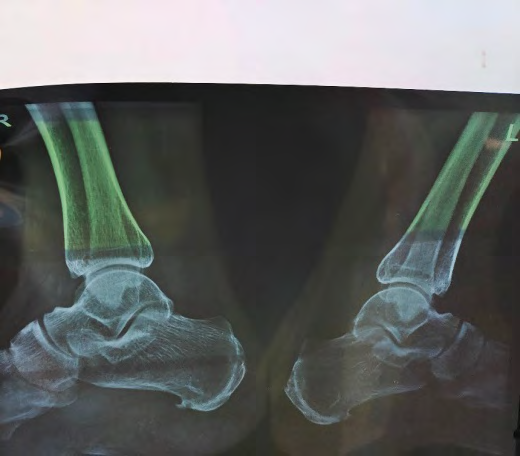
The case was diagnosed as calcaneous spur of posterior aspect of bilateral heels based on X-Ray (AP view) of bilateral foot.
Diagnostic Assessment
• Pain at both heel region
| Nature of pain | Grading |
|---|---|
| No pain | 0 |
| Mild pain | 1 |
| Moderate pain | 2 |
| Severe pain | 3 |
| Distance in feet | Grading |
| 90 feet | 0 |
| 60 feet | 1 |
| 30 feet | 2 |
| Less than 30 feet | 3 |
Table 1: Nature of pain for patient.
• Distance walked by the patient within 10 minutes
Treatment Protocol
Agni Karma for 1st, 2nd and 3rd sittings at interval of 15 days. The Agni Karma was carried out by Pancha Dhatu Shalaka at the exact location of pain. The location of pain was marked by palpation and Pancha Dhatu Shalaka was heated over the burning gas stove until it became red hot. 10-15 Bindu Dagadha was done at painful site. After Agni Karma, Aloe-vera and honey with turmeric was applied. Patient was asked to keep the area clean and moisture free for 1-2 days.
In between the therapy following medication was given After 1st sitting Punarvaadi gugguul 2-tab TDS Pinda Taila for local application After 2nd sitting Yograj guggul 2-tab TDS Panchsakar choorna ½ tsf BD Gandhak Rasyana 250 mg BD after meal After 3rd sitting Cap G Amrita 2-tab BD Panchsakar Choorna 1 Tsf at night
Discussion and Results
Assessment was done before and after treatment by the relief of pain, tenderness and distance covered on walking without pain. Patient got significant relief in above mentioned symptoms.
Observations
| BT | AT | |
|---|---|---|
| Pain at both heel region | 3 | 0 |
| Distance walked by the patient within 10 minutes | 3 | 0 |
Table 2: Observation and analysis.
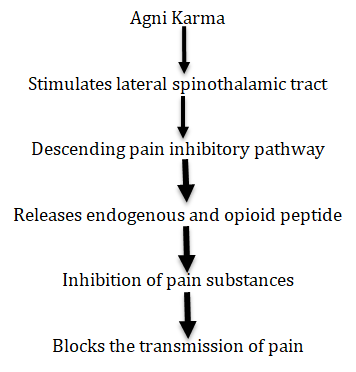
The Ushna, Teekshna, Laghu, Sukshma, Vyavyi, Vikasi and Ashukari Guna of Agni helps to remove Srotoavrodha, pacifies the vitiated Vata-Kapha Dosha which reduces pain. Also, because of its Ushna Guna improves the Dhatvagni that pacifies the Aam Dosha and reduces the pain and inflammation. Ushna Guna of Agni helps to removes the Avarana effectively and stabilizes the movement of Vata, which provide relief from Sholla. Every Dhatu have its own Dhatvagni which is responsible for the nourishment and changes in Dhatu. Agni Karma works by giving external heat thereby increasing the Dhatvagni helps to digest the aggravated Doshas. Various metabolic changes take place at the site of heat burn which leads to increase demand of oxygen and nutrition. Superficial sensory nerves get stimulated by Agnikarma thus leads to exudation of fluid, increase in white blood cells, local dilatation of blood vessels resulting in the increased blood circulation. This induced circulation helps to flush away pain producing substances from affected site and ultimately reduces the local inflammation. Also, the medicines used above are supportive medicines used in treatment of Calcaneus spur. Some medicines are useful to promote the strength of bones and joints as calcium is deposited in other parts of the body. In some studies, it was found that there is no direct effect of Agni Karma on Asthi Dhatu as osteophyte formation is structural defect.
Probable Mode of Action
Importance of Agni Tapta Shalaka
According to Thermodynamics, all the emitted radiation comes under electro-magnetic spectrum. Red hot metals emit the radiation in the visible range which is light. Infrared light immediately follows red light on the electromagnetic spectrum and more useful than the visible radiation for heating process of our body.
Conclusion
This case of calcaneus spur was successfully treated with Agni Karma with no reoccurrence of symptoms. Agni Karma is important para-surgical procedure that can be used for management of various diseases where surgery is not possible. In Agni Karma there is less chances of recurrence of the disease, minimal pain and less complications. Nowadays, modern science uses cautery which is nothing but modified Agni Karma.
References
-
Shastri KA (2016) Sushruta Samhita of Maharsi- Susruta Part 1. Chaukhambha Sanskrit Pratishthan, Delhi, India, 12/3, pp: 50.
-
Lourdes RK, Ram GG (2016) Incidence of calcaneal spur in Indian population with heel pain. Int J Res Orthop 2(3): 174-176.
-
Razak R (2013) Heel Pain or Calcaneal Spur and its Ayurveda Treatments in Kerala. Treatments in Ayurveda, India.
-
Shastri KN, Chaturvedi GN (2004) Agnivesha’s Charaka Samhita, Vidyotini Commentary. Chaukhamba Bharati Academy, Varanasi, India, Chikitsasthana, Chapter 28/33, pp: 235.
-
Shastri KA (2016) Sushruta Samhita of Maharsi- Susruta Part 1. Chaukhambha Sanskrit Pratishthan, Delhi, India, 12/10, pp: 52.
- Management of Ear Keloid with Ksharsutra: A Case Study
- Yoga and Global Sustainability: A Holistic Path to One Earth, One Health
- Autoimmune Diseases in Ayurveda: A Narrative Review with Classical and Modern Perspectives
- Management of Cluster Headache Associated with Pituitary Apophysitis by CERT (Chakrasiddh Energy Release Technique): A Case Report on Energy Rebalancing
- Zygophyllum Geslini Coss : Biochemicals and Antioxidant Activity
- Observations of a Beginner Vaidya