
In-vitro Evaluation of Anti-Urolithiatic Activity of Cuminum Cyminum Seed Extract on Calcium Oxalate Stone
The present study was undertaken to evaluate the Invitro Anti- urolithiatic activity of the selected plant Cuminum cyminum seed extract by using the titrimetry method. The work was performed by using invitro Anti- urolithiatic model for calculating percentage dissolution of Calcium oxalate stone. The standard drug was cystone. The seed extract of Cuminum cyminum showed the higher dissolution than the standard drug cystone. The 30mg/ml seed extract of Cuminum cyminum was highest among the test groups. This study has been primary evidence for Cuminum cyminum as the plant which possess Antiurolithiatic property.
Introduction
Background of the Study and Justification
Kidney stone disease is a multi-factorial disorder resulting from the combined influence of epidemiological, biochemical, and genetic risk factors. Urolithiasis is considered as the third most common affliction of the Urinary Tract [1].
Among the several types of kidney stones, the most common are Calcium oxalate stones representing up to 80% of the analysed stones. Calcium-containing stones may be in the form of pure Calcium oxalate (50%) or calcium phosphate (5%) and a mixture of both (45%) followed by magnesium phosphate (15-20%), uric acid (10%) and cystine (1%) [2].
Nephrolithiasis is one of the most prevalent urologic diseases in Asia. The worldwide prevalence, incidence and composition of calculi varies and have changed in the last several decades, with prevalence ranging from 7% to 13% in Investigation Paper North America, 5% to 9% in Europe, and 1% to 5% in Asia [3].
Epidemiological studies revealed that urolithiasis is more common in men than in women and is more prevalent between the ages of 20 to 40 in both sexes. About 12% of world population is affected by different forms of urolithiasis in which the recurrence rate in female is 47-60% and in male is 70-80%. It is a common clinical problem with high recurrence. After urolithiasis treatment, there is a 50% chance of stone recurrence within 7 years if left untreated [4].
Among the diversity of plants, there are many medicinal plants that showed the Anti- urolithiatic activity. Such as Maeruaangolensis, Euphorbia thymifolia, Cicutavirosa L, Mentha piperita and Kalanchoe pinnata [5].
The Cuminum cyminum is one of the medicinal plants most widely used by the medical officers who are working in the hospitals and the traditional medical practitioners for the Anti- urolithiatic activity as one of the ingredients of the compound drug. Cuminum cyminum plant has a long history of many pharmacological actions. Such as has antimicrobial, insecticidal, anti-inflammatory, analgesic, antioxidant, anticancer and antidiabetic activity. But there was any study had not been done by the Anti- urolithiatic activity of Cuminum cyminum up to now. As per the citation of literature, Cuminumcyminum was selected in order to evaluate the Anti- urolithiatic activity of Calcium oxalate stones in invitro method.
Problem Statement
Kidney stone disease is a crystal concretion formed usually within the kidneys. It is an increasing urological disorder of human health, affecting about 12% of the world population at some stage in their lifetime. It affects all ages, sexes, and races it has been associated with an increased risk of end – stage of renal failure. Currently, there is no satisfactory drug to cure and / or prevent kidney stone recurrences. Medicinal plants are considered as a rich source of therapeutic agents due to the belief and observations regarding traditionally used medicinal plants for the prevention of various ailments. As per the citation of literature, Cuminum cyminum was selected in order to evaluate the Anti- urolithiatic activity of Calcium oxalate stones in invitro method.
Hypothesis
Seed extract of Cuminum cyminum possess Anti- urolithiatic activity of Calcium oxalate stone.
Objective
To evaluate the Anti- urolithiatic activity of Cuminum cyminum seed extract on Calcium oxa-late stone.
Literature Review
Nowadays stone formation is the oldest and serious painful urologic disease with significant prevalence in the population due to change in lifestyle and dietary factors. Stone formation or lithiasis is characterized by calculi formation. It has two main types such as nephrolithiasis and urolithiasis. Calculi formation in urinary bladder, ureter, or any part of Urinary Tract rather than kidney is known as urolithiasis while nephrolithiasis is characterized calculi formation in kidney [2].
Calcium oxalate stones represent up to 80% of analysed stones. Calcium phosphate account for 15-25%, while 10- 15% is mixed stones. The others are struvite 15-3-%, cystine 6-10% and uric acid stones 2-10%. Calcium oxalate stones are of primary two types, Calcium oxalate monohydrate and Calcium oxalate dihydrate. The occurrence of frequency of Calcium oxalate monohydrate is 78% while that of Calcium oxalate dihydrate is 43% [6].
The treatment of urolithiasis involves the dissolution of existing stones and preventing the reoccurrence of stones. An alarming rise in the incidence and recurrence of urolithiasis coupled with adverse effects allopathic drugs necessitates exploration of traditional mode of treatment [1].
Medicinal plants are considered as a rich source of therapeutic agents due to the belief and observations regarding traditionally used medicinal plants for the prevention of various ailments. According to WHO 75% people rely on traditional medicines for the prevention and cure of different ailments. Several plants are employed to cure and prevent urolithiasis. Although medicinal plants produce slow recovery, these are affordable and less expensive, evidence based traditionally proven dissolution or elimination of kidney stones, less relapse of urolithiasis, their successful prophylactic use, less side effects, not only revealing their therapeutic potential but encourages patient’s belief and increasing their interest in traditional practices to find an herbal cure for kidney stones. The belief and observations regarding traditionally used medicinal plants, increasing the interest of people to use natural medicine for their primary health care needs. A wide range of medicinal plants have been used in different countries and cultures as a prophylactic and curative agent for urolithiasis [4].
Many medicines and remedies have been used during the past many years to treat urinary stones. Generally, in the traditional system of medicine, the majority of the remedies are based on plants and they were proved to be useful though the rationale behind their use is not well established through systematic pharmacological and clinical studies expect for some composite herbal drugs and plants [7].
Cumin (Cuminum cyminum) is an aromatic herb of the Apicaceae family, and its dried seeds are used as a spice. It is native to India, Iran, the Mediterranean, and Egypt [8]. Cumin seeds are liberally used in several cuisines of many different food cultures since ancient times, in both whole and ground forms. In India, cumin seeds have been used for thousands of years as a traditional ingredient of innumerable dishes including kormas and soups and form an ingredient of several other spice blends. Besides food use, it has also many applications in traditional medicine. In the Ayurvedic system of medicine in India, cumin seeds have immense medicinal value, particularly for digestive disorders. They are used in chronic diarrhoea and dyspepsia [9].
Materials and Methods
Plant Material
The cumin seeds were purchased from a local Siddha Ayurveda Medical store in Trincomalee and authenticated by the Lecturer in charge of the Kunapadam Department of Unit of Siddha Medicine, Faculty of Applied Science, Trincomalee Campus, Eastern University, Sri Lanka.
Preparation of Plant Extract
The seeds of Cuminum cyminum were washed thoroughly with distilled water and dried in open air at room temperature. The seeds were powdered mechanically. 100g of powder was macerated with 1000ml of distilled water for 24 hours at room temperature. The extract was filtered through the Whatman filter paper, and the obtained filtrate was allowed to air dried for 5 days. The solid extracts were scraped before complete drying.
Three different concentration of seed extract was prepared respectively 10mg/ml, 20mg/ml, and 30mg/ ml. 10mg/ml extract was prepared by 0.1g seed extract was dissolved in 10ml of distilled water, 20mg/ml extract was prepared by 0.2g seed extract was dissolved in 10ml of distilled water, 30mg/ml extract was prepared by 0.3g seed extract was dissolved in 10ml of distilled water. Then samples were kept in an airtight container until use [10].
Chemicals Used
KMnO4, HCl, H2SO4 and Tris buffer were purchased from a chemical store in Jaffna. Cystone was purchased from local Siddha Ayurveda Medical store in Trincomalee.
Investigation of in Vitro Antiurolithiatic Activity Test by Titrimetry
Totally 10 semi permeable egg membranes were collected. Exactly 5mg of Calcium oxalate and 2ml of distilled water were packed together in a semi-permeable membrane and the suture was made. The sample was served as negative control.
The second group was contained 5mg of Calcium oxalate and along with 2ml of 10mg/ml Cystone solution of served as a positive control.
The third group was contained 5mg of Calcium oxalate and along with 2ml of 10mg/ml 20mg/ml and 30mg/ml of Cuminum cyminum seed extract.
These were allowed to suspend in a conical flask containing 100 ml of 0.1M Tris buffer. All the conical flasks were kept in an incubator to 37 °C for 7 hours. Remove the contents of semi-permeable membranes from each group into separate test tubes, add 2 ml of 1N sulfuric acid to each test tube and titrated with 0.9494 N KMnO4 till a light pink colour endpoint obtained. Consequently, 1ml of 0.9494 N KMnO4 was equivalent to 0.1898 mg of calcium.
All the experiments were performed in replicate. Finally, the undissolved Calcium oxalate was subtracted from the total quantity used in the experiment, in the beginning, to know the total quantity of dissolved Calcium oxalate by various dosage [2]. The following formulas were used to calculate dissolved Calcium oxalate and Percentage dissolution respectively.
Dissolved Calcium oxalate = (total quantity used in the experiment in the beginning – undissolved Calcium oxalate) Percentage dissolution = dissolved Calcium oxalate x 100
Results
Reduction in Weight of Calcium Oxalate Stone
Table 1 shows, the standard cystone solution showed the mean weight of calcium reduction 1.68mg in standard group, 1.71mg in 10mg/ml test group, 1.86mg in 20 mg/ml test group and 2.09mg in 30mg/ml test group.
| Groups | Vol. of KMnO4 (ml) | Weight of Calcium oxa- late Estimated (mg) | Mean Weight of Calcium Reduced (mg) | Percentage Dissolution |
|---|---|---|---|---|
| Control | 26.3 | 5 | 0 | 0% |
| Standard Cystone (10mg/ml) | 17.5 | 5 | 1.68 | 33.60% |
| Test 10mg/ml | 17.35 | 5 | 1.71 | 34.20% |
| Test 20mg/ml | 16.55 | 5 | 1.86 | 37.30% |
| Test 30mg/ml | 15.35 | 5 | 2.09 | 41.80% |
Table 1: Estimation of Percentage Dissolution by Titrimetric Method.
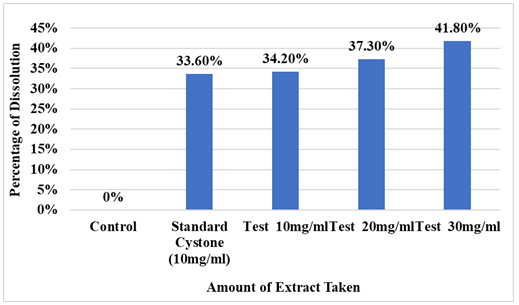
And the dissolution percentage of the standard cystone solution showed 33.60%, 30mg/ml of the cuminum cyminum seed extract showed the highest percentage dissolution 41.80% in comparison with other test samples. The 10mg/ml seed extract showed the 34.20% and 20mg/ml seed extract showed the 37.30% hence it can be concluded the percentage dissolution increases as the concentration increases and also the test drug showed the higher dissolution percentage than the Standard solution.
Dissolution Percentage of Calcium Oxalate by Titrimetry Method
Figure 1 shows that 30mg/ml Cuminum cyminum seed extract showed the highest percentage dissolution in comparison with other test samples. It showed maximum value of 41.80% and the standard cystone solution showed the 33.60% which was the minimum value of this study. Hence it can be concluded that the percentage dissolution increases as the concentration of test drug increases.
Discussion
Nephrolithiasis or renal stone disease remains a significant health problem in the adult population, with serious medical consequences, throughout a patient’s life time. The world-wide incidence urolithiais is quite high, and more than 80% of urinary calculi are Calcium oxalate stones alone or Calcium oxalate mixed with calcium phosphate [11].
Medicinal plants being used in healthcare system since time immemorial and studies being carried out all over the world in order to verify their efficacy and sum of the discoveries have led to the production of plant-based medicine [12].
In spite of substantial progress in the pathophysiology and treatment of urolithiasis, there is no satisfactory drug being used in clinical therapy. Endoscopic stone removal and extracorporeal shock wave lithotripsy are prohibitively costly, and recurrence is quite common with these procedures. Thus, a drug for the prevention of this disease or its recurrence would be of great interest. Medicinal plants have played a significant role in various ancient traditional systems of medication. Even today, plants provide a cheap source of drugs for majority of world’s population. Several pharmacological investigations on the medicinal plants used in traditional antiurolithic therapy have revealed their therapeutic potential in the invitro models [3].
Drug therapy has developed in response to population health care needs. Among the promising areas of research and development of medicines from the vast highly potential plant resources. Plants are also attractive sources for the development of novel and very effective and safe therapeutic agents against kidney procumbence. Herbal medicines are also in great demand in the developed world for primary health care because of their efficacy, safety and lesser side effects [11].
Unlike allopathic medicines which target is only one aspect of urolithiatic pathophysiology, most of plant-based therapy have been shown to be effective at different stages of stone pathophysiology. About 80% of the world populations rely on the use of traditional medicine which is predominantly based on plant materials. Lithiasis (stone formation) is an important cause for acute and chronic renal failure, includes both nephrolithiasis (stone formation in kidney) and urolithiasis (stone formation in ureter or bladder or both). Among the various kinds of stones identified, calcium stones occur mainly in Men, while phosphate stones formation is more in women [3].
Among the diversity of plants Cuminum cyminum is an aromatic herb of the Apicaceae family, and its dried seeds are used as a spice. It is native to India, Iran, the Mediterranean, and Egypt. The cumin seed has many pharmacological activities which were reported by the previous research. This study evaluates the Anti -urolithiatic activity of seed extract of Cuminum cyminum. The highest percentage 41.80% of Calcium oxalate dissolution was obseverd in 30mg/ml seed extract. Cuminum cyminum was found to be more effective in dissolution of Calcium oxalate than standard drug cystone. From this study it was observed that the highest dissolution of Calcium oxalate was increased with the concentration of test drug increses. This study has given primary evidence for Cuminum cyminum as the plant which possess lithotriptic property.
Conclusion
Invitro Anti- urolithiatic activity has been performed on the selected plant Cuminum cyminum seed extract by using the standard drug cystone by titrimetry method. The work was performed by using invitro Anti- urolithiatic model for Calculating percentage dissolution of Calcium oxalate stone. The seed extract of Cuminum cyminum showed the higher dissolution than the standard drug cystone. The 30mg/ ml seed extract of Cuminum cyminum was highest among the test groups. This study has been primary evidence for Cuminum cyminum as the plant which possess Anti- urolithiatic property.
Reference
1. Chakradhar KV (2012) A Comparative study on Renal calculi – An Ayurvedic Perspective. Journal of Dental and Medical sciences 5(2): 21-32.
2. Niharika M, Harshitha V, Ashwini P, Srivinya B, Himabindhu J, et al. (2018) Evaluation of In Vitro Antiurolithiatic Activity of Chloris Barbata. Int J Curr Pharm Res 10(3): 65-67.
3. Reddy JM, Prathyusha K, Himabindhu J, Ramanjaneyulu K (2018) Evaluation of In Vitro Antiurolithiatic Activity of Mentha Piperita. Int Journal of Pharmaceutical Sciences and Medicine 3(8): 22-28.
4. Salman A, Mohtasheemul HM, Alam MZ (2017) Globally used antiurolithiatic plants of family Asteraceae: Historical background, mechanism of action, therapeutic spectrum, formulations with doses. Journal of Pharmacognosy and Phytochemistry 6(3): 394 -402.
5. Sharadanand PR, Subhash HA (2015) In-vitro Antiurolithiatic Activity of Kalanchoe pinnata Extracts. International Journal of Pharmacognosy and Phytochemical Research 7(2): 275-279.
6. Agarwal K, Varma R (2014) Ocimumgratissimum: A Medicinal plant with promising Antiurolithiatic activity. International Journal of Pharmaceutical Sciences and Drug Research 6(1): 78-81.
7. Nagal A, Singla RK (2013) Herbal resources with Antiurolithiatic Effects, Indo Global Journal of Pharmaceutical sciences 3(1): 6-14.
8. Kanagal S, Nagarajan S, Jagan Mohan RL (2011) Cumin (Cuminum cyminum L.) Seed Volatile Oil: Chemistry and Role in Health and Disease Prevention. Nuts and Seeds in Health and Disease Prevention, Academic Press, pp: 417-427.
9. Srinivasan K(2018) Cumin (Cuminum cyminum) and black cumin (Nigella sativa) seeds: traditional uses, chemical constituents, and nutraceutical effects. Food Quality and Safety 2(1): 1-16.
10. Benalia H, Djeridane A, Bensafieddine F, Yousfi M (2016) High in vitro Anti-urolithiyatric effect of Pituranthos scoparius roots extracts. Phamacology online 1: 31-43.
11. Khan SR (1997) Interaction between stone- forming calcific crystals and macromolecules. urol Int 59(2): 59- 71.
12. Babu M, Uma KH, Joseph S, AmoolyaSree, Scariya S, et al. (2021) Invitro evaluation of Anti- urolithiatic and Larvicidal activity of Alternanthera sessilis. Biomed Pharmacol J 14(2): 671-680.
References
-
Chakradhar KV (2012) A Comparative study on Renal calculi – An Ayurvedic Perspective. Journal of Dental and Medical sciences 5(2): 21-32.
-
Niharika M, Harshitha V, Ashwini P, Srivinya B, Himabindhu J, et al. (2018) Evaluation of In Vitro Antiurolithiatic Activity of Chloris Barbata. Int J Curr Pharm Res 10(3): 65-67.
-
Reddy JM, Prathyusha K, Himabindhu J, Ramanjaneyulu K (2018) Evaluation of In Vitro Antiurolithiatic Activity of Mentha Piperita. Int Journal of Pharmaceutical Sciences and Medicine 3(8): 22-28.
-
Salman A, Mohtasheemul HM, Alam MZ (2017) Globally used antiurolithiatic plants of family Asteraceae: Historical background, mechanism of action, therapeutic spectrum, formulations with doses. Journal of Pharmacognosy and Phytochemistry 6(3): 394 -402.
-
Sharadanand PR, Subhash HA (2015) In-vitro Antiurolithiatic Activity of Kalanchoe pinnata Extracts. International Journal of Pharmacognosy and Phytochemical Research 7(2): 275-279.
-
Agarwal K, Varma R (2014) Ocimumgratissimum: A Medicinal plant with promising Antiurolithiatic activity. International Journal of Pharmaceutical Sciences and Drug Research 6(1): 78-81.
-
Nagal A, Singla RK (2013) Herbal resources with Antiurolithiatic Effects, Indo Global Journal of Pharmaceutical sciences 3(1): 6-14.
-
Kanagal S, Nagarajan S, Jagan Mohan RL (2011) Cumin (Cuminum cyminum L.) Seed Volatile Oil: Chemistry and Role in Health and Disease Prevention. Nuts and Seeds in Health and Disease Prevention, Academic Press, pp: 417-427.
-
Srinivasan K(2018) Cumin (Cuminum cyminum) and black cumin (Nigella sativa) seeds: traditional uses, chemical constituents, and nutraceutical effects. Food Quality and Safety 2(1): 1-16.
-
Benalia H, Djeridane A, Bensafieddine F, Yousfi M (2016) High in vitro Anti-urolithiyatric effect of Pituranthos scoparius roots extracts. Phamacology online 1: 31-43.
-
Khan SR (1997) Interaction between stone- forming calcific crystals and macromolecules. urol Int 59(2): 59- 71.
-
Babu M, Uma KH, Joseph S, AmoolyaSree, Scariya S, et al. (2021) Invitro evaluation of Anti- urolithiatic and Larvicidal activity of Alternanthera sessilis. Biomed Pharmacol J 14(2): 671-680.
- Management of Ear Keloid with Ksharsutra: A Case Study
- Yoga and Global Sustainability: A Holistic Path to One Earth, One Health
- Autoimmune Diseases in Ayurveda: A Narrative Review with Classical and Modern Perspectives
- Management of Cluster Headache Associated with Pituitary Apophysitis by CERT (Chakrasiddh Energy Release Technique): A Case Report on Energy Rebalancing
- Zygophyllum Geslini Coss : Biochemicals and Antioxidant Activity
- Observations of a Beginner Vaidya