
A Case Study on Management of Asthigata Vata W.S.R. AVN of Femoral Head
Avascular necrosis of femoral head is a growing condition in the musculoskeletal clinic. This is mainly osteonecrosis caused by injury or occlusion in the blood vessels that supply bone tissue. AVN of femoral head is the most common type of necrosis because the artery that supplies this area is so narrow that it is easily injured, which then causes a lack of nutrition leading to necrosis. Modern medicine has no specific cures other than surgery. Moreover, it is expensive and unpredictable. In Ayurveda, Vata, Pitta, Rakta Dosha, Asthi, and Majja Kshaya play a major role in the pathogenesis of AVN. This article is aimed to nourish, repair, and regenerate Asthi Dhatu & Vatashamana. The current study, at the age of 28, diagnosed AVN of the femoral head was treated with Udvartana, Kshara Basti, Ksheera Basti, and Shasthika Shali Pinda Sveda which plays a significant effect in the improvement of pathology.
Introduction
Avascular necrosis (AVN) of the femur head is a pathological process that results the rom interruption of the blood supply to the bone [1]. In 1835 Curveihier depicted femoral head morphological changes secondary to interruption of blood flow. Clinical AVN most commonly affects the ends of long bones such as the femur, humerus etc [2]. In Ayurveda, it can be correlated with the Asthigata Vata where the symptoms include Asthikshaya, Asthisoushirya etc [3]. No generally good treatment has been grown, in any event, even for early disease progression. But Ayurvedic approach can give a palatable outcome with progress in quality of life.
Aims and Objectives of Treatment
- To increase the ROM (range of movement) which plays a vital role in arresting of disease progression
- To clear the Avaraka and pacify the Vata Dosha
- To nourish, repair and regenerate Asthi Dhatu & Vatashamana.
A Patient of aged 28 years visited the OPD with chief complaints of Pain and Stiffness in the right hip joint, Unable to flex the right hip joint, Unable to sit on the floor, Unable to climb the steps and Reduced range of movements of right hip since 3 years, which was associated with difficulty in walking and heaviness in lower limb. Patient was said to be healthy before 10 years, then he had suffered from Rheumatoid arthritis for 4 years with the complaints of pain in multiple joints, morning stiffness and h/o joint oedema, for that he took corticosteroid treatment for 1 year and got relief from symptoms of rheumatoid arthritis, since 3 years he gradually started complaining of above said complaints. No any specific history regarding systemic disease and no any specific trauma history. He was unable to lift the right limb even up to 10 degrees and his joint gait was hampered on first visit.
Past History – No H/o of HTN, diabetes and Hypothyroidism, H/o - Rheumatoid arthritis.
- Family History – Not specific
- Treatment History – H/o Steroid intake for RA
Personal History
- Appetite: Moderate.
- Bowel: Constipated.
- Micturition: 6-7 times/24 hrs.
- Sleep: Sound
- Diet: Mixed
- Kostha: Madhyama
General Examination
- Pallor: Absent
- Icterus: Absent
- Clubbing: Absent
- Cyanosis: Absent
- Lymphadenopathy: Absent
- Edema: Absent
Vital Examination
- BP – 120/70 mm of Hg.
- Pulse Rate: 74 bpm
- Respiratory Rate: 18 cpm.
- Weight: 50 kg
- Temperature: 98.6 F
Astha Sthana Pareeksha
- Nadi: 74b/min
- Mala: Vibandha
- Mootra: Prakruta
- Jihwa: Liptata
- Shabdha: Prakruta
- Sparsha: Prakruta
- Drik: Prakruta
- Aakruti: Madhyama.
Dashavidha Pareeksha
- Prakruti: Vata-Pittaja
- Vikruti: Vataja
- Saara: Madhyama
- Samahanana: Madhyama
- Pramana: Madhyama
- Satwa: Madhyama
- Satmya: Madhyama
- Ahara Shakti: Madhyama
- Abhyavarana shakti: Madhyama
- Jarana shakti: Madhyama
- Vyayama Shakti : Avara
- Vaya: Taruna
Systemic Examination
- Central Nervous System: Conscious, well oriented with time & place.
- Cardio Vascular System: S1 & S2 heard properly.
- Respiratory System: AEBE.
- G-I Examination: soft, non-tender
Hip Joint Examination – Right Hip Joint
- Inspection: No scar mark, No swelling.
- Palpation: Tenderness – grade 1 tenderness was present on right gluteal region.
- Gait : limping gait
- Arms: Normal
- Legs : affected range of movements of right lower limb
- Spine: mild scoliosis
| Right hip joint examination (visit wise) | Left | ||||||
|---|---|---|---|---|---|---|---|
| 1st | 2nd | 3rd | 4th | 5th | 6th | ||
| Flexion | 18 0 | 18 0 | 20 0 | 22 0 | 26 0 | 26 0 | N |
| Extension | 20 0 | 20 0 | 24 0 | 24 0 | 24 0 | 24 0 | N |
| Abduction | 10 0 | 10 0 | 18 0 | 25 0 | 30 0 | 40 0 | N |
| Adduction | NPP | NPP | NPP | NPP | 100 | 100 | N |
| Leg-Length discrepancy | 34 ’’ | 34 ’’ | 34 ’’ | 34 ’’ | 34 ’’ | 34 ’’ | 34.6’’ |
| Muscle Bulk – Calf muscles | 10.8’’ | 10.8’’ | 10.8’’ | 11.2’’ | 11.2’’ | 11.2’’ | 11.3’’ |
| Gluteus Muscles | 13’’ | 13’’ | 13’’ | 13’’ | 14’’ | 14’’ | 15.4’’ |
| Thigh Muscles | 15.5’’ | 15.5’’ | 15.5’’ | 15.5’’ | 15.5’’ | 15.5’’ | 16.2’’ |
Table 1: Examinations of Hip Joints.
Samprapti
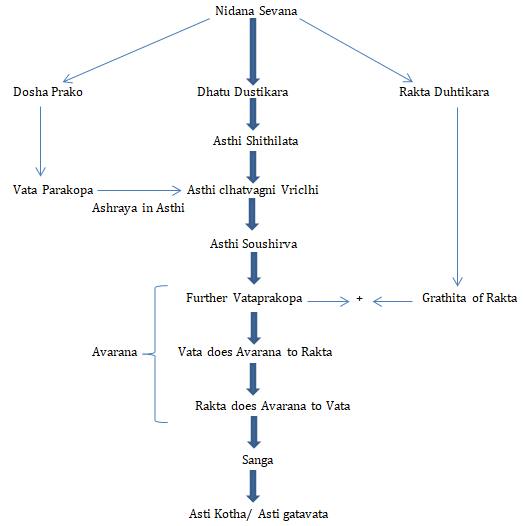
Samprapti Ghataka:
| 1 | Dosha | Vata |
| 2 | Dushya | Asthi, Rakta, Sira, Mamsa |
| 3 | Srotas | Asthivaha, Raktavaha, Mamsavaha, |
| 4 | Srotodushti | Sanga |
| 5 | Roga marga | Madhyama |
| 6 | Udbhavasthana | Pakwashaya |
| 7 | Vyakta sthana | Asthi, Sandhi |
| 8 | Agni | Mandya |
| 8 | Agni | (Jatharagni: Mandya) |
| 8 | Agni | (Bhutagni : Parthiva, Tejasa, Vayavagni :- Mandya) |
| 9 | Ama | Jatharagni; Bhutagni; Dhatwagni Mandya Janya Ama |
| 10 | Roga Prakruti | Chirakari |
| 11 | Sthanasamshraya | Vankshanapradesha |
Table 2: Following methods include in Samprapti ghataka.
Investigation: on 10/10/2020 • X-ray pelvis with both hip joints – AP view & lateral view. Avascular necrosis of right femoral head likely with secondary degenerative changes in right hip joint.
Chikitsa
1st Phases of Treatment • Vatahara
- Raktaprasadana
- Astidhatu shodhana.
2nd Phases of Treatment
- Vatahara
- Asthi Prasadana
- Brimhana (SSPS)
Panchakarma Procedures (Phase 1 treatment- Part A)
- Udwartana : KolkulathadiChoorna + Haridra Choorna + Triphala Choorna +YastimadhuChoorna
- Sarvanga Abhyanga withKottamchukkadi Taila f/b Bhaspa Sweda.
- Manjistadi Kshara Basti: Madhu- 80 ml Saindhava Lavana - 6gm Nimbambrutadi Eranda Taila- 80 ml Kalka – Guduchi, Shatava, Rasna, Musta, Vacha- each 5 gm Manjistadi Kashaya - 200ml Gomutra Arka – 100ml.
• Anuvasana Basti : Nimbambrutadi Eranda Taila- 80 ml
| 11-Mar | 11-Apr | 11-May | 11-Jun | 11-Jul | 11-Aug | 11-Sep | 11-Oct | 11-Nov | 11-Dec | 13/11 |
|---|---|---|---|---|---|---|---|---|---|---|
| UDW | UDW | UDW | UDW | UDW | - | - | - | - | ||
| Sr.Ab BS | Sr.Ab BS | Sr.Ab BS | Sr.Ab BS | Sr.Ab BS | Sr.Ab BS | Sr.Ab BS | Sr.Ab BS | Sr.Ab BS | ||
| Kosta Shodhan | No procedure | AB | AB | AB | ||||||
| MKB | MKB | MKB | MKB | MKB |
Table 3: Panchakarma Procedure Chart of phase 1. (UDW- Udwartana, Sr.Ab BS – Sarvanga Abhyanga, Bhaspa Sweda, AB – Anuvasana Bast
Table 3: Panchakarma Procedure Chart of phase
Table 3: Panchakarma Procedure Chart of phase 1. (UDW- Udwartana, Sr.Ab BS – Sarvanga Abhyanga, Bhaspa Sweda, AB – Anuvasana Basti, MKB- Manjistadi Kshara Basti) • Shamana Medications: • Tab Panchatiktaka Ghrita Guggulu 1 Bd , A/F • Tab Lakshadi Guggulu 1 Bd, A/F • Cap Gandha Taila 2 Bd • Mahatikthaka Kashaya 10 ml, Bd. • Amrutaballataka leha ½ tsf bd Panchakarma Procedures (Phase 1 treatment –Part B) • Sarvanga Abhyanga with Balashvagandha Taila • Shasthika Shali Pinda Sveda • Anuvasana Basti with Guggulu Tiktaka Ghrita – 30ml + Manjisthadi Taila – 30ml • Panchatiktaka Niruha Basti • Madhu – 80 ml • Saindhava Lavana – 6 gms • Sneha – Nimbamrutadi Eranda Taila – 60ml • Kalka – Manjistha + Mustha + Guduchi + Arjun – 30gms • Kashaya – Panchatiktaka Kashaya + Guduchi, Nimba and Vasa Kashaya – 250ml • Gomutra Arka – 50ml
| 22/12 | 23/12 | 24/12 | 25/12 | 26/12 | 27/12 | 28/12 | 29/12 | |
|---|---|---|---|---|---|---|---|---|
| Sr,Ab | Sr,Ab | Sr,Ab | Sr,Ab | Sr,Ab | Sr,Ab | Sr,Ab | Sr,Ab | Sr,Ab |
| SSPS | SSPS | SSPS | SSPS | SSPS | SSPS | SSPS | SSPS | SSPS |
| AB | AB | AB | AB | AB | AB | |||
| PTNB | PTNB | PTNB |
Table 4: Panchakarma Procedure Chart of phase 1. (SSPS - Shasthika Shali Pinda Sveda, PTNB - Panchatiktaka Niruha Basti **Panchak
Table 4: Panchakarma Procedure Chart of phase
Table 4: Panchakarma Procedure Chart of phase 1. (SSPS - Shasthika Shali Pinda Sveda, PTNB - Panchatiktaka Niruha Basti Panchakarma Procedures (Phase 2 treatment) • Sarvanga Abhyanga with Kottamchukkadi Taila f/b Bhaspa Sweda. • Manjistadi Kshara Basti: First day for Shodhanarth, • Madhu- 60 ml • Saindhava Lavana - 6gm • Nimbambrutadi Eranda Taila- 60 ml • Kalka – Vaishwanara, Shatava – 20 gm • Manjistadi Kashaya+ Triphala kashaya - 400ml • Gomutra Arka – 50ml. • Anuvasana Basti: Nimbambrutadi Eranda Taila- 60 ml • Manjistadi Ksheera Basti: • Madhu- 60 ml • Saindhava Lavana - 6gm • Nimbambrutadi Eranda Taila- 60 ml • Kalka – Vaishwanara, Shatava – 20gm • Manjistadi + Triphala ksheera Paka - 400ml
| 22/4/21 | 23/4/21 | 24/4/21 | 25/4/21 | 26/4/21 | 27/4/21 | |
|---|---|---|---|---|---|---|
| Sr Ab, bs | Sr Ab, bs | Sr Ab, bs | Sr Ab, bs | Sr Ab, bs | Sr Ab, bs | Sr Ab, BS |
| AB | Manjistadi Kshara Basti | Manjistadi Ksheera Basti | Manjistadi Ksheera Basti | Manjistadi Ksheera Basti | Manjistadi Ksheera Basti | Manjistadi Ksheera Basti |
| - | - | - | - | - | - | AB |
Table 5: The following record was notices in the mentioned dates.
Discussion
Chikitsa Sootra
• भेदोऽस्थिपर्वणां सन्धिशूलं€मांसबलक्षयः|अस्वप्नः€सन्त ता रुक्€च€मज्जास्थिकुपितेऽनिले|| Cη Chι 28/33.[3]
• अस्थ्याश्रयाणां€व्याधीनां€पञ्चकर्माणि€भेषजम्|बस्त्यः€ क्षीरसर्पींषि€तिक्तकोपहितानि€च|| Cη Sυ 28/27.[4]
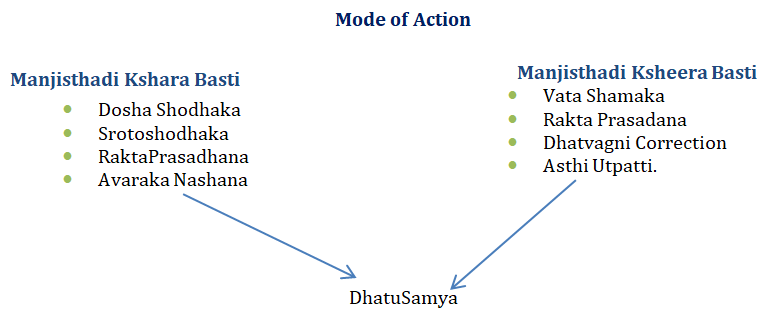
Mode of Action of Kshara Basti
Raktavaha Srotorodha becomes prime cause leading to Asthi Dhatu Kshaya in AVN. To counter this Rakta Dushti, Manjishthadi Kshara Basti was administered. Manjishthadi Kwatha is Tikta, Katu Rasa Pradhana and Ushna Virya which acts as Raktaprasadaka.[5]
Symptomatic assessment
Mode of Action of Ksheera Basti
Ksheera Basti is indicated as a treatment modality in Asthi Pradoshaja Vikara’s. The decoction made in Ksheera which is having Madhura and Snigdha properties help to control Vata Doṣa and acts as Bṛimhaṇa.[5]
Mode of Action of SSPS
It is a kind of Brimhana, Vatahara Sweda. By virtue of its ingredients like Godugdha and Shashtikashali, it nourishes and gives strength to muscle tissues. [5] Shashtikashali Pinda Sweda improves the strength of tissues which in turns increase movements and flexibility. It also helps in the nourishment of muscle tissue, increases muscle bulk and reduces muscle wasting.
| Rt Hip | Before treatment | After treatment |
|---|---|---|
| Pain in hip joint | +++ | - |
| Stiffness of hip joint | ++++ | ++ |
| Heaviness in lower limbs | +++ | - |
| Difficulty in walking | ++++ | ++ |
| Difficulty in sitting (chair) | Unable to sit on floor, Able to sit on chair with support. | He can sit over table, chairs without support. |
| Before Treatment | After Treatment | |
| Flexion | 18 degree | 26 degree |
| Extension | 20 degree | 24 degree |
| Abduction | 10 degree | 40 degree |
| Adduction | Not possible to perform | 10 degree |
| Leg-Length discrepancy | 34 inches | 34inches |
| Muscle Bulk –Calf muscles | 10.8 inches | 11.2 inches |
| Gluteus Muscles | 13 inches | 14 inches |
| Thigh Muscles | 15.5 inches | 15.5 inches |
Table 6: Symptomatic assessment.
Assessment Right Hip joint
Conclusion
- Necrosis is a condition where in cellular death occurs thus the aim was to check the progression of the disease to bring about symptomatic relief in the subject.
- Initial treatment of Udvartana and Kshara Basti plays an important role in the reduction of stiffness at hip joint and improvement in the range of movements
- Kshara Basti, Ksheera Basti and Shasthika Shali Pinda Sveda helps in Samprapti Vighatana of Asthigata Vata.
- Use of Tikta Rasatmaka drugs plays a significant effect in the improvement of pathology.
- Conventional medicine system has a costlier health care approach in AVN without any assurance, but Ayurveda acts like the miracle in restoration of daily activities of the patient.
References
-
Marks JW (2021) MD definition of Avascular necrosis of the femoral head. Wikipedia.
-
Fondi C, Franchi A (2007) Definition of bone necrosis by the pathologist. Clin Cases Miner Bone Metab 4(1): 21- 26.
-
Trikamji Y (2020) Commentary Ayurveda Deepika on Charaka Samhita of Charaka, Chikitsasthana, Chapter -28, verse no-33 Chaukamba publishers, Varanasi, India, pp: 617.
-
Trikamji Y (2020) Commentary: Ayurveda Deepika on Charaka Samhita of Charaka, Sutrasthana, Chapter -28, verse no-27 Chaukamba publishers, Varanasi, India, pp: 280.
-
Vasant P (2014) Principles and Practice of Panchakarma (A Comprehensive Book for PG Scholars, researchers and Practitioners) 5th (Edn.), Choukhamabha Sanskrit Sansthan; Varanasi, India, pp: 712.
- Management of Ear Keloid with Ksharsutra: A Case Study
- Yoga and Global Sustainability: A Holistic Path to One Earth, One Health
- Autoimmune Diseases in Ayurveda: A Narrative Review with Classical and Modern Perspectives
- Management of Cluster Headache Associated with Pituitary Apophysitis by CERT (Chakrasiddh Energy Release Technique): A Case Report on Energy Rebalancing
- Zygophyllum Geslini Coss : Biochemicals and Antioxidant Activity
- Observations of a Beginner Vaidya