
An Economic Analysis of Medicinal Herb Colocasia for Leaf Production
Objective: To study the level of input use in colocasia production, estimate the cost and return and disposable pattern. Colocasia herb is rich source of phenols, flavonoids, saponins, tannins, glycosides, sterols and triterpenoids, therefore, used as traditional medicaments. Farmers cultivate this multi cut crop only for leaf production in middle Gujarat. Methods: This leafy crop production mainly depends upon the level of input used. Hence, the use of judicious inputs (nutritional and irrigation) in production process is vital in this multi cut crop cultivation. Results: Average gross return (Rs. 486454.45 ha-1) and net return (Rs. 293452.22 ha-1) were obtained by producers. Price received by farmers at field level was Rs. 2309.20 q-1 and the cost of production (Rs./q) of colocasia was the tune of Rs. 1020.20. This indicated that price received by producers was higher as compared to the cost incurred by them. The total marketing cost incurred by all the middlemen in the identified channel was about Rs. 844.77 q-1. Out of which the highest cost was incurred by village trader followed by retailer, wholesaler cum commission agent and farmer. Average total margin earned by different functionaries was Rs. 3969.39 q-1 and the margin was higher at retailers’ level (Rs. 2182.50 q-1) as compared to village trader (Rs. 1245.23) and wholesaler-cum-commission agents (Rs 541.66 q-1). The producer’s share in consumer’s rupee was quite low (32.35 per cent) and the price spread was Rs. 4814.16 q-1 in the identified marketing channel of colocasia in study area. Conclusion: Overall, colocasia is the remunerative crop for the farmers and needs to shorten the marketing channel.
Introduction
Colocasia (Colocasia esculanta) is a tropical plant grown primarily for its edible corms, the root vegetable most commonly known as taro. It is the most widely cultivated herb species in the Araceae family which are used as vegetables for their corms, leaves, and petioles. Due to the huge amount of vitamins and minerals, it has substantial value in the food market. As the Taro has raised market demand, it needs to increase production as much as possible. Agroforestry would be a possible production approach for Taro as it can be practiced in partially shaded conditions [1]. Taro corms are a staple food in African and Asian countries, and South Asian cultures, and taro is believed to have been one of the earliest cultivated plants. Cultivation of colocasia is widespread in India, Burma, China, Japan, Hawaii, Egypt, Africa and the Caribbean. Total area under colocasia in the world is about 10.8 million region hectare of which Asia’s share is about 1.5 million hectares [2, 3].
Taro leaves are excellent source of Vitamin-C, Vitamin-A, Vitamin B6, thiamine, niacin and riboflavin, Folate, Manganese, Copper, Potassium and Iron. Leaves are good source of saponins, tannins, phenols, flavonoids, glycosides, sterols and triterpenoids, these help to boost immune system. Leaves have anti-cancer, lower hypertension, anti- diabetic, anti-anemia anti-inflammatory and anti-microbial properties [4].
Taro is majorly grown in localized pockets of Madhya Pradesh, Uttar Pradesh, Andhra Pradesh, Karnataka and Kerala [5]. It is an important vegetable grown throughout India and is sometimes called the “potato” of the humid tropics. It is a perennial, tropical plant primarily grown as a root vegetable for its edible starchy corm in Indian states and as a leafy vegetable in Gujarat. It used in a significant amount and as a staple food in Africa, Oceanic and Asian cultures [6]. As a leafy vegetable it is very famous in Gujarat by the name of ‘Patravalle’. In Gujarat and Maharashtra, the leaves of the plant are used to make patra a dish with gram flour, tamarind and other spices. Therefore, looking to economic importance of leaf of Colocasia in Gujarat, the first time study was under taken to evaluate with level of input use in colocasia production, estimate the cost and return of colocasia and disposable pattern of colocasia by different stakeholders.
Methods
Selection of Area
The present study was confined to middle Gujarat (Anand and Kheda) were selected purposively for detailed study on the basis of availability of colocasia farmers by covering two talukas namely Anand and Nadiad. The villages covered from Anand taluka were Boriavi, Lambhvel and Bakrol and from Nadiad taluka Kanjari, Fatehapura and Chaklasi.
Selection of Respondents
From each selected district, 50 respondents were selected purposively those who were engaged in colocasia cultivation. Thus, total 100 (2x50) respondents were selected to achieve the stipulated objectives of the study. To study marketing cost, margin and price spread, a sample of 5 intermediaries (middlemen) of each type associated in marketing of colocasia spread over Anand market of the study area was selected to achieve the specific objective. Primary data were collected from sample households on various parameters such as socio-economic profile, level of input use, cost and return, disposable pattern and marketing through well-structured and pre-tested interview schedules. The collected data were analyzed and presented in tabular form. The tabular analysis was employed to study the level of input used, cost and return and disposable pattern. Descriptive statistics such as mean, percentage, ratio, etc., was also used for achieving the specific objectives of the study.
The Cost Concept (CACP approach) was widely used by researchers in the field of farm management studies for computing cost of cultivation and cost of production such as Cost A, Cost B, Cost C1 and Cost C2 were used in the present study. Cost A includes, cost of hired human labour, tractor charges, cost of seeds/plantlets, cost of manure and bio fertilizers, cost of chemical fertilizers, cost of insecticides and pesticides, irrigation charges, other paid out expenses if any, depreciation on farm buildings and small farm tools, rental value of leased land, interest on working capital, miscellaneous expenses including land revenue, transport charges, etc. Cost B = Cost A + rental value of owned land + interest on fixed capital Cost C1 = Cost B + imputed value of family labour Cost C2 = Cost C1 + managerial charges Cost of production refers to cost incurred for per quintal production of crop, it was calculated as follows: Cost of production (per quintal) = Cost C2/ Yield of main product in quintal Gross Return = Quantity of produce x Price of produce Net Return = Gross Return – Total Cost The values of purchased inputs were taken into account as reported by the cultivators after due verification. Some of the inputs used in the production process came from family sources. The procedure adopted for deriving imputed value of such inputs was as under taken as per standared norms. Family labour cost was imputed at the wage rates prevailing for different agricultural operations per day in the selected villages. The cost of tractor charges was reckoned as per the prevailing market rate in the villages. The value of own farm produced inputs viz., manure, seeds/plantlets etc. were computed as the rates prevailing in the concerned villages. The cost of irrigation was considered at the prevailing market rates. The kind payments were evaluated at prices prevalent in the village. Interest on working capital was charged at the rate of 12% per annum, according to duration of the crop (6 months). Depreciation of owned farm buildings was calculated at the rate of 5% for kachcha and 2% for pucca buildings per annum. Rental value of owned land was charged at the rate prevailing in the concerned villages. Management charges were calculated at the rate of 10% of Cost $C_1$.
**Income Measures**
- Value of gross output (Gross income): The Value of gross output or Gross income was calculated by considering the total production in quintal and price prevailing of product per quintal (main product + by-product).
- Farm business income: Gross income – Cost A
- Family labour income: Gross income – Cost B
- Farm investment income: Net income + Rental value of owned land + Interest on owned fixed capital.
- Net income: Net income was calculated by considering the value of gross output minus Cost $C_2$.
**Disposable Pattern**
To study disposable pattern the marketable surplus of respondents was estimated and identified the major marketing channel used by producers to sale their produce. Marketable surplus is the quantity of the produce left with the farmer after meeting all the requirements. Marketable surplus was estimated by using the following formula; Marketable surplus = Total production-Total requirements (family, labour, relatives etc.)
**Marketing Costs, Margins and Price-Spread**
The marketing cost and margins including average gross margin, absolute margin, percentage margin, producer’s share in consumer’s rupee and total cost of marketing was calculated for the major channel found in study area by using following formulae [7].
$$\text{Average Gross Margin: } \text{Average gross margin at each successive level of marketing was calculated by dividing the differences of sale value and purchase value by the quantity of the produce handled.}$$
$$\text{AGM} = \frac{\text{Total sale value} - \text{Total purchase value}}{\text{Quantity of produce handled}}$$
Absolute Margin of the Middleman (Ami): Absolute margin of the middleman was calculated by deducting the purchase price and cost incurred by him from the sale price. Ami = $P_{RI} - (P_{PI} + C_{mi})$
Percentage Margin of the Middleman ($P_{mi}$): Percentage margin of the middleman was calculated by expressing the absolute margin as percentage of sale price.
$$P_{mi} = \frac{P_{RI} - (P_{PI} + C_{mi})}{P_{RI}}$$
Where,
$$P_{RI} = \text{Receipt per unit (sale price)}$$
$$P_{PI} = \text{Purchase price of goods per unit (Purchase price)}$$
$$C_{mi} = \text{Cost incurred on marketing per unit}$$
Producer’s Share in Consumer’s Rupee:
Producer Price ($P_F$) = $P_A - C_F$
Where,
$$P_A = \text{Wholesale price in the primary assembling market}$$
$$C_F = \text{Marketing cost incurred by farmer}$$
$$P_S = \frac{P_F}{P_r} \times 100$$
Where,
$$P_S = \text{Producer’s share}$$
$$P_F = \text{Producers price}$$
$$P_r = \text{Retail price (i.e. paid by the consumer)}$$
Price-Spread: Price-spread refers to the differences between the price paid by the ultimate consumer and the price received by the producer for an equivalent quantity of the farm produce.
$$\text{Price-spread} = P_r - P_F$$
Total Cost of Marketing: Total cost of marketing is the sum total of costs incurred by the farmer and different middlemen:
$$C = C_F + C_{m1} + C_{m2} + C_{m3} + \dots \dots \dots + C_{mn}$$
Where,
$$C = \text{Total cost of marketing}$$
$$C_F = \text{Cost of marketing incurred by the farmer and}$$
$$C_{m1} = C_{m2} = C_{m3} = C_{mn} = \text{Cost incurred by different middlemen.}$$
**Results and Discussion**
**Socio-Economic Profile of Respondents**
Socio-economic profile of respondents such as family size, age, education, occupation, association with organizations, size of land holding, source of irrigation etc., play an important role in managerial decision making for optimum use of resources, which also affect the economy of the farm and also the decision making about adoption of inventive techniques to a substantial extent. These aspects of sample respondents have been analyzed and presented as under:
**Average Family Status**
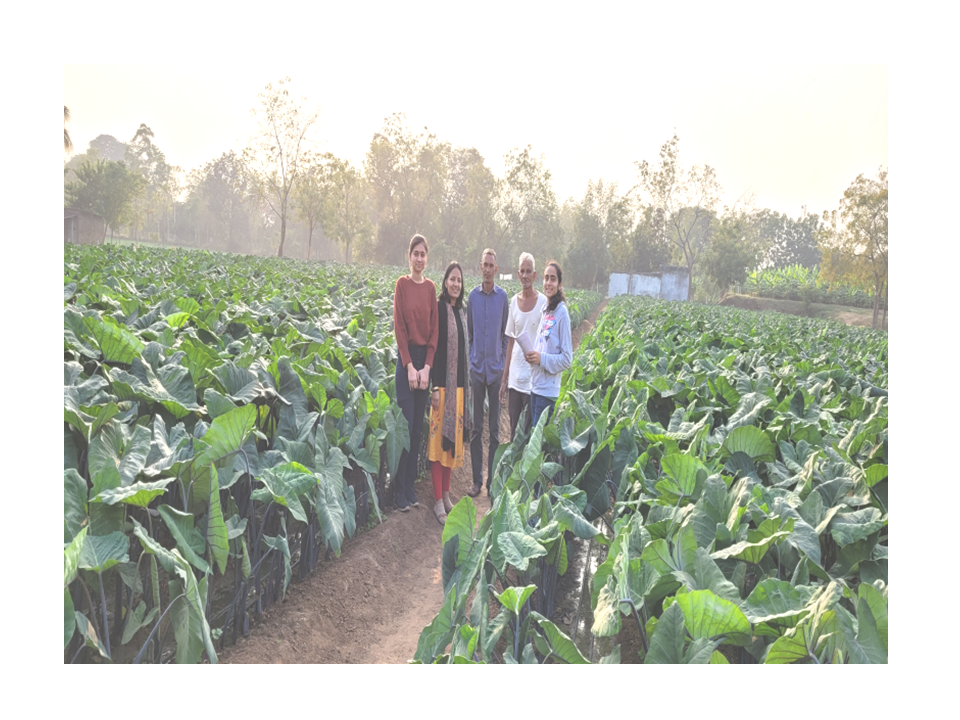
Family size makes available the labour force on the farm and affects the family consumption needs. It was observed that the average size of the family of the respondents was about 6.84 with 35.23, 34.21 and 30.56 male, female and children, respectively. Moreover, the average income earner members in the family were about 2.17 and the average age of respondents was found to be 52.36 years. About 93.00 per cent of the total sample farmers were literate and remaining 7.00 per cent farmers were illiterate. Among the literate respondents 53.00 per cent had education up to secondary level, 21.00 per cent up to primary level and 19.00 per cent up to college. Majority of the farmers (39.00 %) adopted farming with animal husbandry as their main occupation followed by farming (18.00 %), farming + animal husbandry + service (15.00 %), farming + service (12.00 %), farming + business (9.00 %) and farming + animal husbandry + business (7.00 %). Further, it was noticed that the farmers had on an average 19.27 years of experience of colocasia cultivation (Figure 1).
Overall average size of land holding possess by the farmers were about 3.76 hectare, out of which 100 per cent of land was irrigated and the average area allocated by farmers under colocasia cultivation was about 0.51 hectare (13.56 %). About 46.00 per cent farmers had tube well as a main source of irrigation followed by multisource of irrigation (23.00 %), canal (14.00 %), well (9.00 %) and pond (8.00 %). Multisource of irrigation includes tube well + well, tube well + canal + pond, well + canal etc.[8].
Cost and Return Structure
Profit maximization of a farm with respect to productivity, gross income and net income from a crop mainly depend upon the level of input use, resource optimization and managerial skill. Hence, the use of judicious inputs in production process is vital in any crop cultivation.
On an average per hectare use of total human labour in colocasia was about 141.79 man-days (Table 1). Colocasia is the annual crop and it required more labour (man-days) in their cultivation. Out of total human labour, contribution of hired labour and family labour was 114.67 and 27.22 man days, respectively. The per hectare machine hours used by the respondents were about 11.24 hrs. The use of plantlets/ sapling by the farmers was about 84,000 ha-1. Moreover, the results showed that farmers used huge quantity of manure (863.57 q/ha) and fertilizer which required for the vegetative growth of colocasia when it was used as leaf purpose. It can be seen from the table that on an average 52.23 irrigations were applied in colocasia production as it is water intensive crop and required frequent irrigations except in rainy season. It was observed that the frequency of irrigation was every 3-4 days in summer, 5-6 days in winter and only little irrigation were given in rainy season.
| Particulars | Amount | |
|---|---|---|
| 1. | Family labour (man days/ha) | 27.12 |
| 2. | Hired labour (man days/ha) | 114.67 |
| 3. | Total human labour (man days/ha) | 141.79 |
| 4. | Tractor (hrs/ha) | 11.24 |
| 5. | Plantlets/saplings (no./ha) | 84000 |
| 6. | Manure (q/ha) | 863.57 |
| 7. | Fertilizer (kg/ha) Urea | 628.39 |
| 7. | Diammonium Phosphate | 540.76 |
| 7. | Potassium Sulfate and Sulfur Powder | 322.58 |
| 8. | Irrigation (No./ha) | 52.23 |
Table 1: Level of inputs used by respondents in colocasia production. (n=100) Source: Field survey
Cost and Return Analysis
The average cost of cultivation per hectare of colocasia for leaf purpose was worked out (Table 2). It was observed that per hectare total cost of cultivation (Cost C2) of colocasia was Rs. 193002.23. Among the items of total cost the share of planting material (plantlets) (17.41 %) was found highest, followed by chemical fertilizers (14.02 %), human labour (13.82 %), irrigation (12.52 %) rental value of owned land (9.87 %), management cost (9.09 %), interest on working capital (8.31 %), manure (6.54 %) etc. Colocasia is input intensive crop and also covered the field throughout the year. When it was produced for leaf purpose it required lot of inputs for their vegetative growth as compared to their recommended doses for root purpose. Therefore, the total cost of cultivation accounted much higher for leaf purpose as compared to root. The item-wise costs as mentioned above were further classified into four groups viz., Cost A, Cost B, Cost C1 and Cost C2 which amounted to be Rs. 149779.59, Rs. 169737.15, Rs. 175456.57 and Rs. 193002.23 per hectare, respectively. Out of total cost (Cost C2) the share of Cost A, Cost B and Cost C1 was about 77.61, 87.95 and 90.91 per cent, respectively.
| Particular | Value (Rs.) | % to Cost C2 | |
|---|---|---|---|
| 1. | Family labour | 5719.42 | 2.96 |
| 2. | Hired labour | 20954.87 | 10.86 |
| 3. | Total human labour | 26674.29 | 13.82 |
| 4. | Tractor charges | 7758.28 | 4.02 |
| 5. | Plantlets/saplings | 33600.00 | 17.41 |
| 6. | Manures | 12613.60 | 6.54 |
| 7. | Fertilizers | 27098.40 | 14.04 |
| 8. | Irrigation | 24159.60 | 12.52 |
| 9. | Miscellaneous | 1058.36 | 0.55 |
| 10. | Depreciation | 769.25 | 0.40 |
| 11. | Total working cost | 133731.78 | 69.29 |
| 12. | Interest on working capital | 16047.81 | 8.31 |
| 13. | Cost A | 149779.59 | 77.61 |
| 14. | Rental value of owned land | 19049.00 | 9.87 |
| 15. | Interest on fixed capital | 908.56 | 0.47 |
| 16. | Cost B | 169737.15 | 87.95 |
| 17. | Cost C1}$ | $175456.57 | 90.91 |
| 18. | Management cost | 17545.66 | 9.09 |
| 19. | Cost C_{2}$ | 193002.23 | 100.00 |
Table 2: Details of cost of cultivation of colocasia (Rs. ha-1). (n=100) Source: Field survey Average annual herbage yield obtain
Table 2: Details of cost of cultivation of colocasia (Rs. ha-1). (n=100) Source: Field survey Average annual herbage yield obtained from colcocasia cultivation was about 189.18 quintals per hectare (Table 3). Colocasia is the annual crop and its first cutting was started about three months of cultivation, after that every month on an average about 3-4 cuttings are obtained by the farmers for 6-7 months. Initially low yield of herbage was attributed and it was increased in every cutting. Average price received by farmers was Rs. 2309.20 q-1 for main production. In the form of by-product, farmers obtained income around Rs. 49600 ha-1 by selling the extra planlets / sapling produced in the side of main plant. Therefore, the average gross return per hectare was Rs. 486454.45. Net return earned by the farmers was about Rs. 293452.22 ha-1 with the input-output ratio of 2.52. Whereas, the cost of production in the tune of Rs. 1020.20 q-1. This indicated that the per quintal price received by producers was higher as compared to the cost incurred by them to produce one quintal of colocasia. Hence, colocasia is the remunerative crop for the farmers. Similarly, medicinal crop like shatavari for root production and jal Brahmi for dry herbage production were reported remunerative under Gujarat conditions [9, 10].
| Particulars | Amount (Rs.) | |
|---|---|---|
| 1. | Total cost of cultivation | 193002.23 |
| 2. | Yield of main product (q/ha) | 189.18 |
| 3. | Average price of main product (Rs/q) | 2309.20 |
| 4. | Income from main product | 436854.45 |
| 5. | Income from by-product | 49600.00 |
| 6. | Gross return (main product + by-product) | 486454.45 |
| 7. | Net return | 293452.22 |
| 8. | Input-output ratio | 2.52 |
| 9. | Cost of production (Rs/q) | 1020.20 |
Table 3: Yield, price and return obtained from colocasia (Rs. ha-1). n=100 Source: Field survey The different income measures and
Table 3: Yield, price and return obtained from colocasia (Rs. ha-1). n=100 Source: Field survey The different income measures and returns per hectare over various costs of colocasia were worked out (Table 4). Income measures such as average gross income, farm business income, family labour income and farm investment income realized by farmers were about Rs. 486454.45, Rs. 336674.86, Rs. 316717.30 and Rs. 313409.78, respectively. Similarly, the return over Cost A, Cost B, Cost C1 and Cost C2 were accounted to the tune of Rs. 336674.86, Rs. 316717.30, Rs. 310997.88 and Rs. 293452.22, respectively. It indicated that the net return reap from colocasia cultivation was remunerative to the producers. Aromatic crops like lemon basil and clove basil cultivation realize income in same trend from dry herb as well as essential oil production [11, 12].
| Sr. No. | Particulars | Amount (Rs.) |
|---|---|---|
| 1. | Farm business income | 336674.86 |
| 2. | Family labour income | 316717.30 |
| 3. | Farm investment income | 313409.78 |
| 4. | Gross income | 486454.45 |
| 5. | Net Income | 293452.22 |
| 6. | Return over Cost A | 336674.86 |
| 7. | Return over Cost B | 316717.30 |
| 8. | Return over Cost C 1 | 310997.88 |
| 9. | Return over Cost C 2 | 293452.22 |
Table 5: Different income measures and return over different cost concepts. Source: Field survey
| Particulars | Amount (Rs.) | |
|---|---|---|
| Cost of production over | ||
| 1. | Cost A | 791.73 |
| 2. | Cost B | 897.23 |
| 3. | Cost C1 | 927.46 |
| 4. | Cost C2 | 1020.20 |
| Input-output ratio over | ||
| 5. | Cost A | 3.25 |
| 6. | Cost B | 2.87 |
| 7. | Cost C1 | 2.77 |
| 8. | Cost C2 | 2.52 |
Table 6: Cost of production (Rs/q) and input-output ratio on various cost concepts. Source: Field survey Average cost of producti
Table 5: Cost of production (Rs/q) and input-output ratio on various cost concepts. Source: Field survey Average cost of production per quintal over Cost A, Cost B, Cost C1 and Cost C2 was Rs. 791.73, Rs. 897.23, Rs. 927.46 and Rs. 1020.20, respectively. Moreover, the input-output ratio over Cost C2 was 2.52, indicated that if farmers invested one rupee on colocasia, and yielded 2.52 Rs. as an incentive (Table 5). Similarly the cost benefit ration was reported in jal brahmi for dry herbage production [10].
Disposal Pattern
It was observed that about 98.73% of produce was marketable surplus by the producers in market and rest was used for home consumption, labourers, relatives etc (Table 6).
| Sr. No. | Particulars | Quantity (q) | |
|---|---|---|---|
| 1. | Total production | 189.18 | |
| 2. | Quantity retained on farm | ||
| i) Home consumption | 0.07 | ||
| ii) Gift to labourers | 0.20 | ||
| iii) Gift to relatives | 0.15 | ||
| iv) Other purposes | 0.10 | ||
| Sub-total (i to iv) | 0.52 | ||
| 3. | Loss due to spoilage | 1.89 | |
| 4. | Marketable surplus | 186.77 (98.73%) |
Table 4: Disposal pattern of Colocasia. Source: Field survey Note: Figure in parenthesis indicates percentage to total production
Table 6: Disposal pattern of Colocasia. Source: Field survey Note: Figure in parenthesis indicates percentage to total production. Marketing is essential activity of agricultural commodities as the efficient marketing system will serve the best price to the producer. For the marketing of colocasia in study area only one marketing channel was dominant which was as follows: Channel I: Producer - Local Trader - Wholesaler–cum- Commission Agent – Retailer – Consumer
Marketing Cost, Margin and Price Spread
Identified marketing channel of colocasia, producer has not bear any cost except some miscellaneous charges (Rs. 17.06 per quintal), because in this channel village traders directly purchased the produce from the field of farmers (Table 7). However, the per quintal cost incurred by local merchant/village trader was about Rs. 325.78. Out of total cost, labour charges was highest (Rs. 142.06), followed by loading and unloading (Rs. 98.75), transportation (Rs. 57.51), packaging (Rs.18.12) and miscellaneous (Rs. 9.34). Further, it could be seen from the table that total marketing cost borne by wholesaler-cum-commission agent was Rs. 216.41 q-1. Among the various cost components damage/ spoilage accounted highest for about Rs. 118.72 followed by market fee (Rs. 48.67), labour cost (Rs. 28.11), packaging (Rs. 13.32) and miscellaneous cost (Rs. 7.59). Whereas, the total marketing cost incurred by retailer was Rs. 285.52 q-1 with the highest share of storage loss (Rs. 132.23) followed by market fee (Rs. 81.50), labour (Rs. 33.42), transportation (Rs. 28.34). Hence, the total marketing cost incurred by all the middlemen in the identified channel was about Rs. 844.77 q-1.
Similarly, the total margin earned by different functionaries was Rs. 3969.39 and the margin was higher at retailers’ level (Rs. 2182.50 q-1) as compared to village trader (Rs. 1245.23) and wholesaler-cum-commission agents (Rs 541.66 q-1), constituting 30.71, 17.52 and 7.62 per cent of consumer’s price, respectively. Further, it was observed that the producer’s share in consumer’s rupee was quite low (32.35 %) and the price spread was Rs. 4814.16 q-1 in the identified marketing channel of colocasia in study area.
| Particular | Channel-I (Producer-Local Trader-Wholesaler–cum-Commission Agent– Retailer – Consumer ) | |
|---|---|---|
| (Rs. q-1) | (% share in consumer’s rupee) | |
| Net price receive by producer | 2292.14 | 32.25 |
| Cost incurred by producer | ||
| Miscellaneous cost | 17.06 | 0.24 |
| Producer sale price/Local trader purchase price | 2309.20 | - |
| Cost incurred by local merchant | ||
| Labour (cutting, cleaning) | 142.06 | 2.01 |
| Packaging | 18.12 | 0.25 |
| Loading & unloading | 98.75 | 1.39 |
| Transportation | 57.51 | 0.80 |
| Miscellaneous cost | 9.34 | 0.13 |
| Total cost | 325.78 | 4.58 |
| Local trader sale price/Wholesaler purchase price | 3880.21 | 54.60 |
| Cost incurred by wholesaler cum commission agent | ||
| Market fee | 48.67 | 0.69 |
| Packaging | 13.32 | 0.18 |
| Labour cost (loading & unloading) | 28.11 | 0.39 |
| Damage/spoilage | 118.72 | 1.68 |
| Miscellaneous cost | 07.59 | 0.10 |
| Total cost | 216.41 | 3.04 |
| Sale price of wholesaler cum commission agent | 4638.28 | 65.26 |
| Cost incurred by retailer | ||
| Market fee | 81.50 | 1.14 |
| Labour cost (loading & unloading) | 33.42 | 0.47 |
| Transportation | 28.34 | 0.40 |
| Storage loss | 132.23 | 1.86 |
| Miscellaneous cost | 10.03 | 0.14 |
| Total | 285.52 | 4.01 |
| Marketing margin of | ||
| (a) Local trader | 1245.23 | 17.52 |
| (b) Wholesaler cum commission agent | 541.66 | 7.62 |
| (c) Retailer | 2182.50 | 30.71 |
| Total margin (all functionaries) | 3969.39 | 55.85 |
| Total marketing cost (all functionaries) | 844.77 | 11.89 |
| Price spread | 4814.16 | 67.74 |
| Sale price of retailer/purchase price of consumer | 7106.30 | 100.00 |
Table 7: Marketing cost, margin and price spread of colocasia.
Conclusion
In nutshell, the average per hectare total cost of cultivation (Cost C2) of colocasia for leaf purpose was observed to be Rs. 193002.23 with 77.61 % contribution of operational cost (Cost A). Average gross return obtained by producers was Rs. 486454.45 with the net return of Rs. 293452.22 ha-
1. Moreover, the price received by farmers at field level was Rs. 2309.20 q-1 and the cost of production of colocasia was the tune of Rs. 1020.20. This indicated that the per quintal price received by producers was higher as compared to the cost incurred by them to produce one quintal of colocasia. Hence, colocasia is the remunerative crop for the farmers with 2.52 input-output ratio. Further, the results indicated that about 98.73 percent of produce was marketed by the producers in the market. The total marketing cost incurred by all the middlemen in the identified channel was about Rs. 844.77 per quintal. Out of which the highest cost was incurred by village trader followed by retailer, wholesaler cum commission agent and farmer. Similarly, the total margin earned by different functionaries was Rs. 3969.39 per quintal and the margin was higher at retailers’ level (Rs. 2182.50 per quintal) as compared to village trader (Rs. 1245.23) and wholesaler-cum-commission agents (Rs 541.66 per quintal). The producer’s share in consumer’s rupee was quite low (32.35 per cent) and the price spread was Rs. 4814.16 per quintal in the identified marketing channel of colocasia in study area. This may be due to the number of middlemen involved in the channel. Therefore, need to shorten the marketing channel, which will increase the producer share in consumer’s rupee.
Policy Implication
It was observed from the results that colocasia is remunerative crop for the farmers. Therefore, need to focus on more area allocation under the crop and further extensive research required on new potential and untapped uses of their leaf in industry and other sectors, as it is mainly famous for leaf (Patravalle dish) in the Gujarat. It may emerge a highly profitable crop, if it is put for more intact uses by the stakeholders.
References
-
Amin MHA, Sumi S, Jutidamrongphan W, Techato K (2022) Economic potentiality of Colocasia esculenta L. under multipurpose tree-based agroforestry systems. Asian Journal Agriculture & Biology 2022(3): 1-10.
-
Lakra N, Banafar KNS, Gauraha AK, Ram DS (2018) Economics of marketing pattern of Colocasia in Bastar plateau of Chhattisgarh State. Plant Archives 18 (1): 158- 160.
-
Sahu PK, AK Kosta, Choudhary VK (2018) An Economic analysis of production and marketing of colocasia crop in kabirdham district of Chhattisgarh. Plant Archives 18(1): pp: 158-160.
-
Pereira PR, Silva JT, Verícimo MA, Paschoalin VMF, Teixeira GA PB (2015) Crude extract from taro (Colocasia esculenta) as a natural source of bioactive proteins able to stimulate haematopoietic cells in two murine models. Journal of Functional Foods 18(A): 333–343.
-
Thamseer M, Sowmya MK, Kiran Kumar RP (2021) Colocasia: A lucrative rotation crop in Karnataka. Indian Journal of Economics and Development 9(1): 1-4.
-
Lakra N, Kujur P, Bhagat U (2019) Economic analysis of Colocasia production in bastar plateau of Chhattisgarh state. Journal of Pharmacognosy and Phytochemistry 8(5): 2017-2019.
-
Achary SS, Agrawal NL (2011) Agricultural marketing in India, 5th (Edn.) Oxford And Ibh Publishing, India, pp: 572.
-
Salam SR, Banafar KNS (2005) Production and marketing of tuber crops in Baster districts of Chhaattisgarh. M.Sc. (Ag.) Thesis, Indira Gandhi Agricultural University, Raipur (C.G.), pp: 115-116.
-
Saran PL, Singh S, Solanki VH, Devi G, Kansara RV, et al. (2020) Identification of potential accessions of Asparagus racemosus for root yield and shatavarin IV content. Heliyon 6(12): e05674.
-
Saran PL, Damor HI, Lodaya DH, Suthar MK, Kalariya KA, et al. (2022) Identification of potential accessions of Bacopa monnieri L. for herbage yield and bacosides A content. Industrial Crops and Products 176: 114348.
-
Saran PL, Damor HI, Lal M, Sarkar R, Kalariya KA (2022) Selection of Suitable Accession of Ocimum africanum Lour for Herbage and Citral Production. Journal of Essential Oil Bearing Plants 25(3): 707-715.
-
Saran PL, Damor HI, Lal M, Sarkar R, Kalariya KA, et al. (2023) Identification of suitable chemotype of Ocimum gratissimum L. for cost effective eugenol production. Industrial Crops & Products 191(A): 115890.
- Management of Ear Keloid with Ksharsutra: A Case Study
- Yoga and Global Sustainability: A Holistic Path to One Earth, One Health
- Autoimmune Diseases in Ayurveda: A Narrative Review with Classical and Modern Perspectives
- Management of Cluster Headache Associated with Pituitary Apophysitis by CERT (Chakrasiddh Energy Release Technique): A Case Report on Energy Rebalancing
- Zygophyllum Geslini Coss : Biochemicals and Antioxidant Activity
- Observations of a Beginner Vaidya