
Management of Herpes Zooster (Kaksha) through Ayurveda: A Case Study
Background: Varicella zoster virus is the virus that causes shingles or Herpes zoster. Vesicular eruption within the dermatome that occurs unilaterally and is intensely painful. Pre-eruptive, acute exudative, and chronic are the three stages of the disease manifestation. Herpes zoster clinical manifestation includes vesiculo-pustular eruptions accompanied by excruciating pain and burning sensation, which is comparable to the symptomatology described in Ayurveda while referring to the disease kaksha mentioned in kshudra roga. Analyzing symptomatology reveals that, vitiatiation of pitta due to indulging in various causative factors affects Twak and Rakta Dhatu thereby causing this illness. Consequently, pitta shamana line of therapy is advised which helps in samprapti vighatana and dosha shamana. Materials and Methods: A 38-year-old woman’s vesicular skin lesion across her right axilla, arm, and palmar aspect of her left ring finger, along with intense pain, and burning sensation associated with blackish discoloration surrounded by inflammatory signs such as rubor, calor, dolor were her primary complaints. In this case pitta-hara line of management was employed as mentioned in the management of disease Kaksha. Observation and Result: Lesions started to shrink and fall off without any indications of further spread or reoccurrence. Falling lesions had slight yellow discharge from the sight but pain and discomforts had disappeared.
Introduction
Lesions of Herpes zoster starts as clusters of closely spaced erythematous papules, which swiftly transform into vesicles on an erythematous and oedematous base. Lesions can appear unilaterally as continuous or broken bands in one, two or more adjacent dermatomes. The three stages of this infection are pre-eruptive, acute eruptive, and chronic infection [1]. This ailment is comparable to Kaksha, one of the Kshudra rogas, which clinically presents as throbbing, blackish vesicles that spreads from the armpit to the extensor area of the arm. Kaksha is the term given to this illness based on the location of the lesion. The commentary by Chakrapani in Charaka Chikitsa Sthana discusses location and uniqueness of this disease [2].
Case Description
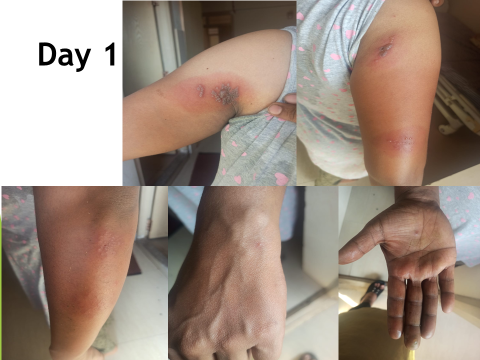
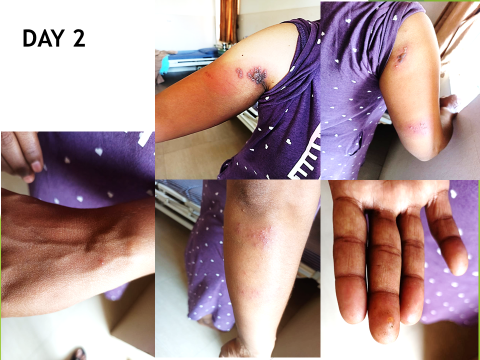
A 38 year old women had developed rashes over her left hand which eventually turned into raised fluid filled clustered bluish lesions at the region of axilla, hands and forearm since two days, which was associated with severe pain and pricking sensation. A similar kind of lesion had appeared over the palmar aspect of right middle finger, palm and over wrist. The patient had approached our hospital (Sri Dharmasthala Manjunatheshwara College of Ayurveda and Hospital) with the above complaints.
Clinical Examination
Personal examination
- Appetite - Reduced
- Bowel - Regular
- Micturition - Regular
- Sleep - Disturbed and Reduced due to Increased Pain and Pricking Sensation over the Lesions
- Diet - Mixed (took Daily Chicken from past 10 Days and weekly thrice fish, and took many Mangoes in past 10 Days)
- Habits - Nothing Specific
- Occupation - Home Maker
- Socio Economic Status - Middle Class
- Treatment History - None Dashavidha pareeksha
- Prakriti (Constitutional Status) - Kapha, Pita
- Vikriti (Abnormal Status of Constituency) - Pitta Pradhana Tridosha (all three Doshas with Pitta Dominance)
- Sara (Status of Tissue and its related system) - Madhyama (Moderate)
- Samhanana (Compactness of the Body) - Madhyama (Moderate)
- Satva (Mental Status) - Madhyama (Moderate)
- Sathmya (Diet Status) - Sarva Rasa Satmya (accustomed to all tastes)
- Ahara Shakti (Digestive Capacity) - Avara (Poor)
- Vyayama Shakti (Physical Capacity) - Madhyama (Moderate)
- Vaya (Age Factor) - Madhyama (Moderate)
- Pramana (Stature) - Madhyama (Moderate) Asta sthana pareeksha
- Nadi (Pulse Rate) - 78 Bpm
- Mutra (Urine) - Prakrutha (Normal)
- Mala (Bowels) - Mridhu Koshta (Laxed Bowel)
- Jihwa (Tongue) - Liptha (Coated)
- Shabda (Voice) - Prakruta (Normal)
- Sparsha (Touch) - Prakrutha (Normal)
- Drik (Vision) - Prakrutha (Normal)
- Akruti (Built) - Madhyama (Moderate)
General Examination
- General Complexion- Brown
- Bp - 120/80 Mmhg
- Pulse -78/Min
- Respiratory Rate -17/Min
- Temperature - Afebrile
- Cardio Vascular System - S1,S2 Heard , no Murmurs
- Central Nervous System - Conscious and Oriented to Time, Place and Person
- Respiratory System - Nvbs Heard , no added sounds
Local Examination
- Site of Lesion - Dorsum of Right Arm, Forearm, Left Palm and Hand
- Distribution - Asymmetrical
- Character of Lesion - Reddish Blue, Fluid Filled, Spreading in Nature
- Itching - Present (Mild)
- Inflammation - Ruber, Calor, Dolar Present
- Discharge - Present when Vesicles Rupture
- Superficial Sensations on Lesion - Pain (Severe ) Swelling (Present) Itching (Present) Burning Sensation (Present)
- Oedema - Lesion Surface Elevated
- Texture of Lesion - Smooth Clustered Vesicles
Laboratory Findings
- Hemoglobin -12 Gm% (13-16 Gm%)
- Esr - 14 Mm/Hour (0-10 Mm/Hour)
- Total Wbc Count - 4500 Cells/Cmm (4000-11000 Cells / Cmm )
- Rbc Count - 4.56 Millions /Cmm
- Fbs - 97.7 Mg /Dl
- Blood Urea - 14.7 Mg/Dl
- Serum Creatinine - 0.6 Mg /Dl
Process of Disease Manifestation
- Nidana:
- Diet - 10 days prior to the appearance of the lesions, increased consumption of milk, curd, salt, sour food, spices, chicken, fish, consumption of fish followed by consumption of milk, over eating, consumption of oil fried food, consumption of food before digestion of previous meals.
- Lifestyle - Occasional day sleep, sedentary lifestyle
- Poorva Rupa - Red rash
- Lakshana - Redness, swelling, burning sensation, spreading in nature, pain, blackish discoloration.
Samprapthi Ghataka (Components of Manifestation of Disease)
• Dosha - Pitta prakopa (aggravated pitta)
- Dushya (effected tissues) - Rasa , Raktha
- Ama (indigested particles at cellular level) - Sama (presence of ama)
- Srotas (affected channels) - Rasavaha, Raktavaha (channels that carry rasa and rakta)
- Agni (digestive fire) - Manda (Diminished)
- Udbavasthana (site of initiation of disease) - Amashaya (Fundus part of stomach)
- Srotodushti Prakara (types of manifestations of vitiation of srothas) - Atipravruthi (increased activity) & Vimarga gamana (moving in improper direction)
- Roga Marga (Pathways of disease) - Bahya (external)
- Vyakta Sthana (Site of manifestation) - Twak (skin)
| Inclusion Criteria | Exclusion Criteria | |
|---|---|---|
| Visarpa [3] | Blisters, blackish discoloration | fever, spreads all over the body in all the 4 directions, it is more severe condition |
| Visphotaka [4] | Blisters, fever | Blisters all over the body, thirst, bursting of blisters lead to denuding of skin |
| Dur Dagda Vrana [5] | Severe blisters, burning sensation, discoloration, suppuration, pain, heals very slowly | No H/O burns, |
| Dur Dagda Vrana [5] | Severe blisters, burning sensation, discoloration, suppuration, pain, heals very slowly | Do not spread |
| Keeta Damsha [6] | Papules, Pricking pain, redness, burning sensation | No H/O insect bite |
| Vicharchika [7] | Blackish popular lesions | Itching with excessive discharge |
| Kaksha [8] | Black vesicular rashes spreading from the lateral aspect of armpit spreading towards the arm, associated with severe pain. |
Table 1: Differential Diagnosis.
| Treatment | Diet | |
|---|---|---|
| Day 1 | Patola katurohinyadi kashaya 10ml – 0 – 10ml B/F | Morning - mudga yusha (green gram soup) |
| Day 1 | Avipathikara choorna 20 grams with warm water at night | Laja manda (parched rice gruel) – 10am, 5 pm |
| Day 1 | Kamaduga rasa 1-1-1 B/F | Afternoon- kichdi |
| Day 1 | Shatadhauta gritha E/A | Night- kichdi |
| Day 2 | Sthanika parisheka (cold shower) with triphala sheeta kashaya 4 times a day | Morning - mudga yusha (green gram soup) |
| Day 2 | Patola katurohinyadi kashaya 10ml – 0 – 10ml b/f | Laja manda (parched rice gruel) – 10am, 5 pm |
| Day 2 | Avipathikara choorna 5 grams with warm water at night | Afternoon- kichdi |
| Day 2 | Kamaduga rasa 1-1-1 B/F | Night- kichdi |
| Day 2 | Shatadhauta gritha E/A | |
| Day 3 | Sthanika parisheka with triphala sheeta kashaya 4 times a day | Morning - mudga yusha (green gram soup) |
| Day 3 | Patola katurohinyadi kashaya 10ml – 0 – 10ml B/F | Laja manda (parched rice gruel) – 10am, 5 pm |
| Day 3 | Avipathikara choorna 5 grams with warm water at night | Afternoon- kichdi |
| Day 3 | Kamaduga rasa 1-1-1 B/F | Night- kichdi |
| Day 3 | Shatadhauta gritha E/A | |
| Day 4 | Sthanika parisheka with triphala sheeta kashaya 4 times a day | Morning - mudga yusha (green gram soup) |
| Day 4 | Patola katurohinyadi kashaya 10ml – 0 – 10ml B/F | Laja manda (parched rice gruel) – 10am, 5 pm |
| Day 4 | Avipathikara choorna 5 grams with warm water at night | Afternoon- kichdi |
| Day 4 | Kamaduga rasa 1-1-1 B/F | Night- kichdi |
| Day 4 | Shatadhauta gritha E/A |
Table 2: Treatment.
| Signs and Symptoms | Before Treatment | After Treatment |
|---|---|---|
| Pricking Sensation | Present | Absent |
| Pain | Severe | Absent |
| Reddness | Present | Absent |
| Spreading | Very quick | Ceased |
| Itching | Mild | Absent |
Table 3: Assesment Before and After Treatment.
Discussion
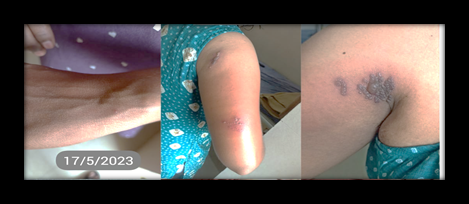
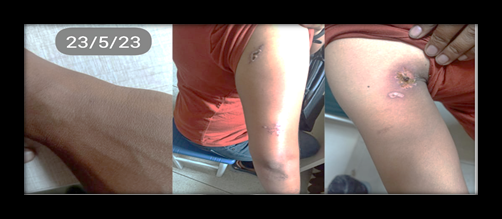
Acharya Sushrutha established vitiation of pitta as the root cause of this illness [8]. Additionally, pittaja visarpa line of therapeutic modalities has been recommended [9]. In this case, patient had indulged in many causative factors like virudha ahara (incompatible foods), avyayama (sedentary life style), and divaswapna (day sleep) frequently over a period of ten days that caused aggravation of pitta dosha, along with agni mandhya, and formation of ama, thereby leading to manifestation of the ailment. Developed lesions were painful, red, sensitive, and had an intense burning sensation. Because of these, pita rechaka (drugs aiding expulsion of pitta) and pita hara (drugs aiding in pacifying pitta) lines of managements were adopted. Formulas patola katu rohinyadhi kashaya, kamaduga rasa, avipathikara choorna, shatadhouta gritha external application, and triphala kashaya sheeta parisheka (showering of cooled decoction) were chosen. Dietary and lifestyle modifications in addition to these treatments, helped to stop the further development of illness and heal the existing lesion. Most of the drugs chosen are even proven to have got strong anti-inflammatory and anti-viral activity which had helped in cessation of the virus. Thereby ceasing the disease progression along with healing of the lesions. Follow up after a week, showed absence of burning, itching, redness, or any discomforts, along with formation of dry crusts over lesions. Peripheral parts of lesions showed signs of healing. Presence of pale yellow discharge was observed at some areas following the breaking off of shrunk and fused lesions. Regions having small lesions had completely healed with appearance of normal healthy skin.
Conclusion
The patient’s recovery through Ayurveda management was clinically significant. Throughout the course of therapy, there were no adverse drug reactions. This case study demonstrates how pitta hara ahara, vihara, and aushadha aid in the efficient treatment of Herpes zoster, which is closely related to the illness kaksha and treated accordingly. And the majority of the ingredients utilised in the formulations listed above have been shown to have antiviral activity and anti-inflammatory activity. This has prevented the disease from progressing and development of severe side-effects such as post-herpetic neuralgia. Exploring the practical use of Ayurvedic formulations in the treatment of different viral symptoms helps in aiding better treatment for other viral diseases.
References
-
Nair PA, Patel BC (2023) Herpes Zoster. Stat Pearls Publishing, Treasure Island (FL).
-
Charak Samhitha, Chikitsa sthana, Shwayathu chikitsa adhyayaha, 12/11.
-
Charak Samhitha, Chikitsa sthana, Visarpa chikitsa adhyayaha, 29/11.
-
Sushruth samhitha, nidana sthana, Kshudra roga nidana, 13/18.
-
Sushruth samhitha, sutra sthana, Agnikarmavidhiadhyayam, 12/16.
-
Sushruth samhitha, kalpa sthana, keetakalpamadhyayam, 8/23.
-
Charak samhitha, Chikitsa sthana, Kusta chikitsa adhyayaha, 7/25.
-
Sushruth samhitha, nidana sthana, Kshudra roga nidana, 13/16.
-
Sushruth samhitha, chikitsa sthana, Kshudra roga chikitsa, 20/7-8.
- Management of Ear Keloid with Ksharsutra: A Case Study
- Yoga and Global Sustainability: A Holistic Path to One Earth, One Health
- Autoimmune Diseases in Ayurveda: A Narrative Review with Classical and Modern Perspectives
- Management of Cluster Headache Associated with Pituitary Apophysitis by CERT (Chakrasiddh Energy Release Technique): A Case Report on Energy Rebalancing
- Zygophyllum Geslini Coss : Biochemicals and Antioxidant Activity
- Observations of a Beginner Vaidya