
To Study Appropriateness of Patient Stay in the Emergency Medicine Department of a Tertiary Care Teaching Hospital of North India
Inappropriate hospital stay increases hospital costs, decrease available resources for patients with critical situation and put patients at risk of nosocomial infections. It was observed that 24.3 % cases of hospital stay studied were inappropriate in Medical Side while as 41.38% cases of hospital stay studied were inappropriate in Surgical Side.
Introduction
Health care is one of the basic needs of each community. Since considering to healthcare and investing in this sector increases labor productivity and service production, therefore, optimal resource allocation and use of resources is very important [1].
Evaluation of health care programs can determine their quality and progress of implementation and failure or success rate [2]. Hospital services absorb almost half of health sector costs, so efficiency promotion of these services through cost reduction and use of potential capacity of health care organizations is necessary [3].
Diverse economic incentives have been used for cost reduction in hospitals. However, in the field of patient access to hospital services and the quality of services have not yielded to positive results. For preserving quality and accessibility, it is necessary to focus on cost containment indexes by attention to the appropriateness or inappropriateness of health care services [4]. Some cost containment strategies such as reduction in hospital beds have increased hospital waiting time. To overcome this problem, we should use hospital beds at highest efficiency and the best way for efficient use of hospital beds is to avoid or to minimize inappropriate patient hospitalization and not to decrease the quality [5].
Inappropriate admission and hospitalization are one of the challenges in health sector even in developed countries. Inappropriate admission is an issue that developing countries ignore its importance and do not have any information about its severity and depth, hence, the present study was aimed to investigate inappropriate hospitalization in medical and surgical division of emergency department of Sher-I-Kashmir Institute of Medical Sciences Soura, Srinagar.
Aims and Objectives
To study appropriateness of patient stay in the Emergency Medicine Department of a tertiary care teaching hospital of north India
Material and Methods
Study Setting
The study was conducted in the Medical and Surgical divisions of Emergency Medicine Department of Sher-I- Kashmir Institute of Medical Sciences, Srinagar. SKIMS is 1200 bedded teaching Hospital.
Study Design
A prospective observational study for a period of six months was carried out in both Surgical and Medical divisions of Emergency Medicine Department of SKIMS.
Study Duration
The study was conducted from 1st November 2018 to 30th April 2019.
Sampling
Using simple random sampling, 20 percent of the total admissions (10,000) in Emergency Medicine Department were studied.
Study Tool
Modified European Appropriateness Evaluation protocol was used as a study tool (Annexure I & II).
Initially, a pilot study was carried out for a period of one month to validate the research tool and modify it according to the local needs.
EAEP is a diagnosis independent criterion based instrument consisting of admission criteria and day of care or hospital stay criteria. AEP and its modified versions have been used internationally. The tool is designed specifically for emergency patients. The validity and reliability of the AEP has been tested extensively. During the study period, appropriateness of stay of all patients was analyzed and assessed by AEP. Their hospital stay was evaluated according to Modified EAEP criteria.
Statistical Analysis
The data was entered in MS excel. Descriptive analysis was done to calculate proportions.
Results
A prospective observational study was conducted in the Emergency Medicine Department for a period of six months. Out of the total admissions (10,000), 20% cases were selected by simple random sampling and a total of 2000 patients were studied. A total of 1420 (71.0%) patients were from Medical Side while as 580 (29.0%) were from Surgical Side.
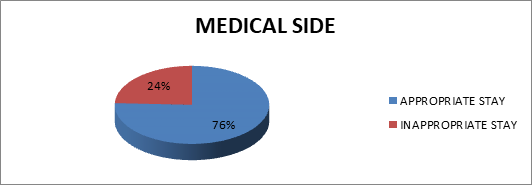
A. Appropriateness /Inappropriateness of hospital stay in Medical Side A total of 1420 patients on Medical Side were studied for appropriateness/ inappropriateness of hospital stay, out of which 345 (24.3%) cases were found to have inappropriate stay (Table 1 & Figure 1).
| Status | Frequency | Percentage |
|---|---|---|
| APPROPRIATE | 1075 | 75.70% |
| INAPPROPRAITE | 345 | 24.30% |
| Total | 1420 | 100.00% |
Table 1: Showing Appropriateness/ Inappropriateness of hospital stay in Medical Side.
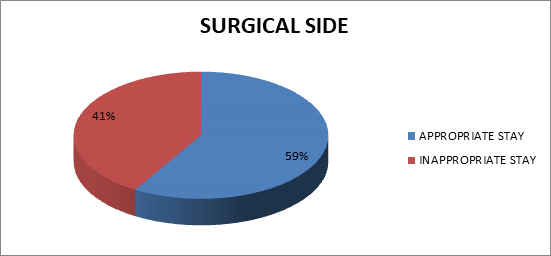
B. Appropriateness/inappropriateness of hospital stays in Surgical Side A total of 580 patients on Surgical Side were studied for appropriateness/inappropriateness of hospital stay, out of which 240 (41.38%) cases were found to have inappropriate hospital stay (Table 2 & Figure 2).
| Status | Frequency | Percentage |
|---|---|---|
| APPROPRIATE | 340 | 58.62% |
| INAPPROPRAITE | 240 | 41.38% |
| Total | 580 | 100.00% |
Table 2: Appropriateness/ inappropriateness of hospital stay in Surgical Side.
Discussion
Inappropriate patient hospitalization is the use of hospital services for patients where the treatment had no benefit for them or the case where the treatment can be delivered at less specialized levels with the same quality. At the contrary, appropriate patient hospitalization is the stay where patient needs continuous and active medical, nursing and paramedical treatments and delivery of these services in other places such as day and outpatient centers cannot be performed.
Inappropriate hospital stays increase hospital costs, decreases available resources for patients with critical situation and put patients at risk of nosocomial infections. Inappropriate admission and hospitalization not only increases the costs but also cause poor health services; increase in death rate, bedsores because of increase in nosocomial infections. Therefore, permanent assessment of hospital services is an important issue done for improving productivity and quality of hospital services.
A prospective observational study was conducted in the Emergency Medicine Department for a period of six months. Out of the total admissions (10,000), 20% cases were selected by simple random sampling and a total of 2000 patients were studied. A total of 1420 (71.0%) patients were from Medical Side while as 580 (29.0%) were from Surgical Side. A total of 580 patients on Surgical Side were studied for appropriateness/inappropriateness of hospital stay, out of which 240 (41.38%) cases were found to have inappropriate hospital stay. In our study, inappropriate were higher in Surgical Emergency as compared to Medical Emergency. Teke K, et al. [6] conducted a study and found that 21.3% patients had inappropriate hospital stay. Pourreza A, et al. [7] conducted a study in Iran where they found inappropriate hospital stay in 22.8% of the cases. Thollander J, et al. [8] found that 23.0 % of the patients had inappropriate stay according to EAP criteria. Hartz, et al. [9] had found 48.0% hospital stay was inappropriate. Wolinsky F, et al. [10] observed that 44.8% of the admissions were inappropriate.
Conclusion
Inappropriate hospital stay increases hospital costs, decrease available resources for patients with critical situation and put patients at risk of nosocomial infections.
It was observed that 24.3 % cases of hospital stay studied were inappropriate in Medical Side while as 41.38% cases of hospital stay studied were inappropriate in Surgical Side
Conflict of Interest
None
Source of Funding
None
Ethical Clearance
Taken
References
-
Arab M, Zarei A, Rahimi A, Fatemeh R, Elah AF, et al. (2010) Analysis of Factors Affecting Length of stay in Public Hospitals in Lorestan Province, Iran. Hakim Health Sys Res 12(4): 27-32.
-
Yaghoobifar M, Maskani K, Akaberi A, Shahabipoor F (2011) The Rate of Inappropriate Admissions and Staying of Patients in Hospitals of Sabzevar, Iran. J of Sabzevar Uni Med Sci 18(3): 224-232.
-
McDonagh MS, Smith DH, Goddard M (2000) Measuring appropriate use of acute beds: A systematic review of methods and results. Health Policy 53(3): 157-184.
-
Chopard P, Perneger TV, Gaspoz JM, Lovis C, Gousset D, et al. (1998) Predictors of inappropriate hospital days in a department of internal medicine. Int J Epidemiol 27(3): 513-519.
-
Panis LJ, Gooskens M, Verheggen FWSM, Pop P, Prins MH, et al. (2003) Predictors of inappropriate hospital stay: a clinical study. Int J Qual Health Care 15(1): 57-65.
-
Teke K, Kisa A, Demir C, Ersoy K (2004) Appropriateness of admission and length of stay in a Turkish military hospital. J of med systems 28(6): 653-663.
-
Pourreza A, Kavosi Z, Khabiri R, Salimzadeh H (2008) Inappropriate Admission and Hospitalization in Teaching Hospitals of Tehran University of Medical Sciences, Iran. Pak J Med Sci 24(2): 301-305.
-
Thollander J, Gertow O, Hansen S, Carlsson B, Hallert C, et al. (2004) Assessment of inappropriate emergency admissions. A study 566 consecutive cases. Lakartidningen 101(10): 888-892.
-
Hartz J, Bade PF, Sigmann P, Guse C, Epple P, et al. (1996) The evaluation of screening methods to identify medically unnecessary hospital stay for patient with Pneumonia. Int J for Quality in Health Care 8(1): 3-11.
-
Wolinsky F (1987) The process and outcome of hospital care for Medicaid versus privately insured hospital patient. Inquiry 29(3): 366-371.
- Capacity Constraints in Pediatric Inpatient Psychiatric Care: A Cross-Sectional Analysis of Bed Availability and Geographic Access in North Carolina
- Why Healthcare Analytics Still Optimizes the Wrong Things
- Coding, Coverage, and Care: The Infrastructure of Transgender Health Inequities
- The Effect of Classroom Attendance on Academic Achievement of Management and Leadership Discipline of Nursing Students at Instituto Superior Cristal and Universidade de Dili, Timor-Leste, 2024: A Case Study
- The Role of Social Bonds in Facilitating Shared Investments and Resource Allocation: Addressing the “Wrong Pocket Problem” in Public Health and Healthcare
- Social-Cultural Factors Contributing to Antimicrobial Resistance in Livestock Farmers and Community Households in Kayonza District, Rwanda