
Delivering Community Based Quality Mental Health CARE for Children and Young People in England, the Ongoing Opportunities and Challenges, with a Focus on School Life in Somerset, UK, Illustrated by Case Studies
Introduction: Around 1 in 8 children and young people (CYP) in England experience behavioural or emotional problems growing up. For some, these will resolve with time, while others will need professional support. Mental ill health is a leading cause of health-related disabilities and can have adverse and long-lasting effects. Despite service developments, The Values- Based Child and Adolescent Mental Health System Commission considered that the mental health and well-being of children and young people has never been of greater concern for a multitude of reasons, including rising levels of self-harm, eating disorders and depression, along with the adverse impacts of social media. However the Commission argued that schools are struggling to support CYP and these problems persist despite national debate and proposals to tackle the challenges (Values- Based Child and Adolescent Mental Health System Commission. The whole situation has been dramatically escalated however as a result of the COVID - 19 pandemic, and the consequential lockdowns and high-level restrictions that have been put in place. This situation has highlighted both existing problems and creating new demand. In addition as a direct result of the pandemic, CYP may also have to endure personal illness, or more likely, cope with unexpected serious illness or even the death of someone close to them, such as a family member, thus potentially adding feelings of sadness, loss and grief to existing emotional obstacles. Discussion: This paper presents an overview of how one county in England, Somerset (with its own limitations including rurality and significant poverty) has sought to address the needs of CYP at this unprecedented time. The work of different organisations in Somerset is discussed and interventions aimed at helping meet the needs of CYP struggling with mental ill health are presented and further illustrated through the use of case studies from one of the key organisations involved, Young Somerset. Key evidence based resources are highlighted to help practitioners in other localities find help for their own CYP needing help and support. Conclusion: There can be no doubt that our children and young people nationally and locally here in Somerset currently, and into the future, have many difficulties to overcome to optimise, a situation made much worse by the COVID-19 pandemic. The depth and breadth of the present and future difficulties facing our CYP has now been recognized nationally and locally. However, different localities have different resource levels but also CYP present a vast range of needs and personal obstacles. Consequently, our future, our present children and young people need help and support from ALL of us going forward. In addition to other traumas endured because of the COVID-19, a catastrophic legacy MUST NOT is a tsunami of mental and physical ill health for our present children and young people. This is a whole nation challenge, not just something to be left to the organisations that have a formal duty to provide care and intervention, each and every one of us has to be there to secure the wellbeing of our future nation.
Introduction
Around 1 in 8 children and young people (CYP) in England experience behavioural or emotional problems growing up [1]. For some, these will resolve with time, while others will need professional support [2]. Mental ill health is a leading cause of health-related disabilities and can have adverse and long-lasting effects [3].
Children and Young People’s Improving Access to Psychological Therapies (CYP IAPT) is a national transformation programme, launched in 2011, which seeks to improve the quality and access to services that provide emotional wellbeing support for children and young people [4]. CYP IAPT was also established to improve both the effectiveness of treatment and the experiences of children, young people and parents in Child and Adolescent Mental Health Services (CAMHS) with integrated structures to promote ongoing development of the service [5]. Fonagy, et al. [6] in a review of CYP IAPT, present data to illustrate that indeed the CYP IAPT programmes have delivered measurable improvements for the CYP they seek to help, but that ongoing research about effectiveness has to be maintained [7].
However, “The mental health and well-being of children and young people has never been of greater concern. Nearly every day a new story breaks: concerns about rising levels of self-harm, eating disorders and depression; concerns from head teachers that schools are struggling to support pupils with mental health problems and are unable to access advice; difficulties in accessing mental healthcare; and fears that the internet acts as a malign force in children’s lives. Perhaps of greatest concern, however, is the fact that these challenges have persisted despite a series of national reports highlighting the problems and offering well-considered solutions” The Values-Based Child and Adolescent Mental Health System Commission [8].
In response to these ongoing concerns, and following a Green Paper and consultation in 2017/2018 [9], the Government sought to increase access and availability of mental health and wellbeing support for CYP, via the establishment of a new post, an Education Mental Health Practitioner (EMHP) as part of the CYP IAPT initiative, working across both educational settings and healthcare sectors in England. Their purpose was to deliver evidence- based early interventions for children and young people [10]. This new service provision is supported by Health Education England, with various providers training the EMH Practitioners around the country, underpinned by standards for the professional training programme [11], and the accompanying supervision [12].
Impacts of the COVID-19 Pandemic
However, the challenges for CYP with new and existing mental health problems have been accelerated by the current COVID-19 pandemic and the consequential lockdowns and high-level restrictions that have been put in place [13, 14]. Most significantly amongst them, the closure of schools for the majority, with normal routines suspended for an unknown period at the beginning of each lockdown, and CYP then spending most of their time at home [13, 14].
This has been complicated by attempting to continue schooling at home with significant concerns about the impact on pupil progress and for many, associated difficulties with accessing the resources required to support home schooling. Additionally, there are fears that home-schooling would widen the attainment gap between children from poor homes and those from more affluent backgrounds [14, 15], and the additional stressor of disrupted contact with important support networks, e.g. family and friends [1].
The NSPCC [1] have highlighted, amongst others that, we must pay extra special pay attention to the mental health and wellbeing of CYP at this time, especially in these totally ‘foreign’ circumstances causing anxiety and worry about existing and now unknown and uncertain things.
More seriously during this time of the COVID-19 pandemic, CYP may also have to endure personal illness, or more likely, cope with the serious illness or even the death of someone close to them, such as a family member, carer, friend or teacher, thus potentially adding feelings of sadness, loss and grief to existing emotional obstacles [1]. In an established situation of commonly limited provision and service support, the pandemic has further compromised capacity and established modes of service delivery [16]. This raises real concerns about exacerbation of pre-existing mental health issues amongst CYP [13, 16]. In response, Health Education England set out plans to expand workforce numbers in focused areas to support future service demands [17].
Consequently, the need for acknowledgement and action to support our CYP with respect to their health and well-being has never been higher. Fortunately, schools have recently re-opened enabling access to a multitude of support and resources, so now the real impacts of the stresses and strains our CYP are trying to deal with have and will perhaps more slowly become apparent, perhaps akin to a tsunami? .
The wellbeing Opportunities and Challenges for Children and Young People in Somerset
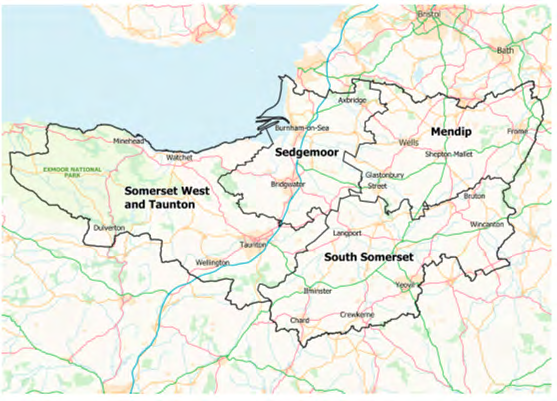
Map 1: Somerset Intelligence.
Somerset Intelligence stated that Somerset covers 3,452 square kilometres (1,333 square miles) with 48% of the population living in rural areas when the English average is only 18% which starts to signal some of the challenges Somerset faces. Of a Somerset population of 562,225 based on 2019 data [18, 19] 47,806 Somerset people live within the 20% most deprived areas in England, a figure that has risen since 2015 [20].
There are 118,438 children and young people aged 5 - 20 years in Somerset, which represents 21% of the total population, a number that is declining [21]. Furthermore, of this number, 11,950 children (aged fewer than 16) were considered to be living in poverty in 2016, equating to 12.9% of all children. In 2016, at a district level in Somerset, the lowest percentage of all children living in poverty was in Mendip (11.9%).
However, the highest percentage of children in poverty was in West Somerset (16.3%) [22]. This no doubt contributed to, in 2017, West Somerset being declared ‘The worst area in the country (Great Britain) (for social mobility) is West Somerset, which performs particularly poorly on the early years and working lives indicators. Disadvantaged people in the area are limited by low levels of local opportunities and poor transport links to neighbouring districts. The area is now one of the government’s 12 Opportunity Areas and will benefit from local initiatives that bring together local stakeholders to deliver tailored solutions to the area’s problems’ [23].
Further national acknowledgement of the challenges faced within Somerset has resulted in action by the Breaking Barriers Innovations team. Breaking Barriers Innovations is an independent research programme with the principal aim of radically improving the delivery of public services across the UK for maximum social impact [21]. The ‘Playbook’ Programme they have constructed for Somerset, (other Playbook Programmed are in Cornwall, Portsmouth, Kent and Essex) aims to take an inter-generational approach to support and manage an ageing population. ‘Young people in the county face a number of challenges including limited job prospects, poor internet access and poor public transport. This programme will consider how to address the issues of exclusion, isolation and disadvantage for young people and how to make health and wellbeing sustainable by increasing the take-up of education, training, employment and enterprise opportunities’ [24].
In 2016, Somerset County Council (SCC) in an educational Inclusion Statement for all CYP aged 0-25, stated that ‘All children and young people in Somerset have the right to an inclusive education where they feel they belong. An inclusive education encourages all children and young people to be the best they can be, whilst making learning enjoyable and fulfilling; socially, emotionally and academically [25]. They stated that ‘Effective Whole School Provision is characterized by: High aspirations for the achievement of all children and young people:
- Good teaching and learning for all children and young people provision based on careful analysis of need, close monitoring of each individual’s progress and a shared perception of desired outcomes;
- Evaluation of the effectiveness of provision at all levels in helping to improve opportunities and progress;
- leaders who look to improve general provision to meet a wider range of need rather than always increasing additional provision;
- Swift changes to provision, in and by individual providers and local areas, as a result of evaluating achievement and well-being’ [25].
To directly support the mental health and wellbeing of CYP, SCC has created a comprehensive mental health toolkit available on line [26]. Furthermore, they established well- constructed mechanisms to ‘listen to the voices of children, young people and their families to help shape better outcomes for them’. [27]. However, face to face services are in much demand.
Delivering Services and Support for Children and Young People with Mental Health Problems in Somerset
In Somerset, as other areas too inevitably, there is a significant surge in demand for emotional wellbeing and mental health services for CYP – both in education and community settings and across the wider system. Young Somerset, the largest youth work charity in the county, provides CYP-IAPT through an established Community Wellbeing Service, and together with Somerset Foundation Trust Child and Adolescent Mental Health Services (SFT: CAMHS), delivers the new Education Mental Health Support (EMHS) service and associated teams. There are currently 34 practitioners across both of those services, with the aim of expanding the services and support delivered to extend across the whole of Somerset.
Throughout the COVID-19 pandemic, Young Somerset has continued to support young people in the county – moving therapeutic services online, providing significant digital preventative resources on various social media platforms (both for young people and parents / carers), and delivering targeted face-to-face supportive interventions with identified vulnerable young people in communities. They have worked closely with statutory partner colleagues (SFT: CAMHS, Children’s Social Care, Public Health, Police and Education) to locate and engage with young people not complying with lockdown restrictions (for a variety of reasons) and provide support to them.
Young Somerset has created a team of mental health practitioners alongside youth workers, which has proved both efficient and effective in accelerating positive outcomes for young people who, because they do not see themselves as vulnerable, are more vulnerable. It should be noted that a number of protective factors for these young people were eroded throughout the pandemic: heightened negative home environment, disruption of routine, lack of social engagement and increased isolation.
Young Somerset holds a youth work ethos at its core – this means that it take the time to build voluntary relationships with young people that are open, honest, trusting, respectful and, critically, led by them. This means working WITH young people – not to or for them [28]. Young Somerset has now extensive experience of working with young people and their vulnerabilities, particularly their lack of core resilience and the prevalence of emotional distress, with Adverse Childhood Experiences and trauma being prevalent. Services can be combined to incorporate a primary focus on therapeutic intervention where that is appropriate and build collaborative capacity (both internally with other Young Somerset services and externally with partner organisations) that work to build an integrated and aligned support offer for individual CYP. Thus Young Somerset is focused on delivering better, simpler, and faster access to the support that CYP NEED at the time THEY need it.
By aligning their work with statutory partners, Young Somerset has demonstrated the value that a third sector organisations (neither solely a public nor private organisations) can bring to the support of children and young people in their communities. Young Somerset, through its established collaborative ways of working can be very agile, and move swiftly and sustainably to address an identified need in ways that large, statutory services are unable to match by stepping up and stepping down seamlessly between different service offerings.
Working together with Somerset CAMHS and the Somerset Clinical Commissioning Group, Young Somerset is currently establishing a Tier 2+/Getting Help team (Tier 2 interventions are targeted services such as youth offending teams, primary mental health workers, educational psychologists and school and voluntary/third sector providers counselling (including social care and education - NHS) [29] which will be manned by both SFT- CAMHS and Young Somerset practitioners. The team will work in an integrated and aligned way – and young people will lead the support they access; it may well be that individuals receive a range of different interventions from team members in order to achieve sustainable positive outcomes.
The Diversion Programme is another new service currently being established by Young Somerset, together with SFT - CAMHS hospital-based Psychiatric Liaison Teams. SFT - CAMHS colleagues will offer additional support to CYP together with a bespoke youth work team at Young Somerset.
This Programme can offer alternative support for the CYP by creating bespoke interventions to suit the needs of the family for a period of up to 4 weeks following the initial assessment. The Programme can provide mentoring and positive activities for those young people experiencing difficulties with mental health and low emotional wellbeing. The aim is to provide a friendly and safe environment, using a youth work methodology, for young people to discuss issues which are affecting them so they can make informed decisions in the future.
Activities can take place across Somerset through the use of venues available to Young Somerset, outdoor spaces and within the community.
Young Somerset youth workers can also provide a safe space for parents who need to talk about how the current family dynamics are affecting them. As well as supportive conversations, youth workers can provide advocacy in professional settings and brokering access to wider services as required. Both of these initiatives have been co-designed with young people and are organic and fluid in nature – intended to adapt and flex as needs demand and the emerging detail around these current ‘gaps’ is better understood, and designed to make sure they are integrated and aligned with existing CAMHS and Young Somerset pathways.
Conclusion
There can be no doubt that our children and young people nationally and locally here in Somerset currently, and into the future, have many challenges and obstacles ahead of them as regards optimising their mental and physical wellbeing. Many had existing mental and physical problems impacting wellbeing from the consequences of growing up; for some, this has been a very challenging journey to date, which may or may not have been recognised and which may or may not have resulted in help and support.
Unfortunately, the advent of the COVID-19 pandemic has added another major diversion and really ‘changed’ their lives, exacerbating the depth and expanse of the struggle to cope day to day. For others, whose path thus far has been smoother, they may not understand what on earth has happened to them and their life as they knew it as a result of COVID-19.
It is clear now that there is national and established local recognition in Somerset of the present challenges facing children and young people with respect to their mental and physical health and wellbeing. So, the question now is: What will be the response of the organisations charged with supporting our children and young people to enable them to cope with what has happened now and any consequences into the future? There are many tools available and increasingly the services in place, but not all areas of the country have the resources to deal with ‘their’ level of demand. There is no one size fits all, and our future, our present children and young people need help and support from ALL of us going forward. In addition to other traumas endured because of the COVID-19, a catastrophic legacy MUST NOT be a tsunami of mental and physical ill health for our present children and young people. This is a whole nation challenge, not just something to be left to the organisations that have a formal duty to provide care and intervention, each and every one of us has to be there to secure the wellbeing of our future nation.
References
-
NSPCC (2021) Supporting children and young people’s mental health.
-
Public Health England: One You (2019) Looking after a child or young person’s mental health.
-
Public Health England (2016) The mental health of children and young people in England.
-
Wolpert M (2011) The Children and Young People’s Improving Access to Psychological Therapies – Tracking Outcomes Resource Pack V2.
-
South West CYP IAPT (2012) What is CYP IAPT?.
-
Fonagy P, Clark DM (2015) Update on the Improving Access to Psychological Therapies programme in England Commentary on Children and Young People’s Improving Access to Psychological Therapies. BJ Psych Bulletin 39(5): 248-251.
-
Ludlow C (2020) A Current Review of the Children and Young People’s Improving Access to Psychological Therapies (CYP IAPT) Program: Perspectives on Developing an Accessible Workforce Adolescent Health Medicine and Therapeutics 11: 21-28.
-
The values-based child and adolescent mental health system commission (2016) What really matters in children and young people’s mental health
-
Department of Health and Social Care/Department for Education (2018) Government Response to the Consultation on Transforming Children and Young People’s Mental Health Provision: a Green Paper and Next Steps pp: 1-48.
-
Greater Manchester Mental Health NHS Foundation Trust (2021) Education Mental Health Practitioner.
-
Health Education England (2020a) Module Aims and Content of Education Mental Health Practitioner for Children and Young People Curriculum (EMHP) PP: 1-53.
-
Health Education England (2020b) EMHP Supervisor Training Competency Assessment and Development Framework PP: 1-27.
-
Blanden J, Crawford C, Fumagalli L (2020) School closures and children’s emotional and behavioural difficulties Institute for Social and Economic Research.
-
Rose S, Twist L, Lord P, Rutt S, Badr K, et al. (2021) Impact of school closures and subsequent support strategies on attainment and socio- emotional wellbeing in Key Stage 1: Interim Paper 1 National Foundation for Educational Research for the Education Endowment Foundation.
-
Bubb S, Jones MA (2020) Learning from the COVID-19 home-schooling experience: Listening to pupils, parents/ carers and teachers Improving Schools 23(3): 209-222.
-
Holmes E (2020) Multidisciplinary research priorities for the COVID-19 pandemic: a call for action for mental health science 7(6): 547-560.
-
Health Education England (2020) Health Education England sets out work to expand and develop the NHS workforce.
-
Somerset Intelligence (2021a) Somerset facts and figures.
-
NOMIS (2021) Official labour market statistics from the Office of National Statistics.
-
National Statistics (2021) 2015, Index of Multiple Deprivation.
-
(2021) Breaking Barriers Innovations: Somerset Playbook.
-
Somerset Intelligence (2021b) Child Poverty.
-
Social Mobility Commission (2017) State of the Nation 2017: Social Mobility in Great Britain.
-
(2020) Breaking Barriers Innovations: Somerset Playbook.
-
Somerset County Council (2016) Somerset Core Standards for Children and Young People (0-25).
-
Somerset County Council (2021) Somerset Children and Young People: Health and Wellbeing: mental Health Toolkit.
-
Somerset County Council (2021) Elections.
-
CAMHS PRESS (2014) CYP IAPT Principles in CHIld & AdolesCenT MenTAl HeAlTH servICes values and standards “Delivering With and Delivering Well”.
-
NHS (2015) Model Specification for Child and Adolescent Mental Health Services: Targeted and Specialist levels (Tiers 2/3).
- Capacity Constraints in Pediatric Inpatient Psychiatric Care: A Cross-Sectional Analysis of Bed Availability and Geographic Access in North Carolina
- Why Healthcare Analytics Still Optimizes the Wrong Things
- Coding, Coverage, and Care: The Infrastructure of Transgender Health Inequities
- The Effect of Classroom Attendance on Academic Achievement of Management and Leadership Discipline of Nursing Students at Instituto Superior Cristal and Universidade de Dili, Timor-Leste, 2024: A Case Study
- The Role of Social Bonds in Facilitating Shared Investments and Resource Allocation: Addressing the “Wrong Pocket Problem” in Public Health and Healthcare
- Social-Cultural Factors Contributing to Antimicrobial Resistance in Livestock Farmers and Community Households in Kayonza District, Rwanda