
Pros and Cons of National Health Insurance Fund in Sudan: A Critical Review
Introduction: National Health Insurance Fund (NHIF) is a semi-autonomous and national organization which is politically affiliated to Ministry of labor and social security and Woman and Child Affairs. NHIF is pointing to mitigate the risks of high cost of health services on both the government and population and securing the quality and accessibility of health services. Aim: this review is aiming to identify, and summarize the findings of relevant studies on the factors that affect NHIF in Sudan to be more accessible for decision makers to take a strategic decisions towards the universal health coverage. Methods: a qualitative exploratory analytical study. The study conducted on National Health Insurance Fund in Khartoum State. The study population was composed of the current literature that clarifying the research question. This study used SALSA framework: the Search, Appraisal, Synthesis, and Analysis framework which is a simple framework divides the review process into four main stages: (1) search (2) appraisal (3) synthesis and (4) analysis. Results: One of NHIF strengthen that it has a large coverage of population but it has low utilization of services by subscribers which considered as threat. Safeguarding health service users especially the poor against the implication of the market liberation policy embarked on by the Sudanese government is considered as opportunity to ensure the financial risk protection at NHIF but existence of The Federal Ministry of Finance as the major contributor in financing NHIF is a threat faces NHIF sustainability. Conclusion: This critical review shows that National Health Insurance Fund (NHIF) affected by many internal and external favorable and unfavorable factors. Those factors are: strengthens, weaknesses, opportunities, threats of NHIF which should be taken in consideration to achieve universal health coverage.
Introduction
National Health Insurance Fund (NHIF) is a semiautonomous and national organization which is politically affiliated to Ministry of labor and social security and Woman and Child Affairs. Social Health Insurance (SHI) in Sudan is governed by an act that enacted in 1994, this act was amended twice & finally repealed by the Act of National Health Insurance Fund (NHIF) in 2016 [1]. National Health Insurance Fund (NHIF) in Sudan aims to mitigate the risks of the high cost of health services on both the government and population and securing the quality and accessibility of health services [2]. Social health insurance (SHI) is one of the principal methods of health financing that have been established to achieve the universal health coverage [3] which is the vision where all people and communities have access to quality health services where and when they need them without suffering financial hardship. The universal health coverage includes the full spectrum of services needed throughout life from health promotion to prevention, treatment, rehabilitation, and palliative care and is best based on a strong primary health care system [4].
Sudan is a lower middle income country in Northern East Africa which spends about 6.5% of its Gross Domestic Product (GDP) and 8.2% of the general government expenditure on health. Sudan has a high Out-of-pocket share which is about 70% (US$84.0 per capita) while the general government heath expenditure represents only 22.3% [5]. Sudan health financing system has gone through different eras, since the economic liberalization on early 90s; social health insurance was established in 1995 to provide financial risk protection to Sudanese people against user fee and improve access to healthcare when needed at the point of health service delivery. Health insurance (HI) in Sudan was first implemented in Sinnar state and then the rest of the states followed gradually until the total number of the states covered by HI reached 18 states.
Pros and cons of National Health Insurance Fund in Sudan have not been reviewed till now. Undertaking a review of Pros and cons of National Health Insurance Fund in Sudan is aiming to identify, and summarize the findings of relevant studies on pros and cons of National Health Insurance Fund in Sudan that are defined as the internal and external favorable and unfavorable factors which affect National Health Insurance Fund in Sudan. Accordingly, the available results of this study will be more accessible to decision makers to take a strategic decisions towards the universal health coverage that was not achieved despite the presence of National Health Insurance Fund in Sudan long time ago [5]. Any internal favorable factors affecting NHIF are defined as strengthens. Weaknesses of NHIF are the internal unfavorable factors that affecting it. On the other side, any external favorable factors are opportunities and any external unfavorable factors is threatens [6, 7].
Materials and Methods
A qualitative exploratory analytical study which conducted on National Health Insurance Fund in Khartoum. The study population was composed of the current literature that clarifying the research question: what are the pros and cons of National Health Insurance Fund in Sudan? Since the critical review has no formal requirement to present methods of the search, synthesis and analysis clearly [8], This study used SALSA framework: the Search, Appraisal, Synthesis, and Analysis framework which is a simple framework adapted to review strengthens, weaknesses, opportunities, threats of National Health Insurance Fund in Sudan. The SALSA framework divides the review process into four main stages: (1) search (2) appraisal (3) synthesis and (4) analysis (9).
Criteria Used to Consider Reviews for Inclusion
Inclusion and exclusion criteria were specified the prior the study to perform the literature search, and the studies were selected based on these criteria. Those criteria ensure that studies are selected in a systematic way.
The criteria for inclusion were that studies: 1) Search terms should be included in the title or abstract and full text. 2) Should be obtained in full-text to ensure availability. 3) Could be published or unpublished but not more than 10 years ago. 4) Studies could be published in English or Arabic. There were no exclusion criteria.
Search Methods for the Identification of Reviews
Search stage: The search stage in critical review involves collecting information in one or more databases according to search strategy which is relevant for the chosen research question. The aim of this stage is to define the research list of studies to be analyzed. To design a search strategy, the research question and objectives had broken down into different aspects each aspect analyzed for possible synonyms, abbreviations and alternative spellings. This study used the following search terms: Pros, Advantages as a synonymous for Pros, Cons, Disadvantage as a synonymous for Cons, National Health Insurance Fund, NHIF as an abbreviation for National Health Insurance Fund , SWOT analysis and Sudan. The complex search strings was created using OR, AND operator [9]. The following search string was generated and applied to the search in all databases mentioned previously: “Pros” AND “Cons” AND “National Health Insurance Fund” AND “Sudan”, “Pros” AND “Cons” AND “National Health
Insurance Fund” OR “NHIF” AND “Sudan”. “Advantages” AND “Disadvantages” AND “National Health Insurance Fund” AND “Sudan”, “Advantages” AND “Disadvantages” AND “National Health Insurance Fund” OR “NHIF” AND “Sudan”. “National Health Insurance Fund” AND “SWOT analysis” AND “Sudan”, “National Health Insurance Fund” OR “NHIF” AND “SWOT analysis” AND “Sudan”.
In PubMed and Google scholar the search string was applied using advanced search. We used the search string to search in the reports in the research department in National Health Insurance Fund in Khartoum. Information sources: All published studies and gray literature [10] were identified by searching the following:
- Two electronic databases: PubMed, Google scholar.
- Manually in the reports in the research department in National Health Insurance Fund in Khartoum.
- The last search was run on the 10th of January 2021.
Assessment of the Methodological Quality of the Included Reviews
Appraisal stage: After the studies were collected, the inclusion criteria were applied to select the studies which reviewed. The study selection process was summarized in a flow diagram shown in the results section.
Data Extraction and Management
Synthesis Stage: Synthesis of data is the next stage after identifying studies included in this critical review and it aims
Results
Description of the Included Reviews
to create summary of findings which are previously defined in the included study [11]. It initialized with the data extraction phase and done in a qualitative manner [9]. A data extraction form was adapted from a data extraction form generated by Cochrane collaboration (see appendices) to obtain information vital to the research question from the included studies. The extraction form includes general information about the study and relevant data which answer the research question. Data extracted manually and described as stated in reports. The following strategy was used to extract data from each study separately, and then collated, summarized and tabulated. Other strategy can be approached by extracting data from all studies directly into a single data extraction form but the first strategy was selected because the studies are detailed with different methodologies and different periods of times [9, 12].
Analysis stage: the extracted data was analyzed manually, using thematic analysis which is “a method for identifying, analyzing and reporting patterns within data”, thematic analysis is an initial and simple method of analysis. The goal of a thematic analysis is to identify themes, which are patterns in the relevant and important data, then use these themes to address the research question. Thematic analysis not about summarizing data, it interprets and makes sense of them [13, 14]. To use thematic analysis, a qualitative thematic description was attributed to all data in the selected studies as codes and build up themes out of these codes. In this study key themes derived to make analysis of data more convenient to answer the research question.
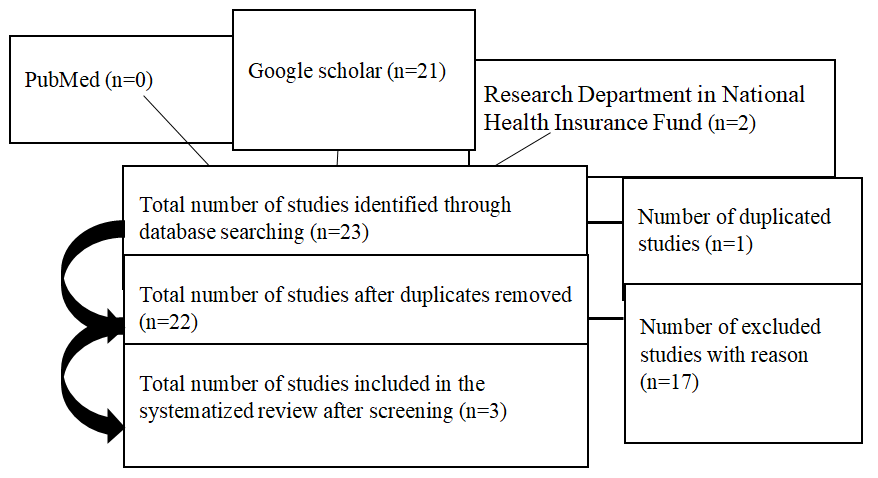
Figure 1 shows the studies that were included in the critical review. Out of 23 studies, only 3 studies met the inclusion criteria and were included in the review. The search resulted in n= 23 studies. Searching in PubMed resulted in n=0 study., searching in Google scholar using the search strings “National Health Insurance Fund” AND “Pros” AND “Cons” AND “Sudan” , “National Health Insurance Fund” OR “NHIF” AND “Pros” AND “Cons” AND “Sudan”, “National Health Insurance Fund” AND “Advantages” AND “Disadvantages” AND “Sudan” and “National Health Insurance Fund” OR “NHIF” AND “Advantages” AND “Disadvantages” AND “Sudan” resulted in n = 21 studies. searching in Google scholar using the search strings “National Health Insurance Fund” AND “SWOT analysis” AND “Sudan” and “National Health Insurance Fund” OR “NHIF” AND “SWOT analysis” AND “Sudan” resulted in n = 0 studies. Searching among reports at NHIF’s research department resulted in n = 2 studies. After duplicates were removed, 20 studies were screened, the screening process removed Seventeen studies from Google Scholar because they did not meet the inclusion criteria which is the search terms were not included in title or abstract and full text. The remaining 3 studies were synthesized then analyzed thematically.
Characteristics and Methodological Aspects of the Included Reviews
This critical review includes three studies that published as a full report. First study was a thesis submitted for the degree of doctor of philosophy (PhD) discussing Sudan Social Health Insurance: challenges towards universal access to health care 2014 and it was a quantitative descriptive cross sectional study design [15]. Second study was the Strategic plan for 4 years of NHIF 2021-202 and it was SWOT analysis [16]. Third study was a quantitative descriptive cross sectional study design that presented as NHIF Satisfaction study report 2013 [1].
Findings of the Synthesized Data
Synthesized data was presented as following:
- Coverage of National Health Insurance Fund.
- Financial risk protection in National Health Insurance Fund:
- Equity in National Health Insurance Fund.
- Quality of services provided by National Health Insurance Fund.
- Capacity building and infrastructure in National Health Insurance Fund.
- Sustainability of National Health Insurance Fund.
In each one of these themes, strengthens, weakness, opportunities and threats which are defined as the internal and external favorable and unfavorable factors affecting National Health Insurance Fund in Sudan were discussed as subsequently:
Coverage of National Health Insurance Fund
National Health Insurance Fund has a large coverage of different sectors of population as formal sector and students. The unit of coverage in the scheme is the insurance family which includes the subscriber, his parents, his wife and children below 18 years which considered as strengthens of NHIF. Weaknesses of NHIF are Low coverage of Informal and private sectors. Lack of clear regulations for coverage of foreigners, nomads and refugees is considered as unfavorable factor that affect NHIF. Low coverage of medical services at rural area and area with fragile security and health situation is one of NHIF weakness. Also, The existence of a health delivery system, which is not effectively distributed to accommodate the increase in coverage that is one of NHIF threats. Finally, the uptake of the scheme is still low which considered as threat and thus the achievement of universal access to health care is skeptical.
Financial Risk Protection in National Health Insurance Fund
Financial risk protection is determined by how funds are raised, and whether and how they are pooled to spread the risk across population groups. One of the NHIF internal favorable factors is Increasing revenue that is helping to target public sector subsidies for the poor and it is also expected to promote equitable and sustainable access to health services. Also, safeguarding health service users, people and households, especially the poor against the implication of the market liberation policy embarked on by the Sudanese government to reform the national economy of the country is considered as opportunity to ensure equity in NHIF. There is a strong political commitment from the government to cover poor families which makes NHIF semi-atounoums organization. The Zakat Chamber pays contributions on behalf of the poor and martyrs’ Families, and the National Social Security Fund pays on behalf of pensioners from the private sectors. Institutions not only pledged to cover the contribution of families as part of their annual budget, but also increase the number of poor families covered in the coming years. Another initiative to reach universal coverage of the poor with health insurance is the social responsibility of the firms which is advocated by the ministry of welfare as well as opening the door for all charitable and non-governmental organizations to participate in the continuous coverage of the poor. All these mentioned initiatives are considered as external favorable factors that ensure equity in NHIF. Also, enrollment of the poor families by the social security of different companies is considered as an opportunity to protect financial risk in NHIF.
Equity in National Health Insurance Fund
Fairness in payment is promoting equity in health which is important to ensure that there are no barriers to access the healthcare services. One of the NHIF strengthen is the adoption of different premium strategies such as; the formal sector workers pay 10% of their gross wage, 4% coming from the employee and 6% from the employer and the other sectors such as retirees, the poor, full-time students and people from the other informal sectors and those self- employed pay a flat rate determined by the actuarial studies. Updating of the health map by using GIS and wide spreading of the private pharmacies that have contracts with NHIF in peripheries area are an opportunities to ensure equity in NHIF.
Quality of Services Provided by National Health Insurance Fund
In NHIF, there is a medical package with wide range of medical services which is strengthen but this package has insufficient implementation of quality services which is an internal unfavorable factor affecting NHIF. Also, NHIF suffers from lack of awareness of health insurance culture among citizens which is a weakness and it also suffers from dropout with failure to prevent people from evading the premium payment which is a threat faces NHIF. In NHIF there are good reported systems which are a favorable internal factor affecting NHIF but there are a weakness in the data collection tools that affecting the quality of services provided by National Health Insurance.
Capacity Building and Infrastructures in National Health Insurance Fund
There is an executive unit of NHIF at locality level and infrastructure for IT which is considered as strengthens of NHIF. One of the external unfavorable factors that affecting NHIF are lack of staff and medical supplies in the existing health facilities; besides, some of them need urgent maintenance to accommodate the new NHIF subscribers. Moreover, NHIF suffers from existing of big numbers of impermanent staff and unapproved administrative structure. Brain drain of competent staff is a big threat of NHIF. Conversely, presence of national and international partials support for capacity building and electronic applications are considered as opportunities for NHIF.
Sustainability of National Health Insurance Fund
Existing of NHIF act 2016 and NHIF strategic plan 2007 -2031 are considered as strengthens of NHIF. One of the external favorable factors that affect NHIF sustainability that Stakeholders and partners mentioned in their meetings that a new methods for supporting enrolment in NHIF should be modified and containing different solidarity mechanisms instead of depending on government alone that considered as threat faces NHIF sustainability. Finally, the following are threats can affect the sustainability of NHIF, Instability of economic situation in the country and lack of national credential body for accreditation of health institution and pricing of medical service.
Discussion
This review showed that NHIF in Sudan has a large coverage of population especially the formal sector who is working for the government, this internal favorable factor has been considered as strengthen of NHIF. On the other hands , NHIF is affected with unfavorable factors as the low coverage of Informal and private sector with lack of clear policy for coverage of foreigners , nomads and refugees in spite of the existence of NHIF act 2016 which considered as strengthen of NHIF. A qualitative, cross-sectional exploratory study conducted in 2017 to explore the health insurance services in Sudan from the perspectives of the insurers Salim AMA, et al. [5] showed that NHIF reached 71.5% families and 50.7% individuals of population coverage; however, there are considerable disparities in insurance coverage between rural and urban areas and between formal and informal sectors. Private health insurance showed disparities regarding the representativeness of different socioeconomic classes due to small number of subscribers which is below 500,000 individual and high premiums. Conversely, system of health accounts Sudan report 2018 [17], showed that household Out-Of-Pocket expenditure as % of current health expenditure equal to 66.95% which indicates a high Out-Of-Pocket expenditure by population who should be largely covered by NHIF. Consequently, the high Out-Of- Pocket expenditure by population in the presence of NHIF act 2016 shows that there is a poor utilization of the health care services by subscribers in spite of the reported large population coverage by NHIF. Thus, the achievement of universal health coverage is skeptical and this considered as a threat faces NHIF which aims to mitigate risks of the high cost of health services and participate in poverty reduction in Sudan through improving accessibility to the health services. Also, this study displayed that one of the threats faces NHIF is the existence of a non-effectively distributed health delivery system to accommodate the increase in the coverage. This threat presented during the era of Sudan ex-president Omer Elbashier due to political issues and also it explains the low uptake of the scheme by subscribers.
The World Bank reported that Sudan has dependency ratio at 76.91 % in 2020 [18]. The dependency ratio is a measure of the number of dependents aged zero to 14 and over the age of 65, compared with the total population aged 15 to 64. This demographic indicator gives perception into the number of people of non-working age, compared with the number of those of working age [19]. In Sudan, high dependency ratio indicates that the economically active population and the overall economy face a greater burden to support and provide the social services needed by children and by older persons who are often economically dependent. This review showed that the unit of coverage in the scheme is family which includes the subscriber, his parents, his wife and children below 18 years and this considered as strengthen of NHIF to reduce the burden of health expenditure among economically dependent groups.
This study indicates one of the external favorable factor that affect NHIF and considered as opportunity for NHIF which is the strong political commitment to safeguard the health service users, people and households, especially the poor against the implication of the market liberation policy and this commitment makes NHIF a semi-atounoums organization but the Instability of economic situation in Sudan is considered as threat faces NHIF sustainability. A study conducted in Sudan 2017 [5] indicates that The Federal Ministry of Finance is the major contributor in financing NHIF with 72% of funds, followed by the Non-Governmental organizations with 12.7% of funds, while households’ contribution is lower with 9% of funds. The level of the current households’ contribution was described as far less than it should be and it describes the high household Out-Of- Pocket expenditure as % of current health expenditure [17], thus impacts the goal of achieving universal coverage.
Also, the review showed that the scheme package has insufficient implementation of quality services which is an internal unfavorable factor affecting it. A study conducted in 2017 to explore the health insurance services in Sudan from the perspectives of the insurers indicates that there is only one services package for all beneficiaries in NHIF which is provided by NHIF itself at its own healthcare facilities with a flat rate fees [5]. On the other hand, the private health insurance companies provide different packages with different premiums. These packages have either different types of services or have the same types of services but with different cost ceilings and the fees depend on the package chosen. A descriptive analytical study conducted in Sudan 2012 [20] about the potentiality of private health insurance in Sudan indicated that private health insurance is gaining importance in Sudan due to its provision of comprehensive medical services with high standards and the high satisfaction of patients’ needs. Conversely, the insufficient implementation of quality services in NHIF healthcare facilities explains the low utilization of health care services delivered by NHIF.
Conclusion
This critical review showed that National Health Insurance Fund (NHIF) affected by many internal and external favorable and unfavorable factors. Those factors are the pros and cons of NHIF. Pros of National Health Insurance Fund (NHIF) are:
- Existing of act of NHIF 2016.
- Large coverage of population by NHIF especially the formal sector.
- The unit of coverage in the scheme is the insurance family which includes the subscriber, his parents, his wife and children below 18 years.
- Strong political commitment from the government safeguarding health service users, people and households, especially the poor against the implication of the market liberation policy embarked Cons of National Health Insurance Fund (NHIF) are:
- NHIF is a semi-autounoums organization with a major contribution by government in financing it.
- Poor utilization of health care services by subscribers.
- Low coverage of Informal and private sector and Lack of clear policy for coverage of foreigners, nomads and refugees
- Insufficient implementation of quality in provided health care services.
Finally, the main challenge facing National Health Insurance Fund is to achieve universal health coverage in Sudan. This review identified, and summarized the findings of all relevant studies on the internal and external favorable and unfavorable factors that affect National Health Insurance Fund in Sudan which are defined as pros and cons of Sudan National Health Insurance Fund, accordingly, stakeholders and policy makers can access results certainly to take a strategic decisions towards Sudan Health Insurance Fund to achieve the universal health coverage.
Policy Implications
This review recommended the following at two levels: At the stakeholder’s level:
- To modify and contain a different solidarity mechanisms in funding NHIF instead of depending on government as major contributor.
- To reinsure NHIF.
- To increase awareness of health insurance culture among citizens.
- To increase coverage of informal and privet sector.
- To develop policy for coverage of foreigners, nomads and refugees.
- To implement a sufficient quality measures in health care services provided by NHIF.
- To retain the competent staff in NHIF.
At the research level: • To conduct a systematic review evaluating comprehensively NHIF.
Acknowledgement
The authors would like to acknowledge that this paper was part of a thesis conducted at University of Medical Sciences & Technology, Khartoum, Sudan.
Ethical Approval
Ethical clearance was obtained from the Institutional Review Board of University of Medical Sciences and Technology.
Financial Resources
The authors would like to acknowledge that this paper was part of a thesis conducted at University of Medical Sciences & Technology, Khartoum, Sudan. The author(s) received no financial support for the research, authorship, and/or publication of this article.
References
-
(2020) National Health Insurance Fund.
-
WHO (2020) National Health Insurance Fund.
-
WHO (2020) Reaching universal coverage via social health insurance: key design features in the transition period.
-
(2021) Universal health coverage.
-
Salim AMA, Hamed FHM (2018) Exploring health insurance services in Sudan from the perspectives of insurers. SAGE Open Med 6: 2050312117752298.
-
Pros and cons (2020) Definition of Pros and cons at Dictionary.com.
-
Maria JG, Booth A (2009) A typology of reviews: an analysis of 14 review types and associated methodologies. Health information and libraries journal 26(2): 91-108.
-
Puks R, Smorgun I, Lamas D (2016) Software Tools for Supporting Literature Reviews: An Overview and a Case Study, pp: 82.
-
Rickman K (2021) LibGuides: Research Tips: Systematic Reviews Step-by-Step.
-
Saragossi J (2020) Research & Subject Guides: Systematic Reviews: Data Extraction
-
Higgins J, Green S (2011) Cochrane Handbook for Systematic Reviews of Interventions.
-
Maguire M, Delahunt B (2017) Doing a Thematic Analysis: A Practical, Step-by-Step Guide for Learning and Teaching Scholars 9(3): 3351-33514.
-
How to Use Thematic Analysis (2006) What is Thematic Analysis?.
-
Mahgoub AAA (2014) Sudan social health insurance challenges towards universal access to health care. pp: 1-295.
-
(2021) NHIF NSP.
-
(2018) Health economics department in federal ministry of health.
-
(2021) Sudan-Age Dependency Ratio (% Of Working-age Population).
-
Hayes A (2020) Reading into the Dependency Ratio.
-
Ahmed A (2012) The potentiality of private health insurance in Sudan: the Shiekan Insurance Company (Ltd.) experience, Dr. Yassir A. Saeed.
- Capacity Constraints in Pediatric Inpatient Psychiatric Care: A Cross-Sectional Analysis of Bed Availability and Geographic Access in North Carolina
- Why Healthcare Analytics Still Optimizes the Wrong Things
- Coding, Coverage, and Care: The Infrastructure of Transgender Health Inequities
- The Effect of Classroom Attendance on Academic Achievement of Management and Leadership Discipline of Nursing Students at Instituto Superior Cristal and Universidade de Dili, Timor-Leste, 2024: A Case Study
- The Role of Social Bonds in Facilitating Shared Investments and Resource Allocation: Addressing the “Wrong Pocket Problem” in Public Health and Healthcare
- Social-Cultural Factors Contributing to Antimicrobial Resistance in Livestock Farmers and Community Households in Kayonza District, Rwanda