
From de Chilean Social Outbreak to the Covid-19 Pandemic: Approaches of a Deep Change
In October 2019 Chile began to experience a process of deep social, political and economic crisis that was triggered by the rise in the price of public transport. One of the most frequently quoted phrases during the beginning of the crisis was "it's not 30 pesos, it's 30 years", indicating that the crisis is not only explained by the increase in transport, but by the overwhelming sum of inequalities that the Chilean people have been experiencing for more than 30 years, this is expressed by the extreme indebtedness of households, high defaults and low salaries, the detestable distribution of wealth. In this way, this article will be a descriptive review which aims to review and analyze the main facts that Chile has experienced since the social explosion of October 2019, and how the COVID-19 has shown the inequalities of a political-economic system that needs to be transformed.
Introduction
The challenge of this article is to review and analyze the main events that Chile has been experiencing during last October 2019 regarding citizen awakening and how this citizen awakening has been made even more visible with the COVID-19 pandemic. This challenge requires review efforts, since addressing issues of social crises, legitimacy crises, and times of pandemic require special attention and care.
It has been this special interest that this article has had to review and analyze the main events from the Chilean social outbreak to the COVID-19 pandemic, in order to approach a profound change that our society is experiencing, which allows stressing the logics of prevailing neoliberal model and identify key dimensions to rethink another society for Chile.
With this purpose and in this direction, reviewing and analyzing the Chilean social outbreak and the effects that the COVID-19 pandemic has made visible, does not lead to questioning the current social logics in Chile and even wondering if Chile is prepared for a profound change.
These questions have made us face problems related to inequalities, the crisis of the neoliberal model, public health, among others, which show that Chile is experiencing a change of great magnitude in all its social spheres, which implies generating new possibilities for relationships and build a new social pact. In addition, these problems put the focus on the questioning of abusive practices that the neoliberal model has led in the last 40 years, so we ask ourselves questions such as: How can abusive practices be transformed? How has the COVID-19 pandemic made visible the deep hidden inequalities in Chile during the last 40 years? How could the Chilean social explosion contribute to the formation of another society?.
These and many more questions are what this article hopes to put on the table, in order to perhaps be able to question ourselves both as subjects and as a society, the commitment that is acquired when a transformation is desired and how other ways of facing the world can make us retake the hope that another society is possible.
Hence, the contribution that this article hopes to deliver is to show the various tensions, questions and challenges involved in betting on the construction of a new society.
General Purpose
Describe the main events that Chile has experienced during October 2019 regarding the “Social Outbreak” and how this “Social Outbreak” has manifested the inequalities of a Political and Economic System that has deepened in the COVID-19 pandemic.
Specific Objectives
Describe the main events that Chile has experienced since the social outbreak of October 2019 and link them to the COVID-19 Pandemic.
The Beginning of Everything: Our Context
For more than 40 years, Chile has been the scene of a profound economic and social experiment. During the Military Dictatorship in September 1973 and certainly for as long as it lasted, Chile experienced a bloody repression of political and social leaders, “the civilian ministers of the military government were able to brutally clear all institutional obstacles and implement, governing through decree laws, an economic model completely foreign to the Chilean tradition” [1]. Many of the policies and social formulas designed by the neoliberal theorists who settled in Chile during the military dictatorship were applied for the first time in Chile and from there they were preached and installed in Chilean activities. This made Chile a country with a small population (16 million in 2012), and with an essentially smaller economy despite its undeniable natural resources, becoming a true model for the new world right. The “success” of this model that began to be installed in the dictatorship and that was deepened during the concertation governments was only covering up an “enormous social catastrophe for the broadest sectors of the Chilean people, and a way of gross depredation and looting of its riches” [1].
Between 2006 and 2011, the large foreign mining companies had taken more than 160,000 million dollars in profits from Chile. “According to data from the Internal Revenue Service (SII), 99% of Chileans live with an average salary of 680 dollars ($339,680), the other 1% with an average salary of 27,400 dollars ($13,703,000), that is to say , 40 times higher” [1].
These data that the author shows us allow us to understand the fraud that is hidden behind the macroeconomic discourse, what we will try here is to describe what this deepening of the neoliberal model has consisted of during the last 30 years in order to link it with the demonstrations and the Chilean awakening October 2019 and the effects of the COVID-19 pandemic.
The First Chilean Neoliberal Stage
The first evident fact of the Chilean neoliberal stage was the privatization of state assets and the reduction of state spending, all this occurred with the military violence that characterized the military dictatorships of Latin America in the 70s and on the other hand the strong “corruption that, sheltered in that position of strength, privatized and denationalized the wealth and state productive apparatus after decades of developmental economies” [1]. What the author indicates to us is the first approach that later becomes much deeper in a second stage that is related to the consolidation of the neoliberal model as an exemplary model to follow and that it is necessary to criticize and analyze, since it is present until our days. days showing that Chile already needs another form or social pact, which is being developed for the next 50 years.
It is necessary to expose and denounce above all to expose “one of the main myths of the prevailing anti-neoliberal criticism: the neoliberal model was NOT imposed, nor was it made effective and viable, from and through military dictatorships. Its true effectiveness and depth has been progressively implemented through civilian governments, by “democratic” means, and by political coalitions that claim to be “center-left” [1]. This proclamation of being “centre- left” governments is nothing more than evidence of a shock policy that has been installed since the 70s and 80s, where “democratic” governments aimed to have massive, rapid and explicit policies to carry out out the neoliberal model. In this sense, the shock policy mentioned (Pérez Soto, 2014) is related to the following:
- Policies of precarious employment and the weakening of labor rights
- The policies of privatization of the branches of production in the hands of the State
- A general policy of denationalization of natural resources
- A general policy of liberalization of world trade, of tariff opening, consistent with the new forms of organization distributed worldwide.
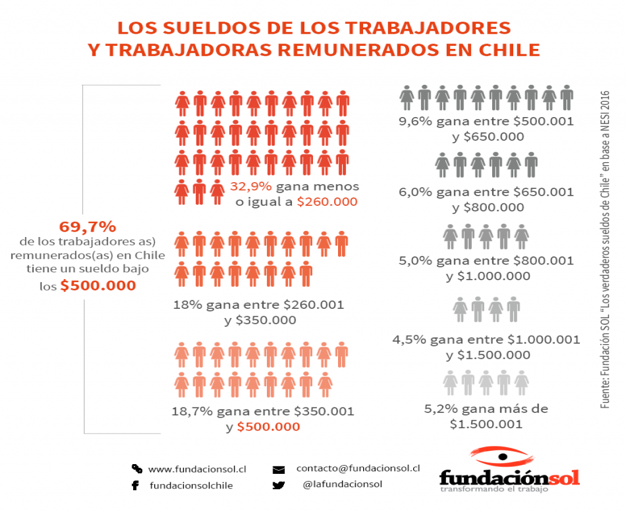
This policy of shock that the author mentions is nothing more than, for example, the precariousness of work, which is presented as a “promotion” or “generation of new jobs” for young people, women, the poor, recent university graduates, creating a trend, accompanied by a pompous propaganda campaign, “in which the labor rights traditionally acquired through prolonged struggles of the workers are weakened by sectors (Figure 1). A propaganda that constantly claims to favor employment, make the economy viable, open up new possibilities for economic advancement of individuals and families, without taking any responsibility whatsoever for the quality of the employment they favor, nor for the low salary levels involved, nor of the absolute lack of labor and union rights that surround them” [1].
The Chilean Awakening: Social Revolt and COVID-19 Health Emergency
All of the above is the reason why Chile has lived for the last 40 years in a regime in which big capital has managed to turn services that were traditionally considered social rights into business areas, “which had to be provided and guaranteed by the State” [1]. This commodification and privatization of basic services that results from these policies and that fall directly on the users, the State’s abandonment of these essential goods, begins to be evident in the social movements of 2006 with the penguin revolution, 2011 with the spring of Chile and the university awakening due to excessive profits in education, end up deepening and being filled in the Chilean awakening of October 2019 that apparently has no turning back, where it is totally clear that citizenship has four main sensitive areas that are common: public transport, education, health and pensions.
These four sensitive areas are what we intend to address during this section and also begin to describe and analyze them in light of the COVID-19 Health Emergency. Well, “Chile woke up”, “Crisis in Chile of 2019”, and “Revolution of the 30 pesos”: This social awakening that took place in Chile, was triggered by a series of inequalities in access to the public transport system, which It was called the “revolution of 30 pesos”, initiated by high school students, which gave rise to the general uprising of citizens, who had been experiencing more than 40 years of social, political, and economic inequalities, which are until now. today protected by the fundamental charter created in the Civic-Military Dictatorship.
Once the awakening of Chilean citizens had begun, the government of Sebastián Piñera “responded to social discontent and demonstrations with repressive measures, taking the military out on the streets for several days.” These first attitudes of the government of Sebastián Piñera to address the social unrest that Chile was beginning to experience, showed that from the interstices of civil society, preannouncements are made from time to time of said unrest, such as: “the penguin revolution, the struggles of the people Mapuche against the State and the powerful lumber industry for their land and the freedom of their loncos, imprisoned leaders and community members, the massive marches of university students for the right to education, citizens against the AFPs, women for equality of gender and their sexual and reproductive rights” have been the cumulative facts that have exploded social unrest and that show the strength of Chilean social movements, which emerge and are articulated to the extent that social phenomena become more complex. In these almost nine months since the Chilean social outbreak occurred and now it is only kept in “lockdown” due to the health emergency of COVID-19, we can see that there is now a new public subject, which has become a relevant social actor with a will to power and a desire for change that inaugurates a new construction of a social conscience, with a “rationality that guides citizen action towards critical reflection and the gestation of a final demand: a new social pact through assembly constituent and new political constitution” [2]. We have to hope that this subject, who is in full construction of himself and of the new social pact that the author tells us about, can achieve the materialization of his transformative purposes.
The Social Crisis and the Effects on Public Health
As we have been describing, the Chilean social crisis has undoubtedly greatly affected the public health and mental health of all Chileans. The national character of the social outbreak that has been able to summon an entire territory, where its strength and massive participation of different civil society organizations, has meant that “important sectors of the citizenry have been exposed in a sustained manner to conditions of maximum psycho-emotional demand and the daily danger of being affected by police repression”. These psycho-emotional effects that are now exacerbated in the “lockdown” due to the COVID-19 health emergency, show us that Chile is experiencing two profound transformations, one of them related to the social outbreak and the more than 40 years of inequalities social, political and economic crisis and the second health emergency crisis COVID - 19 that makes visible and further increases the discomfort of citizens. In this sense, we can see that Chile is going through a double period of crisis with “traumatic events of different types and levels of severity, which three-dimensionally affect corporality (its biological, psychological and social aspects), in the same way that they are projected in the form of expansive from the individual subject” [2].
These effects of both the social crisis and the effects of the COVID-19 health emergency are very worrying because Chileans have been exposed to processes of traumatic violence that affect society as a whole. The repressive violence that has been experienced since the social outbreak began and how there was a series of events that showed the excessive use of force by the armed and law enforcement forces, exposed thousands of Chileans to toxic violence of great magnitude, an example of this was the case of university student Gustavo Gatica, who was hit by pellets, leaving him as the first case of blindness during the social outbreak. This repressive violence that Chilean society has experienced is of a cyclical type in which “policies of control and social submission are reproduced, cycles that are not born with the experience of Pinochet and State terrorism, but are inaugurated with the colonial invasion and they repeat from time to time since the founding of the Chilean Nation State” [2]. In this way, we can see that Chile has experienced an archeology of historical violence, which is installed in social subjectivities and also in the production of discomfort and disease.
We have lived through more than half a century of an experience of extreme social traumatization “inaugurated with the civic-military coup of 1973, which installed almost two decades of State terrorism; The generations that were victims of that historical period carry with them a burden of illness and death that transforms them into vulnerable groups, especially those individuals and families that experienced serious trauma (torture, murder and disappearance of family members, exile, political prison, etc.) ” [2].
The Management of the COVID-19 Pandemic in Chile
If we are linking that Chile from October 2019 to the beginning of March 2020 has been experiencing a series of profound changes, in regards to the management of the COVID-19 pandemic and how it has been handled during the first months that the cases of contagion, we can point out that “the government’s initial reluctance to take social isolation measures seemed to suggest that it would follow the British model of “herd” immunity, that is, seeking that the population’s exposure to the virus would generate immunity “ [3].
As can be seen, in Chile the main strategy to be able to manage the pandemic was to make the population itself regulate its mobility in order to prevent the spread of the virus. However, almost two weeks into the pandemic, the authorities began to give guidelines and intermediate solutions, which meant following a path of gradual and episodic confinement, unlike countries like New Zealand or Norway, which called their population to mandatory and national confinement.
In this way Heiss tells us that “on March 16, President Sebastián Piñera, accompanied by the Minister of Health, Jaime Mañialich, announced the entry into Phase 4 of the pandemic, with 156 people infected and the impossibility of trace the origin of the infection”, an impossibility that was very complex to trace because there were not enough resources and health infrastructure to be able to start with the PCR analysis, making the traceability of the virus complex, this also coupled with the fact that The government regarding this Phase 4 begins to close borders, suspend classes in educational establishments, begin with mandatory quarantines for people already infected, reduce the number of people in public actors and sanitize public transport, and then two days later decree State of Constitutional Exception of Catastrophe [3].
After the first month of the pandemic in Chile, the first analyzes have suggested “that the country has controlled COVID-19 more effectively than others in the region. Minister Mañialich has said that there are enough PCR tests and mechanical ventilators to face the peak of the disease curve. These teams would reach 3,300, if those from the private sector are included”. According to the above, it can be seen that in Chile during the first months the authorities indicated that they had sufficient resources to control the pandemic and that “flattening the curve” of the disease would be controlled, in fact, in March the investment bank J.P. Morgan pointed out in his report entitled “Chile vs COVID-19: initial measures show encouraging results, this report mainly points out the strengths that Chile had in implementing strategies to control the pandemic, these “early preventive measures and that they have been applied to a high level of testing for the presence of the virus, which would give figures closer to reality than those of other countries, adds that there is a high number of infected people, but with low lethality. As an example, it is mentioned that eight days after the first case there were only seven victims, compared to 35 in Italy, 84 in Spain and 57 in Brazil” [3].
However, in the face of this optimistic reality indicated by the report and the Chilean authorities, there are also analysts who have a much more pessimistic view regarding the low lethality of the virus in Chilean cases. One of the most critical voices regarding the handling of the pandemic in Chile has been Dr. Iskia Siches, president of the Chilean Medical College, who has been critical of the government’s handling of the pandemic. In this context, in a communication medium, the president of the Medical College argued that “the diagnosis government strategy to contain the expansion of COVID-19 is impossible to implement by force because our doctors, who are found throughout the network care, have not reported that there are relevant problems of saturation of diagnostic capacity and that the protocols mandated by the health authority are not being applied, not because of contempt but because of implementation problems. In fact, what was raised by the president of the Medical Association shows that the Chilean medical community, at the beginning of the pandemic, was concerned because the medical association indicated that they did not have all the information to collaborate with the government.
The data provided was incomplete, inconsistent and had a tremendous lack of transparency that had not been seen in the institutional history of Chilean public health. It means, then, that “in a more advanced phase, the health system could be saturated, which would generate two additional phenomena: less testing would be done and lethality would increase. In other words, “it is not possible to predict how the situation will evolve when cases expand among more vulnerable groups of the population” [3].
As can be seen both what was stated by the president of the medical college and by the author Heiss, points out that the pandamia and its management during the first months in Chile was a late and somewhat clumsy management, realizing that even the professionals of The Chilean public health system manifested from the beginning the collapse of the health systems, that is, the same “health workers complained about the lack of basic supplies such as masks. Until April 8, it was known that 286 infected health officials, the vast majority of them belonging to the public health network” [3]. However, regarding the capacity of the health system, “the confusing announcement of a purchase of mechanical ventilators whose arrival date is uncertain has been criticized, as well as the scant information on the way in which decisions are made regarding the management of COVID-19. 19. For example, the government has indicated that the maximum rate of contagion will occur between the end of April and the beginning of May, but has not shared the criteria used for that forecast” [3].
As a result of the above, it is that the pandemic of COVID-19 in Chile is still in process “Tuesday, August 18, 2020, the Ministry of Health reports 1,336 new cases of COVID-19, of which 846 correspond to symptomatic people and 443 have no symptoms. In addition, 47 Positive PCR tests were registered that were not notified. Regarding the figures of deaths, the report indicates that “The total number of people who have been diagnosed with COVID-19 in the country reaches 388,885.
Of that total, 15,869 patients are in the active stage of the virus. The recovered cases are 362,440. Regarding deaths, according to the information provided by the Department of Statistics and Health Information (DEIS), in the last 24 hours there were 33 deaths from causes associated with COVID-19. The total number of deceased amounts to 10,546 in the country.
The Economic and Social Measures of COVID-19 in Chile
At the same time that the government was trying to manage the pandemic and keep the curve under control, economic and social measures in the context of the pandemic also began to be important when carrying out the relevant social analyses (Figure 2). Thus, in this sense, many Latin American countries have to turn to the IMF (International Monetary Fund), to seek resources and contain this health and social grayis, however in the case of Chile, these measures do not increase public spending, Rather, the main government announcements have been focused on increasing access to credit in private banking, reallocating funds to the health sector from other items in the fiscal portfolio, and using individual unemployment insurance funds. In this sense, to contain this pandemic, Chile has not resorted to foreign aid or debt, this is explained in the following graph:
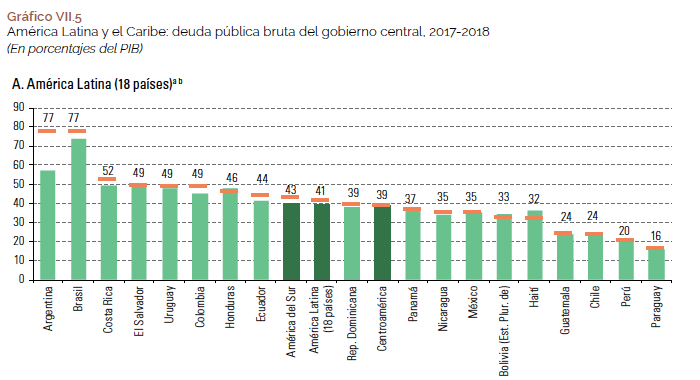
This graph shows us that the gross public debt in the case of Chile corresponds to 24% of its GDP, one of the lowest in the region (ECLAC, 2019: 86) [4]. This shows us that Chile has a margin to borrow and be able to face the pandemic without having to resort to the IMF. The treasury could, for example, issue “debt in international financial markets. It could also resort to the 12.4 billion dollars it has in the Economic and Social Stabilization Fund, which exists precisely to avoid indebtedness in crisis situations, and which is equivalent to around 4% of GDP” [3]. However, the measures announced so far are timid compared to other Latin American countries.
In this sense, the Chilean government, during the month of March, proposed an economic plan to be able to face COVID-19, which had three main axes: the first was to reinforce the budget of the health system, the second axis was to protect income of the family, through unemployment insurance and the delivery of 58 dollars per family, people who were telecommuting could receive part of their unemployment insurance as long as there is an agreement between the employer and there is a mandate from the health authority, the The third axis was aimed at small and medium- sized companies, considering tax measures that referred to the postponement of payments.
While from the official sector they celebrated these measures adopted by the government of Sebastián Piñera, some economists such as “Andrea Repetto objected that the payment from the worker’s unemployment insurance is not an expense but a loan, which will come from the individual accounts of the insurance of each worker. “This policy does not provide security because if they later lose their job, they will not have how to finance that unemployment, since they used the funds during the crisis to pay their own salary,” he said. On the other hand, for those who do not have unemployment insurance because they do not have employment contracts, the only benefit is the bonus that will be delivered once. “Those people will necessarily have to go out to work and the quarantine effort is going to be ineffective” [3].
After this economic plan was announced, the opposition did not delay in proposing another economic plan which consisted of 4 main axes which are related to: establishing a basic emergency income for all families while the pandemic lasts; postponement of payments and prohibit cuts in basic services, postpone credit installments without interest and temporarily control the prices of some products to avoid hoarding; a third axis has to do with state support for companies, including state-backed loans for small and medium-sized companies; and lastly, prohibit the dismissal of workers and inject state resources into strategic companies in exchange for state participation in them.
This opposition plan to the one proposed by the government required an unprecedented amount of fiscal resources, for which the opposition considered that “Chile was prepared to go into debt” to reduce the costs of the health crisis. Once this is over, a new progressive fiscal pact is necessary to reduce the greater fiscal deficit that will be generated. “But if we don’t act boldly today, future spending will be higher and will be accompanied by painful social costs” [3].
From the above approaches, it can be deduced that the Chilean government’s announcements have sought to moderate the recessive effects that the pandemic has brought, without incurring public spending such as that which would be necessary to keep families in total confinement. In some way, the responsibility of the Chilean state has been weak in the sense that it has not put all its efforts into safeguarding the health of the population, and furthermore, this crisis has been coupled with a constituent process underway that has put Chile in an approximation to profound change. Approaching the Plebiscite of October 2020 As we have seen in the previous statements, and how the pandemic has put everything on pause in our country, a new historic moment in our history is approaching us and it is the one that is related to the next plebiscite of October 2020 that was born in the middle of the social and political upheaval that we also experienced in October 2019. This is a historical process of relevance even since the return to democracy in 1990. As a result of the social revolt on November 15, 2019, political parties from across the ideological spectrum agreed a set of proposals to make possible the change of the 1980 Constitution, imposed during the dictatorship of Augusto Pinochet. Many sectors point out that the effects of the pandemic could weaken the constitutional process due to the fact that the pandemic could take the lead from the plebiscite and it could even happen that it will increase the approval of the government.
However, it seems unlikely that the demands for structural change in Chilean society will disappear as a result of the COVID-19 pandemic, even more so in a context of economic recession, unrest and social discontent with political institutions and their elites could arise. with greater force the constituent process.
Therefore, it becomes difficult to predict what will happen with the COVID-19 pandemic and the constitutional process underway, we could think that COVID-19 could reinforce a structural change that Chile has been waiting for more than 40 years and we could also To think that this pandemic exposes the evident weakness of the Chilean social protection systems, revealed the miserable pensions of our older adults, the precariousness of work and their almost zero labor rights, to mention aspects that have been at the center of the debate from the COVID-19 pandemic. Consequently, the accentuated electoral abstention, the evident explosion of social movements from 2011, have been showing accurate signs of deep citizen discontent and the inability of the institutional political system to channel it. The constant focus on the “macroeconomic” growth of the country and healthy finances where when it was said that “when Chile grows we all grow” did not allow us to see that those healthy finances were for a few and that the whole of the country was sustained by a class worker on indebted, families in the lack of protection and absolute old age.
Conclusion
The arrival of the COVID-19 pandemic in Chile took place in a context of full social explosion, where citizens had and have a deep social discomfort which is expressed by the crisis of legitimacy of the institutions and their ruling elites, the deep inequalities of a political, economic and cultural system that has benefited for years from the Chilean labor force where individualism and consumption was the way of living and existing in Chile. The Chilean people have woken up to all that and much more. But if we enter the post-pandemic scenario that we will have to face at some point, it is possible to think of the following: social demobilization could favor the forces of the right with a view to the October plebiscite, on the understanding that these right-wing forces build a discourse of unity that helps to get out of the health crisis process, it is possible that support for a new Constitution suffers. A second possible scenario is the one that is related to the COVID-19 pandemic being controlled and it may cease to be the focus in our society, the opposition forces may return and point to the weaknesses of the market economy, the fragmentations and inequalities in the health system and the lack of universal policies that safeguard the social rights of Chileans. If this case happens, we will see a process of profound change and the concrete and real creation of a new partner pact for Chile. However, we are still in the process of moving parallel and we are not certain what will happen. What can be assured is that in a context of enormous discount, system limitations and the adverse results that have been seen, they could exacerbate social discontent and increase reformist pressures.
References
-
Soto CP (2014) Marxism: here and now. Triangle Publisher.
-
Madariaga C (2019) The “Social Outburst” and the Mental Health of Citizens: An Appreciation from the PRAIS Experience. Chilean Journal of Public Health 23(2): 146-156.
-
Heiss C (2020) Chile: between the social outbreak and the pandemic. Analysis Carolina 18(1).
-
ECLAC N (2019) Preliminary Balance of the Economies of Latin America and the Caribbean 2018.
- Capacity Constraints in Pediatric Inpatient Psychiatric Care: A Cross-Sectional Analysis of Bed Availability and Geographic Access in North Carolina
- Why Healthcare Analytics Still Optimizes the Wrong Things
- Coding, Coverage, and Care: The Infrastructure of Transgender Health Inequities
- The Effect of Classroom Attendance on Academic Achievement of Management and Leadership Discipline of Nursing Students at Instituto Superior Cristal and Universidade de Dili, Timor-Leste, 2024: A Case Study
- The Role of Social Bonds in Facilitating Shared Investments and Resource Allocation: Addressing the “Wrong Pocket Problem” in Public Health and Healthcare
- Social-Cultural Factors Contributing to Antimicrobial Resistance in Livestock Farmers and Community Households in Kayonza District, Rwanda