
Occupational Sun Exposure in Agents Fighting Endemics in the Municipality of Ourinhos-SP
Introduction: The skin, which represents the largest organ in the human body and makes up around 16% of body weight, plays a fundamental role in protecting the body's internal structures against the external environment. It is structured into three distinct layers: the epidermis, the dermis and the hypodermis (also known as the subcutaneous tissue). This organ has several purposes for the functioning of our body, such as: perspiration, thermoregulation, pigmentation, nutrition, and mainly protection against harmful agents. The objective of this present study was to analyze occupational sun exposure in agents fighting endemic diseases in the municipality of Ourinhos-SP. Method: The research was carried out using a questionnaire on sun exposure and photoprotection, containing 11 questions regarding photoprotection and sun exposure habits, applied to 27 (twenty-seven) agents combating endemic vector diseases, in Ourinhos-SP. Results: 44% of participants expose themselves to the sun for more than 6 hours from Monday to Friday and on weekends this exposure decreases to 7.6%, exposure to the sun in summer 65.2% of participants expose themselves to the sun between 10 am and 3 pm and 44.4 of the participants do not use sunscreen daily. Conclusion: It is concluded that these professionals face a high risk of developing skin cancer.
Introduction
The skin, which represents the largest organ in the human body and makes up around 16% of body weight, plays a fundamental role in protecting the body’s internal structures against the external environment. It is structured into three distinct layers: the epidermis, the dermis and the hypodermis (also known as the subcutaneous tissue). This organ has several purposes for the functioning of our body, such as: perspiration, thermoregulation, pigmentation, nutrition, and mainly protection against harmful agents [1].
The outer layer of the skin is the epidermis, its main function is to protect the body against external agents. Just below is the dermis, a deeper layer composed of irregular dense connective tissue; This layer is located between the epidermis and the subcutaneous tissue, being rich in collagen fibers and elastin and playing an important role in supporting the epidermis. Finally, the last layer is the hypodermis or subcutaneous tissue, which is considered an endocrine organ; it is mainly composed of adipocytes and has several functions, such as storing energy, protecting against impacts, regulating body temperature and shaping the body [1].
According to Bomfim, et al. [2] skin cancer is the type of tumor with the highest incidence in Brazil, the most common lineages found in the population are non-melanoma skin cancer (NMSC) and melanoma type ( MC). The factors that can lead to the development of the disease may be related to: skin type, family history, number of nerves and especially excessive exposure to solar radiation.
Skin cancer is classified into non-melanoma and melanoma, however the non- melanoma group is subdivided into Basal Cell Carcinoma (BCC) – corresponding to 80% of cases in this group and Squamous Cell Carcinoma (SCC) – corresponding to 20% of cases in this group. The tumor classified as Melanoma is the most aggressive and rarest type, as it has a higher mutation rate and affects a small portion of the population, while tumors classified as non- melanoma correspond to the largest portion of the Brazilian population [3].
Due to Morais, et al. [4], relates the appearance of cutaneous tumors on the skin to factors linked to the patient’s family history, genetic factors and mainly the degree of skin pigmentation, since people with lighter skin pigmentation are more predisposed to developing lesions (burns) and melanomas than people with a greater degree of skin pigmentation. However, skin care must be taken with the same degree of concern for all races, as no level of pigmentation is exempt from developing skin cancer.
In agreement with Faro, et al. [5], the manifestation of this type of tumor in Brazil represents approximately 30% of malignant neoplasms treated in the country, as excessive exposure to ultraviolet radiation is decisive in the development of the melanoma type or not. Therefore, the rays reaching the skin cells damage the DNA present in them and cause mutations in their structure and oxidation.
Therefore, it is necessary for health professionals to be alert to detect unusual signs on the skin that could signify the emergence of one of the types of skin cancer, such as: elevations or nodules, wounds that do not heal, spots that change color, texture, size, itching, pain or even bleeding. Therefore, the diagnosis of skin cancer must be made by a qualified professional to ensure that the treatment used is the most appropriate, in order to enable the patient to receive early and safe treatment, in order to increase their chances of cure [6].
Endemic Disease Control Agents play a fundamental role in combating diseases, carrying out surveillance, prevention, control of endemic diseases and health promotion activities. His area of activity is the environment in which people live, which puts him face to face with daily challenges faced by communities, such as security issues and vulnerable situations. This exposes you to several risks, including psychosocial ones, and makes you more susceptible to excessive exposure to solar radiation, increasing the potential development of skin cancer due to long hours under the sun. Therefore, it is crucial to implement prevention and awareness measures to encourage changes in habits that promote self-care among these professionals [7, 8].
In line with Santos, et al. [9], it is notable that the population needs guidance and knowledge about the correct way to use sunscreen, and above all the benefits that this product brings to skin health in relation to, for example: photoaging and the types of tumors that excessive exposure to the sun can bring to people who do not use any form of protection.
The types of treatment must take into account the type of skin the patient has, as each skin has its own particularities in relation to its anatomical and physiological condition. Furthermore, any and all signs of skin cancer must be treated immediately, even the less lethal ones, to prevent its development, and for this purpose, surgical treatments, phototherapeutic therapy, laser therapy, among others, are indicated [10].
In accordance with Souza, et al. [11], it is highly recommended for everyone to use and apply sunscreen daily to the entire body, in order to avoid the incidence of ultraviolet solar radiation in direct contact with the skin. Using this product on the skin helps reduce the harmful effects of this radiation on this organ, and above all the health of workers who are exposed to it daily.
In relation to Schmidt [12] the physiotherapy professional plays an important role in promoting health actions, since, during his generalist training, the physiotherapist acquired knowledge regarding this type of pathology as well as possible treatments. Meanwhile, this professional can also specialize in the field of oncology and work directly in the rehabilitation of patients with skin cancer.
The objective of this present study was to analyze occupational sun exposure in agents fighting endemic diseases in the municipality of Ourinhos-SP.
Methodology
For the convenience of the researchers, a total of 27 (twenty-seven) participants were invited, all being agents to combat endemic diseases in the municipality of Ourinhos – SP, aged 26 – 64 years, 16 male participants and 11 female participants.
Who should meet the following eligibility criteria: A) Adults over 18 years old; B) Agents to combat endemic diseases; C) All participants must speak and understand Portuguese (Brazilian) perfectly. The exclusion criteria points used were: A) Participants who do not work in the sun.
The research was carried out using an adapted questionnaire on sun exposure and photoprotection Lara, et al. [13], containing 11 questions regarding photoprotection and sun exposure habits, applied to agents combating endemic diseases in the vector nucleus, in Ourinhos- SP, from August to September 2023.
Results
For the convenience of the researchers, a total of 27 (twenty-seven) participants were invited, all of whom were agents to combat endemic diseases in the municipality of Ourinhos – SP, aged 26 – 64 years, 16 male participants and 11 female participants.
The questionnaires of the 27 (twenty-seven) participants were analyzed, on issues such as personal characteristics, use of sunscreen and sun exposure (Table 1; Figures 1-4).
| Variable | N | % |
|---|---|---|
| Masculine | 16 | 59,3 |
| Feminine | 11 | 40,7 |
| Age | ||
| 18-25 | ||
| 26-35 | 11 | 40,7 |
| 36-45 | 9 | 33,3 |
| 46-55 | 6 | 22,2 |
| Over 55 | 1 | 3,7 |
Source: Own preparation. Table 1: Presentation of the characteristics of the participants regarding gender and age group, Participants were submitted to the adapted questionnaire on sun exposure and photoprotection, based on sun exposure results from Monday to Friday. where 44.4% of participants expose themselves to the sun for more than 6 hours from Monday to Friday (days on which participants work).
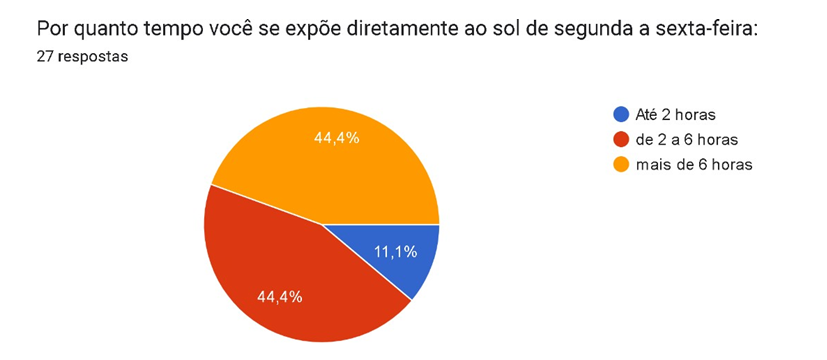
Source: Own preparation. Figure 1: Presentation of sun exposure results from Monday to Friday.
At the weekend, sun exposure decreases, with 7.6% of participants exposing themselves to the sun for more than 6 hours at the weekend (days when participants are off).
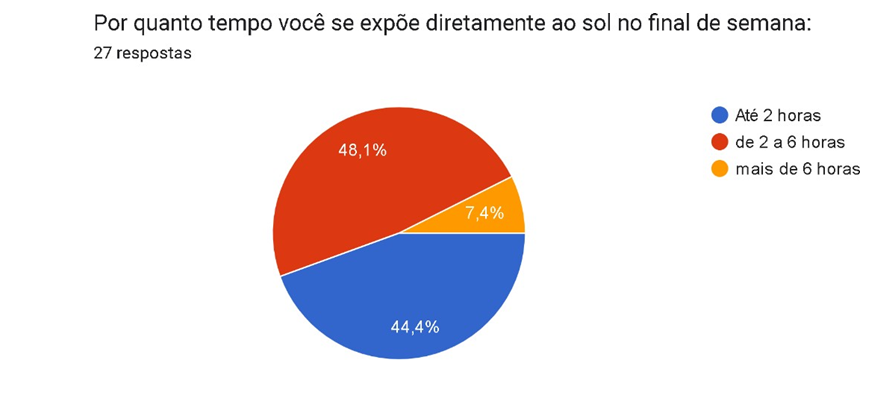
Source: Own preparation. Figure 2: Presentation of sun exposure results over the weekend.
In the results of sun exposure in summer, 65.2% of participants are exposed to the sun between 10 am and 3 pm.
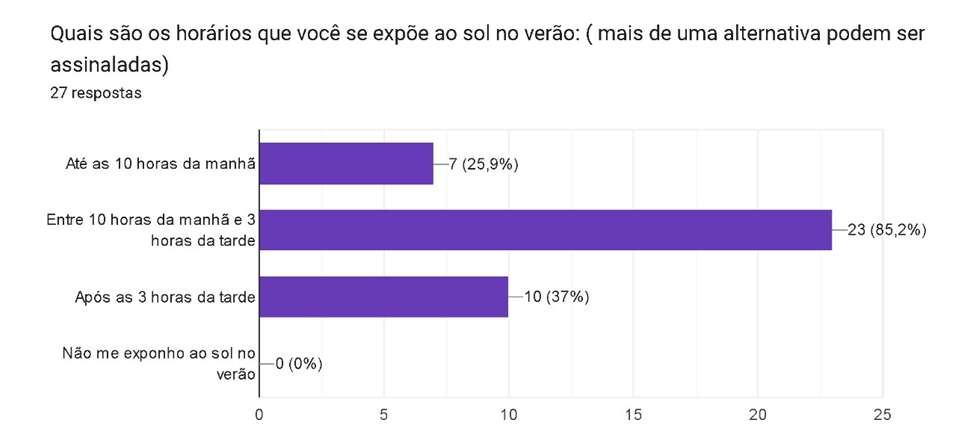
Source: Own preparation. Figure 3: Presentation of the results of times exposed to the sun in summer.
In the results in table 5, 44.4% of participants do not use sunscreen daily.
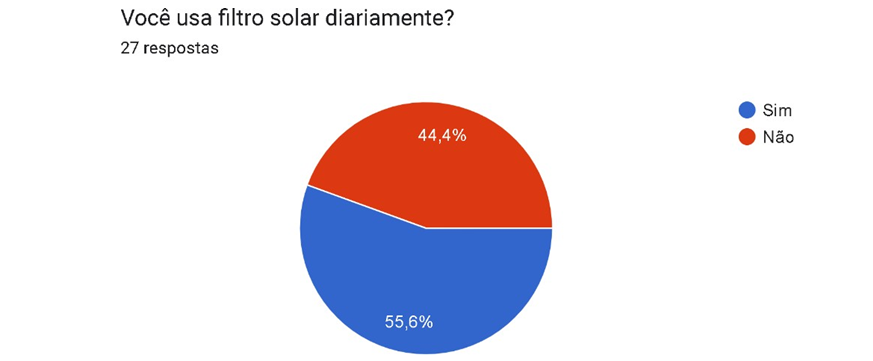
Source: Own preparation. Figure 4: Presentation of the results of daily sunscreen use.
Discussion
Based on the results, it is evident that participants are at high risk of developing malignant and pre-malignant skin lesions, as most of them are exposed to the sun for more than 6 hours during weekdays.
Among the numerous damages resulting from occupational exposure to the Sun, the detection of malignant and pre-malignant lesions on the skin of workers who perform their duties outdoors stands out, with solar radiation identified as an independent risk factor [14].
The period during which agents fighting endemic diseases in Ourinhos-SP are most exposed to the sun ranges from 10am to 3pm, which increases the likelihood of developing skin cancer.
According to Rabelo, et al. [15], in addition to the use of sunscreens, it is essential to adopt other precautions regarding sun exposure. Therefore, it is recommended to avoid being outdoors during periods of greatest intensity of solar radiation, which occur from 10 am to 4 pm. Using umbrellas, caps, hats and clothing that covers areas such as the face, arms and legs, including clothing with protection against ultraviolet rays, are important measures to consider.
Even though participants carry out their activities under sun exposure, some of them have not yet acquired the habit of applying sunscreen daily, which represents a significant risk to their health.
Using sunscreen daily is a fundamental measure to prevent skin cancer, as it represents an effective protection strategy against damage caused by sun exposure. This highlights the need to care for the skin appropriately when applying sunscreen [16].
Considerations
The relevance of the subject of skin cancer and its preventive measures arises from its significant prevalence in Brazil, being the most common type among the country’s population. This type of neoplasia is directly linked to the progressive accumulation of solar radiation and safeguarding practices; therefore, adopting precautions and carrying out self-assessment skin exams prove to be effective approaches to prevent the occurrence. Although prevention is possible, preventive strategies and early detection have not yet reached the desired level. Based on the findings of the present study, it is feasible to conclude that these professionals face a high risk of developing skin cancer. More effective preventive measures focused on the topic are necessary in order to effectively influence changes in habits and make these individuals more aware of the importance of self-care.
References
-
Bernardo AF, Santos K, Silva DP (2019) Skin: anatomical and physiological changesfrom birth to maturity.
-
Bomfim SS, Giotto AC, Silva AG (2018) Skin cancer: understanding and preventing the population. Rev Cient Sena Aires 7(3): 255-259.
-
Buhring CA Z, Wagner LS, Silva IK, Parisi MM (2020)Skin Cancer Subtypes and the Impacts of Risk Factors. 8(1): 241-254
-
Morais CSI, Morais L, Marques JLB, Marques CMG (2019) Assessment of knowledge of risk factors for cutaneous melanoma: vision of preventive physiotherapy.
-
Faro SML, Bahia SHA, Sodré RS, Marinho PC, Silva ALM, et al. (2020) Health education on skin cancer for agents responsible for the health of units of family health in the D’AGUA District in Belém, State of Pará, Brazil 9(11).
-
Carminate CB, Rocha AB, Gomes BP, Nakagawa FNF, Oliveira GL, et al. (2021) Early detection of skin cancer in primary care.
-
Nobre RAP (2015) Occupational sun exposure in community health workers in a city in Minas Gerais. 15th national scientific initiation congress pp: 1-8.
-
Matos GCR, Silva JM, Silveira AM (2020) Work and health: the perspective of the endemic diseases control agents of Belo Horizonte, Minas Gerais, Brazil.
-
Santos KS, Inácio CG (2022) Importance of using sunscreen in preventing skin cancer.
-
Silva ALA, Sousa KRF, Silva AF, Fernandes AB, Matias VL, et al. (2015) The importance of using sunscreens in preventing photoaging and skin cancer.
-
Souza MCMR, Horta TG, Melo ES, Rocha FDB (2016) Skin cancer: sun exposure habits and skin changes among health workers in a city in Minas Gerais. Nursing magazine from the center west of Minas Gerais 1(6): 1945-1956.
-
Schmidt SC (2020) The role of the physiotherapist in the care of individuals with skin cancer at all levels of health care.
-
Lara RF, Rodrigues RC, De Lima ER, Nassif PW (2013) Assessment of sun exposure habits and photo protection of medical students at the Faculty of Ingá.
-
Lopes MS, Lima ARS, Santos ES, Santos TS, Barreiro MSC (2022) Impacts of occupational exposure to the sun on the skin of outdoor workers. 11(3).
-
Rabelo JR, Ballestreri E (2019)Comparative study on the use of sunscreen in rural and urban areas.
-
Santos SO, Sobrinho RR, Oliveira TA (2018) Importance of using sunscreen in preventing skin cancer and analysis of information on these products intended for their users. J Health Biol Sci 6(3): 279-285.
- Capacity Constraints in Pediatric Inpatient Psychiatric Care: A Cross-Sectional Analysis of Bed Availability and Geographic Access in North Carolina
- Why Healthcare Analytics Still Optimizes the Wrong Things
- Coding, Coverage, and Care: The Infrastructure of Transgender Health Inequities
- The Effect of Classroom Attendance on Academic Achievement of Management and Leadership Discipline of Nursing Students at Instituto Superior Cristal and Universidade de Dili, Timor-Leste, 2024: A Case Study
- The Role of Social Bonds in Facilitating Shared Investments and Resource Allocation: Addressing the “Wrong Pocket Problem” in Public Health and Healthcare
- Social-Cultural Factors Contributing to Antimicrobial Resistance in Livestock Farmers and Community Households in Kayonza District, Rwanda