
Advanced Practice Registered Nurses Role Transition; A Mini Literature Review
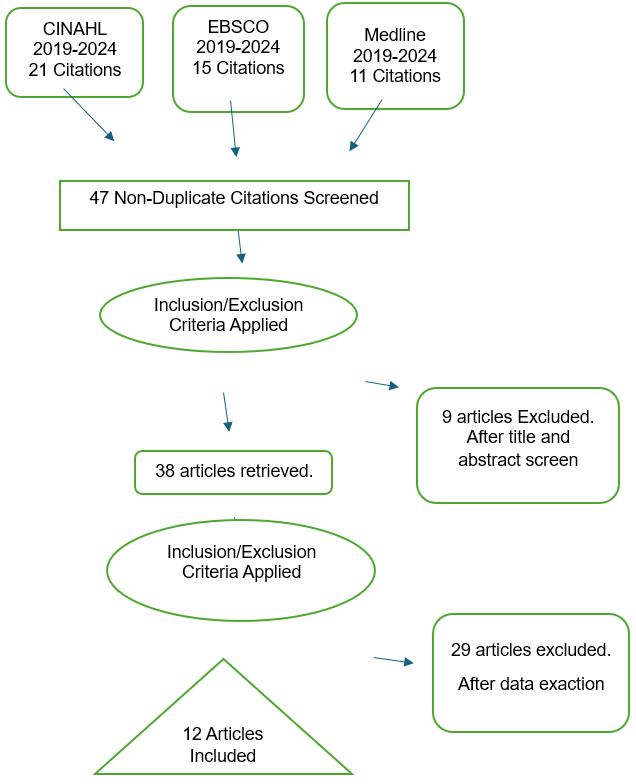
Background: The demand for primary care providers is expected to continue to grow more rapidly with increased retirement among current providers and the population growing older with complex health care needs. Advanced practice registered nurses must be able to successfully develop in their role and have a smooth transition from Registered Nurse to Advanced Practice Registered Nurse. Design: To examine factors related to role transition for the APRN, a mini rapid review. Methods: An extensive review of the literature was conducted using the following key words: nurse practitioner student, novice, graduate, role transition, job satisfaction, quality of care, residency, fellowship, and orientation. CINHAL, EBSCO and Medline databases were used. Searches were conducted from 2019-2023. Assessed the studies for selection, risk of bias, and extraction of data. Publications were eliminated based on the following exclusion criteria: the research utilized small sample sizes or new data was available, or the peer review process was limited. 47 non-duplicated articles were initially reviewed. After initial review of the title and abstract, 38 articles remained. Of the remaining 38 articles, 29 articles were excluded during the data extraction. The 12 remaining articles were included in this literature rapid review. Conclusion: Nursing Students entering APPRN programs are often younger in age and have fewer years of registered nurse experience compared with cohorts in the past ten years. Higher Education Nursing Programs need to be aware and the importance of post-graduate residencies and expanded orientation programs for novice professionals. APRN need to be aware that competency impacts quality care that can impact financials.
Abbreviations
APRN: Advanced Practice Registered Nurses, HCP: Health Care Provider.
Introduction
Advanced Practice Registered Nurses (APRN) are a vital part of the health care team. The advanced practice registered nurse (APRN) role has existed for over half a century. APRN role has evolved to provide health care needs to different populations and sub-specialties throughout the United States. APRNs are registered nurses with master’s and/or doctorate degrees with advanced education and training beyond registered nurses. Therefore, they have additional scopes of practice over and above traditional nursing duties [1]. APRN’s students experience stress, being overwhelmed, financial constraints, new knowledge, and the rigor of their program(S). Being a competent practitioner should be the focus for any nursing student, especially advanced practice registered nurse. APRN students are faced with many challenges when leaving the role of registered nurse to assume the role of advanced practice such as a nurse practitioner. Being a competent provider allows for improved patient outcomes that align with quality of care. Challenges include lack of support, lack of resources, lack of mentoring, all factors that influence the role of transition.
Problem Statement
The loss of providers across the healthcare continuum results in numerous positions of direct patient care that APRNs are poised to fill. According to the American Association of Nurse Practitioners (AANP), there are more than 355,000 NPs licensed in the United States. In 2022, 88.9% of NPs were certified in primary care and out of the 88.9%, only 70.2% delivered primary care (Nurse Practitioners in Primary Care). APRNs face role transition difficulties such as feeling overwhelmed, change of environment, change of skill and competency level, and lack of support. Facing difficulties will decrease quality of care that will impact financials, as patients will need to seek out care and or increase hospitalizations.

Theoretical Perspective
Patricia Benner has been a research leader in the field of nursing since 1982. Benner developed a concept known as “From Novice to Expert.” This concept explains that nurses develop skills and an understanding of patient care over time from a combination of a strong educational foundation and personal experiences. Benner proposed that a nurse could gain knowledge and skills without using a theory [2]. She describes this a nurse “knowing how” without “knowing that.” Benner’s theory has the foundation set from the Dreyfus Model that posits that in the acquisition and development of a skill, a student passes through five levels of proficiency. The theory identifies five levels of nursing experience: novice, advanced beginner, competent, proficient, and expert. She further explains that the development of knowledge in fields such as nursing is made up of the extension of knowledge through research and understanding through clinical experience. APRN transitioning from being a registered nurse to advance practice will be at the novice stage.
Literature Review
An extensive review of the literature was conducted using the following key words: nurse practitioner student, novice, graduate, role transition, job satisfaction, residency, fellowship, and orientation. CINHAL, EBSCO and Medline databases were used. Searches were conducted from 2019- 2024. Keywords included both singularly and in multiple combinations: role transition, advanced practice nurse, family nurse practitioner, transition, new graduate nurse, role change, new graduate role, transitional programs, mid-level practitioner, nurse residencies. The 5-year dates were used to ensure current evidence-based literature was reviewed and summarized.
Education
Master’s degree programs for APRN include fundamental classes such as advanced pharmacology, pharmacotherapy, pathology/physiology, advanced physical assessment skills, and transition roles. Role content can be incorporated into the overall curriculum, specific to courses and or assignments, or a stand-alone course could be designed for the end of the program that offers DEA information, certification information, along with graduation material. Strategies known to facilitate role transition for APRN students include role rehearsal, reflective journaling, student selection of preceptors, interdisciplinary collaboration and finding a role mentor that can guide, answer questions, and often just listen. Focusing on role transition later in the educational process helps promote adaptation and adjustment to the APRN role in the clinical setting after graduation and promotes professionalism. Preparing students with courses in business, economics, and political role integration would nurture novices and allow networking across diverse areas of practice, incorporating business strategy and work ethics that is needed for the role transition. Economics plays a large role within the APRN role, as they need to be aware of insurance policies including lab and prescription costs. The APRN often has 15 minutes to complete an assessment, prescribe, and educate the patient before they need to move on to the next patient.
Clinical Education
Clinical education is an important factor in APRNs difficult transition to practice and their employment choices. Providing primary care services is a complex nonlinear skill, and many novices may be intimidated by its complexity [3]. Master of Science in any nursing program has didactic, clinical and simulation requirements. The nursing student explores and learns new knowledge that they will apply (application) during their clinical practicums. Clinical
education allows APRNs students to apply their advanced nursing knowledge to practice. One of the most important clinical education resources that nursing students rely on during their experiential learning is preceptorship [3]. Preceptorship is normally encountered by an APRN during graduate school when obtaining clinical experience. Preceptorship is a process of a nursing student’s learning experience in a clinical environment guided by the student’s preceptor and faculty [4]. Clinical education is essential to the learning process and critical to hands on approach. A clinical learning environment framing could introduce the additional perspective of required outcomes and implications for the university and open up a scholarly discourse about alignment between education and health delivery systems [5]. Lack of structure in regard to education quality and the learning needs of the new nurse often is a barrier for the APRN to have a positive transition to a new practice role [6].
Certification
Upon fulfilling the needs for graduation, APRN students must pass a national certification exam. Certification must be acquired in most states before obtaining a state APRN license. Certification is the belief that certification measures the nurses’ abilities to provide safe and competent care at a higher level. Various studies demonstrate that Certification does promote optional health outcomes in patient population [7]. Successful certification validates to healthcare organizations that an nurse has mastered a body of knowledge and has gained expertise in the advanced practice role and the population of interest [8]. In many studies that were reviewed nurses felt that certification provides empowerment but also increased their self-confidence.
Transition
The transition from RN to APRN requires a change in role from providing care that is ordered by a health care provider (HCP) to the APRN who is demonstrating autonomy by prescribing patient care to a Registered Nurse. The process of a successful role transition requires APRN to reflect and let go of their former role as a RN, disconnect from previous social links and support, integrate new knowledge, alter behavior, learn new roles, and provide leadership. autonomy, fear and even confusion. Often this leads APRN out of their comfort zone of being an experienced RN for a new career as in experienced advance practice registered nurse is one of the greatest difficulties of the APRN transition to practice [9].
Mentoring
Mentoring is not new to nursing, as many healthcare organizations offer mentoring for the novice RN and many Universities have mentoring programs for novice faculty.
Mentoring is valued in the nursing profession and essential to building an evidence-based practice culture [10]. Evidence demonstrates that competent mentors aid in facilitating role transitions. APRNs’ have the skill set, knowledge, and competency to provide safe and patient centered care. They are lacking a mentor who is available for the extra Guidance [11].
Conclusion
APRNs’ need to have knowledge and be able to apply the new knowledge acquired from the graduate program to their first APRN position. Certifications are a requirement for many healthcare organizations as that demonstrates competency. There are barriers that the novice APRN will face and will continue to grow during their first year. During the transition period, which will differ from one advanced nurse to the next, they will feel overwhelmed, lack of support, lack of socialization, and lack of resources. APRNs’ will have to learn to cope, lead, and demonstrate autonomy in the workplace environment. APRN needs to be aware of the financial impact on the patient and the healthcare organization. Quality care is essential to the role but can be influenced by economics. Finding a mentor that will guide the process will impact job satisfaction, autonomy, empowerment and the role development of the APRN.
References
-
Boehning AP, Punsalan LD (2023) Advanced practice registered nurse roles. In StatPearls. StatPearls Publishing.
-
Benner P (2001) From Novice to Expert: Excellence and Power in Clinical Nursing Practice. Upper Saddle River, New Jersey: Prentice-Hall.
-
Pleshkan V, Boykins A (2022) Cognitive preceptorship: An emerging nurse practitioner role transition to practice model. Journal of Professional Nursing 39: 194- 205.
-
(2020 )HRSA Health Workforce.
-
O’Brien B, Reed A (2019) Exploring the intersections of education and healthcare delivery using a clinical learning environment framework. Journal of General Internal Medicine 34(5): 654-656.
-
Hoffman DME (2019) Transitional experiences: From clinical nurse to nurse faculty. The Journal of Nursing Education 58(5): 260-265.
-
Marfell J, McNelly H, Ma H, Chappell K (2021) The importance of board certification. Journal Nursing Administration 51(9): 417-419.
-
Koehn A (2024) Education and certification. The Journal of Perinatal & Neonatal Nursing 38(1): 98-100.
-
Urbanowicz J (2019) Program development tips. The Nurse Practitioner 44(12): 50-55.
-
Hooge N, Allen D, McKenzie R, Pandian V (2022) Engaging advanced practice nurses in evidence-based practice: An e-mentoring program. World Views Evidence Based Nursing 19(3): 235-244.
-
Dunlap E, Fitzpatrick S (2023) Mentorship education for advanced practice registered nurses. Journal of Nursing Practice.
- Capacity Constraints in Pediatric Inpatient Psychiatric Care: A Cross-Sectional Analysis of Bed Availability and Geographic Access in North Carolina
- Why Healthcare Analytics Still Optimizes the Wrong Things
- Coding, Coverage, and Care: The Infrastructure of Transgender Health Inequities
- The Effect of Classroom Attendance on Academic Achievement of Management and Leadership Discipline of Nursing Students at Instituto Superior Cristal and Universidade de Dili, Timor-Leste, 2024: A Case Study
- The Role of Social Bonds in Facilitating Shared Investments and Resource Allocation: Addressing the “Wrong Pocket Problem” in Public Health and Healthcare
- Social-Cultural Factors Contributing to Antimicrobial Resistance in Livestock Farmers and Community Households in Kayonza District, Rwanda