
Nature Inspired Discovery and Development of Antibacterials: An Update
The growing prevalence of pathogens resistant to several drugs poses an urgent health concern, which can only be addressed by increasing support for the research and development of newer antibiotics. Drug discovery through the exploration of nature's treasures is a successful and ongoing endeavor. However, the conventional method of discovering new drugs from natural sources has become an adjunct choice of the pharmaceutical corporations since it is time-consuming, complicated, expensive, and fraught with uncertainty. The application of several computational techniques, including combinatorial chemistry, metagenomics, and high throughput screening, has accelerated the drug development process simultaneously reducing costs and time. It is a well-established fact that synthetic drugs generated through computer-aided research are frequently linked to a restricted spectrum of pharmacological activity and adverse side effects as compared to treatments that are either directly or indirectly derived from natural sources. Hence, an innovative drug discovery program may be centered on the virtual design of molecules using a scaffold with a natural origin in order to develop effective and affordable therapies with a wide variety of functionality.
Introduction
In ethnic communities all across the world, plants have long been the main source of medicinal resources [1, 2, 3]. Over time, the practice of using plants as folk treatments became increasingly popular and gave rise to organized, controlled systems of traditional Chinese, Korean, Unani, and Indian Ayurvedic medicine [4]. Since substances derived from nature are already designed to work in living things, medicinal plant treatments are thought to be extremely safe and have very few, if any, or adverse reactions [5]. Plants generate a wide range of chemical substances known as secondary metabolites as a defensive mechanism against different environmental circumstances [6]. Later, as of scientifically proven biological effects against various debilities and diseases caused by pathogenic microbes, these secondary metabolites have been the great source of ‘modern drugs’. The emergence of a multitude of advanced instruments and procedures for the separation and Characterisation of secondary metabolites from plants and the mass screening of microorganisms following World War II led to a rapid shift in the field of modern pharmacological research. With the isolation of morphine, a secondary metabolite from Papaver somniferum in the early 19th century, many isolated natural products viz. artemisinin from Artemisia annua, quinine from Cinchona ledgeriana, digoxin from Digitalis purpurea, reserpine from Rowalfia serpentina, taxol from Taxus brevifolia, vincristine and vinblastine from Catharanthus roseus, L-Dopa from Mucuna species and silymarin from Silybum marianum served as blockbuster drugs [7, 8]. In many cases, the isolated compounds may not be clinically relevant or potentially active enough to be developed into a drug molecule. Scientists explore the structure-activity relationships (SAR) between existing functional groups and a specific disease or debility in an effort to increase the selectivity of such molecules [9, 10]. This strategy has produced many exciting leads with improved efficiency over the parent phytomolecules [11, 12, 13]. The fact that over half of the drugs licensed by the United States Food and Drug Administration (USFDA) between 1981 and 2019 contain molecules that were initially found from plants or their derivatives is a testimony to the sector’s mastery of natural products in drug discovery [14].
Discovery of Antibiotics: The Golden Era of Modern Drugs
The greatest medical discovery of the 20th century may have been the development of antibiotics for clinical use that revolutionized the field of medicine, providing effective treatments for infectious diseases and saving countless lives. From the discovery of penicillin by Alexander Fleming to the antibiotics of the Golden Age, these drugs have been instrumental in reducing mortality rates and improving public health [15]. This era saw the isolation and development of several key antibiotics, including streptomycin, chloramphenicol, tetracycline, and erythromycin [15]. These drugs proved highly effective in treating various infectious diseases and saving countless lives. Diseases that were once considered deadly, such as bacterial pneumonia and syphilis, became manageable with the introduction of antibiotics [16]. They also played a crucial role in the success of surgical procedures, as antibiotics helped prevent postoperative infections, making surgeries safer. The chemical diversity of some major group of antibiotics is depicted in Figure 1.
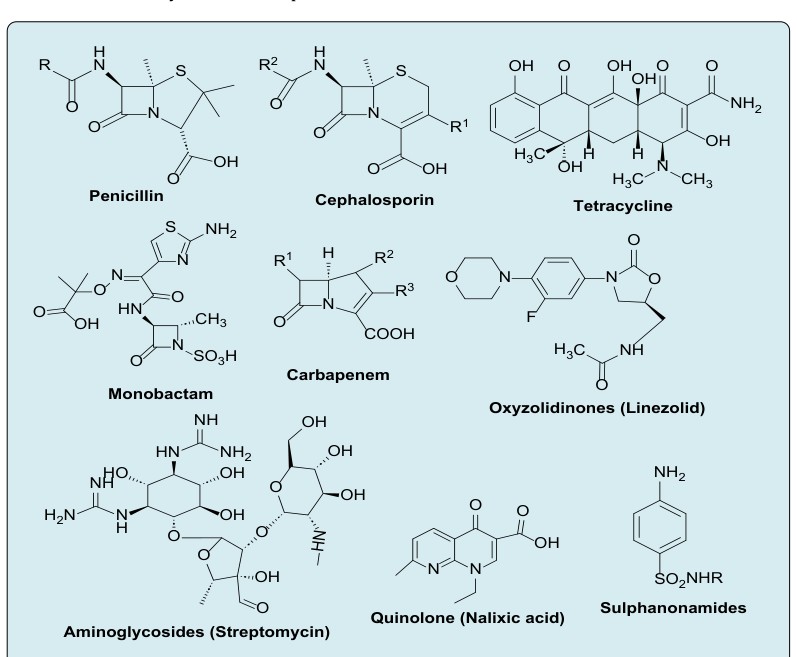
The first antibiotic, penicillin, was discovered and described by Alexander Fleming in 1929. These are beta- lactam compounds with additional ring side chains and a nucleus of 6-animopenicillanic acid (lactam plus thiazolidine). Penicillin G, Penicillin V, Oxacillin (dicloxacillin), Methicillin, Nafcillin, Ampicillin, Amoxicillin, Carbenicilin, Piperacillin, Mezlocillin, and Ticarcillin are among the members of the Penicillin class. Some of them such as ampicillin, carbenicillin and amoxicillin have been developed semi-synthetically with different side-chains [16]. Basically, penicillin kills bacteria through binding of the beta-lactam ring to DD-transpeptidase, which inhibits its cross-linking activity and prevents the creation of new cell walls [16]. Cephalosporins, another class of antibiotics, have a side chain with 3,6-dihydro-2 H-1,3- thiazane rings and a 7-aminocephalosporanic acid nucleus. The structure and way to action of antibiotics belonging to the cephalosporin class are similar to those of penicillin [17].
The emergence of beta-lactamase in bacteria conferred resistance against penicillin in later period then the demand of beta lactamase inhibitor were fulfilled by the discovery and development of clavulanic acid (isolated from Streptomyces clavuligerus), and thienamycin (isolated from S. cattleya) [18]. The ability of these antibiotics from the carbapenem group to withstand the hydrolytic action of the beta-lactamase enzyme gives them a crucial role in the battle against bacterial infections. Carbapenems are the most potent and have the largest spectrum of activity against both Gram-positive and Gram-negative bacteria among the several hundred beta-lactams that are known to exist [18]. They are hence sometimes referred to as “antibiotics of last resort” and are given to patients with infections when they become critically unwell or are thought to be carrying resistant germs. Tetracycline, Chlortetracycline, Oxytetracycline, and Demeclocycline are first-generation antibiotics in the tetracycline category [19]. Due to their semi-synthesis origins, members including doxycycline, lymecycline, meclocycline, methacycline, minocycline, and rolitertracycline are categorized as second generation. Third generation drugs include those made by complete synthesis, like tigecycline [18]. They specifically target the ribosome in bacteria with their antibacterial action. In this bacterial organelle, they obstruct the process of amino acids being added to polypeptide chains during protein synthesis.
Quinolone group antibiotics, which include ciproxacin, temafloxacin, sparfloxacin, nalidixic acid, enoxacin, and norfloxacin, are derived from the basic moieties’ quinolones and naphthyridones. They prevent bacterial DNA replication [20]. The compounds known as aminoglycosides, which are often composed of three amino sugars joined by glycosidic linkages, have a wide range of antibacterial action. Their ability to bind to a ribosomal subunit allows them to prevent bacteria from synthesizing proteins. Streptomycin, a popular antibiotic in this class, has been extensively used to treat Mycobacterium tuberculosis [18]. Another class of antibiotics, the sulphonamides continue to be an essential component of both human and veterinary medicine, having been the first class of antibiotics to be employed therapeutically [21].
They are widely used to treat a variety of infections, such as tonsillitis, septicemia, meningococcal meningitis, bacillary dysentery, and some urinary tract infections. They inhibit both Gram-positive and Gram-negative bacteria, including Nocardia, E. coli, Klebsiella, Salmonella, Shigella, and Enterobacter, as well as some Protozoa. Some other class of traditional antibiotics include Glycopeptides and Macrolides [22]. Linezolid is one of the synthetic antibiotics (oxyzolidinones) that was only recently approved for usage [23]. By attaching to the ribosomal 50S subunit's P site, they prevent the synthesis of new proteins. They are effective against a wide range of Gram-positive bacteria, including as anaerobes, vancomycin-resistant Enterococci, methicillin- and vancomycin-resistant Staphylococci, and penicillin- resistant Pneumococci.
Antimicrobial Resistance: The Greatest Challenge to Antibiotics
The pleasant era of lifesaving antibiotics is now facing a serious problem of resistance developed by pathogenic bacteria [20, 24]. As a consequence of selective pressure of use and misuse, the pathogenic bacteria, fungi, and other parasites have developed ability to resist the effects of antimicrobial drugs, rendering them ineffective in treating infections [25, 26]. New strains of multidrug resistant pathogenic strains have emerged as a consequence of various mechanisms viz. novel penicillin-binding proteins (PBPs), enzyme-mediated drug modification, mutant drug targets, increased efflux pump expression, and altered membrane permeability [26]. Antimicrobial resistance (AMR) is a global health challenge that has emerged as a consequence of the widespread use and misuse of antibiotics [24, 26]. Infections caused by resistant microorganisms are more difficult to treat, often requiring more expensive and toxic drugs, and leading to longer hospital stays and increased healthcare costs [27, 28]. The economic impact of AMR is also significant, with estimates suggesting that it could cost the global economy up to $100 trillion by 2050 if left unchecked [29, 30]. AMR is a critical issue that requires urgent attention and action for which the discovery and development of novel antimicrobial leads with broad spectrum functionality is the need of hour.
Conclusion and Future Perspectives
The scaffolds from nature are always of first choice for drug discovery because of their better compatibility with human biological systems. Although, the glorious entry of antibiotics from natural scaffolds in modern medical system has saved billions of lives by effectively controlling bacterial infections, the pathogenic bacteria, viruses, fungi, and other parasites have developed ability to resist the effects of antimicrobial drugs, rendering them ineffective in treating infections. Antimicrobial resistance (AMR), a global health challenge that include increased morbidity and mortality, prolonged illness, increased healthcare costs, and reduced productivity. In recent years, the computer-aided drug design (CADD) techniques such as molecular docking, molecular dynamics simulations, and quantitative structure- activity relationship (QSAR) modeling have a significant impact on the antibiotic drug design industry by enabling the rational design and optimization of new antibiotics with improved potency and selectivity. Since the natural scaffolds have always been found suitable for introducing chemical diversity, despite the grand success and numerous challenges, the traditional drug discovery process must be continued for the search of novel scaffolds of natural origin. Further, the innovative drug discovery program for the advent of efficient and cost-effective antibacterials with broad range of functionality may be shifted on virtual design of molecules taking a scaffold of natural origin to apply a multidisciplinary strategy of computational, synthetic chemistry, and biology for the development of novel antibacterials with better pharmacodynamics/pharmacokinetics (PK/PD) profile and high therapeutic index, preferably with a novel mechanism of action to combat the drug-resistance.
Conflict of Interest
There is no conflict of interest among the authors.
References
-
Upadhyay HC (2023) Exploring Nature’s Treasure for Drug Discovery. Lett Drug Des Discov 20(4): 373-374.
-
Upadhyay HC, Dwivedi GR, Darokar MP, Chaturvedi V, Srivastava SK (2012) Bioenhancing and antimycobacterial agents from _Ammannia multiflora_. Planta Med 78(1): 79-81.
-
Upadhyay HC, Sisodia BS, Cheema HS, Agrawal J, Pal A, et al. (2013) Novel antiplasmodial agents from _Christia_ _vespertilionis_. Nat Prod Commun 8(11): 1591-1594.
-
Upadhyay HC (2019) Medicinal chemistry of alternative therapeutics: Novelty and hopes with genus _Ammannia_. Curr Top Med Chem 19(10): 784-794.
-
Upadhyay HC, Saini DC, Srivastava SK (2011) Phytochemical analysis of _Ammannia_ _multiflora_. Research Journal of Phytochemistry 5(3): 170-176.
-
Harvey A (2000) Strategies for discovering drugs from previously unexplored natural products. Drug Discov Today 5(7): 294-300.
-
Harvey AL (2008) Natural products in drug discovery. Drug Discov Today 13(19-20): 894-901.
-
Lautié E, Russo O, Ducrot P, Boutin JA (2020) Unraveling Plant Natural Chemical Diversity for Drug Discovery Purposes. Front Pharmacol 11: 397.
-
Upadhyay HC, Thakur JP, Saikia D, Srivastava SK (2013) Anti-tubercular agents from _Ammannia baccifera_ (Linn.). Medicinal Chemistry Research 22: 16-21.
-
Saxena A, Upadhyay HC, Cheema HS, Srivastava SK, Darokar MP, et al. (2018) Antimalarial activity of phytol derivatives: in vitro and in vivo study. Medicinal Chemistry Research 27: 1345-1354.
-
Upadhyay HC, Singh M, Prakash O, Khan F, Srivastava SK, et al. (2020) QSAR, ADME and docking guided semi-synthesis and in vitro evaluation of 4-hydroxy-α- tetralone analogs for anti-inflammatory activity. SN Appl Sci 2: 2069.
-
Upadhyay HC, Dwivedi GR, Roy S, Sharma A, Darokar MP, et al. (2014) Phytol derivatives as drug resistance reversal agents. ChemMedChem 9(8): 1860-1868.
-
Mishra KN, Singh S, Upadhyay HC, Sanket AS, Kumar M, et al. (2023) Synergy Potential of Ursolic Acid-Based Hybrid Molecules. Lett Drug Des Discov 20(4): 469-478.
-
Upadhyay HC (2021) Coumarin-1,2,3-triazole Hybrid Molecules: An Emerging Scaffold for Combating Drug Resistance. Curr Top Med Chem 21(8): 737-752.
-
Kardos N, Demain AL (2011) Penicillin: The medicine with the greatest impact on therapeutic outcomes. Appl Microbiol Biotechnol 92(4): 677-687.
-
Wainwright M (1990) Miracle Cure: The Story of Penicillin and the Golden Age of Antibiotics. Blackwell publishers, John Wiley & Sons, Inc, USA.
-
Peach KC, Bray WM, Winslow D, Linington PF, Linington RG (2013) Mechanism of action-based classification of antibiotics using high-content bacterial image analysis. Mol Biosyst 9(7): 1837-1848.
-
Ebimieowei E, Ibemologi A (2016) Antibiotics: Classification and mechanisms of action with emphasis on molecular perspectives. International Journal of Applied Microbiology and Biotechnology Research 4: 90-101.
-
Parkes AL, Yule IA (2016) Hybrid antibiotics – clinical progress and novel designs. Expert Opin Drug Discov 11(7): 655-680.
-
Fair RJ, Tor Y (2014) Antibiotics and bacterial resistance in the 21st century. Perspect Medicin Chem 6: 25-64.
-
Orwa JD, Matofari JW, Muliro PS, Lamuka P (2017) Assessment of sulphonamides and tetracyclines antibiotic residue contaminants in rural and peri urban dairy value chains in Kenya. Int J Food Contam 4: 5.
-
Chiu C (2013) Definitions, classifications, and antibiotics. In: Rane A, et al. Urinary Tract Infection: Clinical Perspectives on Urinary Tract Infection, Springer, London, pp: 1-10.
-
Perlaza-Jiménez L, Tan KS, Piper SJ, Johnson RM, Bamert RS, et al. (2022) A Structurally Characterized Staphylococcus aureus Evolutionary Escape Route from Treatment with the Antibiotic Linezolid. Microbiol Spectr 10(4): e0058322.
-
Zaman SB, Hussain MA, Nye R, Mehta V, Mamun KT, et al. (2017) A Review on Antibiotic Resistance: Alarm Bells are Ringing. Cureus 9(6): e1403.
-
Maddocks S (2013) Antimicrobial resistance: Global problems need global solutions. Med J Aust 198(5): 241.
-
Yang YH, Buttery J (2018) Antimicrobial resistance: a global one-health problem for all ages. World J Pediatr 14(6): 521-522.
-
Morrison L, Zembower TR (2020) Antimicrobial Resistance. Gastrointest Endosc Clin N Am 30(4): 619- 635.
-
WHO (2020) Antimicrobial resistance.
-
Dadgostar P (2019) Antimicrobial resistance: implications and costs. Infect Drug Resist 12: 3903-3910.
-
Spellberg B, Bartlett JG, Gilbert DN (2013) The Future of Antibiotics and Resistance. N Engl J Med 368(4): 299- 302.
- Spectrophotometric Determination of Lanthanum (III) and Some Rare Earths with Xylenol Orange
- Introduction and Sources of Molluscicides
- Trimetazidine: An Antianginal Drug and Not Only!
- Fungal Biodegradation of Polycyclic Aromatic Hydrocarbons (PAHs)
- Recent Approaches of Impurity Profiling in Pharmaceutical Analysis: A Concise Review
- Next Generation Tools in mRNA Purification: The Role of Continuous Raman Spectroscopy Testing with Pretreatment of the Sample