
Bibliographical Analysis of Positivity: Approach to Optimal Functioning
When positivity is mentioned, it is referring to the phenomenon that includes positive emotions and actions that help people experience these emotions which promote the best in people. A bibliographic analysis of positivity was carried out, emphasizing the fundamentals of positive psychology, theoretical and practical contributions, as well as optimal functioning. Documents such as scientific articles and books were used. The analysis of the information was carried out through the signing technique. Starting from the review, it is necessary to empirically deepen the scope of positive emotions, as well as implement intervention tools aimed at optimal functioning.
Introduction
Positivity promotes the best in people and one way is the generation of positive emotions, for Barbara Fredrickson these emotions are conceived as forms of positivity which are joy, gratitude, serenity, interest, hope, pride, fun, inspiration, amazement and love, these forms of positivity have been the object of study independently, however it deserves the strengthening of the scientific field. It should be noted that just like Seligman; Fredrickson and Losada are interested in “human flourishing”; term used to refer to optimal functioning, which goes hand in hand with kindness, creativity and resilience. To flourish is more than the absence of pathology, it includes the presence of positive functioning [1].
Fredrickson indicates that some people do not flourish, but decline, feeling that their lives are empty. On the other hand, that person who flourishes experiences extraordinary levels of psychological and social well-being; they also tend to do well to others; they are committed to the world, to their families and to their work. They have a goal, they share and celebrate what is good [2]. It is important to highlight that well-being is not only about psychological factors; it depends on economic development and the proper functioning of social institutions as well as the communities from which we come.
Foundations of Positive Psychology
Positive psychology is the science that emphasizes the understanding and construction of the most positive qualities of the individual: optimism, courage, work ethic, interpersonal skills, the ability to experience pleasure and social responsibility. It is focused on optimism, gratitude and creativity, as well as humour, goal setting and achievement, spirituality, optimal experiences, values and character strengths, transcendence and resilience [3]. The literature presents two forces, traditional psychology vs. positive psychology, the first is focused on psychological suffering and mental illness, while the second focuses on psychological well- being and maximum development; In order to understand these fields, it is necessary to pay attention to the historical line; Before World War II there were three missions, to cure mental illness, to help people lead productive and fulfilling lives, and to identify and promote talent, but after World War II in 1946, the Veterans Administration was created: charged with treatment of mental illness and in 1947, the National Institute of Mental Health was founded: study of psychopathologies; paying attention to only one of the missions of psychology: to focus on psychopathology [4].
As time progressed, a field emerged that provided balance to that traditional psychology, where the study of subjective well-being, happiness, flow (positive experience) became necessary; positive individual traits (positive individual); positive communities (positive societies) [5]. Hence, the objectives of positive psychology are to strengthen potentialities; investigate psychological and subjective well-being; identify measure and promote well-being in individuals, groups and societies and have scientific rigor [4].
Positivity: Theoretical and Practical Aspects
Positive Emotions vs. Negative Emotions
An ingenious way to evoke positive emotions was the experiment by Fredrickson where a group of university students, doctors and adults were presented with a variety of funny videos and offered sweets, the experiment resulted in: improvement of concentration and short-term memory, better results in verbal tasks, visual attention and verbal creativity. This experiment was a sign that people who evoke more positive emotions in their lives can have improvements on a personal, family and social level [1]. Fredrickson and Cohn’s theory of expansion and construction of positive emotions reinforces the experiment; the presence of positive emotions and their production, provides the ability to generate new thoughts, activities and relationships, as well as the construction of lasting personal resources such as social support, resilience and knowledge, in the same way it is reflected in health, survival and plenitude, this theory is conceived as an ascending spiral [6].
The Four Positive Emotions: happiness, satisfaction, interest and love, were transformed into ten forms of positivity, the same one that promotes the best in people. The investigations carried out on the forms of positivity were studied from an independent point of view, where the object and method were varied.
Optimism versus Self-Esteem: Implications for clinical psychology and psychotherapy [7], the target population was 309 university students (non-clinical), between 18 and 25 years old. Differences were sought between optimistic and non-optimistic subjects, in negative variables (Depression, Anxiety) and positive variables (Satisfaction with life, Happiness and Self-esteem). It was concluded that there are significant differences for the negative variables. Regarding the positive variables: significant differences for satisfaction with life and happiness. The optimism variable stands out in relation to the other variables. The self-esteem variable does not appear as a relevant one. The use of optimism and other positive variables is recommended as tools for psychotherapy and clinical interventions.
Positive Emotions: their importance in the framework of mental health promotion in childhood [8], whose objective was to identify, promote and strengthen psychological resources such as positive emotions that can act as protectors of mental health within the framework of a health promotion program. The relationship between the experience of positive emotions and cognitive flexibility to solve interpersonal problems is highlighted, contributing to the achievement of social skills in childhood. Spanish translation and psychometric properties of the Positivity Self-Test instrument [2], a study conducted with 383 students from the School of Nursing and Obstetrics of the National Autonomous University of Mexico. The objective was to translate, adapt, validate and determine the reliability of the Fredrickson positivity self-test on the internet. It was concluded that the Mexican version of this test has adequate psychometric properties for measuring positivity in Mexican university students.
Optimum Performance: Bloom
Fredrickson and team in 2009 argued that people who flourish and function optimally have one thing in common; they experience more positivity than negativity in their daily lives. Mihaly Csikszentmihalyi (optimal experiences or flow, creativity, development of talents and well-being at work), Christopher Peterson (strengths and virtues, positive interpersonal relationships and optimism), Edward Diener (study of happiness and subjective well-being and life satisfaction), Barbara Fredrickson (psychophysiology of positive emotions and their role in human flourishing), Martin Seligman (character strengths and the virtues) [9] they provided contributions to psychology giving it a positive connotation and in turn trying to generate its functioning in the person. One of the tools for this purpose are stories, the same ones that have an impact on the person and how they express their emotions, thoughts and relate to others.
Dominant Story vs. Alternative History
In narrative therapy, stories are emphasized as an effective tool to evaluate and propose changes in the person when they are the protagonist of a “negative” event, the dominance of the story and the alternative is analysed as a means to realize possibilities previously “unseen” by the person and that he leaves aside, acting and feeling only in relation to the story that has the greatest strength in him (Figure 1).
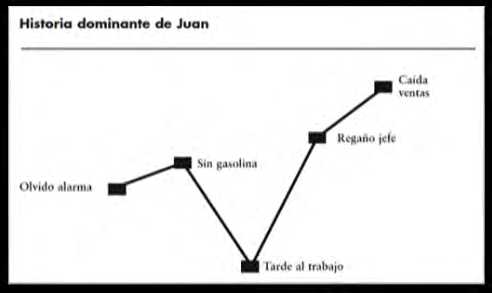
Fountain. Margaret Tarragona. Your best you Figure 1: Juan’s Dominant Story Graphic Case.
Storytelling as a Therapeutic Medium, Here are Two Main Sources
Happily Ever after
The Use of Stories to Promote Positive Interventions [10]. A proposal is made that the stories be used more frequently as a vehicle to demonstrate and encourage the use of positive interventions. The story should be an example of a positive intervention in action, be a personal narrative, activate empathy and commitment, be nuclear in the sense that it reflects a high or low point, a beginning or an end, be a positive version of the self that others can relate to within the culture, to be a reflective and redemptive self that has the bow of tragedy to triumph.
Positive Psychology and Constructive Therapies
An Integrative Proposal [6] why and how positive psychology and constructive therapies can be integrated and mutually enriched in therapeutic practice. “Constructive” therapies, including solution-focused, narrative, and collaborative therapy, focus on building on exceptions to problems, inquiring about clients’ strengths and resources, and assuming that people want have good relationships and fulfilling lives (Figure 2).
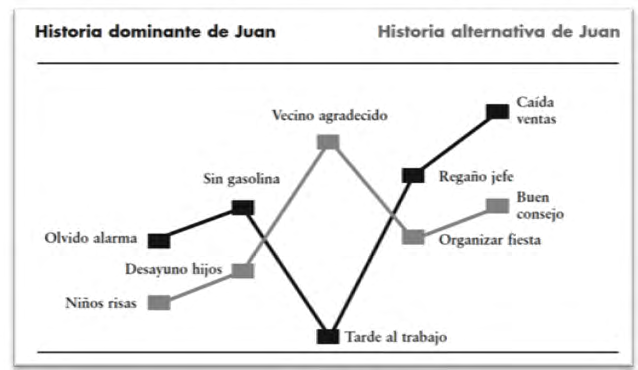
Fountain. Margaret Tarragona. Your best you Figure 2: Juan’s Dominant and Alternative Story Graphic Case.
Positive psychology is generating expectations for the recognition of the potentialities of the person, where optimal functioning will be the product of the generation and development of positive emotions and therefore a good state of mental health and integration of the person into his community.
Conclusion
Positive psychology emphasizes the evaluation of positive emotions, salugenic aspects, considering the scientific method. Experiencing positive emotions will allow the construction and strengthening of personal resources, promoting a healthy and positive development, translating into an indicator of mental health. Optimal functioning will be related to having an involved life, experiencing positive emotions and identifying strengths and abilities, which should be enhanced. Narration as an intervention tool is effective in the search for optimal functioning, being a means of recognizing emotions, thoughts and relationships with others.
References
-
Margarita T (2014) You better yourself. How positive psychology teaches you to underline the experiences that strengthen your identity. Madrid.
-
Guzmán LGC, Gom SB (2013) Spanish translation and psychometric properties of the Positivity Self Test instrument. Psicol Iberoam 21(1): 53-64.
-
Contreras F, Esguerra G (2006) Positive psychology: a new perspective in psychology. Diversitas: Perspectives in Psychology 2(2): 311-319.
-
Perugini MLL, Solano AC (2010) Positive Psychology: Analysis since Its Emergence Positive Psychology: Analysing Its Beginnings. Psychological Sciences 4(1): 43-56.
-
Seligman MEP, Csikszentmihalyi M (2000) Positive psychology: An introduction. Am Psychol 55(1): 5-14.
-
Tarragona M (2013) Positive Psychology and Constructive Therapies: An Integrative Proposal. Psychological Ter 31(1): 115-125.
-
Villarroel PV, Rubio NC (2009) Optimism versus Self- esteem. Revista Argentina 18(1): 21-30.
-
Greco C (2010) Positive emotions: their importance in the framework of mental health promotion in childhood. Liberabit 16(1): 81-93.
-
Bolaños RED (2017) Positive psychology: A new approach to the study of happiness. Reason and Word 21(1): 21.
-
Tomasulo DJ, Pawelski JO (2012) Happily Ever After: The Use of Stories to Promote Positive Interventions. Psychology 3(12): 1189-1195.
- Systematic Review and Meta-analysis Investigating the Prevalence of Depression, Anxiety, Loneliness and Help seeking among International Students
- Family Experiences and their Interpretations as a Source of Adaptive Behaviour in Young Adults: A Qualitative Model of Adaptive Behaviour
- The Development of Responsibility in Teenage Mothers: A Qualitative Model
- Post-Truth Reality: Worldwide Infodemia and Mental Health Concerns during and Post COVID-19 Pandemic Scenarios
- Psycho-Emotional Rehabilitating Means of Overcoming Extreme and Stressful Impact
- The Paradox of Humbleness, Arrogance and the Concept of Fluid Individuality