
Intragender Violence: An Approach from LGBTIQ+ University Students in Chile
Intimate partner violence has been extensively studied in the Latin context and in Chile, however, these do not distinguish between heteronormative relationships and those belonging to the LGBTIQ+ community, which is why the latter are invisible, which is why this study aims to understand the specific characteristics of how young LGBTIQ+ university students in Chile experience intragender violence, identifying its main manifestations and consequences. The research has a non-probabilistic sample of nine participants, who correspond to six women and three men between 18 and 31 years old, who participated in a semi-structured individual interview and/or in a discussion group conducted online, this being a qualitative study guided by the constructivist grounded theory. Among the main results found, it is reported that psychological violence is one of the most experienced by the participants, followed by cyber violence and sexual violence, in addition, other findings show that perception and social pressure are possible triggers of intragender violence, Thanks to this, it is possible to identify the low representativeness in terms of the LGBTIQ+ community and age ranges, so it is proposed to expand the sample for future research, in addition to this, other topics such as the experiences of having a diagnosis of STD in an intragender relationship should be investigated.
Introduction
Studies whose main theme is intimate partner violence and its consequences have had significant growth in recent years, however, these inquiries focus on heteronormative relationships, making invisible those couples made up of people belonging to the LGBTIQ+ community [1], considering in turn that these investigations are carried out more frequently in Anglo-Saxon and not Spanish-speaking countries [2], leaves between seeing the lack of information on the subject and the limited access to representative figures of intra-gender violence in the community, glimpsing the discrimination and homophobia that exists worldwide, despite the fact that homosexuality was eliminated more than forty years ago from the list of mental illnesses of the American Psychiatric Association (APA), promoting development in terms of rights and freedoms in the LGBTIQ+ community [3], currently yes However, according to ILGA [4], 35% of countries still criminalize sexual acts between people of the same sex, which causes constant stress in the community, known as minority stress [5], originating from various social sources, such as; acts of discrimination, sexual prejudice, concealment of identity and sexual orientation, causing in the community and in discriminated people a greater effort for their adaptation and acceptance compared to other social groups [6].
In Chile, approximately in the 1990s, awareness of homophobia began, thanks to research carried out by the National AIDS Commission and civil society organizations around homosexuals and bisexuals, in addition, at the end of the year 2000, the results of the first national survey of sexual behavior are published, in which, for the first time, the prevalence of this population in the country is visualized (CONASIDA [National AIDS Commission] and ANRS [7]. Today, there are some laws that protect the rights and interests of the LGBTIQ+ community in Chile, such as; Zamudio Law, Gender Identity Law and the Civil Union Agreement, which have meant great progress and development in the social field, however, there are still shortcomings and issues to address, which are present in projects against homophobia and transphobia, projects on family and adoption rights, projects on the custody of homosexual mothers and fathers, projects on LGBTIQ+ children and adolescents, among others (MOVILH) [8].
Likewise, there is a deficit of public policies and laws that provide support to LGBTIQ+ people when they are in violent affective relationships, since according to some figures exposed in the ninth national survey of youth of the INJUV [9], It is revealed that 2.1% of the population declares that they maintain a homosexual relationship, stating that psychological violence is among the most experienced types of violence with 12.5%, followed by physical violence with 6.1%, economic violence with 4.2% and finally cyber violence with 3.0%. Results that are consistent with other studies carried out specifically with young homosexual couples where it is noted that 84% of the participants experience violence in their relationships, 80.5% experience psychological violence, 31.2% physical violence, and a 48.8% sexual violence [10], showing that it is a problem experienced by the LGBTIQ+ community that is going unnoticed by national events, requiring greater visibility, legislation and prevention.
That said, it is necessary to specify some concepts that revolve around research, starting with the LGBTIQ+ community, which refers to the group that represents sexual diversity, whose acronym alludes to; L, lesbian, is female homosexuality, that is, the affective-sexual attraction that one woman feels for another; G, gay, is male homosexuality; B, bisexual, refers to the affective-sexual attraction towards more than one gender and/or sex; T, trans, corresponds to all those people whose gender identity or expression differs from social expectations based on the sex assigned at birth; I, intersex, people born with both physical sexes; Q, queer, are those people who reject the binarism of woman or man and the roles that this entails; +, includes the rest of the identities and sexual orientations with which a person can identify, in view of this it is important to clarify that the acronym does not include all the identities and/or sexual orientations, therefore, it is continuously evolving [3].
The community is constantly affected by discrimination linked to heterormative patterns imposed by society, an example of this is the invisibility of violence in same-sex couples, since compared to heterosexual couples, this is an emerging issue [11], which is why this study aims to find out about intragender violence in love relationships in LGBTIQ+ people, (mentioned that due to the characteristics of the sample, the study is composed only of lesbians, gays and bisexuals), according to Robles A, et al. [12], violence in same-sex couples occurs when there are violent behaviors that are characterized by the position of power of one of the members of the couple, whose objective is control, coerce, dominate and/or isolate the other. In addition, it can be exercised psychologically, physically, sexually or materially, episodically or continuously, varying in frequency and intensity and may vary in levels of damage.
According to Park S, et al. [13], intimate partner violence is that which occurs in love relationships (courtship), which is characterized by controlling, aggressive and abusive behaviors, which in turn can manifest themselves in ways; physical involving any type of act directed towards a person to cause damage or pain through blows, pinches, kicks, among others; psychological corresponding to the manifestation of any action that intends to control, isolate, humiliate, devalue and belittle a person and/or; sexual being this any non- consensual or forced act directed towards a person (victim) to satisfy sexual desires or needs of the aggressor [14]. Another manifestation of violence within the couple is cyber violence, in which the perpetrator seeks to gain access to the devices and accounts (of social networks) of the victim, harassing her through messages or calls, sometimes creating accounts false or threatening to share private information and thus maintain control over the other [15].
There are some expressions of partner violence that are shared by both heterosexual relationships and LGBTIQ+ relationships; however there are others that are only expressed within intragender violence. Ortega A [16] defines this as the abuse that occurs over sexual identity, in which sexual orientation is used as a method of control over the other person, based on stereotypes that explain what a person who belongs to should be like. community; In turn, there is the term forced outing, which according to Ortega A [16] consists of having the intention of revealing the sexual orientation of the partner without their consent or threatening to “take him/her out of the closet”. ”; either before her family or social circle, in addition to making fun of him or her for not being able to expose her sexual orientation.
Methods
Design
The present study, whose main objective is to understand how LGBTIQ+ university students in Chile experience intragender violence, also identifying its manifestations, describing the way of experiencing it and its consequences, corresponds to a qualitative research, governed by the design of the grounded theory with a constructivist perspective, since it promotes the integration of the subjective experience of the researcher and the social conditions of the object of study, placing special emphasis on the latter, which is also called a phenomenon. This approach is characterized by seeking interpretive representations of reality, which will vary depending on the environment and context [17].
Participants
The sample used is of a homogeneous non- probabilistic type, since the participants must have certain characteristics required by the research [18], reflecting this in the corresponding inclusion criteria; maintain permanent residence in Chile, be a university student and have maintained at least one love relationship with someone of the same sex. In this way, the sample was made up of nine university students from three regions of the country (Maule, Ñuble and Bío Bío), who correspond to six women and three men. Table 1 summarizes the main sociodemographic characteristics of the participants who were approached. On the research:
| Sex (Assigned at Birth) | Age | Sexual Orientation | Relational State | Age 1st LGBTIQ+ Relationship |
|---|---|---|---|---|
| Woman* | 21 | Bisexual | In a relationship | 15 |
| Woman * | 22 | Lesbian | In a relationship | 15 |
| Man* | 24 | Gay | In a relationship | 18 |
| Woman * | 24 | Bisexual | In a relationship | 20 |
| Man ** | 18 | Bisexual | Single | 17 |
Table 1: Characterization of the participants.
Note: *Participated in the in-depth interview; Participated in the focus group; *Participated in both activities. Source: self-made. Table 1: Characterization of the participants.
Instruments
In the first instance, a self-applicable questionnaire was carried out through Google Forms to collect sociodemographic information from the participants, which consists of seven items divided into topics related to personal, academic, socioeconomic, relational, and health background; plus a section for opinions, suggestions and means of contact, thus providing important information to understand the personal and social context of the participants, in addition to providing the general guidelines to see if they met the inclusion criteria.
In turn, a semi-structured interview guideline was developed, addressing topics related to the manifestations and consequences of physical, psychological, sexual violence, cyber violence and forced outing in LGBTIQ+ couple relationships. It is worth mentioning that before its application and to ensure validity and consistency, the instrument was reviewed and provided feedback by two experts on the subject, who have carried out various qualitative researches on intimate partner violence, gender stereotypes and violence gender, among others. Finally, the interviews were applied individually to each and one of the participants online through the Zoom platform. This instrument was divided into five parts contemplating some questions such as those shown in Table 2.
For the development of the focus group, a semi- structured guideline derived from the information obtained in the interviews was created again, which is framed in three large topics, the first corresponds to the manifestations and consequence of intra-gender violence in LGBTIQ+ youth, the second to family and socio-community factors and the third to socio-sanitary factors (Sexually Transmitted Diseases [STDs]).
| Topic | Questions |
|---|---|
| Exploratory questions | At what age was your first relationship with someone of the same sex? |
| How could you characterize that relationship? | |
| What does relationship seem to have meant to you? | |
| Introductory questions | What types of violence do you know? How would you define them? |
| Do you keep or did you keep your sexual orientation a secret? For how long? | |
| Questions about violence | Has your partner ever hit you, pushed you, or done something similar? |
| Has your partner ever made fun of you or made you feel slighted? | |
| Has your partner ever pressured you and forced you to have sex? | |
| Has your partner threatened to tell you about your sexual orientation to try to control you or get some benefit? | |
| Questions about violence´s effects | What repercussions from the physical sphere do you think existed in you after this episode of violence? |
| Close question | What changes do you think existed in you after experience the episodes of violence that you mentioned earlier? |
Table 2: Semiestructured Interview examples.
Note: The questions correspond only to references, since at the time of each interview others were elaborated or these same ones underwent modifications. Source: self-made. Table 2: Semiestructured Interview examples.
Process
To begin the search for participants, videos and posters were made that were disseminated through social networks and emails from the researchers, before which, the interested parties had to fill out a sociodemographic file where some personal and social data were collected, later they were contacted via email or social networks, mainly WhatsApp and Instagram (means that the participants themselves provided), to invite them to the interview or focus group and send the informed consent, in which the objectives of the research and all those criteria are explained. Corresponding ethics such as; that the activities would be recorded and later transcribed, voluntariness (the participant could leave the research or refuse to answer any question if they so wished), protection of identity (in the focus group the possibility of keeping the camera turned off) and the contacts of the researchers.
Thus, between the months of August and September 2021, seven interviews were carried out through the Zoom platform, which had an average duration of between 1 hour and 1 hour 30 minutes. Likewise, in early November of the same year, a focus group was held on the same platform, which had five participants and lasted approximately two hours. Parallel to the aforementioned, the researchers transcribed the interviews in their entirety to later be entered into the Nvivo software and perform the corresponding analysis.
Data Analysis
An analysis of the qualitative content was carried out, based on the review of the information obtained in the interviews, focus group and their respective transcripts, in this way a panorama as broad as possible is ensured to identify the categories or patterns present in the different narratives, also seeking relationships between the stories and thus guaranteeing a constant comparative analysis between them, intending to refine and/or elaborate emerging categories and subcategories until theoretical saturation occurred and no more new or relevant data for the investigation emerged [18].
To carry out the aforementioned, the Nvivo analysis software version 12 was used, since it allows data to be stored and encoded by importing documents and files, adapting to the needs of the Grounded Theory [19]. In this way, the first step was to import the transcripts made into the Nvivo software, which were reviewed by each of the researchers and transferred verbatim from the audios obtained from the recording of both the focus group and the interviews, then an open coding where general codes were identified which gave way to the creation of categories referring to manifestations, consequences, way of experiencing and other findings.
Results
As mentioned above, there are four closely related categories: violent manifestations, consequence of violence and way of experiencing violence through experience and inexperience, which in turn are divided into subcategories. Next, each one of them will be described, exemplifying them with direct quotes from the interviews and focus group. In addition, to finish, other findings that can lead to intra- gender violence, such as perception and social pressure, will be announced.
Violent Demonstrations
According to the participants, intra-gender violence in the couple can be defined as any action that damages and puts at risk the physical and psychological integrity of another, through physical, psychological and/or sexual violence, as exemplified below: I understand violence as all kinds of aggression, be it verbal, physical, any aggression that invades the space of another person and not just the space, such as the interior of another person, that is, the fact of manipulating a person noo, I find it a horrible violence and not necessarily beatings (...) (Man, 24 years old) As a violation of the integrity of the other, whether in the psychological or sexual physical field, anything that could harm another person (Woman, 22 years old) (...) something that starts very small and ends very big and is something that is present in almost all the relationships that I have had as a couple and it is something that kills you, good for you, can kill you and consumes you, changes you and it is something that no one should experience again (Woman, 21 years old) Physical violence is understood as any action with the purpose of damaging the other’s body, which implies violent contact with the partner, such as pushing, squeezing, kicking, hitting, among others, being defined and experienced in this way. Shaped by the participants.
(...) like any action that occurs physically, aggression, pushing, everything that implies physical contact between the couple that occurs violently (...) once when my partner, since I was angry, I asked him to leave me alone, but she didn’t want to leave me alone and that’s when the situation escalated, I didn’t hit her, but I did take her by the arms and that for me is violence, I took her and out of rage, one should never come into contact with another person like so to speak, if you’re angry no, no, then eeeh, that sense, I did incur violence and I was a victimizer (Female, 22 years old) (...) just erm, I don’t know about physical violence cachai1, like ehh, ehh blows, squeezes, shoves, etc. (...) shoves and other things suddenly, arguing, not in order to go and push me as if from the front, but, but if it is going to be on the side abruptly and throw myself to the side (Female, 22 years old) (...) I remember we were arguing, I had to go, it was night and she tried to hit me like I raised my hand, she was going to hit me and she retracted and she kind of hugged me and it was like a scene from a toxic movie romantic (…) (Female, 21 years old) Regarding psychological violence, it is understood as that in which it is intended to maintain control over the couple, expressing itself through manipulation, low empathy, jealousy, teasing, contempt, among others: (...) as manipulation, the degradation towards the partner and him or her, as the bad vibes towards the other person, make him less, control him too, things like that obviously, sometimes since they are not physical, I don’t know they notice or sometimes go unnoticed (...) psychologically it was a somewhat toxic relationship as not so much in manipulations, but in these things of “you can decide now, how so indecisive” or how today I want to be with you, tomorrow No, but I keep you there and he manipulated you into staying with me, even though I don’t want to be with you and want to be with other people. (Female, 22 years old) Psychological violence can come across in various forms, it can lead to manipulation and low empathy, that there is not much emotional responsibility in the couple, cause emotional dependence in the relationship, have little trust and (...) for example with that couple a lot of what happened she would get annoyed, for example, aah she was very jealous, she was jealous so sometimes she would talk to a man x it could be a friend, it could be her friend’s boyfriend or a salesman and it bothered her a lot, yes it bothered her a lot. (Male, 25 years old) Sexual violence, on the other hand, is reported as any non-consensual act in the sexual sphere and/or the pressure exerted on the partner to have intimate relationships, which can lead to rape, such as: Well, sexual violence, assaults in the sexual sphere, such as forcing against the consent of the partner to have relations or doing something that, perhaps, something sexual that he does not want, ehh perhaps also saying things to him, but in sexual terms, but everything without the consent of the other person when it has already been transgressed like that line of this is where it is consented and they pass that already in the sexual sphere it would be like sexual violence. (Female, 22 years old)
1 chilenism mean ´you know´
(...) as I was telling you, the context was that I was sleepy at a party with his friend in Cobquecura, so I went to bed, but he stayed at the party, but afterwards he, like he was very waiting to be intimate, then he told me that later he was going to wake me up, so when he later came to my bed and went to bed eemh there he wanted to be intimate with me, since I’m already there, he’s sleeping and in the end it was more for him, because I was obviously sleepy, I was sleeping. (Male, 25 years old) (...) I never knew if it was a lie or if it was true, but the thing is that he raped me (...) but we were lying down and as always, we always spent a lot of time lying down and he sort of got on top of me, I was telling him, of course, we were talking about what had happened before and and and like he started making fun of me and he got on top of me and he says, what if he raped you again and I was petrified eh and like he kept playing with this and it was going to be the act and I go and bite her nose and it leaves her bleeding and then she starts screaming (…) (Woman, 21 years old). In addition to the violence already mentioned, which arose from the participants themselves, evidence was found of manifestations of cyber violence and forced outing, which, although they did not emerge a priori when asking about the types of violence in the couple, if they were identified in the accounts: (Referring to cyber violence) (...) until when I realized that he was getting into my social networks and I already found that it was the last thing, even long after the term (...), that is, getting into your social networks , at that time Facebook and talking to people pretending to be you and generating conversations (...) ended up blocking me on Facebook and of course, he got in when he wanted to know about me and then he unblocked me again, until I found out in a moment and then I blocked it for the rest of my life (...) (Woman, 31 years old) (Referring to cyber violence) (...) how would you say it happened on multiple occasions and in different ways, I took someone’s cell phone to check it because I wanted to know if they were shitting me, just toxic, ehh they did the same with me, they searched my cell phone without my consent, they search me, what’s their name, when they watch you, when they’re next to you the same, then in multiple ways, it’s happened to me that they search my cell phone, even when I lend it as for an action and then I go back to look for it on my cell phone and I see that they are looking at photos, for example, looking at the chats like “hey, I lent it to you so you could call on the phone, not so you could check my things.” (Male, 24 years old) (Referring to the forced outing) (...) yes, but not with, not with doing as such, not with threatening me that they were going to do something, but that they would do something to me, it was like the option “or tell your parents, I mean, your mom, or we’re done” and I was like “no, I’m not going to tell her, because I’m not ready yet” and we were done (...) (Man, 24 years old) (Referring to the forced outing) The benefit was to continue with him, because he told me that, practically if I didn’t tell him, he couldn’t project himself with me and obviously it would be a reason to end the relationship (...) (Male, 25 years old) Next, Table 3 is presented, in which the main violent manifestations exposed by the participants are collected according to each type of violence:
| Manifestations of violence | |
|---|---|
| Physical violence | Excessive use of force - Hair pulling - Pushing - Squeezing - Shaking - Hitting |
| Psychological violence | Invalidation - Contempt - Humiliation - Insults - Yelling - Jealousy - Teasing - Indifference - Manipulation - Lies - Image control - Disqualifications - Control - Little empathy - Ignore emotion - Ghosting* |
| Sexual violence | Rape - Sexual coercion** - Aggressive sexual relations - Sexual acts without consent |
| Cyber violence | Ignore messages - Cell phone review - Control of social networks (RRSS) |
| Forced outing | Threats and manipulation around the disclosure of the partner's sexual orientation |
Table 3: Violent demonstrations according to participants.
Note: *Ghosting, is understood as ceasing communication without prior notice. Sexual coercion refers to the pressure exerted on the partner to have sexual relations. Source: self-made. Table 3:** Violent demonstrations according to participants.
Consequences of Violence
The main consequences reported by the participants and that go hand in hand with the manifestations of violence experienced, were categorized in different areas; personal, social, academic and relationship. The personal sphere refers to all the repercussions that the person himself presented, either with himself/herself or to relate to others, such as, for example, insecurity (in himself/herself), devaluation, emotional instability, demotivation, feeling of guilt and distrust in the other. On the other hand, it was reported that, thanks to certain lived experiences, personal growth was achieved. In addition, it was identified that the consequences in the personal sphere could influence the rest of the spheres.
(...) I was very depressed, it was hard for me to get out of bed and I cried for hours for her, I stopped doing many things that I liked, because I didn’t have the courage, I remember that and it, the only thing I remember is lying on the bed bed or on the couch, like that, looking at the ceiling was what she did eh and that, more than anything, very insecure, very insecure of who she was, very insecure of the relationship she was in, unsure of where to go and how to do it . (Female, 22 years old) The social sphere includes all those consequences experienced by the participants, in terms of their interactions and dynamics shared with their close environment, such as the family and group of friends, being affected when generating new relationships, seeking help and establish relationships of trust, manifesting itself in social isolation; On the contrary, from a more positive perspective, some participants managed to strengthen those significant relationships, finding in their friends an important support network when experiencing intra-gender violence.
(...) finally both things happened to me that I isolated myself and at the same time I didn’t have the confidence to tell my friends what was going on. (Female, 31 years old) (...) I began to value my social circle more, ehhmm that it was quality time and that they were true friends, um and that I had a very large support network, so I began to have more relationships with them (...) (Man, 25 years old) In the academic field, poor university performance is reported due to the high demand for time that the partner of the participants supposes and/or the lack of motivation to study, which in turn generates low grades.
(...) more than anything, it consumed a lot of personal time to be able to be with her and it was time that I also lost to study, so since I had less time to study, sometimes I couldn’t read everything I had to read for tests or Sometimes I was studying the night before and she spoke to me there, it would be with some problem, I stopped studying and put aside my studies to see her needs or even sometimes I also missed a little class, to make some plan with her , that kind of things. (Female, 24 years old) Finally, the area referring to the relationship alludes to all the problems that the couple faced after a manifestation of violence, which are mainly mistrust, arguments, insecurity, breakdown of the relationship, ending and resuming the relationship and in some cases the boundary creation.
(...) after that we were able to talk for a while, but not her, from then on the relationship changed a lot and it was obvious that she did not have much confidence in me, so the relationship lasted a few more days after that incident. (Female, 24 years old)
Way of Experiencing Violence
The way in which the participants lived and perceived their experiences of intragender violence in their love relationships was subdivided into two categories: inexperience and experience. Inexperience is identified as immaturity, since most of the people present in the study report that the first relationship with someone of the same sex that they had was where the manifestations of violence were mainly present, being related in turn to self-discovery, given because thanks to this first relationship they began to discover or clarify their sexual orientation, this is established because seven of the nine participants stated that they had previously established a heteronormative relationship, for which internal conflicts arose when they did not understand why attracted to someone of the same sex.
(...) I entered into a relatively formal relationship, eh, it lasted a year, with a woman after that I didn’t feel as straight attracted to women and I went straight into a relationship with a man, a friend (...) (Man, 18 years old) (...) As I told you, I was quite a girl with no experience, I had only had a swag once before and I also had experience in terms of knowing myself, I didn’t know myself as much as I thought (...) (Woman, 22 years old) Regarding the experience, most of the participants obtained it from the first relationship, generating personal growth and creating limits for future relationships, however, some people report that they suffered the same violence in more than one relationship, before it it is concluded that the experience is acquired over time, with personal reflections, identifying the ill-treatment exercised or suffered and requesting the help of third parties such as support networks and health professionals, so as not to naturalize certain behaviors and attitudes that originate from the violence.
(...) As for the aspect of being able to recognize this abuse, so to speak, and no longer allow it with another person to set that limit, I think that, well, at least it taught me something that I don’t want in a relationship (...) power relate more healthily, knowing that I am not going to put up with things like this happening to me again, nor am I going to be a person who is going to cause harm to another person, because if at a certain point one also causes harm (...) (Woman , 22 years).
Other Findings that Favor Intragender Violence
Linked to the aforementioned self-discovery, there is social pressure, since sometimes it is society itself that forces LGBTIQ+ people to define themselves or, as stated in the research, “to put on a label”, making the discovery process even more difficult. and personal acceptance, added to this, social perception is identified as another factor that pigeonholes certain groups in the community, as is the case of bisexuality, which is seen as a process of definition rather than an orientation as such, being strongly discriminated against and sexualized by society (regardless of sexual orientation).
(...) I always try to tell them how, no, no, not because I’m bisexual, I want a cachai threesome, how please, just try not to do it and not to propose it, in that case you are going to propose it or some photos, what either in, at a time as chord or consensus, but not always because I say I’m bisexual “hey let’s have a threesome” (...) (Woman, 22 years old) Sexually transmitted diseases (STDs) and the concealment of these in couple relationships is a problem that, according to the participants, is accompanied by a deficit in access to information by the social environment, which favors the creation of Prejudices regarding STD diagnoses, in turn also low communication and trust in the couple often means not performing preventive tests or not disclosing their results.
(...) well, it had been a year, obviously there was sexual intercourse, ehh, after that, since we were both, quite good in the area of health, eh we went to the doctor, we did tests (...) I went to my home town , and he stayed alone for several months (...) while I was not there, it was a party, and, but at the party he had, he hooked up with someone and had a one-night stand and everything, and I told him already no, it’s good that you tell me, eh I understand everything, but did you take the exams? and he told me, I’m not going to do it tomorrow, eh, we went the other day and he was diagnosed with herpes (...) (Man, 18 years old) (...) well, as the person in charge, I showed my tests from the, from the laboratory, that I did not have any sexually transmitted disease and he verbally told me no, but I never saw a test in hand and well, later, with him time I trusted his word, so we never used an external condom for the relationship, but in the end and talking to the person and gaining more confidence, I rebelled that he was a carrier of HIV and had AIDS (...) in the end he betrayed me trust because it is something super serious, it affects health (...) (Man, 25 years old) Based on the reports, it is concluded that the violence in the LGBTIQ+ couple that is most experienced is psychological, manifesting verbally and non-verbally (with attitudes), followed by cyber violence, taking place mostly through the control of social networks and the content that is shared in them, later sexual violence is found, which is exerted mainly through pressure to maintain intimate relationships, in terms of physical violence it was identified to a lesser extent compared to the previous ones and the outing forced was only identified by two people. Next, in Figure 1, a summary diagram of the main results obtained is shown. For more details, you can review the semantic network in Annex A.
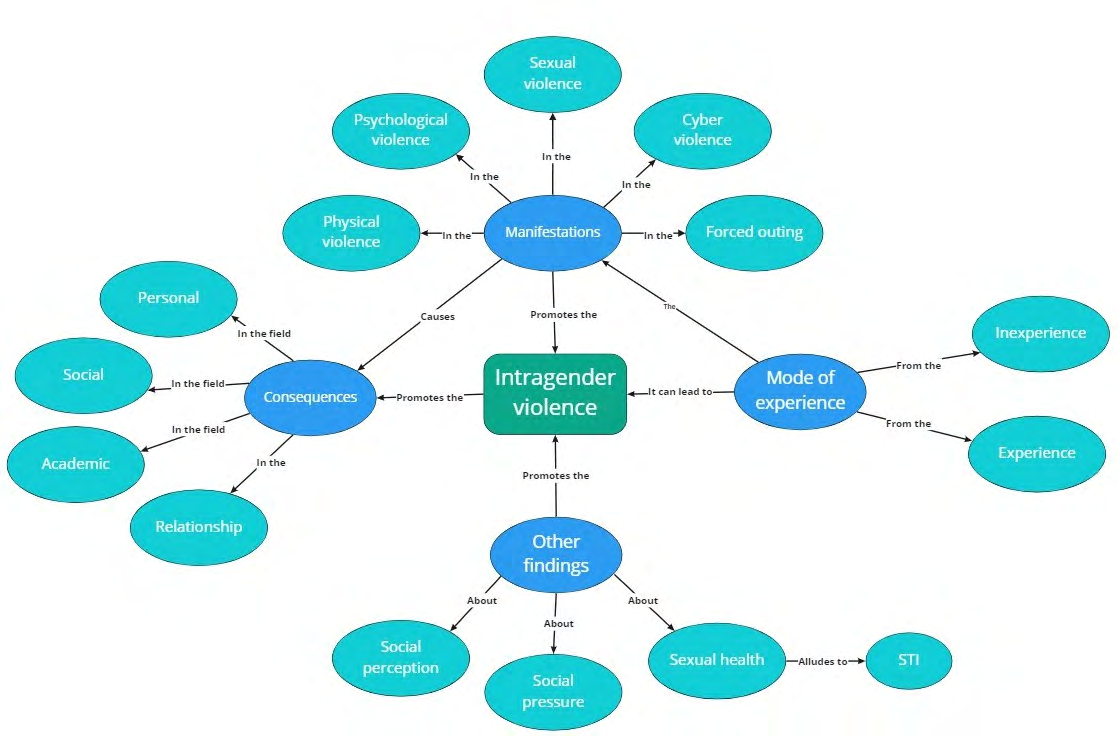
Source: self-made Figure 1: Summary diagram of the results.
Discussion
Although there is plenty of evidence and research worldwide, in Latin America and in Chile regarding intimate partner violence [20], they do not make a distinction between heterosexual or homosexual relationships, often making the latter invisible. Longares L, et al. [1], which is why the research was mainly aimed at the LGBTIQ+ community and thus learn about their experiences around intragender violence, however, those who were interested in being part of the study, correspond to lesbians, gays and bisexuals, limiting the sample to a single sector of the community.
As for the types of violence evidenced, like other investigations, the ones that are mostly known and manifested are those of a physical, psychological and sexual nature [21], for which cyber violence was also included and forced dating as possible triggers of intragender violence in love relationships, as well as the data collected by Longobardi C, et al. [21], it is identified that LGBTIQ+ people experience different types of violence in similar measures. Given this, it is necessary to note that, as mentioned in the results, psychological violence is the most evidenced by the participants, which is consistent with some of the figures provided from research focused on partner violence within the community, which reveal that among the types of violence most experienced by LGBTIQ+ people is psychological violence, followed by physical violence and sexual violence [10], these being also commonly expressed from heteronormative relationships [22]. However, there are some factors within LGBTIQ+ relationships that can lead to intragender violence, such as the difficulty that arises in self- discovery regarding sexual orientation, being influenced by the stigma and social pressure that falls on LGBTIQ+ people to the time of “pigeonholing or labeling” oneself or another sexual orientation, which is closely related to what was found by Longobardi C, et al. [21] in their systematic review (2017) on the influence of minority stress on LGBTIQ+ people and intragender violence in couples, indicating as main elements internalized homophobia, stigmatization around the community and discriminatory acts, which leads to the concealment of sexual orientation or hinders the process of self-discovery.
Limitations
Regarding the limitations of the study, these are linked to the topics to be addressed in future research regarding intragender violence, the first one being the low representation of the LGBTIQ+ community, due to the fact that only LGB people were included, therefore, it is necessary to extend the sample to the rest of the minorities that are part of the community [23]. There is also evidence of the scarcity of people who have completed their educational process or who are not studying and high school students since, in relation to the latter, it would be of great investigative use to carry out studies focused on intra-gender violence, since it is in the adolescence where sexual self-discovery generally begins and the first love relationships occur.
Other topics to be taken into consideration for future research are STDs, positioning them based on experiences and not so much on prevention as has been shown in other studies, that is, finding out how the diagnosis of an STD influences the couple’s relationship and if this in turn originates some manifestation of intra-gender violence. On the other hand, it was identified that the university is perceived as a tolerant place where the participants felt freer to explore their sexuality, inferring that this is due to the greater access they have to information. This assumption is correct and in turn if there are other spaces that are seen in the same way, distinguishing the main reasons for these conjectures. In view of all that has been investigated and exposed above, it is concluded that it is necessary to give greater visibility to the LGBTIQ+ community and intra-gender violence in the Chilean context, collapsing myths around it and STDs, through future research and/or through public policies. that they be in charge of providing society with pertinent and specific information on these issues, so that safe spaces are forged for each and every person belonging to the community.
References
-
Longares L, Saldana O, Escartin J, Barrientos J, Rodriguez CA (2018) Measurement of psychological abuse in same-sex couples: evidence of validity of the EAPA-P in a Spanish-speaking sample. Annals of Psychology 34(3): 555-561.
-
Barrientos J, Rodriguez CA, Escartin SJ, Longares HL (2016) Same-sex partner violence: Review and current perspectives/Intimate same-sex partner violence: Review and outlook. Argentine Journal of Clinical Psychology 25(3): 289-298.
-
San VJ, Peris R, Agut S (2017) LGBTIQ+ identity as a holistic process for collective empowerment in cooperation strategies. Fernandez M, Herrera A, et al. (Eds.), V International Congress of Development Studies, Libro de Actas, pp: 795-814.
-
International Lesbian, Gay, Bisexual and Intersex Association (ILGA) (2019) State Homophobia, pp: 1-558.
-
Meyer I (2013) Prejudice, Social Stress, and Mental Health in Lesbian, Gay, and Bisexual Populations: Conceptual Issues and Research Evidence. Psychology of Sexual Orientation and Gender Diversity 1: 3-26.
-
Barrientos DJ, Espinoza TR, Meza OP, Saiz JL, Cardenas CM, et al. (2019) Effects of sexual prejudice on the mental health of Chilean transgender people from the Minority Stress Model: A qualitative approach. Psychological Therapy 37(3): 181-197.
-
Barrientos J (2016) Homophobia in Chile: a state of the art. Liminals Magazine. Writings on Psychology and Society 5(9): 129-151.
-
Movement for Homosexual Integration and Liberation (MOVILH). Legislation, USA.
-
National Youth Institute (INJUV) (2018) 9th National Youth Survey, USA.
-
Saldivia C, Faundez B, Sotomayor S, Cea F (2017) Intimate violence in young same-sex couples in Chile. Last decade 25(46): 184-212.
-
Villalon L (2015) Violence in homosexual couples: social and legal aspects of violence in relationships between women. Final project of the Master in Criminology, Criminal Policy and Legal-criminal Sociology. University of Barcelona, Barcelona, Spain, pp: 1-116.
-
Robles A, Toribio A (2017) Color violence. Expressions of violence in homosexual couples. Graffylia 15(25): 126-140.
-
Park S, Kim SH (2019) Who are the victims and who are the perpetrators in dating violence? Sharing the role of victim and perpetrator. Trauma, Violence, & Abuse 20(5): 732-741.
-
Anacona RCA (2013) Prevalence and types of dating abuse in adolescents and young adults. Psychological Therapy 31(2): 143-154.
-
Freed D, Palmer J, Minchala D, Levy K, Ristenpart T, et al. (2017) Digital Technologies and Intimate Partner Violence: A Qualitative Analysis with Multiple Stakeholders. PACM on Human-Computer Interaction 1(46): 1-22.
-
Ortega A (2014) Aggression in homosexual couples in Spain and Argentina: prevalence and heterosexism. Complutense University of Madrid, pp: 1-373.
-
Bonilla GM, Lopez SA (2016) Exemplification of the methodological process of grounded theory. Ribbon of Moebium (57): 305-315.
-
Hernandez R, Fernandez C, Baptista P (2014) Investigation methodology. McGraw-Hill, Mexico.
-
Dias DNJ, Meireles GI, Ribeiro LM, Braga DCT, Catafesta UF, et al. (2016) Use of NVivo® software in a Grounded Theory investigation. Nursing Index 25(4): 263-267.
-
Valdivia PM, Fonseca PE, González L, Paíno M (2019) Invisibility of dating violence in Chile: Evidence from empirical research. Latin American Profiles 27(54): 1-31.
-
Longobardi C, Badenes RL (2017) Intimate Partner Violence in Same-Sex Relationships and The Role of Sexual Minority Stressors: A Systematic Review of the Past 10 Years. Journal of Child and Family Studies 26: 2039-2049.
-
Sanhueza T, Lessard G (2018) Representations of dating violence in Chilean adolescents: A qualitative study. Children and Youth Services Review 87: 41-51.
-
Leiva R, Lay LS (2017) The symbolic construction of violence against men in the context of a couple: An approach in the northern Chilean scenario. Health & Society 8(2): 138-153.
- Systematic Review and Meta-analysis Investigating the Prevalence of Depression, Anxiety, Loneliness and Help seeking among International Students
- Family Experiences and their Interpretations as a Source of Adaptive Behaviour in Young Adults: A Qualitative Model of Adaptive Behaviour
- The Development of Responsibility in Teenage Mothers: A Qualitative Model
- Post-Truth Reality: Worldwide Infodemia and Mental Health Concerns during and Post COVID-19 Pandemic Scenarios
- Psycho-Emotional Rehabilitating Means of Overcoming Extreme and Stressful Impact
- The Paradox of Humbleness, Arrogance and the Concept of Fluid Individuality