
Resilience Model for War Psychotrauma Victims Based on African Cultural Signifiers
Clinical observations at the RAPHA-Psy Psychology Center have revealed resilience with the appearance of sociocultural adaptation in some psychotraumatized soldiers of war. This has led to an attempt to understand the role of culture in this resilience, through cultural signifiers. The study was guided by the clinical method with five resilient psycho-trauma war soldiers. The results obtained after semi-structured interviews show that among these soldiers, the work of resilience was structured around the strengthening of the link between the Soldier and the bio-lineage Family, the strengthening of the link between the Soldier and the Ancestor, the consolidation of the link between the Bio-lineage Family and the Ancestor and the emergence of the Soldier’s mastery over the Enemy. The cultural signifiers in the work of resilience therefore have a function of reconstruction and solidification of the Soldier’s links in his different existential axes. The study thus made it possible to work out a model of resilience of the psychotraumatized ones of war based on the African cultural signifiers.
Introduction
Several researchers (Ungar M [1]; Goldberg JF, et al. [2]; Rutter M [3]; Cyrulnik B [4]; Martin M, et al. [5] agree that resilience cannot be reduced to a simple capacity for resistance that would convey the idea of ‘’ a rigidity, but that it evokes more properties of vigor, adaptation, but especially flexibility, flexibility and elasticity. This is why it very often means to bounce back. However, what has interested researchers more in recent years is to list the foundations of this rebound. Polk LV [6] in a synthesis of 26 articles, deduces that resilience is based on patterns. It is first of all the personal boss who refers to the physical and psychological attributes which contribute to the manifestation of resilience, including intelligence, health and temperament. Also with Jakubowski S [7], he identifies the relational boss who refers to the characteristics of the roles and relationships that influence resilience, that is to say, seeking support, reaching out to others, having interests and hobbies. Richard J [8] joins him in this perspective by evoking the situational boss which refers to an approach to a situation or stressors which manifests itself by the implementation of cognitive assessment skills, conflict resolution skills and attributes. Which indicate an ability to act in an adverse situation, such as flexibility, perseverance, curiosity and creativity? Gutton P [9], he returns to the philosophical boss who is part of personal beliefs which leads to a positive vision characterized by ideas such that the future will be good, we find meaning in lived experiences, life is worth the worth living. It is therefore these different bosses that would fundamentally promote the restoration of psychic integrity.
However, for some authors, essentially leaning in a psychoanalytic orientation, it is the adaptive use of defense mechanisms and the quality of metallization that underpin the process of resilience. Regarding defense mechanisms, Houssier F [10]; Vanistendael S [11]; Lecomte J [12]; Cyrulnik B [4, 13] and Anaut M [14] recognize the predominant role of the mechanisms of denial, cleavage, isolation, identification with the aggressor, recourse to the imaginary. However, Cyrulnik B [4] emphasizes three defensive processes which for him seem to play a more important role in the process of resilience, in the sense that they avoid the repetition of the traumatic break-in. It’s about altruism, humor and sublimation. Notwithstanding, for de Tychey C, et al. [15] defense mechanisms only allow to absorb and alleviate aggression and suffering after the breaking of the excitation shield by the traumatic event. They think that another essential operation, held by the ego of the psychotraumatized soldier, must be carried out thereafter. These include the psychic connection of affects and representations, allowing a work of mental elaboration of the tensions generated by the trauma of war. This operation is called mentalization.
For de Tychey C, et al. [15], it is mentalization which constitutes the essential intrapsychic process which underlies the subject’s capacity for resilience. We can say that Marty F [16] is of this opinion, because for him, mentalization deals with the quantity and the quality of the psychic representations of individuals, which representations base the capacity for resilience.
Debray R [17] also recognizes the importance of metallization in resilience, but much more in its role in avoiding somatic disorganization of psychotrauma. Besides this possibility of somatization of the trauma, Bergeret J [18] specifies indeed that when there is bankruptcy of mentalization, two ways of discharge are possible: the discharge by the somatic way, but also that in behavioral action. The failure of mentalization for this author, would therefore let the trauma develop easily in all its spheres. Furthermore, Fonagy P [19], which is closer to developmental trauma than war trauma, notes that, when traumatic situations result from attachment figures, they can greatly hamper mental capacity. Consequently, the absence, in the internal organization, of a complete capacity for mentalization, creates a tendency to the continuous repetition of the trauma, without the modulation that a representational vision of psychic reality would bring. We will therefore tend to believe that soldiers mistreated in their childhood have a poor quality mentalization, and would present difficulties in setting up a resilience process when they are affected by war psychotrauma.
However, several elements show that these metapsychological postulates of originating fantasies as the primary organizing structure of all concrete psychic activity make it difficult to grasp a culturally colored process of resilience, as is the case with psycho-traumatized soldiers encountered at military hospital of Yaoundé in Cameroon. Let us first note that for Ombolo JP [20], “one cannot simply ignore beliefs, social practices, myths and traditions, which are elements of psychic organization once one is in a comprehensive perspective”, and especially in the present context of traditional Africa where trauma makes a lot of reference to cultural elements. Furthermore, it should be remembered that even protective factors are intimately linked to the cultural environment. This is what Kimessoukié OE [21] reveals in the Cameroonian context when talking about traditions and customs. On the other hand, Tsala Tsala JP [22] emphasizes the socio-cultural importance of the African family which meets the security and socialization needs of each member. However, beyond this role of protection, security and socialization, cultural elements also seem to play a significant role in a person’s capacity to develop, to continue to project them into the future, despite the sometimes severe trauma. We could therefore ask ourselves how does culture intervene in the work of resilience in certain psychotraumatized people like Cameroonian psychotraumatized soldiers during the war against the terrorist sect Boko Haram? The aim is to understand the role played by culture through the action of cultural signifiers in the work of resilience among Cameroonian psychotrauma victims of war.
Methods
The study is qualitative research. Its purpose is often to study human phenomena for greater understanding. It is for us here to understand the function of cultural signifiers in the work of resilience. It was the inductive approach that was chosen. It consisted of ascertaining the facts and making rigorous, punctual and repeated observations concerning the participation of cultural signifiers in the resilience of psychotraumatized war soldiers. We made use of the clinical method, because it is defined above all by taking into account the singularity and the whole situation. We mainly relied on the case study, because of its ability to provide an in-depth analysis of a phenomenon such as resilience and this in a specific cultural context, that of traditional Black Africa. The research took place at the RAPHA-Psy Psychology Center. It is a structure that often receives soldiers in mental distress, upon their return from war missions.
As the research is qualitative, the use of a small, non- probabilistic sample was preferred. Participants were chosen based on their ability to provide interesting and relevant data on the role that cultural signifiers would play in their resilience work. They were five Cameroonian soldiers, having participated in anti-terrorist missions against Boko Haram in Far North Cameroon. They were diagnosed with severe psychotrauma using the Post-traumatic Stress Disorder Checklist Scale. This scale has a threshold score of 44 for the diagnosis of PTSD, its sensitivity is 97% and its specificity is 87%. It therefore makes it possible to effectively identify psychotraumatized individuals coming under psychiatric or psychotherapeutic care. These soldiers were identified as highly resilient using the Wagnild and Young Resilience Scale. This scale explains 44% of the variance in resilience, its internal consistency varies from 0.72 to 0.94. The Cronbach alphas of the French version used in this research for the dimensions Personal skills, Self-acceptance and life, are respectively (0.90), (0.76) and (0.91). As another selection criterion, participants did not adhere to hospital care. For their recovery, they only performed the rites in their respective villages.
Data collection was done through semi-structured interviews. This technique allowed us to focus the participants’ comments essentially on the themes of resilience and cultural signifiers that we wanted to address. We met each participant four times according to the saturation principle, where the continuation of the collection no longer gave us any new information. The interviews lasted approximately one hour each, depending on the participant’s availability. These voluntary participants, after signing the informed consent, were free to suspend the interviews at any time. Also, it was up to them to deliver only what they could say. As a data analysis technique, we used content analysis, which focused on identifying significant themes. In this context, we have used inter-coder agreements to ensure the relevance of the themes and sub-themes identified. The participants’ speech fragments are used to empirically base the analysis.
Results
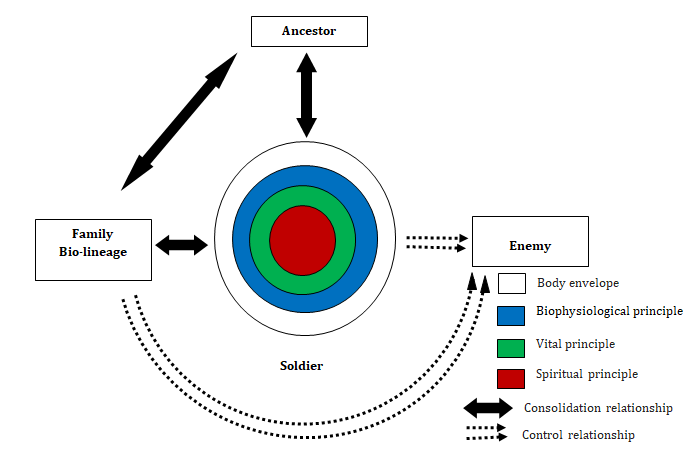
The results show that the resilient trajectory of the psychotraumatized war soldiers interviewed in this study is underpinned by the practice of rites. The main dynamic observed is the reconfiguration of the soiled links. Thus, the work of resilience was done around the tightening of the link between the Soldier and the bio-lineage Family, the strengthening of the link between the Soldier and the Ancestor, the consolidation of the link between the bio- lineage Family and the Ancestor, as well as the emergence of the Soldier’s mastery over the Enemy.
The Tightening of the Link Between Ego and the Bio-Lineage Family
The strengthening of the Axis of bio-lineage existence or the Existential Axis proper to the Person reinforces individuality in relation to the Self, to the immediate feeling of existing for oneself and of being at the same time closely united in as a «member» of his own lineage which is the real family in the African sense. It is this feeling that Soldier Bama expresses on the evening of the Tsô: «That evening, for once, I felt accepted and loved by the big family, their sacrifice for me was great. I also understood that I had a special place within her, that I was a special being.» The individual therefore feels that he belongs to the family, while experiencing himself as unique, with a lineage structure and organization. The tightening of the link between the Soldier and the bio-lineage family was also observed during the diagnostic activity, which did not take place in a vacuum of ecmnesic transfer and a singular colloquium of conscious to conscious and from unconscious to unconscious by the lively and economic mediation of transference. But, this interpretive activity rather required in each of its moments, the community consensus, in particular that of the patient’s family. This was the process with Soldier Afana:»... I suspected that I was tormented by the spirits of the dead terrorists, my father was of this opinion, my uncle too. And that’s what Simbo’s dad confirmed, but in a clearer way.” Indeed, in the traditional African clinic, the current conflict really questions the structure of the patient’s relationships in the panstructured universe, and not only at the imaginary level of private myth. Thus, the elucidation of the consultant’s case is, at the same time, the elucidation of the position, of each and every one, in the global relational structures.
Already, during the interpretive phase, the mental disorder must mean something common for the Ego and the bio-lineage family. It is a work of elaboration which consists in its essence, in giving a name to the anxiety experienced by the subject and / or his family. It is in fact a question of allowing the patient to «delirium» according to the framework of an institutionalized «delirium», that is to say from the modalities of «delirium» available in culture and proposed by it [23]. We see it in Soldier Chimbo: «When I told the doctors that the terrorist woman that I eliminated there, reappears from time to time true, they did not believe me. My people told them it was the truth, explaining that it was her spirit and that she could even change her face. For the hospital, stories were told, my family and I. «. It is therefore in this context that we can say that the «delirium» of the Ego becomes the «delirium» of the bio-lineage family, which characterizes a deep tightening of ties. And this is one of the nodes in the development of existential anxiety experienced in organized and defensive «delirium». But this is an organized persecution-defense of a collective structure. And this was only possible here because there is an institutional cultural possibility of establishing continuity between these soldiers and their families. It is not a passive observation of a rupture between the individual imagination and a structured collective imagination, but rather a true collective reservoir where acts of thought draw a good part of their basal representations before being reworked.
However, the consensus on the significance of the disorder between Ego and the Bio-lineage Family implies that effective management requires prior agreement within the family. This implies that the existing problems between its own members must first be resolved. This is what was done during the Tsô in Soldier Bama: “… at the stage of public confessions, each of us first confessed all the bad things that he committed either towards a member of the family, or to the whole community. Thereafter, forgiveness was implored and peace found.” Here we see that confession and forgiveness first purify the bonds in order to strengthen them better. Furthermore, in terms of African psychopathological coherence, clinical practice based on the concept of conflict is accompanied by an awareness of the meaning during the interpretative moment. This not only strengthens the ties between the patient and the family, but above all represents the very prototype of the entire successful clinical relationship. That is to say the one that surpasses simple healing. Ritopsychotherapy therefore draws all its effectiveness and goes beyond treatment, because, going beyond the simple framework of the technical manipulation of isolated facts, it penetrates to the depths of human meanings by mainly strengthening the concrete and total ties which unite indissolubly individuality and its community of sacred origin. This is what drives real development, what happens despite the trauma experienced. It is precisely in this sense that the tightening of the link between the Soldier and the bio-lineage Family presents itself as an important factor in the resilient leap.
Indeed, the consolidation of the link between the Soldier and the bio-lineage family had to provide participants with a feeling of confidence, confidence, and fullness to exist for them in the total security of the sacred African family who protects. Also, they now live a solidarity and a bio-lineage belonging in which the relational implication of each one is maximum, guaranteed, optimal of the unity and the total cohesion of the immediate experiences within permissive families who will support them whatever he is coming. This is a cluster of protective factors that effectively promote the resilience of the psychotrauma survivor.
The Strengthening of the Link between the Soldier and the Ancestor
Ritopsychotherapy is a great opportunity for dialogue between the practitioner and the Ancestor. It can be done directly as during the Simbo at Soldier Afana or during the Tsô at Private Bama. This communication between the initiate and the ancestral pole can also be done via genius or what Soldier Dewa calls the mind: «... this night, the mind has turned into a bird, it shakes houses, it puts on the roof, he cries, he shouts, he expresses his anger. It was the concession insiders who discerned what angered him, what he demanded, what he said. I was told in the morning that he was talking about me, some of my failures on the battlefield. And that we were to bring him directly to the level of the Mfossie tree. «. The ritopsychotherapist in turn builds the contact between Ego (the Soldier) and the Ancestor: «It was when we put white wine in the terracotta pot that I was introduced to the ancestors by pronouncing my name many times…” (Soldier Dewa). For Soldier Bama, this direct contact with the Ancestor was made after having slaughtered the goat «Tsig Tsô called my name and the two uncles said» here it is «. And I felt a strange presence invisible before me». These ritual acts thus significantly brought the psychotraumatized soldiers closer to the ancestral pole, support of the Law and the Word.
In terms of traditional African psychopathological practice, the work of resilience is therefore activated here by the implementation of care that allows not only to restore the broken link, but above all to strengthen it. On the other hand, it is the interpretation of the significant material collected in the psychotraumatic symptomatology (nightmares, hallucinations, illusions, etc.) of a mystico-cultural order, which makes it possible to diagnose the discomfort of the ancestral bond. This leads to a re-articulation of the patient in his continuous relationship with the transcendental Signified that is the Ancestor. All this implies that we should constantly restructure or recreate the «We» itself. Hence the need for renewed contact with the supreme legislator of the renewed order.
In addition, as a spiritual axis of the person-personality, the strengthening of the Vertical Axis maintains a direct access between the spirit of the Soldier and the Ancestral Reality. With this reinforcement of bond, the psychotraumatized of war profits from a feeling of plenitude of being, of deep «seat» and of onto-phylogenetic continuity. It regenerates in a climate of permanent and «continued» vivification in a larger but orderly and coherent whole. We can therefore understand this testimony of Soldier Omar after the Mbàk: “… feeling linked to such a powerful force, I felt like a new being, ready to face all kinds of challenges, ready to overcome all kinds of obstacles. «. To understand this, the traumatic crisis presents itself here as an unprecedented opportunity to bring together and then strengthen the bond between the Soldier and the Ancestor. The mental disorder although disorder, but this disorder, conceived as such in traditional African society, is thought and acted in «order», in so many articulated signifiers, aimed at re-establishing communication with the world of the signified. In this sense, the psychotraumatized patient because of the disorder of his disorder, has an opportunity par excellence to begin the coherence of his link with the support of the Law, the Word
and the Order. When there is therapeutic success and under culturally defined conditions, this can be considered as an accomplished initiation, recreating a union between the Signified and the psychotraumatized soldier. Like what, the purpose of a successful ritopsychotherapy is the resilience of said soldier.
Consolidation of the Link between the Bio- Lineage Family and the Ancestor
African psychopathological thinking permanently and deeply links the patient’s existence to that of members of the bio-lineage family. Mental disorder, like psychotrauma here, is never an isolable fact isolated from current practical socio-cultural reality. In traditional Africa, the fundamental signified is the Ancestor and not the desire of each individual taken in isolation and from which descends analytically by regression, the chain of singular meaning. This is why the dreams, the nightmares, the hallucinations and all the other experiences of the traumatic consciousness do not present here a singular unusual character, strange, even agonizing for the singularly conceived soldier. The dynamist and continuist conception of the psyche in Black Africa proceeds from the apprehension of thought as a psychic and social phenomenon. The African cultural clinic thus represents a particular model not only because it essentially attaches to meaning, but also because it is always and at the same times a therapeutic opportunity for the entire bio-lineage family. This is what Soldier Bama lets us understand «My uncle explained to me that this Tso ceremony also removed the chess, bad luck and misfortunes that already abounded in the village because the Mvamba visited us. And that it’s been since the Mvamba hadn’t visited us”. The Tsô, initially summoned for this soldier, was much more of an occasion that brought the whole family closer to the ancestral pole. And this renewed connection with the Ancestor has made the bio-lineage family less fragmented, more unifying, more structuring, and subsequently more prone to resilience.
The session of rites as a fundamental turning point in the trajectory of resilience for these soldiers has as its general meaning: the continuous creation and the consecration of a renewed global order in real, symbolic and imaginary terms from the new signifiers that have appeared within the community. The soldier’s psychotrauma of war, the vector of these signifiers, transformed him into a new man, whose ordeal benefits the whole community. Conversely, the community revitalized by the consolidation of ties with the Ancestor becomes a vase, a source of resilient resources for the psychotraumatized soldier. This reciprocity is well elucidated by Soldier Dewa after communion with the genius: «during the Mfossie, it was said that the spirit also brought abundance in the concession. The concession was celebrating, it looked like it was waking up, I can even say that it was rising.
And I felt myself reborn with it”. We note here the feeling of rebounding after a certain adversity.
On the other hand, it is indeed a regulated disorder, cathartic of psychodramatic readjustment that we attend during the collective celebrations of Tsô with Soldier Bama, of Mbàk with Soldier Omar and Mfossié with Soldier Dewa. This regulated disorder and this ordered chaos absorb the hierarchical tensions of the Vertical Axis and resolve the difficulties of intercommunication between the bio- lineage family and the ancestral pole. The songs, the cries, the intonations, the cheers and the festive dances noted during the ritopsychotherapies of the psychotraumatized soldiers call the Ancestor, celebrate it and honor it. These commemorative attitudes significantly bring the Ancestor closer to his community. Also, everything happens as if these collective behaviors aimed to shake, at the level of the deep psyche, the rigid pan-structure of the statutes, functions and daily social roles. The ancestral Being by communicating with the bio-lineage family, not only puts an end to the precultural violence, source of the psychotraumatic disorder, but mainly gives it the feeling of security and the assurance of the future which are the foundation of a real resilience.
The Establishment of the Soldier’s Control Over the Enemy
The strengthening of the links between the Soldier and the bio-lineage family on the one hand, between Ego and the Ancestor on the other hand, but also between the Ancestor and the bio-lineage family of which Ego is a part, creates in Ego a feeling of confidence and domination over the Enemy. Indeed, the benefit of a consolidation of ties on this triple front, would offer Ego a consistent source, solid support, effective support, an increase in skills that allow it to control the enemy from now on. Also, we will see later that Ego’s victories in the conflict with the Enemy will maintain this bond of mastery over the Enemy. In return, this link reinforces the trust that Ego already places in the two relational poles and leads it to get closer to it. It is in this spirit that Soldier Dewa testifies: «with all the terrorists that I could neutralize after the Mfossie, I can no longer have fun with the spirit of the Mfossie, nor with the village». This feeling of control over the Enemy brings the soldier a feeling of agreement with the main cultural values, based on the ancestral Signified. This creates a reassuring atmosphere around Ego in bio- lineage and ancestral relational structures, necessary for the development of the resilience process.
On the other hand, it should be remembered that the social role of the traditional therapist is that responsible for defending the group. He is not satisfied with detecting the agents of the conflictual relation, cause of existential disarray, that is to say cause of traumatic disharmony, but communicating with them in the mesocosmos, he masters them. Then, through ritual acts and symbolic objects, the initiate diffuses this bond of mastery to Ego. This bond of mastery gives our psychotraumatized participants a sense of control with Soldier Omar «since my return from the village, I feel that even if there is an ambush, the whole group can fall, except me»; a feeling of self-efficacy in Soldier Chimbo «When I put on the set of gris-gris that the marabout had given me, I go up on the mine of Boko Haram, it does not trigger. Or else it triggers when I’m already left. If you ask, I was nicknamed”; self-confidence in Soldier Afana «with the Simbo, I am sure of myself first, because I am sure to walk from now on these little mystical practices of BH»; positive thoughts in Soldier Bama «Now that I have the advantage over these people, even when I’m at the front, I think serenely about my family. Before, I was very afraid of leaving my children orphaned.» We notice there, that these feelings and attitudes are explicitly fundamental characteristics of resilience.
However, we note that the work of resilience among psychotraumatized soldiers in the present study was forged on the restructuring of the links between Ego and its different relational poles. The first was the tightening of ties between Ego and the Bio-lineage Family, which gave them a feeling of confidence, solidarity, and fullness to exist for themselves in the total security of the protective African family. Then, the strengthening of the link between Ego and the Ancestor, which allowed them to regenerate in a climate of permanent, orderly and coherent vivification, thus offering them a feeling of deep «sitting» and onto-phylogenetic continuity. Then simultaneously, the consolidation of the link between the Bio-lineage Family and the Ancestor which, by making the family more unifying and more structuring, transformed it into a vase of resilient resources for psychotraumatized soldiers. Finally, the bond of Ego mastery over the Enemy which provided these soldiers with a sense of control, self- efficacy, self-confidence and positive thoughts. This model of resilience work focused on restructuring, in particular the solidification of the links between Ego and its relational poles can be represented on the diagram below (Figure 1).
Discussion
The capacity for resilience certainly results from the mental work of the individual, as shown by Tychey C, et al. [15] when speaking of intrinsic factors. With regard to extrinsic variables, the family is often considered as the holder of defensive and protective modalities, being resources that will help the individual in the face of adversity and modes of support that can promote their development and mental reconstruction [14]. However, it should be emphasized that in traditional Africa, family support is deeper than just emotional support. Regarding for example the rapid absorption of psychotraumatic symptoms and the good prognosis noted in the patients of this study, for Berthod MA [24], this can be explained by the great tolerance of those around them, allowing rapid reintegration into the family group. And the quality of human relationships. This is the case of the delirium noted by Soldier Charli (persecuted by the woman who prepares the gris-gris for terrorists), which for the family group is not a strange, incomprehensible phenomenon. Rather, it is part of existence, and as such, it always receives, an explanation. This attitude therefore does not lead to rejection or alienation. Moreover for Mboussou M, et al. [25], the notion of persecution colors all of African
psychopathology; invoked by the patient, it is taken up by family and friends, shaped and used by the traditional therapist. It therefore constitutes a socialized, intra- Community defense, solidly institutionalized and effective. This collective support supports the significant coherence of the traumatic symptomatology which therefore presents itself here as an in-depth form of social support, an important node in the resilient process.
On the other hand, it was seen higher than Houssier F [10]; Vanistendael S [11]; Lecomte J [12]; Cyrulnik B [4] and Anaut M [14], discuss more the classic defense mechanisms in the work of resilience. Furthermore, Nathan T [26] and Nguimfack L [27] speak much more about cultural defenses. It may be the exteriority of the conflict; the specific collective appointment of a persecutor; the protected status of the patient as an surrounded victim; also of the objective reality of the constituent vertical, horizontal and bio-lineage dimensions, as external to the individual subject. This type of defenses proved to be effective in this study, certainly because they are fundamentally anchored in the African cultural context. Latoki PE [28] and Kipambala Mvudi JFP [29], they are very specific on these cultural defenses, speaking of attachment to the Ancestor. They insist that among Africans, the Ancestor, a kind of absent presence, is the reference and recourse to his Being, his Law, his Word and his Order. He is at the same time: the foundation, the guarantor, but also the founder of the community and of the current cultural order. He is the one who puts an end to chaos, cultural indifferentiation and, in turn, psychotraumatic disorder.
This reflection associated with that of Berthod MA [24] summoned above, joins what Sow I [30] calls «an imaginary structured collective» which is a structuring vase endowed with real sediments of collective symbols, which leads to common meanings and whose sacred origin is the Ancestor. An approach which according to Péruchon M [31] is very different from a psychoanalytic type relationship, practiced in a «universe» where the narcissistic libido thrones, and of essentially individualistic structure, and which can only be circumscribed to a singular imagination, «Self- sufficient», whose essential motor is the singular desire. However, African psychic dynamics go far beyond this singular functioning, consequently the process of resilience here cannot be based on singular defense mechanisms. In Collomb and Zadje to precede us by affirming that as much, the fullness of a feeling of well-being in the West is defined in terms of individual “independence”, as much in Africa the sign of full development personal consists in the feeling of a solid articulation of the self with the three axes leading to the poles which constitute it. We therefore understand that if resilience in the West can be based on the autonomy of the individual, in an African cultural context, it is rather based on the re-articulation of individuality in its fundamental polar dimensions, in particular in the consolidation of “his links”.
War psychotrauma, far from being a simple calamity of psychic invasion, on the contrary, allows a high level relational readjustment between the affected individual, society and culture. Thus conceived, this mental affection marks the triumph of the power of culture over simple defense mechanisms or natural adaptation strategies [32]. Thus, for Nsabiyeze S [33], Society, Person, Culture are not destroyed; but they will only continue to exist thanks to collective operations of renewal and rebirth, the foundation of resilience from an African perspective. Traumatic affection would therefore correspond to a reshuffle, even a reordering of the deepest elements of the person-personality. The restructuring of relational networks at the level of the three fundamental poles is therefore what the resilient war psychotrauma patient draws his coherence and strength. Indeed, the traumatic crisis dominated by the notion of conflict between the subject and the external persecuting authorities, creates a link between the «superficial» and the «deep»; the true link between men and spirits as Foucault P [34] thinks: «The reality for African culture lies not in the relationship of man and things, but of men with spirits». This is what opens the way to a real renaissance (resilience) for the patient as well as for the whole community.
For Sajus N [35], there is indeed restoration of mental integrity, but it does not stop at a singular conference, it leads to a new necessary balance between the psychotraumatized soldier of war and his constituent poles, a readjustment of relational polarities. This feeling of intimate coherence is experienced, through individuality at the triple level of the experience of the body, the experience of consciousness and the psychosocial experience. This is why for Gishoma D, et al. [36] restoring order to the affected subject, victim, means, at the same time restoring the broken link, reinserting the patient in the place from which he had been excluded, cut off from his instances constituents by the aggressor. By borrowing the terms of Moro MR [37], it is therefore a question of strengthening its relational networks, of toning them more than they were before the psychotraumatic crisis. Since conceived ritotherapy not only restores Being in its integrity, but above all consolidates it in its power to exist. Resilience is therefore based here on the proper development of the deepest relationships of the individual with his constituent elements and the constituent socio- cultural instances which assure him coherence and unity in interdependence.
Conclusion
This study began by highlighting two main lines of research on resilience. The first axis is of great interest in identifying the factors that favor this phenomenon and those that limit it. It was he who brought out the concepts of protective factors and risk factors. The second axis is in a comprehensive approach and focuses especially on the intrapsychic processes that govern resilience. This is mainly concerned with mentalization and the adaptive use of defense mechanisms. With regard specifically to this research, it was a question of first identifying cultural signifiers as actors in the resilience of war psychotrauma victims. Then, it was a question of understanding their dynamic function in the process of resilience. The study went beyond the classical psychodynamic approach, going beyond the essentially «interiorist» vision of the psychic activity of resilience. She highlighted the preponderance of the exteriority-interiority complex in the work of resilience. Indeed, here it is the external restructuring which conditions the internal restructuring. It is the collective sociocultural behaviors which work the deep individual psyche. The dynamist and continuist conception of the psyche in Black Africa proceeds from the apprehension of thought as a psychic and social phenomenon. It is in this sense that the engine of the resilience work among certain psycho-traumatized Cameroonian soldiers of war would be the rearrangement of ties. It follows therefore that among these soldiers, the work of resilience was structured around the tightening of the link between the Soldier and the bio- lineage Family, the strengthening of the link between the Soldier and the Ancestor, the consolidation of the link between the Bio-lineage Family and the Ancestor and the emergence of the Soldier’s control over the Enemy. The cultural signifiers in the work of resilience therefore have a function of reconstruction and solidification of the Soldier’s links in his different existential axes. It is these results that have made it possible to develop the cultural model of the work of resilience among psychotraumatized soldiers of war, starting from the theory of conflict of relationship.
References
-
Ungar M (2013) Resilience, trauma, context, and culture. Trauma Violence Abuse 14(3): 255-266.
-
Goldberg JF, Garno JL (2005) Development of posttraumatic stress disorder in adult bipolar patients with histories of severe childhood abuse star. J Psychiatr Res 39(6): 595-601.
-
Rutter M (2007) Resilience, competence, and coping. Child Abuse Neglect 31(3): 205-209.
-
Cyrulnik B (2013) Resilience: a multi-causal process. French Journal of Social Affairs 1: 15-31.
-
Martin M, Marchand A, Boyer R, Martin N (2009) Predictors of the development of posttraumatic stress disorder among police officers. J Trauma Dissociation 10(4): 451-468.
-
Polk LV (1997) Toward a middle-range theory of resilience. ANS Adv Nurs Sci 19(3): 1-13.
-
Jakubowski S (2007) The Professionalization Of The French Army Consequences On Authority. L’Harmattan, Paris.
-
Richard J (2004) Resilience and vulnerability On the adjustment of concepts in psychogerontology. Gerontology and society 2(109): 109-125.
-
Gutton P (2007) Resilience as affect. In: Aïn J (Ed.), Resiliences. Eres, Paris, pp: 227-236.
-
Houssier F (2002) Clinic of trauma and resilience: a look at the career of B. Bettelheim. Psychological Practices 1: 65-73.
-
Vanistendael S (2001) Humor and resilience: the smile that brings life. In: Poilpot MP (Ed.), Resilience: the realism of hope. ERES, Ramonville Saint-Agne, France, pp: 161-195.
-
Lecomte J (2004) Healing from his childhood. Odile Jacob, Paris.
-
Cyrulnik B (1999) Resilience: unexpected hope. In: Poilpot MP (Ed.), To suffer but to build oneself. ERES, Ramonville Saint-Agne, France, pp: 13-24.
-
Anaut M (2003) Resilience. Overcome trauma. Nathan University, Paris.
-
Tychey C, Lighezzolo J, Claudon P, Diwo R (2006) Thoughts on the prevention of certain contemporary forms of depression. Psychology Bulletin 5(485): 515- 522.
-
Marty F (2001) Introduction: Trauma, a renewed clinic. In: Marty F (Ed.), Figures and treatments of trauma. Dunod, Paris, pp: 1-13.
-
Debray R (2001) Epistle to those who somatize. PUF, Paris.
-
Bergeret J (2004) Theoretical and clinical pathological psychology. Masson, Paris.
-
Fonagy P (2004) Attachment theory and psychoanalysis. Ramonville Saint-Agne, Eres.
-
Ombolo JP (1975) Sexuality and history in black Africa - Essay on the dynamics of modernization of the concept of sexuality among the Pahanins. Ethnology doctoral thesis. University of Lyon 2, Lyon, France.
-
Kimessoukié OE (2014) Quebec women and Cameroonian women: Risk assessment for their mental health. Poster presented at the 21st scientific poster competition of the University of Quebec in Trois-Rivières, Quebec.
-
Tsala Tsala JP (2009) African Families In Therapy Cameroonian Family Clinic. Harmatan, Yaoundé, Cameroon.
-
Sow I (1978) The Anthropological Structures of Madness in Black Africa. Payot, Paris.
-
Berthod MA (2009) Between psychology of rites and anthropology of loss Notes for the study of bereavement. Journal of Anthropologists 2(117) : 159-180.
-
Mboussou M, Mbadinga S, Koumou RD (2009) African religion and psychopathology. Psychiatric Information 8(85): 769-774.
-
Nathan T (2013) The madness of others Treatise on clinical ethnopsychiatry. Dunod, Paris.
-
Nguimfack L (2016) Psychotherapy of Cameroonian families confronted with witchcraft Systemic intervention with the family of a delinquent child. Family Therapy 3(37): 293-305.
-
Latoki PE (2010) Religion as a quest for order in traditional African society. Political Psychology Notebooks 16: 63-79.
-
Kipambala Mvudi JFP (2012) Identity and belonging: time and anthropological computation at RE Mutuza Kabe. Thesis for Doctorate in Philosophy. University of Kinshasa, Republic of the Congo.
-
Sow I (1977) African Dynamic Psychiatry. Payot, Paris.
-
Péruchon M (2013) Narcissism, mentalization and object, foundation of resilience Its future in the elderly. Aging, an Art of Living, pp: 75-111.
-
Trincaz J (1980) Sow (Ibrahima) Dynamic African Psychiatry and The Anthropological Structures of Madness in Black Africa. Archives of Social Sciences of Religions 49(2): 309.
-
Nsabiyeze S (2004) Culture and psychic trauma; understanding and psychological management of PTSD. Memoire Online. National University of Rwanda, Rwanda.
-
Foucault P (2010) «The African Man» and his masks Psychological anthropology of the person, from colonial psychiatry to the Postcolonial School of the Fann-Dakar hospital in Senegal. University of Ottawa, Ottawa, Canada.
-
Sajus N (2018) Adolescence and discourse of resilience. The Journal of Psychologists 6(358): 74-78.
-
Gishoma D, Brackelaire JL (2008) When the body shelters the inconceivable How to express the upheaval witnessed by the bodies in Rwanda? Clinical Psychology Notebooks 1(30): 159-183.
-
Moro MR (2016) Beyond Cultures. In: Marion JF (Ed.), Mental disorders and psychotherapies. Editions Human Sciences, Paris, pp: 159-162.
- Systematic Review and Meta-analysis Investigating the Prevalence of Depression, Anxiety, Loneliness and Help seeking among International Students
- Family Experiences and their Interpretations as a Source of Adaptive Behaviour in Young Adults: A Qualitative Model of Adaptive Behaviour
- The Development of Responsibility in Teenage Mothers: A Qualitative Model
- Post-Truth Reality: Worldwide Infodemia and Mental Health Concerns during and Post COVID-19 Pandemic Scenarios
- Psycho-Emotional Rehabilitating Means of Overcoming Extreme and Stressful Impact
- The Paradox of Humbleness, Arrogance and the Concept of Fluid Individuality