
Hardware Psychodiagnosis of Resilience Indicators Mental Health
The article reveals the psychohygienic significance of apparatus-psychological objectification of the main indicators of mental health for each person to acquire knowledge about his own individuality and self-regulation of his own mental states. It is noted that self-control of one’s own mental functioning is necessary in the process of treatment of mental disorders and the long-term rehabilitation of patients with chronic mental illnesses, as it allows activating the awareness of the main objective parameters of one’s own mental capabilities in relation to the desired capabilities necessary for a full-fledged life. The functions of the “Hyst” device, manufactured by the Kyiv Telekom-pneumatik plant under the patent of Dr. Sergii Boltivets, are presented as a separate device and a program installed on a computer that processes the received psychodiagnostic data. In accordance with the psychodiagnostic purpose of each of the components of the apparatus complex, its use allows to conduct reactometry, labiliometry and tremormetry of the psychomotor praxis of thinking of children and adults, starting, as a rule, from the age of 5. The device provides the possibility of choosing both a single signal and a series of 10 responses with separate calculation of the reaction of the right and left hand and leg. This provides a psychodiagnostic assessment of interhemispheric interaction and the presence of asymmetry of interhemispheric functioning and its severity. The obtained data are important for identifying the consequences of unconscious but existing craniocerebral injuries and other dysfunctions of psychophysical development. The results of psychological examinations of 2,548 people, including children and adults aged 5 to 82 years, regardless of mental health status, including both self-actualized individuals with high quality indicators of mental health and individuals with chronic mental disorders and various degrees of mental retardation. This made it possible to generalize the main indicators of the instrumental and psychological objectification of the main indicators of the stability of mental health. It was established that the functional indicators of reactometry, labiliometry and tremometry are the basic characteristics of individuality, activity and the ability to self-regulate, which are the main indicators of the stability of a person’s mental health. It was noted that such universal forms and patterns of mental self-organization of a person, which, being transformed during human life, are not lost, have the greatest value.
Hardware Self-Control
Apparatus-psychological objectification of the main indicators of mental health has important psychohygienic significance for each person to acquire knowledge about his own individuality and self-regulation of his own mental states. The hardware and software complex of psychological and professional diagnostics with the function of remote control is presented in the researches of Varlamova NV, et al. [1], where the speed of human reactions to light, color, sound and tactile stimuli is given. The specified components of a single information-measuring and management decision- making system in the subject area are important for the study of professional suitability and the psychophysiological state of a person. Among the general-purpose psychological equipment in the practice of psychologists in different countries of the world, the apparatus for mirror drawing, human labyrinth, finger labyrinth, memory drum, colour mixer, stability tester, metronome, anthropometer, sliding caliper, craniophorus, goniometer, techistoscope, chronoscope and others are used [2]. Computer programs that have permeated all aspects of psychological practice are discussed in detail in psychodiagnostic computing by Watkins MW, et al. [3]. It should be noted that the problematic areas of psychodiagnostics in the mentioned directions were outlined almost half a century ago in the work of B. Kleinmuntz and Don N. Kleinmuntz by modeling a hypothetical psychodiagnostic system that can function in artificially created mental health environments. The idea is to combine the psychodiagnostic system and the clinician’s strategies to take advantage of the computer in combination with human information processing [4]. Joseph DM [5] draws attention to the discrepancy in the development of computers and related hardware for the computer interpretation of psychological tests, which is an important advance in the field of psychological assessment. Unfortunately, as noted by Joseph DM [5], the development and verification of related software is not as advanced as the hardware.
A special place among researches in which psychological equipment is used belongs to immersive technologies. Peculiarities of their use are covered by Matthew L, et al. [6], Max M, et al. [7], Daniel, et al. [8].
Self-monitoring of one’s own mental functioning is especially important in the process of treating mental disorders and the long-term rehabilitation of patients with chronic mental illnesses, as it allows to activate awareness of the main objective parameters of one’s own mental capabilities in relation to the desired capabilities necessary for a full-functioning life.
The patient’s subjective perception of his doctor, clinical psychologist as a trusted person in the matter of restoring mental health, thanks to instrumental and psychological data, acquires a reliable basis of objective mediation in self- movement to improve his own abilities to reveal individual capabilities, his own activity and self-regulation. In order to determine the individual psychological abilities and state of each person, we developed and applied the psychological apparatus “Hyst”, which summarizes the obtained data in a psychogram.
Psychological Apparatus “Hyst”
Structurally, the “Hyst” device is manufactured by the Kyiv Telekom-pneumatik plant as a separate device and a program installed on a computer that processes the received psychodiagnostic data. In accordance with the psychodiagnostic purpose of each of the components of the apparatus complex, its use allows to conduct reactometry, labiliometry and tremormetry of the psychomotor praxis of thinking of children and adults, starting, as a rule, from the age of 5. Psychodiagnostic examination on the “Hyst” device is presented in Figure 1.
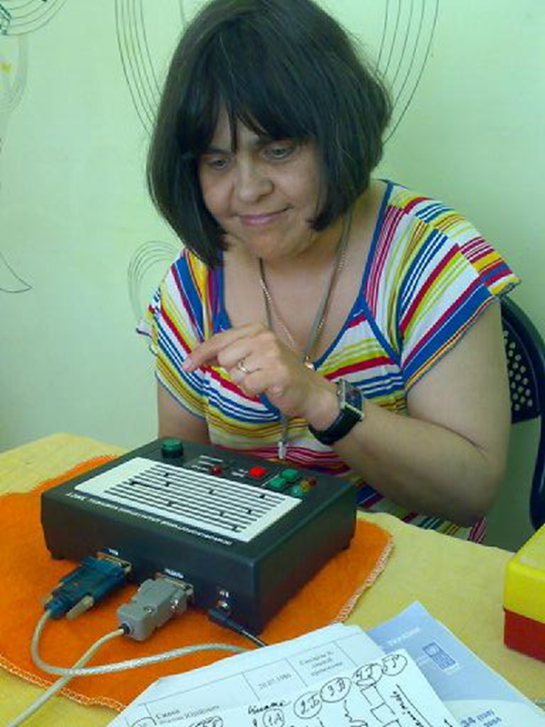
Reactometry is carried out with a reactometer - a psychological device for measuring the time of a simple sensorimotor person to a light and sound stimulus signal. An important feature of the device is the measurement of the sensorimotor reaction of the subject both to the appearance and to the disappearance of the signal, which allows for a holistic assessment of the individual psychomotor pace of the subject. The device provides the possibility of choosing both a single signal and a series of 10 responses with separate calculation of the reaction of the right and left hand and leg. This provides a psychodiagnostic assessment of interhemispheric interaction and the presence of asymmetry of interhemispheric functioning and its severity. The obtained data are important for identifying the consequences of unconscious but existing craniocerebral injuries in the past, other dysfunctions of psychophysical development, which the examined person may not be aware of under certain conditions of his previous life.
As a rule, for the reliability of the obtained data, a series of 10 identical sound or light stimuli is used, which, after the completion of the last, 10th test, automatically displays the average result of the entire series on the monitor. Comparing the obtained reaction results, for example, with the right and left hand, with the results of reaction with the right and left leg allows, on the one hand, to identify the leading hand and leg, and on the other hand, the leading method of reaction: for example, natural defensive reactions - defending with hands, defending, attacking, or giving preference to the legs, fleeing from danger, defending with them, while giving preference to the leading leg.
For tremometry, which consists in measuring the parameters of dynamic hand tremors, a tremometer is used, which allows to draw a conclusion about the accuracy of the psychomotor praxis of thinking reflected in the movements, the resistance of the examined person to psychophysical loads, the coordination of the examined person’s psychomotor thinking, which is dominant in complex and complicated conditions life and activity compared to verbal-logical and figurative types of thinking activity. The tremometer allows you to accurately trace the interdependence of the time of passing the maze and the number of touches made. This dependence is inversely proportional: the shorter the time of passing the maze, the greater the number of touches. Conversely, the longer the maze, the smaller the number of touches.
In the case of detection of higher or significantly higher performance of virtual psychomotor skills of the examined person when working with a drawing than real psychomotor skills when working directly with the device, the ratio of psychomotor dependence of the main work to operations with a computer, i.e. with an electronic control panel, other machines, is found out mechanisms, devices and tools.
The labiliometer is a device for researching the lability of the nervous system, that is, conducting labiliometry, which allows you to measure the critical frequency of the fusion of light flashes, which is the main indicator of the lability of a person’s visual perception, a feature of his psychophysical status and the current psychophysiological state at the time of the psychological examination. The labiliometer contains buttons for selecting a color and transferring data to a computer, decreasing and increasing the frequency of green, yellow, and red LED flashes. Yes, the green LED turns on at a rate of 1 flash per second. When pressing and releasing the button, the person under examination gradually increases the frequency of flashes to the state when the discrimination of the flickering of the LED is completed. This will be the critical frequency of flashes for this colour, which is fixed by sending the received data to the computer by pressing the appropriate button, as a result of which the result appears on the monitor.
Results of Instrumental and Psychological Examinations
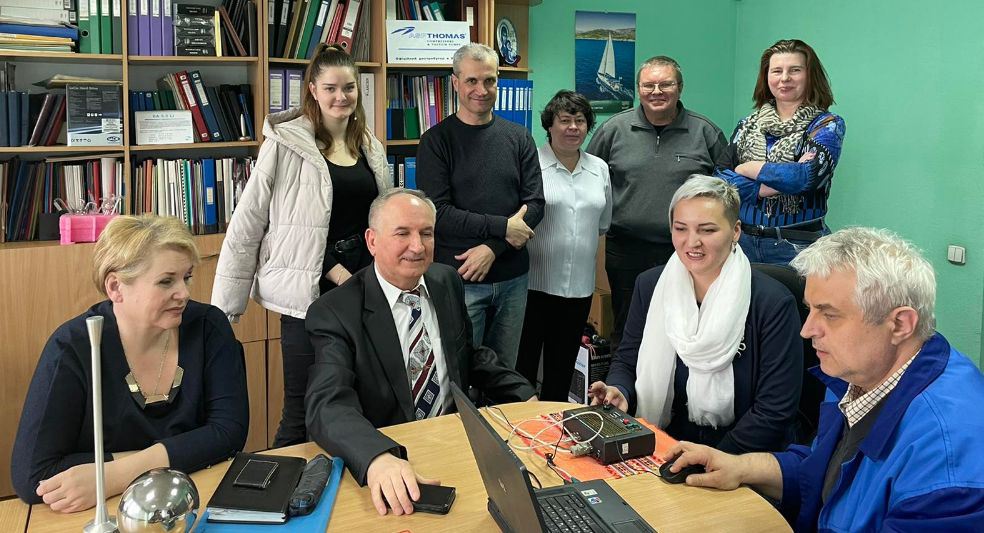
A psychological examination of 2,548 people was conducted, which included children and adults from 5 to 82 years of age, regardless of the state of mental health, including both self-actualized persons with high indicators of the quality of mental health, and persons with chronic mental disorders and various degrees of mental backwardness, made it possible to generalize the main indicators of the apparatus-psychological objectification of the main indicators of mental health, defined by us. The procedure of psychological examination of adults at their request is presented in Figure 2.
Labiliometry
The labiliometric analysis of the variability of the critical frequency of the fusion of light flickers made it possible to determine the following indicators of the state of mental health of the examined persons in accordance with 1 Hz = 1/sec: 1 – 11 Hz - the general indicator of lability indicates the presence of aproxexia - the inability to focus attention on indicators due to the absence of it conscious regulation and the general functional state of the organism in cases of emotional and volitional immaturity of the mental processes of concentration of attention, organic damage, mainly of the frontal lobes and other areas of the brain or at the stage of pronounced overfatigue, by evaluating the suprathreshold value of the critical frequency of the fusion of light flickers of the visual analyzer; 12–22 Hz – the general index of lability indicates the presence of hypoprolexia – reduced ability to focus attention on indicators as a result of minimal concentration of attention and its conscious regulation and the general functional state of the body in cases of incomplete emotional and volitional maturity of mental processes of concentration, or in various cases of asthenic syndrome , associated with a change in the degree of wakefulness, increased fatigue as a result of a brain injury and/or other organic brain lesions, or at the stage of pronounced general fatigue, by estimating the suprathreshold value of the critical frequency of the fusion of light flickers of the visual analyser; 23 – 29 Hz – the general indicator of lability indicates the presence of a moderately reduced ability to focus attention on the indicators due to introverted concentration of mental processes and their conscious regulation and the general functional state of the organism in cases of existing exhaustion of mental processes of concentration, situational or permanent weakening of the intensity and strength of emotional volitional functioning, associated with a change in the degree of wakefulness, a state of increased fatigue, by estimating the suprathreshold value of the critical frequency of the fusion of light flickers of the visual analyzer; 30–46 Hz – the general index of lability indicates the presence of a normal ability to focus attention on the indicators as a result of extroverted concentration of mental processes and their conscious regulation and the proper general functional state of the organism, the optimum of mental processes of concentration, sufficient intensity and strength of emotional- volitional functioning, the absence of pronounced the degree of wakefulness and the state of fatigue, by estimating the above-threshold value of the critical frequency of the fusion of light flickers of the visual analyzer; 46 – 58 Hz – the general index of lability indicates the presence of hyperprosexia as an increased ability to focus attention on indicators as a result of extroverted concentration of mental processes and their conscious regulation and the general functional state of the body, the optimum of mental processes of concentration, high intensity and strength of emotional-volitional functioning, lack of expressed degree of wakefulness and fatigue, by estimating the above-threshold value of the critical frequency of the fusion of light flickers of the visual analyzer.
Reactometry
The coefficient of general activity of mental functioning determined by reactometry has the following values: less than 132 μs – hyperactive mental functioning; 133 – 160 μs – intense mental functioning; 161 – 180 μs – optimal mental functioning; 181 – 289 μs – acceptable mental functioning;
290 – 340 μs – moderate mental functioning; 341 – 380 μs – slowed mental functioning; 381 μs and more - reduced mental functioning. A further decrease in mental functioning, reaching indicators of 420 μs and more, reliably correlates with a decrease in the intellectual abilities of the examined persons, in particular, with a slight degree of mental retardation within the range of up to 499 μs, moderate mental retardation within the range of 630 μs, severe mental retardation - more than 738 μs and with profound mental retardation - more than 831 μs with an episodic possibility of understanding the essence of the performed psychomotor action.
The intensity ratio reflects the number of leads and skips of the signal to the total number of samples, where the absence of leads and skips has the highest value. The coefficient of psychological stability is the number of repetitions of the same results in a variation series of 10 reactometric samples. The coefficient of depression expresses a positive value of an algebraic value and a relatively large number of delayed reactions as a predominance of inhibitory processes over the ability to be excited and the concentration of attention associated with it. The coefficient of excessive excitement, on the contrary, testifies to the negative value of the average algebraic value and the predominance of premature reactions. The coefficient of mental balance is expressed by the zero sign of the average algebraic value and a relatively equal number of premature and late reactions.
Tremometry
The coefficient of psychomotor self-regulation, obtained by tremometry, is an integral indicator of movement coordination, which is calculated by dividing the number of touches by the time spent on passing the labyrinths, that is, by the ratio of accuracy and speed: high - 0 - 0.7 touches / s; sufficient – 0.71 – 1.2 touches/s; pronounced - 1.21 - 1.75 touches/s; moderate - 1.76 - 2.3 touches /s; primary - 2.31 - ... touches /s.
Conclusion
Thus, the functional indicators of reactometry, labiliometry, and tremometry are the basic characteristics of individuality, activity, and the ability to self-regulate, which are the main indicators of the stability of a person’s mental health. To determine the individual psychophysical abilities and state of each person, the psychological equipment complex “His” is used, which summarizes the data obtained in the psychogram developed by us. The given indicators determine the quality category of mental health, which is an individual property of a person to ensure his own procedural integrity, adequate to his inner nature, in the interaction of a person with his own self and environment.
Such universal forms and patterns of mental self- organization of a person, which, being transformed during human life, are not lost have the greatest value. Increasing the quality of mental health, acquiring higher levels of it is a constant process of self-improvement, the basis of which is the integrity of knowing oneself and the world, mastering the abilities of self-regulation of one’s own mental activity, and self-realization as a self-sufficient embodiment of the meaning of one’s own life activity - one’s perceived purpose.
References
-
Varlamova NV, Styervoyedov NG (2018) Hardware- software complex for psychological and professional diagnostics with the remote control function. Bulletin of Kharkiv National University 38: 25-32.
-
Jain V (2023) Micro Teknik.
-
Watkins MW, Dermott PA (1991) Psychodiagnostic Computing: From Interpretive Programs to Expert Systems. The Computer and the Decision-Making Process.
-
Kleinmuntz B, Kleinmuntz DN (1981) Psychodiagnosisin hypothetical problem spaces. Behavior Research Methods & Instrumentation 13(4): 417-420.
-
Matarazzo JD (1985) Clinical psychological test interpretations by computer: Hardware outpaces software. Computers in Human Behavior 1( 3-4): 235- 253.
-
Lombard M, Freeman FBJ, Schaevitz WIRJ (2015) Immersed in media: Telepresence theory, measurement & technology.
-
Max M, North SM (2016) A comparative study of sense of presence of traditional virtual reality and immersive environments: Australasian Journal of Information Systems 20(2016).
-
Freeman D, Haselton P, Freeman J, Spanlang B, Kishore S, et al. (2018) Automated psychological therapy using immersive virtual reality for treatment of fear of heights: a single-blind, parallel-group, randomised controlled trial (2018). The Lancet Psychiatry 5(8): 625-632.
- Systematic Review and Meta-analysis Investigating the Prevalence of Depression, Anxiety, Loneliness and Help seeking among International Students
- Family Experiences and their Interpretations as a Source of Adaptive Behaviour in Young Adults: A Qualitative Model of Adaptive Behaviour
- The Development of Responsibility in Teenage Mothers: A Qualitative Model
- Post-Truth Reality: Worldwide Infodemia and Mental Health Concerns during and Post COVID-19 Pandemic Scenarios
- Psycho-Emotional Rehabilitating Means of Overcoming Extreme and Stressful Impact
- The Paradox of Humbleness, Arrogance and the Concept of Fluid Individuality