
Decent Work for a Better Life: Unpacking the Role of Career Adaptability and Sustainability
The 2030 Agenda for Sustainable Development has integrated the International Labor Organization's Decent Work Agenda into its broader vision to promote a more sustainable future for all. As one of the Global Goals for Sustainable Development, the concept of decent work has been widely promoted in theory, practice and research to improve people's ability to experience freedom, fairness, security and dignity at work. However, the evidence on the impact of decent work on individuals' quality of life and long-term career prospects is still inconclusive. In this study, the relationship between decent work and quality of life was examined, with career adaptability and career sustainability playing an indirect role. The study involved 218 people between the ages of 19 and 71 who worked in various roles in the tourism industry. The results show a significant positive relationship between decent work and quality of life. Decent work improves both career adaptability and career sustainability, which in turn has a positive impact on quality of life. Serial mediation analysis confirms that career adaptability and career sustainability mediate the relationship between decent work and quality of life (B = 0.493, p < 0.001). These results are clear evidence that the development of career adaptability and the promotion of sustainable career practices are crucial when it comes to translating decent working conditions into a higher quality of life for workers.
Abbreviations
SDGs: Sustainable Development Goals; OSD8: One of these goals; ILO: International Labor Organization; PWT: Psychology of Working Theory.
Introduction
The world of work continues to change, with the impact of technology, the intensification of activities and increasing inequality in the workplace bringing potentially negative predictions for the future. These factors have a negative impact on careers and underline the need for effective strategies to ensure their sustainability. More and more jobs are becoming unsustainable due to high employer demands, stress, burnout and a lack of work-life balance. This affects the well-being of individuals, organizations and society. In response to these challenges, the United Nations adopted the 2030 Agenda for Sustainable Development in 2015, which includes 17 Sustainable Development Goals (SDGs) aimed at alleviating the lack of sustainability in current development models, particularly in the environmental, economic and social sectors.
One of these goals (OSD8) relates to decent work. The eighth SDG, entitled Decent Work and Economic Growth, emphasizes the need to strive for decent work and growth to promote sustainable, inclusive – and lasting - economic growth, full employment and decent work for all.
Decent Work
The concept of “decent work” was introduced by the International Labor Organization (ILO) in 1999 and is defined as opportunities for women and men to obtain decent and productive work in conditions of freedom, justice, security and human dignity (ILO, 1999). This concept encompasses four main dimensions:
- Job creation,
- Rights at work,
- Social protection and
- Social dialog. Decent work is seen as crucial not only for the development of individual careers, but also for the long-term competitive advantage of organizations and the general well- being of society [1, 2, 3].
The literature suggests that decent work is associated with a healthy work environment, social inclusion and the promotion of a sense of purpose and personal fulfillment [2]. As work is closely linked to self-concept, its conditions affect both the physical and psychological well-being of workers [4, 5].
The Psychology of Working Theory (PWT) assumes that decent work results from the interplay of psychological, contextual and economic factors that either facilitate or hinder its realization. According to this theory, decent work has a direct impact on the well-being of individuals by satisfying their needs for survival, self-determination and social contribution [6, 7].
Empirical studies confirm that decent work has a positive impact on job satisfaction and employees’ lives [8] and improves the perception of meaningfulness of work [9, 10]. In addition, a work environment that is aligned with workers’ interests, values and talents increases job satisfaction and promotes indicators of well-being [11]. Conversely, the lack of appropriate working conditions has a negative impact on employees’ psychological and physiological well-being [12]. Research on Chinese Generation Y suggests that decent work can contribute significantly to their happiness and overall satisfaction [13, 14]. Overall, people in decent working conditions are happier in both their professional and personal lives.
Quality of life and well-being at Work
Quality of life is traditionally viewed from different perspectives, including physical, psychological, social and environmental dimensions. In the work context, quality of life is often associated with the concept of well-being at work, which includes factors such as job satisfaction, mental health, work-life balance and financial security [15].
Workers who feel secure, valued and integrated into a healthy work environment tend to report higher levels of quality of life. Studies by Kaan NM, et al. [16] suggest that the perception of a decent job increases job satisfaction and well-being, which in turn contributes positively to overall quality of life.
Career Adaptability
Career adaptability is defined as a person’s ability to adapt to career challenges and transitions while maintaining employability in a constantly changing labor market [17]. It is considered an important psychological resource that helps individuals develop the necessary skills to cope with the uncertainties of working life, thus promoting a more sustainable and fulfilling career.
Studies show that employees with high levels of career adaptability are better able to respond positively to changes and challenges in the work environment, such as organizational restructuring or economic crises, which increases their resilience and long-term well-being [18].
Career Sustainability
Career sustainability is the ability of a person to maintain a continuous and satisfying career over an extended period without compromising their health or well-being [19, 20]. It is influenced by various factors, including support from the company, the flexibility of the work environment and the adaptability of the employee themselves.
Research by Van der Heijden, et al. [21] suggests that career sustainability is strongly associated with job satisfaction and job longevity, especially in sectors characterized by high volatility and innovation. Therefore, career sustainability is an important mediating factor in the relationship between working conditions and quality of life.
Aim and Hypotheses
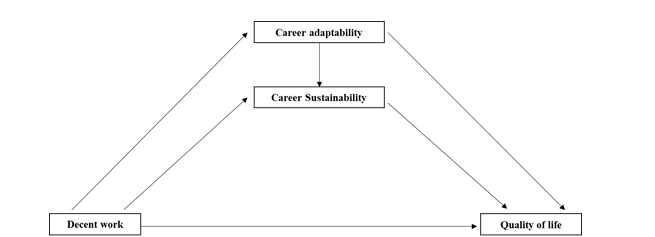
This study aims to analyze the impact of decent work on quality of life, with indirect mediation through job adaptability and career sustainability. The model (Figure 1) assumes that decent work increases career adaptability, which in turn leads to greater career sustainability, ultimately resulting in an improvement in quality of life. Our research hypotheses were formulated as follows: Hypothesis 1 (H1): Decent work has a direct positive impact on an individual’s quality of life. Hypothesis 2 (H2): Career adaptability mediates the relationship between decent work and quality of life, such that decent work promotes greater adaptability, leading to better quality of life.
Hypothesis 3 (H3): Career sustainability mediates the relationship between decent work and quality of life such that decent work contributes to greater career sustainability, thereby promoting a better quality of life. Hypothesis 4 (H4): Career adaptability and career sustainability act as serial mediators and jointly influence the relationship between decent work and quality of life. Specifically, decent work improves career adaptability, which in turn improves career sustainability and leads to a higher quality of life.
Materials and Methods
Participants
The study included 218 participants aged between 19 and 71 years (M = 44.47, SD = 11.27). The participants held various positions in the tourism industry, including sales manager, hotel manager, receptionist, reservation manager and travel agency employee. All participants were employed in Portugal’s tourism industry in 2023.
Measures
Four measures were used to assess the constructs studied: Decent work: the Decent Work Scale [22] was used, which was adapted for Portugal by Ferreira, et al. [23]. This scale assesses five dimensions of decent work: workplace safety, healthcare, adequate compensation, free time and rest, and organizational values that correspond to family and social values.
Career adaptability: we adopted the Portuguese version of the Career Adapt-Abilities Scale by Savickas and Porfeli [24], which was adapted by Duarte, et al. [25]. This scale assesses four dimensions: concern, curiosity, control, and confidence.
Career sustainability: the Career Sustainability Scale [26] was used. This scale assesses four dimensions: flexible, renewable, integrative, and resourceful.
Quality of life: The WHOQOL-BREF instrument [27] was used, which consists of four domains: physical health, mental health, social relationships and environmental health.
Procedures
The research was approved by the Ethics Committee of Universidade Europeia. Participants were asked to give their consent to participate in the online survey, which included an electronic consent form outlining the aims of the study. The form emphasized the importance of their participation, assured confidentiality, and informed them of their right to voluntarily participate in or withdraw from the study at any time.
PROCESS model 6, a macro developed by Andrew F. Hayes [28], was used for data analysis. Model 6 of PROCESS is a serial mediation model that can be used to examine how an independent variable influences a dependent variable through two sequential mediators.
Results
The results indicate a positive and statistically significant relationship between decent work and quality of life, which supports hypothesis H1 (see Table 1 – Model 1). Approximately 26.5% of the variability in quality of life can be explained by decent work (R² = 0.265). In addition, the analysis revealed a moderately strong relationship between the two variables (β = 0.515, p< 0.001), indicating that the observed relationship is highly significant.
In relation to hypothesis H2, the analysis (see Table 1 – Model 2) shows that decent work significantly affects career adaptability (B = 0.406, p < 0.001), indicating that better working conditions improve career adaptability. This adaptability in turn has a positive effect on quality of life (B = 0.482, p < 0.001), which indicates that greater career adaptability contributes to a better quality of life.
Similarly, for hypothesis H3, decent work was found to have a significant effect on career sustainability (B = 0.588, p < 0.001) and career sustainability was found to have a positive effect on quality of life (B = 0.515, p < 0.001), confirming that higher career sustainability is associated with better quality of life (see Table 1 – Model 3).
| Hypothesis | Model | Variable | R | R-square | Adjusted R-square | B | Beta | t | Sig. |
|---|---|---|---|---|---|---|---|---|---|
| H1 | Model 1: Direct Effect | ||||||||
| Decent Work → Quality of Life | Decent Work | 0.515 | 0.265 | 0.262 | 0.492 | 0.515 | 9.028 | <0.001 | |
| Model 2: Mediation Effect | |||||||||
| H2 | Decent Work → Career Adaptability | Decent Work | 0.406 | 0.163 | 0.161 | 0.406 | 0.406 | 6.67 | <0.001 |
| Career Adaptability → Quality of Life | Career Adaptability | 0.482 | 0.233 | 0.229 | 0.482 | 0.482 | 8.22 | <0.00 | |
| H3 | Decent Work → Career Sustainability | Decent Work | 0.588 | 0.346 | 0.343 | 0.588 | 0.054 | 10.931 | <0.001 |
| Career Sustainability → Quality of Life | Career Sustainability | 0.515 | 0.266 | 0.263 | 0.515 | 0.515 | 9.124 | <0.001 | |
| Serial Mediation | |||||||||
| H4 | Decent Work → Career Adaptability → Career Sustainability → Quality of Life | Decent Work (with mediation) | 0.528 | 0.279 | 0.275 | 0.493 | 0.495 | 8.743 | <0.001 |
| Career Adaptability → Career Sustainability | Career Adaptability | 0.471 | 0.222 | 0.219 | 0.471 | 0.471 | 7.855 | <0.001 | |
| Career Sustainability → Quality of Life | Career Sustainability | 0.523 | 0.274 | 0.27 | 0.523 | 0.523 | 9.312 | <0.001 |
Table 1: Regression Analysis.
For hypothesis H4, the serial mediation analysis (see Table 1 – Serial mediation) shows that decent work significantly influences career adaptability (B = 0.406, p < 0.001), which in turn promotes career sustainability (B = 0.471, p < 0.001). Career sustainability, in turn, has a significantly positive effect on quality of life (B = 0.523, p < 0.001). When career adaptability and career sustainability are included as serial mediators, the direct effect of decent work on quality of life is reduced (B = 0.493, p < 0.001), which underlines the crucial role of these serial mediators. The overall effect of decent work on quality of life is thus mediated by the sequence: decent work → career adaptability → career sustainability → quality of life. These results confirm that career adaptability and career sustainability act as serial mediators and influence the relationship between decent work and quality of life.
Discussion
The results of this study confirm that decent work has a significant positive impact on quality of life (H1), which is consistent with recent findings in the literature. Studies show that better working conditions, including job security and fair treatment, are strongly associated with individual well- being, suggesting that a healthy work environment is crucial for job satisfaction and quality of life (e.g., [8, 15, 29, 30]). For example, recent research by Junker, et al. [29] emphasizes the importance of job resources and a supportive work climate in enhancing employee well-being and life satisfaction. Similarly, studies (e.g., [8, 15, 30]) have shown that a positive work environment contributes significantly to employees’ overall quality of life and mental health, supporting the idea that decent work is an essential component of well-being.
Confirmation of H2 suggests that career adaptability acts as a mediator in the relationship between decent work and quality of life. The data show that decent work promotes greater career adaptability, which in turn leads to higher quality of life. These findings are consistent with career adaptability theory, which emphasizes the importance of the ability to adapt to changes in the work environment for individual success and well-being [31]. The literature supports this view and suggests that career adaptability is crucial for coping with challenges and changes in the labor market and thus contributes to overall well-being [32].
Confirmation of hypothesis 3 (H3) also shows that career sustainability mediates the relationship between decent work and quality of life. Decent work is associated with greater career sustainability, which in turn improves quality of life. This finding supports the notion that career sustainability, which encompasses the ability to maintain long-term employment and balance work and personal demands, is a critical determinant of well-being [33, 34]. Previous studies have shown that career sustainability is closely related to work-life balance, which has a positive impact on quality of life [35].
Finally, the confirmation of hypothesis 4 (H4) shows that career adaptability and career sustainability act as serial mediators in the relationship between decent work and quality of life. The overall effect of decent work on quality of life is mediated by the sequence: decent work → career adaptability → career sustainability → quality of life. This result suggests that career adaptability and career sustainability are interlinked components of a complex mediation process. Decent work increases adaptability, which in turn improves career sustainability and leads to a better quality of life.
Implications
The results support the integration of theories of career adaptability and career sustainability when analyzing the impact of working conditions on quality of life. The serial mediation model presented offers a more comprehensive and dynamic understanding of the interactions between these variables and provides a detailed view of the mediation processes involved.
These results make an important contribution to the existing literature by demonstrating that serial mediation can provide a more comprehensive explanation of the mechanisms through which decent work affects quality of life. The identification of career adaptability and career sustainability as serial mediators highlights the complexity and interconnectedness of these factors in the context of the relationship between working conditions and well-being.
Furthermore, the practical implications of these findings suggest that policies promoting fair and safe working conditions can have a significant impact not only on career adaptability and career sustainability, but also on workers’ quality of life. Investing in programs that promote career adaptability and sustainability can therefore be an effective strategy to improve workers’ quality of life and promote a work environment that supports both career development and personal well-being.
Limitations and Future Research Directions
Several limitations must be acknowledged in this study, including the sample size and the specific context of the research, which focused exclusively on workers in the tourism sector in Portugal. This narrow scope limits the generalizability of the results to other sectors and cultures.
Future research should address these limitations by examining additional mediating variables, such as work engagement and job satisfaction. Research shows that employees who feel valued in a decent work environment tend to show higher levels of engagement, which can contribute to a higher quality of life [29, 30]. Fair and safe working conditions have also been shown to increase job satisfaction and have a positive impact on overall wellbeing [16].
Furthermore, it is important to investigate these relationships in different cultural contexts and industries beyond tourism. Conducting longitudinal studies could further confirm the causal relationships identified in this study. Increasing the sample size and including more heterogeneous populations would improve the external validity of the results. A more comprehensive examination of mediators could provide a more holistic understanding of the mechanisms linking decent work to quality of life**. Longitudinal studies would also facilitate the demonstration of causal pathways and allow the observation of changes over time, providing deeper insights into the dynamic relationships between variables.
Conclusion
This study shows that decent work has a significant and positive impact on quality of life and is mediated by factors such as career adaptability and career sustainability, which play a crucial role in the relationship between working conditions and individual well-being. Serial mediation analysis has led to a deeper understanding of these mechanisms and has shown that decent work can only lead to a substantial improvement in quality of life if individuals develop adaptive skills and promote a sustainable career. Therefore, the improvement of these skills should be promoted at both individual and organizational levels.
This understanding can serve as a basis for public policies-such as workforce development programs, decent work regulations and career guidance and support services- as well as corporate practices, including organizational training and development, promotion of sustainable careers and work-life balance initiatives, to improve quality of life by promoting decent working conditions. It also underlines the importance of flexible and sustainable career strategies in an ever-changing labor market.
References
-
International Labor Organization (1999) Decent Work. Report of the director-general. report of the 87th session. Genebra, Suíça: International Labour Office.
-
International Labor Organization (2022) The future of work in the tourism sector: Sustainable and safe recovery and decent work in the context of the COVID-19 pandemic. Report for the Technical Meeting on COVID-19 and Sustainable Recovery in the Tourism Sector.
-
Ferraro T, Moreira JM, Dos SNR, Pais L, Sedmak C (2018) Decent work, work motivation and psychological capital: An empirical research. Work (Reading, Mass.) 60(2): 339-354.
-
Wang D, Jia Y, Hou ZJ, Xu H, Zhang H, et al. (2019) A test of psychology of working theory among Chinese urban workers: Examining predictors and outcomes of decent work. Journal of Vocational Behavior 115: 103325.
-
Wang M, Wanberg CR (2017) 100 years of applied psychology research on individual careers: From career management to retirement. Journal of Applied Psychology 102(3): 546-563.
-
Blustein DL, Olle C, Connors KA, Diamonti AJ (2016) Decent Work: A psychological perspective. Frontiers in Psychology 7: 407.
-
Duffy RD, Blustein DL, Diemer MA, Autin KL (2016) The psychology of working theory. Journal of Counseling Psychology 63: 127-148.
-
Chen H, Richard OC, Boncoeur OD, Ford DL (2020) Work engagement, emotional exhaustion, and counterproductive work behavior. Journal of Business Research 114: 30-41.
-
Allan BA, Tebbe EA, Bouchard LM, Duffy RD (2019) Access to decent and meaningful work in a sexual minority population. Journal of Career Assessment 27(3): 408-421.
-
Allan BA, Batz BC, Sterling HM, Tay L (2018) Outcomes of meaningful work: A meta-analysis. Journal of Management Studies 55(3): 500-528.
-
Nauta MM (2013) Holland’s theory of vocational choice and adjustment. In: Lent RW, Brown SD (Eds.), Career development and counseling. putting theory and research to work. John Wiley, Hoboken, NJ, USA, pp: 55- 82.
-
Belloni M, Carrino L, Meschi E (2022) The impact of working conditions on mental health: Novel evidence from the UK. Labour Economics 76: 102176.
-
Wan W, Cao T (2022) Linking decent work and well-being among Chinese millennial employees: A psychology of working perspective. Frontiers in Psychology 13: 909423.
-
Wan W, Duffy RD (2023) Decent work and turnover intentions among chinese millennials: A longitudinal study. Journal of Career Development 50(4): 933-946.
-
Diener E, Oishi S, Tay L (2018) Advances in subjective well-being research. Nat Hum Behavior 2: 253-260.
-
Kaan NM, Tufan C, Sani MI, Arun K (2024) Decent Work, employee satisfaction, and the mediating role of social courage in reducing turnover. Sage Open 14(2).
-
Savickas ML (2013) The theory and practice of career construction. In: Brown SD, Lent RW (Eds.), Career development and counselling: Putting theory and research to work. Wiley, Hoboken, USA, pp. 147-183.
-
Koen J, Klehe UC, Van VAEM (2012) Training career adaptability to facilitate a successful school-to-work transition. Journal of Vocational Behavior 81(3): 395- 408.
-
De VA, Van HBIM (2017) Current thinking on contemporary careers: The key roles of sustainable HRM and sustainability of careers. Current Opinion in Environmental Sustainability 28: 41-50.
-
Van HBIJM, De VA (2015) Sustainable careers: Introductory chapter. In: Vos AD, Van Der Heijden BIJM (Eds.), Handbook of research on sustainable careers. Cheltenham, Edward Elgar Publishing, UK, pp: 1-19.
-
Van HB, De VA, Akkermans J, Spurk D, Semeijn J, et al. (2020) Sustainable careers across the lifespan: Moving the field forward. Journal of Vocational Behavior 117: 103344.
-
Duffy RD, Allan BA, England JW, Blustein DL, Autin KL, et al. (2017) The development and initial validation of the Decent Work Scale. Journal of Counseling Psychology 64: 206-221.
-
Ferreira JA, Haase RF, Santos ER, Rabaça JA, Figueiredo L, et al. (2019) Decent work in Portugal: Context, conceptualization, and assessment. Journal of Vocational Behavior 112: 77-91.
-
Savickas ML, Porfeli EJ (2012) Career adapt-abilities scale: Construction, reliability, and measurement equivalence across 13 countries. Journal of Vocational Behavior 80(3): 661-673.
-
Duarte ME, Soares MC, Fraga S, Rafael M, Lima M R, et al. (2012) Career Adapt-Abilities Scale–Portugal Form: Psychometric properties and relationships to employment status. Journal of Vocational Behavior 80: 725-729.
-
Chin T, Jawahar IM, Li G (2022) Development and Validation of a Career Sustainability Scale. Journal of Career Development 49(4): 769-787.
-
WHO Quality of Life Assessment Group (1996) What quality of life? World Health Forum 17(4): 354-356.
-
Hayes AF (2018) Introduction to mediation, moderation, and conditional process analysis: a regression-based approach. Guilford Publications.
-
Junker NM, Kaluza AJ, Häusser JA, Mojzisch A, Dick R, et al. (2021) Is work engagement exhausting? The longitudinal relationship between work engagement and exhaustion using latent growth modeling. Applied Psychology: An International Review 70(2): 788-815.
-
Mazzetti G, Robledo E, Vignoli M, Topa G, Guglielmi D, et al. (2023) Work engagement: A meta-analysis using the job demands-resources model. Psychological Reports 126(3): 1069-1107.
-
Savickas ML (2005) The theory and practice of career construction. In S D Brown, R W Lent (Eds.), Career development and counseling: Putting theory and research to work. John Wiley & Sons, Inc, pp: 42-70.
-
Lent RW, Brown SD (2006) On conceptualizing and assessing social cognitive constructs in career research: A measurement guide. Journal of Career Assessment 14(1): 12-35.
-
Greenhaus JH, Powell GN (2006) When work and family are allies: A theory of work-family enrichment. The Academy of Management Review 31(1): 72-92.
-
Greenhaus JH, Powell GN (2012) The family-relatedness of work decisions: A framework and agenda for theory and research. Journal of Vocational Behavior 80(2): 246- 255.
-
De VA, Van HBIJM, Akkermans J (2020) Sustainable careers: Towards a conceptual model. Journal of Vocational Behavior 117: 103196.
- Systematic Review and Meta-analysis Investigating the Prevalence of Depression, Anxiety, Loneliness and Help seeking among International Students
- Family Experiences and their Interpretations as a Source of Adaptive Behaviour in Young Adults: A Qualitative Model of Adaptive Behaviour
- The Development of Responsibility in Teenage Mothers: A Qualitative Model
- Post-Truth Reality: Worldwide Infodemia and Mental Health Concerns during and Post COVID-19 Pandemic Scenarios
- Psycho-Emotional Rehabilitating Means of Overcoming Extreme and Stressful Impact
- The Paradox of Humbleness, Arrogance and the Concept of Fluid Individuality