
A Study to Assess the Effectiveness of Structured Teaching Programme on Knowledge Regarding Substance Abuse and Its Prevention among Late Adolescence Non-Medical under Graduate Students at Selected College of Surat City
Quantitative approach was used with pre-experimental one group pre-test post-test design. The structured teaching program regarding substance abuse and its prevention among late adolescence non-medical under graduate students at selected college of surat. The study was conducted at Industrial training institute, Majura gate, Surat. The sample of 60 ITI students were selected though non probability convenient sampling technique. A structured knowledge questionnaire was prepared to assess the knowledge of sample. Content validity of the developed tools and structured teaching program was established by 5 experts and necessary modifications were made as suggested by them. Reliability of the tool was ascertained by karl pearson’s coefficient correlation method. The mean pre-test score was 9.95 and mean post-test knowledge score was17.13. significant of the difference between pre-test and post-test was statistically tested using paired ‘t’ test and it was found significant at 0.05 level. There was significant increase in the knowledge of the sample after administration of the structured teaching program regarding substance abuse and its prevention among late adolescent non-medical under graduate students. Hence it is concluded that structured teaching program was effective in improving the knowledge of the students.
Introduction
Substance abuse is growing problem throughout the world and unfortunately this is more common among young children and adolescents, where they are about to various reasons. Substance abuse refers to use of drugs, alcohol and any other mind – altering agent to such an extent that it interferes with the person’s biological or social integrity. Adolescent use of tobacco and alcohol should be minimized because they can be ‘‘gate way drugs ’’ for other drugs (marijuana, cocaine hallucinogens, inhalant, and heroin) [1]. Teenage drug abuse – effect on schooling: the adolescent drug/ alcohol user’s academic performance is severely impaired, along with his or her level of responsibility – such as skipping class, failing to complete assignments, etc. this abuse has produced teenage students body’s with many abusers whose relationship, reputations, futures, wallets, self-images and especially grades suffer as a direct result of the teen drug abuse. One might readily argue that teenage drug abuse has reached epidemic proportions on some college campuses and high school facilities.
Objective
- To assess the knowledge regarding substance abuse and its prevention among late adolescent non-medical under graduate student at selected college of surat city [2].
- To evaluate the effectiveness of structured teaching programme on knowledge regarding substance abuse and its prevention among late adolescent non -medical under graduate student at selected college.
Hypothesis
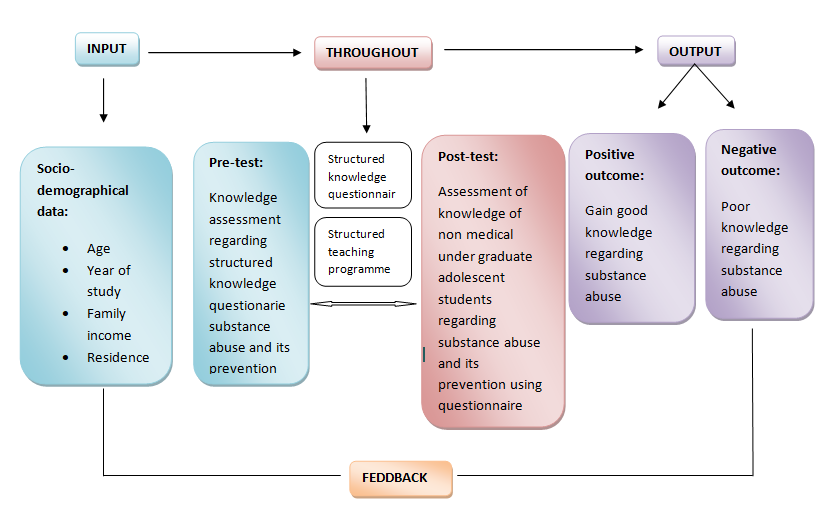
H1: Mean posttest knowledge score regarding substance abuse and its prevention among late adolescent is significant higher than mean pretest knowledge score as evidenced by structured knowledge questionnaire at 0.05 level (Figure 1).
Material and Methods
Research Methodology
This chapter deals with the methodology selected by the investigator to study the effectiveness of structure teaching program on knowledge regarding substance abuse among late adolescent non-medical under graduate students at selected college of Surat city [3].
Research methodology involves the systematic procedure, by which the investigator starts from the initial identification of the problem to its conclusion. It was considered as the backbone or the structure of the study [4]. So methodology was a significant part of an investigation under which the investigator was able to project a conclusion of the study undertaken.
Research Approach
Quantitative research approach
Research Design
In this present study pre-experimental and one group pre-test and post-test design.
Variables
Independent variables According to Treece and Treece (1988) the independent variable is the one variable that stands alone and not dependent on any other. It is cause of the action [5]. In this study the independent variable will be plan on structure teaching program regarding substance abuse and its prevention.
Dependent variables Dependent variables are the effect of the action of the independent variable and cannot exist by it. In this study the dependent variables knowledge regarding substance abuse and its prevention.
Demographic variables An uncontrolled variable that greatly influences the result of the study is called as the demographic variables.
- In this study the demographic variables are age, year of study, education, family income, type of family, area of residence.
- Research Setting
- The setting is the physical location and conditions in which data collection takes place. This study was conducted at industrial training institute, majura gate, Surat.
- Research Population
- Population is the entire aggregation of subject that meets a designed set of criteria. It is sometime referred to as the target population. In this study the population comprises of all undergraduate students.
- Sampling Technique
- Sample: A sample of 60 undergraduate students who met the inclusion criteria were selected from the target population for this study. Non-probability convenience sampling technique.
- Inclusion criteria
- Undergraduate students
- Adolescent student who will be available at the time of data collection.
- Exclusion criteria
- •
- Adolescent students who are absent on the day of data collection.
- •
- Adolescent students who are not co-operative.
- Results
- Level of Knowledge pretest posttest f
- % f
- % poor
- 4
- 6.67%
- 0
- 0.00% average
- 48
- 80%
- 6
- 10% good
- 8
- 13.33%
- 54
- 90%
Table 1: Data pre-test and post-test level of knowledge
The data presented out of under graduate students majority (80%) of them where in the age group of 18-20 years and the minority (20%) of them where in the age group of 20-22 years. Year of the study of under graduate students are (50%) of them where in the first year and (50%) of them in second year. Family income of the under graduate students majority (63.33%) of them who have up to Rs.10,000 and minimum (11.67%) of them who have Rs.30,000 family income (Table 1). Type of family of under graduate students majority (61.67%) of them have joint family and (17%) of them are in the nuclear family. Residence of under graduate students’ majority (95%) of them live at the home and minimum students (5%) of them live at hostel. According to the data pre-test and post-test level of knowledge majority (80%) average knowledge, (6.66%) poor knowledge, and (13.33%) good knowledge in pretest but in posttest majority (90%) hade good knowledge and (10%) had average knowledge.
Limitation of the Study
- The study is delimitation to late adolescent student who are able to understand English/Gujrati.
- The study is delimitation is 60 samples only.
Recommendation
On the basis of findings of the study the following recommendation were made:
- The study can be replicated on large sample, there by findings can be generalized for a large population.
- A similar study can be conducted with survey type research [6, 7].
- A comparative survey study can be conducted among non-medical students in selected colleges in Surat.
- Follow up of present study subject can be done to evaluate the long term effect of guidelines.
- A similar study can be done using and another teaching strategies e.g. guidelines, self-instructional module etc.
Conclusion
On the basis of findings of the study the following conclusion were drawn:
- The deficit knowledge regarding substance abuse disorder of late adolescent non-medical undergraduate students existed in all content area in varying degree.
- The planned teaching programme was found to be effective in increasing the knowledge of late adolescent non-medical undergraduate students.
References
-
Basavanthappa R (2007) Text Book of Psychiatric Nursing. 1st (Edn), New Delhi: Jaypee Brothers.
-
Bimla Kapoor (1994) Text Book of Psychiatric Nursing. 1st (Edn), Kwnar Publishing House.
-
Dorothy D Theodore (2014) Text Book of Mental Health Nursing. Reed Elsevier India Private Limited.
-
Neeraja KP (2008) Essentials of Mental Health And Psychiatric Nursing. 1st (Edn), Jaypee Publishers Pvt, pp: 18.
-
Mahajan BK (1997) Methods in Biostatics. 6th (Edn), New Delhi: Jaypee Brothers.
-
Manisha Gupta (2015) Text Book of Therapeutic Modalities In Psychiatric Nursing. Jaypee Brothers Medical Publishers (P) Ltd, pp: 268.
-
Sreevani R (2016) A Guide To Mental Health and Psychiatric Nursing. 2nd (Edn), Jaypee Brothers Publication, pp: 518.
- Teaching Cognitive Behavioral Therapy to Graduate Psychiatric Mental Health Nurse Practitioner Students: Utilizing A Mixed Methods Course Evaluation
- The Role of Pharmacogenetic Testing in Clinical Practice: A Path toward more Effective, Personalized and Cost-effective Care
- Implementing Screening with the GAD-7 in an Outpatient Mental Health Setting: A Quality Improvement Project
- Social Media and Health Promotion
- Impact of Covid-19 Pandemic on the Academic Performance and Attitude of Nursing Students towards E-Learning
- A Study to Assess the Knowledge Regarding Ill Effects of Tobacco Consumption on Health among Adolescents in Selected Higher Secondary School in Nadiad City