
Effectiveness of Educational Program on Knowledge about Infection Control Measures among the Nursing Students
Background: Infection prevention and control (IPC) is a practical, evidence-based approach preventing patients and health workers from being harmed by avoidable infections. The investigators during their clinical experience observed that the incidence of nosocomial infection increased because of unhygienic practices. These things provoked us to select the following topic for the study to improve the knowledge of nursing students regarding infection control. Method: Quantitative pre-experimental one group pre-test and post-test design was used in the study. A sample size of 60 nursing students was selected using purposive sampling technique. Structured knowledge questionnaire was developed for data collection and a structured teaching program was carried out. Results: Findings of the study indicated that the mean pretest knowledge score was 14.02 and mean post-test score was 23.87. Mean difference was 9.85 and obtained “t” value 33.091 was significant at 0.05 level. Hence, it was inferred that the structured teaching program was effective in increasing the knowledge of nursing students regarding infection control measures. Conclusion: Study concluded that continue educational intervention is the need of hour in enhancing knowledge level of nursing students regarding infection control measures.
Abbreviations
IPC: Infection Prevention and Control; HAI’s: Hospital Acquired Infections.
Introduction
Infection prevention and control (IPC) is a practical, evidence-based approach preventing patients and health workers from being harmed by avoidable infections. At all tiers of the health system including politicians, facility administrators, healthcare providers, and patients continuous activity is necessary for effective IPC [1]. The main goals of infection control programs were to concentrate on HAI surveillance and integrate fundamental epidemiological knowledge to clarify risk factors for HAIs. However, most of the infection control programs were organized and managed by large academic centers rather than public health agencies which lead to sporadic efficiency and suboptimal outcomes [2]. A study found person, task, and organizational level factors were the primary barriers and facilitators to infection control at this hospital. High rates of nursing staff turnover, the time required to train new hires, language competency issues, and intense clinical workloads were among the main obstacles.. A well-developed infection control team and an institutional climate that prioritizes infection control were major facilitators [3]. Gupta R, et al. [4] revealed overall score for infection control practices was low, with knowledge score being 51%. The gaps were identified across all components with major gaps in the knowledge of care of devices (74%), barrier nursing/isolation precautions (60%), indications of using hand rub (55%), understanding the meaning of healthcare-associated infections, AMR (50%) and optimum use of personnel protective equipment (44%) [4]. Kanwar V, et al. [5] found that knowledge regarding biomedical waste management (76%) could be labelled as good knowledge. Hospital acquired infections accounted for the least amount of familiarity for the nurses (26.2%). Overall there was moderate knowledge about hand hygiene (47.1%), sterilization and disinfection techniques (44.9%) and infection control practices in the ward (46.6%) [5]. Goyal M, et al. [6] found significant difference in the scores of pretests and posttests and also statistically significant difference in scores of all 3 domains- Nosocomial infections, Standard Precautions and Hand Hygiene. The results suggest that educational and training programs have positive impact on knowledge of HCS regarding nosocomial infections, standard precautions, and hand hygiene [6]. Rabiu, et al. [7] also indicated the respondents’ knowledge mean score before and after the intervention differed significantly (t=- 22.96, p = 0.00). Majority of the respondent had moderate knowledge about infection control measures, but they showed lack of skill prior intervention but was noted to increase significantly during post intervention [7]. The investigators during their clinical experience observed that the incidence of nosocomial infection increased because of unhygienic practices. This will increase the length of stay in hospital and increase the healthcare assonated infection. These things provoked us to select the following topic for the study to improve the knowledge of nursing students regarding infection control.
Statement of Problem
“A study to evaluate the effectiveness of structured teaching program on knowledge about infection control measures among nursing students of selected nursing institutes at Udaipur Rajasthan”.
Objectives
- To assess the level of knowledge regarding infection control measures among nursing students of selected nursing institutes at Udaipur.
- To evaluate the effectiveness of structure teaching program on level of knowledge regarding infection control measures among nursing students.
- To find out the association of the pre-test knowledge score of nursing students regarding infection control measures with their selected demographic variables.
Material and Methods
Research Approach
Quantitative approach was used for the study.
Research Design
Pre experimental one group pretest post-test research design was used to conduct study.
Research Setting
Study was conducted at Mass College of nursing Udaipur, Rajasthan.
Population
Study population consisted of all B.Sc. Nursing students studying in Mass College of nursing Udaipur, Rajasthan.
Sampling Technique and Sample
60 nursing students studying in Mass College of nursing Udaipur, Rajasthan selected through non-probability purposive sampling technique.
Research Tool
The study’s chosen instruments are split into two portions. • Section I: Socio-demographic variables included 10 items such as age, gender, educational status, religion, previously attended seminar regarding infection control measures regarding infection control measures.
• Section II: Consists of self-structured questionnaires to assess the level of knowledge regarding infection control measures among nursing students. The tool consisted of 30 multiple choice questions to measure the level of knowledge regarding infection control measures among nursing students. Each item contained four possible responses: one right answer and three incorrect ones.. The correct answer was given a score of 1 and wrong answer was given a score of 0. The total possible score was 30 Content validity of tool was established through experts in the field of nursing. Reliability as tool was established by split half method and calculated Karl Pearson’s correlation coefficient was 0.82 which was acceptable for the study. An information sheet outlining the goal and results of the study was given to each subject prior to the administration of the instrument. Participants provided their informed consent and were given self-explanatory materials. Authorization for the research was obtained from relevant authorities.
Results
| S. No. | Demographic Variables | Freq. | % |
|---|---|---|---|
| 1 | Age (in years) | ||
| a) | 18 years | 0 | 0% |
| b) | 19-21 years | 53 | 88.33% |
| c) | 22-24years | 7 | 11.67% |
| d) | > 24 years | 0 | 0% |
| 2 | Gender | ||
| a) | Male | 36 | 60% |
| b) | Female | 24 | 40% |
| 3 | Religion | ||
| a) | Hindu | 52 | 86.67% |
| b) | Muslim | 8 | 13.33% |
| c) | Christian | 0 | 0% |
| d) | Others | 0 | 0% |
| 4 | Course of study | ||
| a) | B.sc Nursing Part-I | 40 | 66.67% |
| b) | B.sc Nursing Part-II | 9 | 15% |
| c) | B.sc Nursing Part-III | 11 | 18.33% |
| d) | B.sc Nursing Part-IV | 0 | 0% |
| 5 | Have you attended any seminar, conference or workshop regarding infection control measures | ||
| a) | Yes | 23 | 38.33% |
| b) | No | 37 | 61.67% |
Table 1: Distribution of sample according to socio demographic variables (N=60).
According to Table 1, out of 60 nursing students, 88.33% nursing students were in the age group of 19-21 years, 11.67% were in the age group of 22-24 years. Majority of nursing students 60% were male and 86.67% nursing students were from Hindu religion. As per Course of study, 66.67% nursing students were from B.sc Nursing Part-I and only 38.33% nursing students had attended seminar, conference or workshop regarding infection control measures.
Figure 1, Depicts the distribution of pre – test and post – test scores of knowledge regarding infection control measures. In pre – test majority of nursing students 51 (85 %) had inadequate knowledge level and 9 (15%) had moderately adequate knowledge level while in post- test majority 33 (55%) of nursing students had adequate knowledge level and 27 (45%) had moderately adequate knowledge level regarding infection control measures.
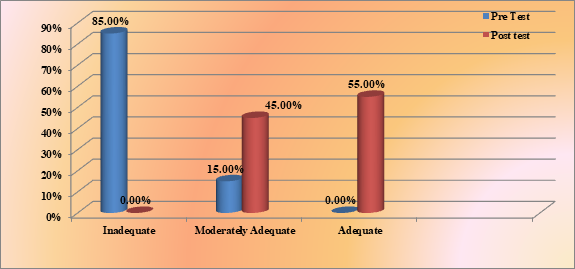
Table 2, while comparing in between pre-test and post- test level of knowledge among nursing students regarding infection control measures, mean pre-test knowledge score was 14.02 and mean post-test score was 23.87. Mean difference was 9.85. It shows that there is significant difference between the pre-test and post-test level of knowledge regarding infection control measures among nursing students. The Paired ‘t’ test value was 33.0914 was greater than table value (2.00 at df-59) at 0.05 level of significance. It shows that there is significant difference between the pre- test and post-test level of knowledge regarding infection control measures among nursing students.
| Sr. No. | Observation | Mean | SD | Mean Difference | Paired ‘t’ value |
|---|---|---|---|---|---|
| 1 2 | Pre-test Post-test | 14.02 23.87 | 1.53 1.81 | 9.85 | 33.0914 |
Table 2: Comparison of mean pre-test and mean post-test score of knowledge among samples (N=60).
The data in Table 3 shows that there is no significant association between level of knowledge and selected demographic variables such as age, gender, religion, course of study, attended any conference and workshop regarding infection control measures, at < 0.05 level. As all demographic variables was not associated with the knowledge level of the nursing students.
| S. No. | Demographic Variables | Level of knowledge | X2 | Table Value | Level of significance | ||
|---|---|---|---|---|---|---|---|
| Freq. | In-adequate | Mod.Adequate | |||||
| 1 | Age (in years) | ||||||
| a) | 18 years | 0 | 0 | 0 | 0.003 | 3.84 | NS |
| b) | 19-21 years | 53 | 45 | 8 | |||
| c) | 22-24years | 7 | 6 | 1 | |||
| d) | > 24 years | 0 | 0 | 0 | |||
| 2 | Gender | ||||||
| a) | Male | 36 | 30 | 6 | 0.196 | 3.84 | NS |
| b) | Female | 24 | 21 | 3 | |||
| 3 | Religion | ||||||
| a) | Hindu | 52 | 43 | 9 | 1.628 | 3.84 | NS |
| b) | Muslim | 8 | 8 | 0 | |||
| c) | Christian | 0 | 0 | 0 | |||
| d) | Others | 0 | 0 | 0 | |||
| 4 | Course of study | ||||||
| a) | B.sc Nursing Part-I | 40 | 34 | 6 | 0.194 | 5.99 | NS |
| b) | B.sc Nursing Part-II | 9 | 8 | 1 | |||
| c) | B.sc Nursing Part-III | 11 | 9 | 2 | |||
| d) | B.sc Nursing Part-IV | 0 | 0 | 0 | |||
| 5 | Have you attended any seminar, conference or workshop regarding infection control measures | ||||||
| a) | Yes | 23 | 17 | 6 | 3.595 | 3.84 | NS |
| b) | No | 37 | 34 | 3 |
Table 3: Associations between pre-test scores of knowledge regarding infection control measures among nursing students with demog
Discussion
The present study was aimed at assessing the effectiveness of structured teaching program on knowledge about infection control measures among nursing students. The key focus of the present study was infection control measures as many studies and reports revealed prevalence of poor knowledge among health care workers. Findings of the study revealed that in pre-test majority of nursing students 85 % had inadequate knowledge level and 15% had moderately adequate knowledge level and none of the nursing students had scored good level of knowledge regarding infection control measures. Our study findings were supported by a study conducted by Eskander H, et al. [8]
with similar objectives and findings which were that 63.6% of samples had unsatisfactory knowledge level regarding infection control standard precautions among clinical nurses. Our findings were partially supported by study conducted by Al-Ahmari AM, et al. [9] in which one third of participants (31.6%) had poor knowledge about infection control. A research study conducted by Kanwar V, et al. [5] also revealed that participants had moderate knowledge about hand hygiene (47.1%), sterilization and disinfection techniques (44.9%) and infection control practices in the ward (46.6%).
Our study also found that in post-test majority 33 (55%) of nursing students had adequate knowledge level and 27
(45%) had moderately adequate knowledge level. Gaikwad UN, et al. [10] also found average percentage of test score increased significantly from 19.71% (pre-test score) to 76.69% (post-test score). Raj MAM, et al. [11] also found 18% student nurses had good knowledge score and 82% had average knowledge score in post-test regarding prevention of hospital acquired infection.
In our study mean pre-test knowledge score was 14.02 and mean post-test knowledge score was 23.87. Mean difference was 9.85. The Paired ‘t’ test value was 33.09 was greater than table value (df-59) at .05 level of significance. Our study finding supported by study conducted by Priya M, et al. [12] in which effectiveness of structured teaching programme was established regarding knowledge and practice on infection control measures in labour room among the nursing students. Similar findings of effectiveness of educational intervention on level of knowledge regarding Hospital Acquired Infections were revealed by a study conducted by Degavi G. et al. [13]. Aby AR [14] also found effectiveness of structured teaching programme regarding knowledge on nosocomial infections in newborns among the staff nurses. Tak HK, et al. [15] also found effectiveness of educational intervention in their study. Our study found that there was no significant association between pre-test knowledge score regarding infection control measures among nursing students with demographic variables like age, gender, religion, course of study and attended of any seminar, conference or workshop regarding infection control measures. Our findings were supported by a study conducted by Meera Raj MAM, et al. [11]. Our findings were partially supported by a study conducted by Hiremath S, et al. [16]. Gupta MM, et al. [17] also revealed no significant association between pre-test knowledge score regarding Prevention of Nosocomial Infections among B.Sc. nursing 1st Year Student.
While contradictory findings revealed by Narasimhaiah J, et al. [18] in which significant association between post- test knowledge scores and selected demographic variables was revealed regarding prevention of nosocomial infection among staff nurses. Saini P [19] also found significant association of knowledge level with demographic variables. Some studies by Anjali M, et al. [20] and Kumar S, et al [21], Singh M, et al. [22] and Pareek S, et al. [23] also revealed that learning packages were effective in enhancing the knowledge of the participants.
Conclusion
The study concluded that structured teaching program was effective in enhancing knowledge level of nursing students regarding infection control measures. This study also showed that there was no significant association between the knowledge score and the demographic variables. Study suggests regular educational intervention to improve knowledge level of nursing students and other direct health care provider staff regarding infection control measures.
Limitations
The small size of the sample made it difficult to draw generalization; Purposive sampling technique was used for conducting this study which restricts the generalization of result.
Source of Funding
The current study was self-financed by the researcher.
Conflict of Interest
The current study was carried out without any conflicts of interest.
References
-
Infection Prevention and Control. WHO.
-
Habboush Y, Yarrarapu SNS, Guzman N (2022) Infection Control. In: StatPearls [Internet]. Treasure Island (FL): StatPearls Publishing.
-
Barker A, Brown K, Siraj D, Ahsan M, Sengupta S, et al. (2017) Barriers and Facilitators to Infection Control at a Hospital in Northern India: A Qualitative Study. Antimicrobial Resistance & Infection Control 6.
-
Gupta R, Sharma S, Yadav A, Arora U, Bhattar S, et al. (2020) A Multicentric Study to Ascertain Knowledge, Attitude and Practices for Infection Prevention and Control amongst Nurses. Journal of Patient Safety and Infection Control 8(1): 21-28.
-
Kanwar V, Sood A, Gupta PK, Salaria N (2015) Knowledge Regarding Infection Control Practices among Nurses in Rural Public Health Settings: An Emerging Public Health Concern in India. International Journal of Health Sciences and Research 5(2): 282-287.
-
Goyal M, Chaudhry D (2019) Impact of Educational and Training Programs on Knowledge of Healthcare Students Regarding Nosocomial Infections, Standard Precautions and Hand Hygiene: A Study at Tertiary Care Hospital. Indian J Crit Care Med 23(2): 227-231.
-
Arison E, Popoola RO, Olajide T, Adeola OE (2020) Outcome of Nursing Intervention on Knowledge and Skill of Infection Control among Nurses in Ekiti State University Teaching Hospital Ado-Ekiti, Ekiti State. IOSR Journal of Nursing and Health Science (IOSR-JNHS) 9(3): 21-28.
-
Eskander H, Morsy W, Elfeky H (2013) Intensive Care Nurses’ Knowledge & Practices Regarding Infection Control Standard Precautions at a Selected Egyptian Cancer Hospital. Journal of Education and Practice 4(19): 160-174.
-
Al-Ahmari AM, Ahmed M, Alkhaldi (2021) Knowledge, Attitude and Practice about Infection Control among Primary Care Professionals in Abha City, Kingdom of Saudi Arabia. J Family Med Prim Care 10(2): 662-668.
-
Gaikwad UN, Silpi B, Kulkarni P, Sande S, Cahavan S, et al. (2018) Educational Intervention to Foster Best Infection Control Practices Among Nursing Staff. International Journal of Infection 5(3): e81531.
-
Raj MAM, Singh H (2022) A Study on The Effectiveness of Structured Teaching Programme on Knowledge Regarding Prevention of Hospital Acquired Infection among Student Nurses of Selected Colleges of Meerut. Inter J Nursing Edu Res 10(2): 174-178.
-
Priya M, Gandhi RM (2023) A Study to Assess Effectiveness Structured Teaching Programme was Established Regarding Knowledge and Practice on Infection Control Measures in Labour Room among Fourth Year BSC(N) Students in Selected Nursing Colleges of Tumkur. Asian Journal of Nursing Education and Research 13(3): 221- 225.
-
Degavi G, Damalli V, Jevoor P (2015) Effectiveness of Structured Teaching Programme (STP) on selected Aspects of Hospital Acquired Infections (HAI’s). International Journal of Advances in Nursing Management 3(1): 10-17.
-
Aby AR (2015) A Study to Assess the Effectiveness of Structured Teaching Programme Regarding Knowledge on Nosocomial Infections in Newborns among the Staff Nurses Working in Labour and Paediatric Units of Selected Hospitals in Tumkur District. International Journal of Healthcare Sciences 3(1): 110-119.
-
Tak HK, Chaturvedi D, Jeenagar M, Chundawat BS (2021) Effectiveness of Planned Teaching Program Regarding Ebola Virus Disease on the Level of Knowledge among B. Sc. Nursing Students. GFNPSS-Inter J Multidisciplinary Res 2(10): 829-839.
-
Hiremath S, Gudimath S, Kashinathchavan (2022) A Study to Evaluate the Effectiveness of Structured Teaching Programme on Knowledge Regarding the Prevention of Nosocomial Infections in Children. Interl J Sci Healthcare Res 7(2): 262-271.
-
Gupta MM, Pandey A (2022) A Study to Assess the Effectiveness of Structured Teaching Programs on Knowledge Regarding Prevention of Nosocomial Infections among B.Sc. Nursing 1st Year Student at Baba Educational Society, Institute of Paramedical College of Nursing, Lucknow, Uttar Pradesh. International Journal of Research Publication and Reviews 3(9): 730-735.
-
Narasimhaiah J, Moorthy P (2018) Effectiveness of Structural Teaching Programme on Knowledge Regarding Prevention of Nosocomial Infection among Staff Nurses in Selected Paediatric Hospitals of Bengaluru, Karnataka, India. Journal of Evolution of Medical and Dental Sciences 7(35): 3811.
-
Saini P (2020) A Study to Assess the Effectiveness of STP on Knowledge Regarding Prevention of Nosocomial Infection and Hand Hygiene among Nursing Personnel in Selected Hospital Mullana (Ambala). International Journal of Scientific Research 9(10): 11-14.
-
Anjali M, Bijaya M, Shatrughan P (2021) The Knowledge and Practices toward Neonatal Care among Primipara Mothers in Dehradun, Uttarakhand: A Correlation Study. MRIMS J Health Sci 9(2): 124-126.
-
Kumar S, Pareek S (2021) Impact of Video-Assisted Teaching Programs Regarding Hand Hygiene among Oncology Nurses. MGM J Med Sci 8(2): 131-135.
-
Singh M, Pareek S (2019) Evaluation of the Knowledge Regarding Risk Factors of Coronary Artery Disease (CAD) among Patients Attending Medical OPD in Doon Medical College Hospital, Dehradun. J Nursing Sci Prac 9(2): 1-5.
-
Pareek S, Kaushik NK (2018) Implementation and Outcomes of Cardiac Rehabilitation Educational Package: A Tertiary Center Study. International Journal of Nursing Education and Research 6(4): 401-403.
- Teaching Cognitive Behavioral Therapy to Graduate Psychiatric Mental Health Nurse Practitioner Students: Utilizing A Mixed Methods Course Evaluation
- The Role of Pharmacogenetic Testing in Clinical Practice: A Path toward more Effective, Personalized and Cost-effective Care
- Implementing Screening with the GAD-7 in an Outpatient Mental Health Setting: A Quality Improvement Project
- Social Media and Health Promotion
- Impact of Covid-19 Pandemic on the Academic Performance and Attitude of Nursing Students towards E-Learning
- A Study to Assess the Knowledge Regarding Ill Effects of Tobacco Consumption on Health among Adolescents in Selected Higher Secondary School in Nadiad City