
Implementing Screening with the GAD-7 in an Outpatient Mental Health Setting: A Quality Improvement Project
Anxiety disorders are a significant health concern because they impact many individuals and impair their quality of life. Generalized Anxiety Disorder (GAD) is the most common of all anxiety disorders that may affect an individual’s physical and mental health. The project was initiated because the specific site lacked a tool to screen for individuals with generalized anxiety disorders. This quality improvement project was implemented in a suburban outpatient mental health setting using the GAD-7 to screen for generalized anxiety disorders. The overall goal was to understand whether utilizing the tool affected the number of patients screened for anxiety compared to the current practice. Guided by the Plan–Do–Check–Act (PDCA) framework and reported in accordance with the Standards for Quality Improvement Reporting Excellence (SQUIRE 2.0), the project integrated the GAD-7 into the clinic’s electronic workflow using Qualtrics. Data from the electronic health record (EHR) were analyzed across two eight-week periods (pre- and post-implementation). The project demonstrated that screening using the GAD-7 increased the number of patients screened by 81%, a significant change that can improve patient outcomes. The findings from this project highlight the important role of evidence-based screening tools, such as the GAD-7, in improving the diagnosis and management of patients with mental health disorders in outpatient settings.
Abbreviations
GAD-7: Generalized Anxiety Disorder-7; PDCA: Plan– Do–Check–Act; EHR: Electronic Health Record; SQUIRE: Standards for Quality Improvement Reporting Excellence; IRB: Institutional Review Board.
Introduction
Anxiety is increasingly becoming a significant health concern because anxiety disorders such as Generalized Anxiety Disorders (GAD) inflict a heavy toll on people by impairing their ability to thrive, and it impairs their general quality of life of Dursun P, et al. [1]. To identify people experiencing symptoms associated with GAD, the generalized anxiety disorder-7 item questionnaire (GAD- 7) screening tool has emerged as a reliable and valid tool by Azhar E, et al. [2]. However, the effectiveness of this tool in increasing identification in mental health settings is understudied. The disparity in the utilization of the GAD-7 among psychiatric providers in a mental health setting can affect the quality of care. Therefore, the proposed purpose of this quality improvement project was to decrease the gap in the frequency of the GAD-7 being utilized in an outpatient mental health setting. The study has significant implications for mental health professionals, enabling them to understand how implementing a standard of practice improves patients outcome from Byrd-Bredbenner C, et al. [3]. On the other hand, it will allow healthcare practices and systems to develop targeted interventions, allocate resources effectively, and provide enhanced support to people with anxiety. The findings of the quality improvement project will potentially impact early detection and intervention strategies for patients with generalized anxiety in mental health settings by implementing a standard of practice.
Methods
The quality improvement project adopted a plan-do- check-act (PDCA) cycle to assess whether adding the GAD–7 impacted the number of patients screened for anxiety, thus creating an opportunity for identification of previously undetected cases of anxiety. Before the intervention, anxiety screening practices were inconsistent; clinicians relied primarily on clinical interviews, and documentation rarely included standardized anxiety scores. Inconsistent screening has been identified a barrier to accurate diagnosis and timely intervention [2].
The project occurred in a private outpatient mental health clinic located in suburban New York State that provides psychiatric evaluation, medication management, and psychotherapy services to adult clients. Before the intervention, anxiety screening practices were inconsistent; clinicians relied primarily on clinical interviews, and documentation rarely included standardized anxiety scores. This inconsistent screening was identified as a barrier to accurate diagnosis and timely intervention. Institutional priorities emphasized the adoption of measurement-based care to enhance quality metrics and patient outcomes.
During the “Plan” phase, approval was obtained to allocate resources for implementation. The GAD-7 instrument was selected because of its strong psychometric properties (Cronbach α = .92; Spitzer et al., 2006) and it has emerged as an important tool for improving quality and evidenced based care in mental health [4]. Educational sessions introduced the project, its purpose, the Qualtrics survey, and information that will be obtained. In the “Do” phase, the GAD-7 was embedded into the clinic’s digital workflow using Qualtrics. Each patient received the questionnaire electronically before appointments via a Qualtrics survey. The “Check” phase involved weekly audits to track the number of completed screenings and identify workflow issues. In the “Act” phase, minor adjustments—such as automated email reminders— were instituted to sustain compliance and ensure full integration into practice.
Data collection involved retrieving and analyzing patient records from the mental health center’s electronic health record (EHR) system. Reliance on EHR data introduced the possibility of missing or incomplete information; therefore, data collection procedures were important. Baseline Data Collection: Before implementing the GAD-7 screening tool, data was collected on screening for generalized anxiety in the selected healthcare setting during the eight weeks before screening using the GAD-7. This data collection involved reviewing medical records and extracting relevant data, including the number of adult patients screened within those eight weeks. After implementing the GAD-7 screening tool, post-implementation data was collected using a Qualtrics survey.
The primary outcome was the percentage of adult patient encounters with documented GAD-7 screening. Secondary outcomes included provider adherence and data completeness. Data were extracted from the EHR for the eight weeks preceding and following implementation. Demographic variables (age and gender) were recorded but not analyzed because the focus was process improvement. Data accuracy was verified through cross-checking Qualtrics logs with EHR entries. Descriptive statistics summarized screening frequencies pre- and post-implementation. Percentages were calculated using counts of screened encounters divided by total encounters in each period. Because the projects goal was process improvement rather than hypothesis testing, inferential statistics were not performed. The overall change was measured by finding the difference between the screening rates before and after the project.
This project met criteria for a QI activity and was exempt from Institutional Review Board (IRB) review. All patients were informed that participation in routine anxiety screening was voluntary, and data were de-identified to preserve confidentiality.
Results
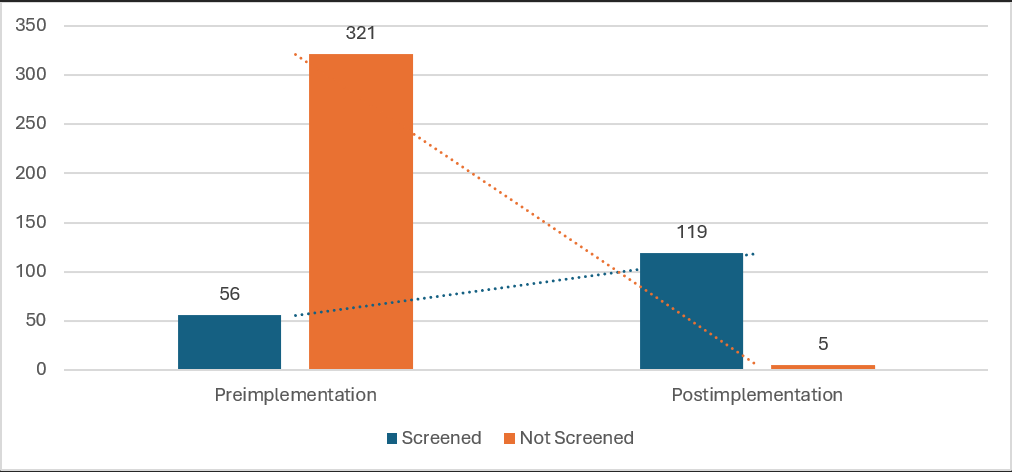
A total of 501 encounters were analyzed: 377 before implementation and 124 after. As noted in Table 1, prior to introducing the GAD-7, only 15 percent (56 of 377) of encounters included documented anxiety screening. Following implementation, 96 percent (119 of 124) included GAD-7 completion, yielding an 81-percentage-point increase. Figure 1 illustrates the improvement in screening rates.
Beyond numerical results, feedback indicated that providers perceived the GAD-7 as efficient and clinically useful. Several clinicians noted that standardized scores facilitated communication with patients about symptom severity and treatment progress. No workflow disruptions or patient complaints were reported, suggesting high acceptability of the tool.
| Baseline characteristic | Encounters | Screened for Anxiety | ||
|---|---|---|---|---|
| N | % | N | % | |
| Pre-implementation | 377 | 75% | 56 | 15% |
| Postimplementation | 124 | 25% | 119 | 96% |
Table 1: Frequencies of Patient Encounters.
Discussion
The routine for providers before the implementation phase was to screen for generalized anxiety during the initial consultation and follow up if indicated. During the implementation phase, patients were screened at every appointment, offering an opportunity to capture changes in patients’ symptoms. The effectiveness of screening with the GAD-7 was assessed by the percentages of patients seen and screened during each time period. Although the GAD-7 does not definitively diagnose someone with generalized anxiety, it offers the provider a quick, reliable, and valid method for detecting anxiety symptoms [2]. Implementation of the GAD- 7 produced a dramatic improvement in documented anxiety screening, supporting the hypothesis that structured, validated tools enhance detection. This data has significant implications and can impact early detection and intervention strategies for patients with generalized anxiety disorders. Early detection can improve patient safety, decrease costs and improve patient outcomes.
The implementation of the Generalized Anxiety Disorders Scale (GAD-7) in a suburban mental health practice demonstrated significant improvements in the screening rates for anxiety, marking a crucial step in enhancing mental health services. The data revealed a substantial increase from 15% to 96% in the screening rates post-implementation, illustrating the effectiveness of integrating the GAD-7 into routine clinical practice. This increase highlights the implementation strategy’s success and underscores the importance of systematic screening in mental health settings. The findings from this quality improvement project confirm that systematic use of the GAD-7 improves screening for anxiety disorders, which are among the most common mental health conditions but often go undiagnosed and untreated. The change demonstrates that even modest workflow modifications—combined with staff education and digital integration—can yield substantial quality gains.
By implementing the GAD-7, the practice will be able to identify patients needing further psychological assessment and intervention, thereby potentially reducing the long-term consequences of untreated anxiety, such as depression and cardiovascular disease [5].
The success of the GAD-7 implementation was significantly aided by the early and ongoing engagement of stakeholders, including mental health providers at the practice. Meeting with the stakeholders and staff and educating them regarding the project and using the GAD-7 via Qualtrics was essential for their buy-in. Future projects should emphasize the importance of involving all stakeholders early to ensure their commitment and address any concerns they may have. Providers need to know how to use the tool and understand its significance and how it fits into the broader goal of improving patient outcomes. Regular training sessions should be part of the implementation strategy.
Using Qualtrics to administer the GAD-7 streamlined the process, making collecting and analyzing data easier. Integrating such technologies in healthcare settings can enhance the efficiency of implementing new tools and practices. Qualtrics surveys allow providers to develop project questions and test and distribute surveys online [6]. Future projects should consider the role of technology in facilitating data collection and management. Lastly, utilizing the Plan-Do-Check-Act (PDCA) cycle was instrumental in evaluating the effectiveness of the GAD-7 implementation and allowed for ongoing adjustments. Continuous monitoring and evaluation should be built into any implementation plan to ensure the tool remains effective and to make necessary improvements.
This project’s successful implementation and results offer significant implications for practice and future projects. The project demonstrates the tool’s effectiveness in a suburban mental health practice, highlighting its potential as a standard component in mental health evaluations. Integrating the GAD-7 will lead to earlier identification and treatment of generalized anxiety disorders and mitigate the progression and severity of the condition. Increasing screening rates post-implementation suggests that integrating the GAD-7 into the routine workflow of outpatient mental health settings is not only feasible but also beneficial. Practices should consider regular updates and training for staff to ensure the tool’s practical use and to keep up with the latest developments in anxiety management. Healthcare policymakers and administrators may consider developing guidelines that utilize validated screening tools, such as the GAD-7. Policies could also outline protocols for responding to high scores, ensuring that patients receive appropriate follow-up care, including referrals to mental health specialists or immediate therapeutic interventions. Continuous professional development sessions should be implemented to educate mental health providers on interpreting and acting upon GAD-7 results. This education should also emphasize the importance of holistic patient care and the potential comorbidities associated with anxiety, such as cardiovascular diseases and depression.
The findings from this project also underscore the necessity for further projects and development in several key areas. Future projects should include longitudinal studies to track the outcomes of patients diagnosed with generalized anxiety disorder through routine GAD-7 screenings. Such studies will provide data on the long-term effectiveness of early detection and ongoing management strategies to influence future clinical guidelines. Extending the use of the GAD-7 to varied settings, including urban clinics, primary care, and specialty practices (like cardiology and gastroenterology, where anxiety often presents as somatic symptoms), could provide insights into the tool’s versatility and effectiveness across different patient demographics and medical specialties.
Investigating the integration of screening tools with electronic health records (EHRs) and telehealth platforms will enhance the accessibility and consistency of screening for anxiety [7]. Research into the development of app-based or web-based platforms that allow for real-time data collection and analysis could further streamline the screening process. Future projects might compare the GAD-7 with other screening tools to determine the most effective instruments for specific patient populations or settings. Comparative effectiveness research could also explore modifications or alternatives to the GAD-7 that address cultural, linguistic, or age-specific factors.
The project’s implications extend to the broader goal of promoting patient-centered care. Increasing patient awareness about the symptoms of anxiety and the importance of screening will empower patients to seek help earlier. Educational campaigns and materials will help demystify the symptoms of anxiety and encourage patients to participate actively in their mental health care [8]. Encouraging collaboration between primary care providers, mental health specialists, and other healthcare professionals will ensure that patients benefit from a comprehensive approach to anxiety management. The project has exemplified how quality improvement initiatives are effectively implemented in clinical settings. Future projects could use similar methodologies to address other mental health or general healthcare areas, promoting continuous improvement in healthcare practices.
Conclusion
This project has demonstrated the impact of implementing the Generalized Anxiety Disorder-7 (GAD- 7) screening tool in an outpatient suburban mental health practice in New York State. Implementing screening substantially increased anxiety screening rates—from
15 percent to 96 percent—over eight weeks. Substantial evidence supporting the integration of GAD-7 into routine clinical assessments to improve the screening, which can then assist in identifying generalized anxiety disorders. The implementation of the GAD-7 has led to a significant increase in the number of patients screened for anxiety, thus facilitating early detection and intervention, which are critical for effective treatment outcomes. The project’s primary outcome indicated that the use of the GAD-7 increased the screening rates from 15% to 96% over the eight-week implementation period. This substantial improvement highlights the tool’s effectiveness in enhancing the detection of anxiety symptoms in patients who might otherwise remain undiagnosed and untreated. The ability of the GAD-7 to integrate seamlessly into existing clinical workflows, coupled with its ease of administration via Qualtrics, underscores its practicality and applicability in diverse healthcare settings.
References
-
Dursun P, Alyagut P, Yilmaz I (2022) Meaning in life, Psychological Hardiness and Death Anxiety: Individuals with or without Generalized Anxiety Disorder (GAD). Current Psychology 41(6): 3299-3317.
-
Azhar E, Fatima H, Umer M, Afridi AK, Arif M, et al. (2025) Increasing utilization of standardized tools for measurement-based care in the management of generalized anxiety disorder. Global Journal on Quality and Safety in Healthcare. Glob J Qual Saf Healthc 8(3): 127-134.
-
Byrd-Bredbenner C, Eck K, Quick V (2021) Gad-7, Gad- 2, and GAD-mini: Psychometric Properties and Norms of University Students in the United States. General Hospital Psychiatry 69: 61-66.
-
Claridad T (2023) Resource Document on Implementation of Measurement-based Care.
-
Sapra A, Bhandari P, Sharma S, Chanpura T, Lopp L (2020) Using Generalized Anxiety Disorder-2 (GAD-2) and GAD- 7 in a Primary Care Setting. Cureus 12(5): e8224.
-
Miller CA, Guidry JP, Dahman B, Thomson MD (2020) A Tale of Two Diverse Qualtrics Samples: Information for Online Survey Researchers. Cancer Epidemiol Biomarkers Prev 29(4): 731-735.
-
Munir S, Takov V (2022) Generalized Anxiety Disorder. The Journal of Clinical Psychiatry 70 (Suppl 2).
-
Spitzer RL, Kroenke K, Williams JBW, Lowe B (2006) A Brief Measure for Assessing Generalized Anxiety Disorder: The GAD-7. Arch Intern Med 166(10): 1092- 1097.
- Teaching Cognitive Behavioral Therapy to Graduate Psychiatric Mental Health Nurse Practitioner Students: Utilizing A Mixed Methods Course Evaluation
- The Role of Pharmacogenetic Testing in Clinical Practice: A Path toward more Effective, Personalized and Cost-effective Care
- Social Media and Health Promotion
- Impact of Covid-19 Pandemic on the Academic Performance and Attitude of Nursing Students towards E-Learning
- A Study to Assess the Knowledge Regarding Ill Effects of Tobacco Consumption on Health among Adolescents in Selected Higher Secondary School in Nadiad City
- A Study to Assess the Effectiveness of Video Assisted Teaching Programme on Knowledge and Practice Regarding Adult Cardiopulmonary Resuscitation among School Teachers of Selected Schools of Kheda District