
Human Exposure to Micro- and Nanoplastics: Pathways, Toxicity, and Intervention Strategies
Micro- and nanoplastics (MNPs) are emerging global contaminants of profound concern for both environmental integrity and human health. This short communication addresses human exposure to MNPs, examining exposure pathways, toxicological effects, and potential intervention strategies, while outlining future research directions to advance the field.
Abbreviations
MNPs: Micro and Nanoplastics; PE: Polyethylene; PS: Polystyrene; PP: polypropylene; AI: Artificial Intelligence.
Introduction
Micro and nanoplastics (MNPs) are emerging global contaminants of profound concern for both environmental integrity and human health. Recent studies Anik AH, et al. [1, 2, 3, 4, 5, 6, 7, 8, 9, 10, 11, 12, 13, 14, 15] have examined their toxicity, transport pathways, and deposition in biological systems, revealing complex interactions and long-term accumulation in the human body. Lifetime exposure varies by age and sex, with adults consuming an estimated 50,000 particles annually compared to 8,000 for children, and higher gastrointestinal accumulation observed in adult females than males [1]. This short communication addresses human exposure to MNPs, examining exposure pathways, toxicological effects, and potential intervention strategies, while outlining future research directions to advance the field.
Sources and Pathways of Human Exposure
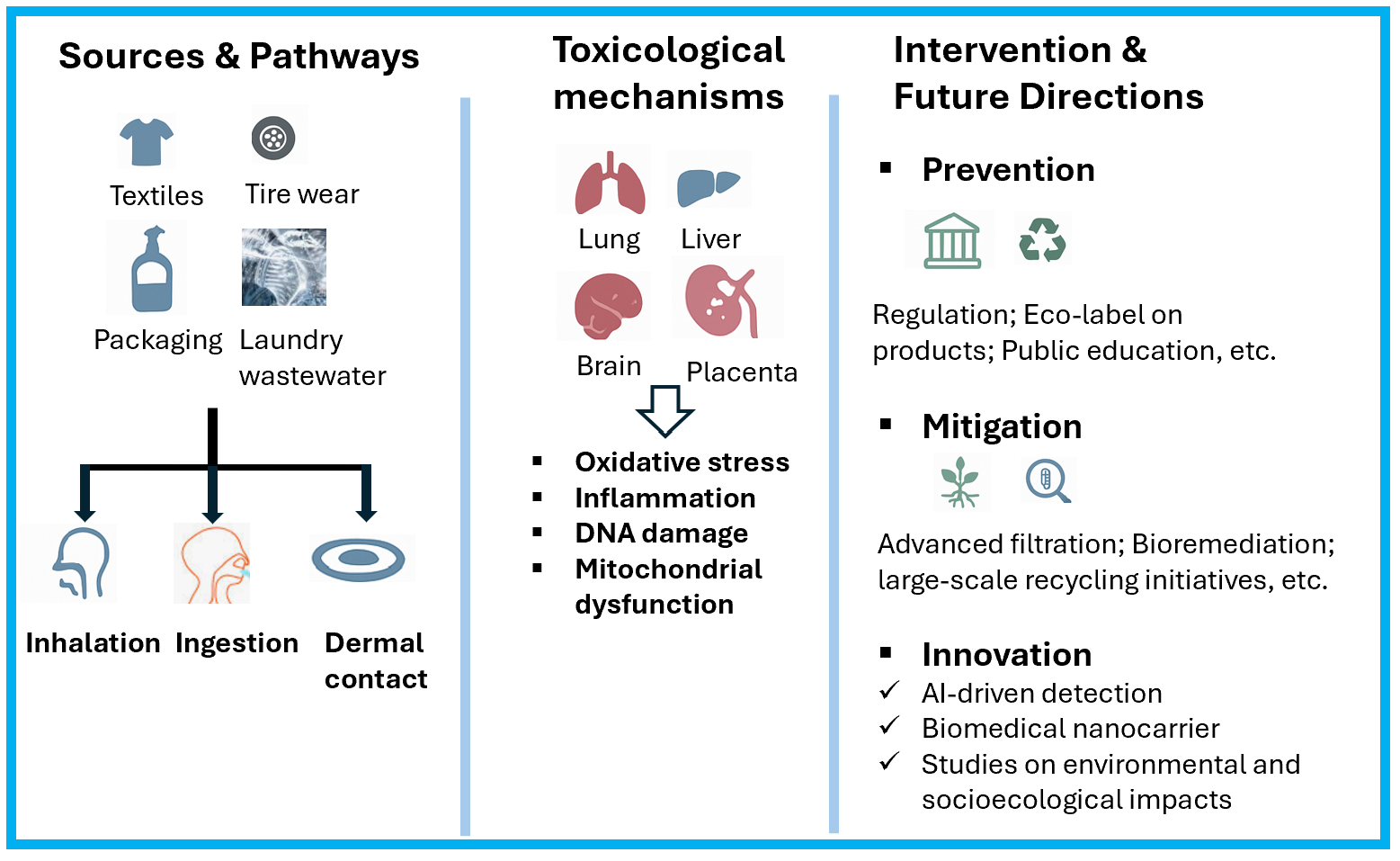
MNPs originate from diverse sources including textiles, packaging, paints, sewage sludge, personal care products, vehicle tire wear, fishing gear, and agricultural films [2, 3]. Notably, overlooked sources such as tire wear particles and laundry wastewater represent major contributors [3]. Once released, MNPs undergo secondary degradation through ultraviolet radiation, thermal stress, and mechanical abrasion, ultimately accumulating in terrestrial, aquatic, and atmospheric compartments—and, subsequently, in plants, animals, and humans. Human exposure occurs via ingestion, inhalation, and dermal absorption.
Inhalation arises from indoor/outdoor air and industrial emissions; ingestion from contaminated food, beverages, and packaging; and dermal uptake from personal care and medical products [2, 3, 4, 5, 6, 7]. MNPs distribute across multiple organs—including the brain, heart, liver, and kidneys— eliciting oxidative stress, inflammation, and genotoxicity [1, 2, 8]. Quantitative evidence confirms MNP presence in multiple human tissues: stool (18 particles/g), blood (3.25 µg/mL), lungs (14.3 particles/g), placenta (4.92 particles/g), and arterial plaques (85 µg/g), primarily comprising polyethylene (PE), polystyrene (PS), and polypropylene (PP) [1]. Despite evidence of tissue accumulation, long-term exposure data remain scarce, and the interaction between MNPs and co-contaminants has yet to be systematically incorporated into risk assessments.
Toxicological Effects
Primary microplastics (MPs) are manufactured for industrial and consumer use, whereas secondary MPs result from fragmentation of larger plastics through photodegradation, mechanical abrasion, and chemical weathering [4]. MPs have been linked to carcinogenicity, yet paradoxically are also being investigated for biomedical applications, such as targeted drug delivery [4]. MNP toxicity is determined by both physical properties (size, shape, charge, surface roughness) and chemical properties (polymer type, additives) [9]. Microplastics (<5 mm) and nanoplastics (<100 nm) exert toxic effects via oxidative stress, inflammation, metabolic disruption, neurotoxicity, reproductive dysfunction, and carcinogenicity [2, 7]. Submicron particles (<1 µm) specifically induce oxidative stress, DNA damage, and cytotoxicity at concentrations >200 µg/mL [1].
MNPs affect multiple organ systems: lungs and systemic circulation (inhalation), liver and gastrointestinal tract (ingestion), and skin and hypodermis (dermal absorption) [2, 3, 4, 5, 6, 7]. Pathways of toxicity include inflammation, oxidative stress, apoptosis, genotoxicity, and mitochondrial dysfunction [2, 3, 5, 6, 7]. Notably, MNPs have been detected in cardiovascular, nervous, reproductive, and digestive systems, with demonstrated cardiovascular toxicity [10, 11]. Breathing patterns influence respiratory deposition, with faster breathing increasing microplastic retention, while slower breathing facilitates deeper NP penetration [11]. Particle morphology further modulates deposition, with non-spherical MPs penetrating deeper into the lungs than spherical ones [11]. At the cellular level, nanoplastics disrupt membranes, impair mitochondria, trigger ROS generation, and promote DNA damage, ultimately driving carcinogenesis and immune dysregulation [9, 12]. Unlike conventional nanoparticles, nanoplastics resist clearance, persisting within lysosomes and potentially exacerbating tumor progression [9]. Evidence underscores a heightened risk in high-exposure groups such as residents of polluted regions and plastic industry workers [4].
Intervention Strategies
The ubiquity of plastic pollution raises concern for a potential “plastics pandemic.” Degradation of plastics may exacerbate antibiotic resistance [13]. Intervention strategies span prevention, mitigation, and biomedical innovation.
Prevention—the most effective strategy—requires strict regulatory frameworks, global standards, and public education to encourage sustainable consumption. Optimizing manufacturing processes, adopting circular economy principles, and developing alternative biodegradable materials are essential.
Mitigation approaches include advanced filtration systems, bioremediation using bioactive compounds, enhanced plastic degradation technologies, and large-scale recycling initiatives [3, 14].
Biomedical applications, paradoxically, position MNPs as potential drug carriers or diagnostic tools for cancer [4], though safety requires rigorous evaluation. Systematic assessment of nanoplastic toxicity, particularly of aged particles and leachates, remains a prerequisite for evidence- based interventions [3].
Future Research Directions
Despite rapid progress, critical gaps persist. These include limited understanding of the chronic effects of low- dose exposure [14, 15]; insufficient investigation of organ- and system-specific toxicities; absence of standardized toxicity testing protocols addressing particle properties such as size, shape, and surface charge; and inadequate methods for separation, collection, and detection of NPs in environmental and biological matrices [3, 5]. Additional gaps include limited knowledge of synergistic toxicities between MNPs and co-occurring environmental contaminants, incomplete characterization of bioaccumulation and biotransformation pathways in humans, and the lack of targeted toxicity assessments in high-risk populations, including occupationally exposed individuals [14].
Research Priorities include
Comparative studies on fresh vs. aged MPs and their leachates.
Dose–response relationships and threshold safety values (e.g., NOAELs) [2].
Synergistic toxicities with other environmental contaminants.
Psychological and physiological effects of chronic MNP exposure [9].
Technological innovation will be key. Artificial intelligence (AI) offers transformative potential for rapid MNP detection, quantification, and mechanistic analysis. Furthermore, climate-driven environmental changes may amplify MNP generation and exposure, disproportionately impacting vulnerable populations, underscoring the need for studies on environmental and socioecological impacts. Integrating toxicology, environmental science, and computational tools will be essential to establishing global standards, guiding regulation, and protecting public health.
Competing Interests
The author declares no competing interests.
References
-
Anik AH, Oishy MN, Murshed MF, Abdullah RB, Khan MR (2025) Distribution and health impacts of micro- and nanoplastics (MNPs) in human organs: Accumulation, translocation, and toxicity– A systematic review of current evidence. Journal of Hazardous Materials Plastics 1: 100002.
-
Bhardwaj G, Abdulkadhim M, Joshi K, Wankhede L, Das RK, et al. (2025) Exposure Pathways, Systemic Distribution, and Health Implications of Micro- and Nanoplastics in Humans. Applied Sciences 15(16): 8813.
-
Lai H, Liu X, Qu M (2022) Nanoplastics and Human Health: Hazard Identification and Biointerface. Nanomaterials 12(8): 1298.
-
Deng X, Gui Y, Zhao L (2025) The micro(nano)plastics perspective: exploring cancer development and therapy. Molecular Cancer 24: 30.
-
Nouri M, Massahi T, Hossini H (2025) Microplastics in human body: a narrative on routes of exposure to contamination and potential health effects. Environmental Pollutants and Bioavailability 37(1): 2538535.
-
Sun A, Wang WX (2023) Human Exposure to Microplastics and Its Associated Health Risks. Environment & Health 1(3): 139-149.
-
Winiarska E, Jutel M, Zemelka-Wiacek M (2024) The potential impact of nano- and microplastic son human health: Understanding human health risks. Environmental Research 251(2): 118535.
-
Bakan B, Kalcec N, Liu S, Ilic K, Qi Y, et al. (2024) Science-based evidence on pathways and effects of human exposure to micro- and nanoplastics. Archives of Industrial Hygiene and Toxicology 75(1): 1-14.
-
Singh S, Tiwari RR (2025) Micro/nanoplastics and human health: A review of the evidence, consequences, and toxicity assessment. Food and Chemical Toxicology 203: 115595.
-
Donisi I, Colloca A, Anastasio C, Balestrieri ML, D’Onofrio N (2024) Micro(nano)plastics: an Emerging Birden for Human Health. International Journal of Biological Sciences 20(14): 5779-5792.
-
Huang X, Saha SC, Saha G, Francis I, Luo Z (2024) Transport and deposition of microplastics and nanoplastics in the human respiratory tract. Environmental Advances 16:100525.
-
Zhang S, Zhang H, Li Y, Sun Z, Chen Y (2024) Recent advances on transport and transformation mechanism of nanoplastics in lung cells. Science of the Total Environment 952: 175881.
-
Joo SH, Knauer K, Su C, Toborek M (2025) Antibiotic resistance in plastisphere. Journal of Environmental Chemical Engineering 13(1): 115217.
-
Jahedi F, Fard NJH (2025) Micro- and nanoplastic toxicity in humans: Exposure pathways, cellular effects, and mitigation strategies. Toxicology Reports 14: 102043.
-
Yee MS-L, Hill L-W, Looi CK, Lim W-M, Wong S-F, et al. (2021) Impact of Microplastics and Nanoplastics on Human Health. Nanomaterials 11(2): 496.
- Solution-Processed Chiral Perovskites for Biomedical Applications
- Nanotechnology in Health Chemistry and Medicine: Current Challenges and Future Directions
- Exosome Nanomedicine for Cancer Therapy
- Micro and Nanoplastics–Plastisphere, Biotoxicity, Impact on Human Health, and Mitigation Strategies
- Process Validation of Cefixime Powder for Suspension Dosage Form, 50 mL
- Applications and Challenges of Nano Medicine for Covid-19 Outbreak: The Potential Relevance of Therapeutic and Diagnostic Approaches for Treatment