
Developmental Medicine - A New Concept
From a developmental pediatrician toward a new concept, an expanded definition and a broader view of developmental medicine: The German term “Entwicklungsheilkunde” has just been created and it is composed of “Entwicklung”- development, “Heil”- whole and healed and “Kunde” – science and knowledge. This composition also could lead to an expanded content, a new concept and definition of developmental medicine. The common use of developmental medicine (simultaneously used are developmental neurology and pediatrics) refers mainly to neurodevelopment from infancy to adolescence leading to diagnoses of disability, impairment, delay, neurodisability, developmental disability in the motor, speech, intellectual, sensory functions and special needs due to disorders of the brain and nervous system. The author proposes that developmental medicine should equally focus on developmental trauma and (also minor) adverse childhood experiences (ACEs) to diagnose and treat developmental trauma as early as possible to avoid the severe impact on the developing brain and the future life. There is already an opening to a broader view of developmental medicine from some departments; however, the explicit connection to developmental trauma is still missing. Therefore, the author suggests: a. To explicitly broaden the definition and the concept of developmental medicine to include developmental trauma, the relational aspect and also minor adverse childhood experiences in its focus and diagnostic criteria. b. To find and evaluate the earliest therapeutic approaches possible to avoid chronification. c. To include parents and caregivers in the therapeutic concepts as trauma has the relational aspect and is often transmitted through the environment. d. To raise awareness within the society for the healthy development of children and how to facilitate it.
Introduction
From a developmental pediatrician toward a new concept, an expanded definition and a broader view of developmental medicine: The German term “Entwicklungsheilkunde” has just been created and it is composed of “Entwicklung”- development, “Heil”- whole and healed and “Kunde” – science and knowledge. This composition also could lead to an expanded content, a new concept and definition of developmental medicine.
Often used synonymously with developmental neurology and developmental pediatrics the common use of all three expressions will be investigated. The terms are applied to pediatric patients to assess neurodevelopment from infancy to adolescence including motor, cognitive and behavioral development leading to diagnoses of disability, impairment, delay, neurodisability, developmental disability in the motor, speech, intellectual, sensory functions and special needs mainly due to chromosomal abnormalities, seizure disorders or brain and nervous system alterations. There exist journals of Developmental Medicine and Child Neurology as well as Reproductive and Developmental Medicine, which focus mostly on disabiliting neurological diseases or how to avoid disability (the later).
New Concept
In parallel there is growing evidence of developmental trauma (van der Kolk), resulting from abandonment, abuse, and neglect during the first three years of a child’s life that disrupt cognitive, neurological and psychological development and attachment and has lifelong impact on the development of the self (Schore), the ability to life and function in society [1, 2]. The study to the adverse childhood experiences (ACEs) (Felitti) brought sight to and insight into the importance of the environment of the child: The ACEs contain emotional, physical and sexual abuse, emotional and physical neglect, and among the primary caregivers: separation, spousal abuse, substance abuse, mental illness and incarceration [3]. This study and its outcome together with the knowledge about developmental trauma raise the awareness how vulnerable the infant’s and child’s brain is (Liebermann; Gregorowski) [4, 5]. Those events and environments alter pathways of processing in the brain and lead to dysfunctional behavioral patterns.
The authors of the new DSM-V edition, released in 2014, proposed including Developmental Trauma Disorder (DTD) as a new diagnostic category (van der Kolk) that would encapsulate diagnoses such as bipolar disorder, ADHD (Endo), PTSD (De Young), conduct disorder, phobic anxiety, reactive attachment disorder and separation anxiety, the cause of these problems is disrupted attachment and untreated emotional abuse and/or neglect according to leading trauma specialists (Gregorowski, Jaite, Liebermann, van der Kolk) [4, 6, 7, 8, 9]. Another term used in the context is relational Trauma, trauma in the context of a relationship. Only relational processes can explain DTD, not incidents. Dr. van der Kolk lists DTD’s symptoms as relational and chronic: inability to concentrate or regulate feelings (Pears) [10]; chronic anger, fear and anxiety; self-loathing; aggression; and self- destructive behavior. Because DTD happens before we have a thinking brain, the body is forced to store all the memories as somatic trauma. This somatic experience leads the body to become an anxious, terrified organism (Corrigan) with changes in the stress hormone system, the immune system and the perception [11].
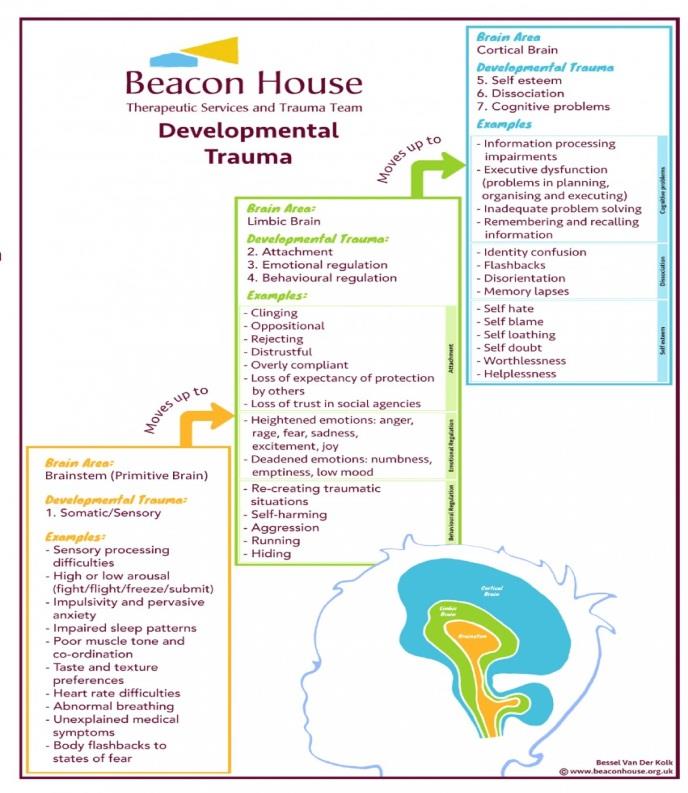
Figure 1 of Beacon house summarizes the impact on the different parts of the brain and the immense consequences -when unrecognized and untreated- to many aspects of health and life.
A developmental pediatrician, the author proposes that developmental medicine should focus as much on developmental trauma and ACEs as on chromosomal abnormalities, seizure disorders or other nervous system related diseases. To diagnose and treat developmental trauma as early as possible is mandatory in order to avoid the severe impact on the developing brain and the future life. Also, minor ACEs should be noted and treated when there is evidence of overburdening for the child. They can already occur in utero when the mother experiences e.g. shock in herself due to a car accident or emotionally due to death or relational loss. Childbirth can lead to trauma for the child, near suffocation, being stuck, torn, twisted etc. Then all those early separations due to adaptation problems and illnesses of the child or the mother or a sibling. Overwhelm of the caregiver, many forms of early childcare, different placements with always new (to the infant) people, insensitive teachers, bullying neighbors, to just name a few. There are lots of opportunities that children have experiences they cannot fully process and therefore not store in memory. They stay with uneasy feelings that are triggered in certain situations leading to avoiding or compensation behaviors. Symptoms of unprocessed (even minor) adverse childhood experiences can be all of the above (in the picture), but also: frequent spacing out, being too slow, disproportionate fears, separation anxiety, tics, compulsions, sleeping problems, increased impulsivity, interaction problems, hyper mirroring (Stoeckl-Drax), excessive tantrums, profound shyness, dependency [12].
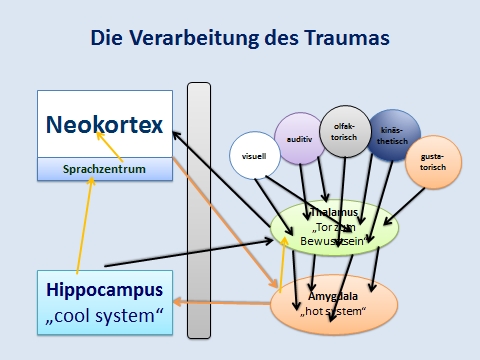
The following figure 2 (courtesy of Christiane Sautter, Emotionale Gewalt und ihre traumatischen Folgen (Emotional Abuse and its Traumatic Consequences), 2019 [13]) shows the disrupted communication within the brain (the big block between the thalamus and the neocortex and how the amygdala become a “hot system”, disconnected from the “cooling” (regular storage/ processing of experiences) of the hippocampus. The yellow arrows show how therapy (Saxe) can cross the block and reestablish the normal connections and communication within the brain [14].
Discussion and Conclusion
The mission statement of The University of Washington for its Program of Developmental Medicine is: “We specialize in the care of children with special needs, and tailor our services to the individual child and family.” The Boston children’s hospital has the vision to improve the lives of infants, children, and adolescents who face developmental and behavioral challenges and to support their families throughout their child’s life span. At the University of California, San Francisco: (UCSF) The Developmental Medicine Clinic is the newest division of the Department of Pediatrics and was created in response to the growing recognition that parents and pediatricians need support in managing complex behavioral and learning problems.
From those statements there is already an opening to a broader view of developmental medicine, however, the explicit connection to developmental trauma is still missing. Therefore, the author suggests:
- To explicitly broaden the definition and the concept of developmental medicine to include developmental trauma, the relational aspect and also minor adverse childhood experiences in its focus and diagnostic criteria.
- To find and evaluate the earliest therapeutic approaches possible to avoid chronification.
- To include parents and caregivers in the therapeutic concepts as trauma has the relational aspect and is often transmitted through the environment.
- To raise awareness within the society for the healthy development and how to facilitate it.
Acknowledgement
Thanks to Suzanne Papasian to making it sound English.
References
-
Van der Kolk BA, Pynoos RS, Cicchetti D, Cloitre M, D'Andrea W, et al. (2009) Proposal to include Developmental Trauma Disorder diagnosis for children and adolescents in DSM-V, pp: 1-33.
-
Schore AN (2003) Affect regulation & the repair of the self. W.W. Norton, New York 15(2): 99-100.
-
Felitti VJ, Anda RF, Nordernberg D, Williamson DF, Spitz AM, et al. (1998) Relationship of childhood abuse to many of the leading causes of death in adults: the adverse childhood experiences (ACE) study. Am J Prev Med 14(4): 245-258.
-
Lieberman AF, Chu A, van Horn P, Harris WW (2011) Trauma in early childhood: Empirical evidence and clinical implications. Development and Psychopathology 23(2): 397-410.
-
Gregorowski C, Seedat S (2013) Addressing childhood trauma in a developmental context. J Child Adolesc Ment Health 25(2): 105-118.
-
Endo T, Sugiyama T, Someya T (2006) Attention- deficit/hyperactivity disorder and dissociative disorder among abused children. Psychiatry Clin Neurosci 60(4): 434-438.
-
De Young AC, Kenardy JA, Cobham VE (2011) Diagnosis of posttraumatic stress disorder in preschool children. Journal of Clinical Child & Adolescent Psychology 40(3): 375-384.
-
Jaite C, Schneider N, Hilbert A, Pfeiffer E, Lehmkuhl U, et al. (2011) Etiological role of childhood emotional trauma and neglect in adolescent anorexia nervosa: A cross-sectional questionnaire analysis. Psychopathology 45(1): 61-66.
-
van der Kolk B (2005) Developmental trauma disorder: Toward a rational diagnosis for children with complex trauma histories. Psychiatric Annals 35(5): 401-408.
-
Pears KC, Fisher PA (2005) Emotion understanding and theory of mind among maltreated children in foster care: evidence of deficits. Dev Psychopathol 17(1): 47-65.
-
Corrigan FM, Fisher JJ, Nutt DJ (2011) Autonomic dysregulation and the Window of Tolerance model of the effects of complex emotional trauma. J Psychopharmacol 25(1): 17-25.
-
Stoeckl-Drax, Theresia (2019) Hypermirroring, an empathy spectrum disorder or giftedness? AAPB, Denver, USA.
-
Sautter, Christiane (2019) Emotionale Gewalt und ihre traumatischen Folgen (Emotional Abuse and its Traumatic Consequences), KoKi Germany.
-
Saxe GN, Ellis BH, Fogler J, Hansen S, Sorkin B (2005) Comprehensive care for traumatized children: An open trial examines treatment using trauma systems therapy. Psychiatric Annals 35(5): 443-448.
-
Fonagy P, Gergely G, Target M (2007) The parent- infant dyad and the construction of the subjective self. Journal of Child Psychology and Psychiatry 48(3-4): 288-328.
-
Sautter, Christiane (2017) Wenn die Seele verletzt ist (When the soul is wounded), 8th (Edn.), Verlag für systemische Konzepte, Ulm, Germany, pp: 61.
-
Schore AN (2003) Affect dysregulation & disorders of the self. WW Norton, New York.
- A Review of Gene Therapy for Parkinson's Disease to Control Dopaminergic Neurons
- Late-Onset Myasthenia Gravis in a Patient with Recurrent Breast Cancer: A Case Report
- Covid-Induced Dystonia and Opsoclonus: A Case Report
- Generalized Tonic-Clonic Seizure in a Pediatric Patient with Sunflower Syndrome: A Case Report
- Comparison of Doppler Guided Seldinger Technique Versus Classic Palpatory Seldinger Technique for Radial Artery Cannulation-an Open Label Randomized Controlled Trial
- Brown Sequard Syndrome: Understanding the Complexities of Spinal Cord Injury