
Exploiting Nanoparticles for Blood-Brain Barrier Permeation: A Promising Paradigm in Neurotherapeutics
Nano particles are widely used in the drug delivery systems to improve efficacy, bioavailability and targeted delivery of therapeutic agents. They are typically ranging from the 1-100 nm in size and emerged as versatile tools in the field of drug delivery, revolutionizing the way therapeutic agents are transported and released within the human body. Role played by nanoparticles in crossing physiological barriers and enhancing the efficacy of therapeutic decisions. Nanoparticles exhibit unique physicochemical properties that enable them to navigate the intricate biological milieu and optimize drug delivery. The Blood Brain Barrier (BBB’s) intricate structure and its pivotal role in maintaining neural homeostasis Endothelial cells, tight junctions, and efflux transporters make up the majority of this specific barrier, which has historically made it difficult to deliver medications and therapeutic agents to the brain. These problems can only be solved by using nanoparticles’ unique physical and biological characteristics, which also provide a wide variety of nanocarriers and methods for improving BBB permeability. Nanoparticles use a variety of techniques to improve their interactions with the BBB, such as size optimization, surface charge alteration, and active targeting ligands the interplay of these mechanisms serves to overcome the physical and biochemical restrictions, allowing for controlled and targeted drug delivery to specific brain regions. The design and functionalization of nanoparticles play a pivotal role in their ability to traverse the BBB. Surface modifications, including ligand conjugation and coating with targeting moieties, enable specific interactions with BBB receptors, facilitating transcytosis and enhancing brain accumulation. Additionally, the size, shape, and surface charge of nanoparticles significantly influence their BBB permeation and bio distribution. Furthermore, nanoparticle-based strategies have shown promising results in delivering a spectrum of therapeutics, including chemotherapeutic agents, neuroprotective compounds, gene therapy vectors, and imaging agents, for various neurological disorders like Alzheimer’s disease, brain tumors, and stroke. These approaches offer the potential for targeted and sustained drug release, minimizing systemic side effects and improving therapeutic outcomes. Nevertheless, challenges such as nanoparticle toxicity, stability, scalability, and clinical translation remain significant hurdles in harnessing their full potential for clinical neurotherapeutics. Addressing these limitations through innovative engineering approaches and comprehensive preclinical evaluations will be crucial for the successful translation of nanoparticle-based therapies for CNS disorders. The role of nanoparticles in crossing the BBB represents a transformative approach in the realm of neurotherapeutics. Their capacity to overcome biological barriers, enhance drug bioavailability in the brain, and reduce systemic side effects makes them a promising tool for the development of novel treatments for a wide range of neurological disorders.
Introduction
The concern of efficiently delivering therapeutic drugs to the brain has been a formidable impediment in the treatment of neurological illnesses in the field of neurotherapeutics. The blood-brain barrier (BBB), a highly selective and protective barrier, prevents most chemicals from entering the brain, making it a difficult fortress to breach. However, recent advances in nanotechnology have opened up new approaches for circumventing this obstacle [1]. Exploiting nanoparticles as carriers for drug delivery across the BBB represents a promising and innovative paradigm in neurotherapeutics. The realm of nanoparticle- based strategies, offering a glimpse into their potential to revolutionize the treatment of neurological disorders by enhancing drug permeation through the BBB. The BBB is a highly selective and semi-permeable barrier that separates the circulatory system (blood) from the central nervous system (brain and spinal cord). It is formed by a layer of tightly packed endothelial cells in brain capillaries. These cells are connected by tight junctions, which restrict the passage of most substances from the bloodstream into the brain. Therapeutic drug delivery to the brain is hindered by the BBB, despite its need for brain protection. Many drugs, including large molecules like proteins and most small molecules, cannot easily cross the BBB. This poses a significant challenge to the treatment of many neurological conditions. The selective nature of the blood-brain barrier has made it more difficult to transfer therapeutic agents to the brain, which has limited the therapy choices available for neurological illnesses [2]. An innovative and promising way to tackle this problem is through the use of nanoparticles. Because they vary in size range variation, which mostly consists of big macroparticles and nanoparticles, they have gained attention as potential drug delivery vehicles to the brain. They can be engineered to transport drugs or other therapeutic agents across the BBB and release them in a controlled manner within the brain [3]. Various types of nanoparticles have been explored for this purpose, including liposomes, polymeric nanoparticles, dendrimers, and solid lipid nanoparticles. These nanoparticles can be loaded with drugs or imaging agents and functionalized to improve their interaction with the BBB [4].
Mechanisms of Nanoparticle BBB Penetration
There are several mechanisms by which nanoparticles can traverse the BBB
• Passive Diffusion: Some nanoparticles which have properties of smaller size and lipophilic in nature may passively diffuse through the tight junctions.
• Receptor-Mediated Transport: Certain nanoparticles can be modified with ligands that target specific receptors on the BBB endothelial cells. This targeted approach can facilitate by promoting receptor-mediated transcytosis, allowing nanoparticles to cross the BBB [5].
• Adsorptive-Mediated Transcytosis: Cationic nanoparticles can interact with negatively charged components of the BBB, potentially allowing them to cross through adsorptive-mediated transcytosis.
Characteristics Effecting the Nanoparticles in Crossing the BBB
Particle size
Smaller particles shown that they are capable of pass through the cell membranes with relative ease when compared with the larger particles. Recent studies shown that the Insulin targeted gold nanoparticles with relatable <20nm diameter are ease in biocompatibility and bioavailability [6].
Small Particle Size: Nanoparticles should be on the Nano scale (typically less than 200 nanometers) to facilitate their penetration through the tight junctions of the BBB [7].
Biocompatibility: The nanoparticles should be non-toxic and biocompatible to avoid adverse reactions or damage to brain tissue.
Surface Functionalization: Surface modifications with appropriate ligands or targeting moieties are essential to enhance the nanoparticles’ ability to bind to specific receptors on the BBB, increasing their chances of transport into the brain [8].
Stability: Nanoparticles should maintain their structural integrity and drug-loading capacity during circulation and transport through the bloodstream to reach the brain.
Drug Loading Capacity: The nanoparticles should efficiently encapsulate and protect the therapeutic agent, ensuring its stability and controlled release within the brain [9].
Controlled Release: The ability to release the drug in a controlled and sustained manner is critical to optimize therapeutic efficacy while minimizing side effects.
Transport Mechanisms: Effective nanoparticles can exploit various transport mechanisms, including receptor-mediated transcytosis, adsorptive-mediated transcytosis, or passive diffusion, to traverse the BBB [10].
Protection from Enzymatic Degradation: Nanoparticles should shield the loaded drug from degradation by enzymes in the bloodstream and brain tissue.
Long Circulation Time: Prolonged circulation in the bloodstream allows nanoparticles to maximize their chances of crossing the BBB, so they should evade rapid clearance by the reticuloendothelial system [11].
Selective Targeting: The ability to target specific cells or regions within the brain is advantageous to ensure precise drug delivery and minimize off-target effects.
Biodegradability: Biodegradable nanoparticles are advantageous as they can be broken down and excreted from the body after drug release, reducing potential long-term accumulation.
Non-Immunogenic: The nanoparticle system should not trigger a significant immune response to avoid complications and ensure long-term application.
Scalability: The manufacturing process for these nanoparticles should be scalable to meet the demands of large-scale production for clinical applications [12].
Stability under Storage Conditions: Maintaining stability and drug-loading capacity during storage is crucial to ensure the product’s efficacy over time.
Regulatory Compliance: The nanoparticle DDS (Drug Delivery System) should meet regulatory standards for safety and efficacy to facilitate its approval for clinical use. Developing nanoparticle drug delivery systems that embody these characteristics is crucial for the successful treatment of neurological disorders and represents a promising avenue for advancing neurotherapeutics [13].
Trancytosis – and Entry Portal System into the CNS
As evidence shown that the blood–brain barrier is usually as the most effective entry route for nanoparticles as it presents the largest surface area between the periphery and the CNS (∼20 m2), is the major access point for most endogenous molecules, and provides the most direct access route to cellular targets in the interstitial fluid [14]. Recently, a transport route that permits endogenous macromolecules, such as proteins and lipoproteins, to cross the blood–brain barrier endothelial cells has gained wide- scale interest in nanoparticle delivery to the CNS. This transport route, called transcytosis, involves endocytosis into a transport vesicle that is trafficked across the cell to the opposite membrane, where it is fuses and the cargo is released unaltered [13].
Transcytosis is a fundamental cellular process involved in the movement of substances across the blood-brain barrier (BBB) and the uptake of nanoparticles into the brain. Nanoparticles, due to their unique properties and engineered characteristics, can exploit transcytosis mechanisms to traverse the BBB, allowing for the delivery of therapeutic agents or diagnostic tools to the brain.
The Process Involves the Following Steps
Endocytosis ate the luminal site by nanoparticles are often functionalized with ligands or surface modifications that enable them to interact with specific receptors on the luminal (blood-facing) side of brain endothelial cells that make up the BBB. These ligands can mimic the natural ligands that the endothelial cells would typically recognize. Vesicle formation happens by when nanoparticles bind to these receptors, the endothelial cells engulf the nanoparticles through receptor-mediated endocytosis [13, 14]. This process results in the formation of vesicles, which encapsulate the nanoparticles. Transcytosis across Endothelial Cells as vesicles carrying the nanoparticles move through the cytoplasm of the endothelial cells towards the abluminal (brain-facing) side. This process can involve passing through multiple cellular compartments. Exocytosis at the abluminal side, the vesicles containing nanoparticles are subjected to exocytosis, releasing the nanoparticles into the brain’s interstitial fluid. This allows the nanoparticles to access the neural tissue and interact with specific brain cells or structures [15]. And distributed in the central nervous system (CNS), the nanoparticles can be designed to disperse to their intended target, whether it is a specific brain region, cell type, or pathological site. This can be achieved through various surface modifications and targeting ligands on the nanoparticles.
Transcytosis related to the blood brain barrier by receptor mediated transcytosis
On the luminal (blood-facing) side of the brain endothelial cells interact with specific ligands, allowing them to be internalized and transported across the cell. On the abluminal (brain-facing) side, these vesicles can undergo exocytosis to release the transported substances into the brain tissue [16] (Figure 1).
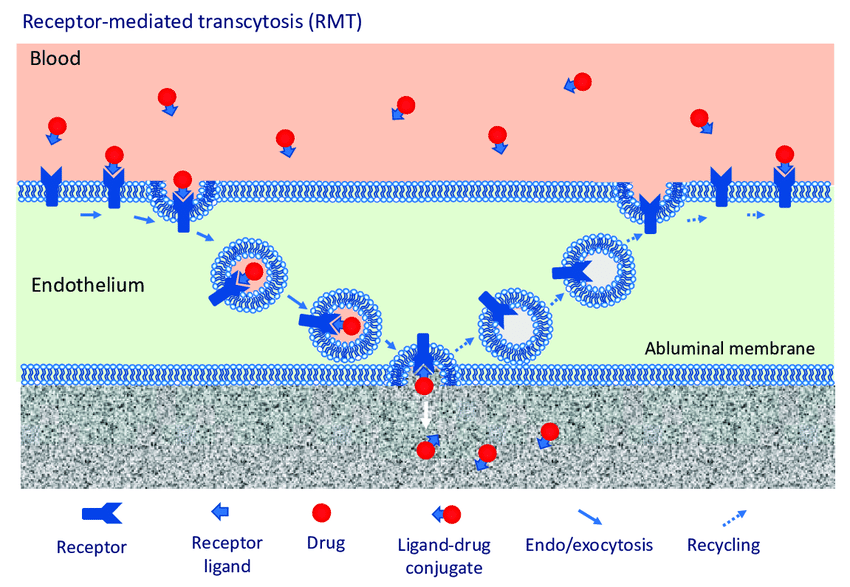
Ligand-Receptor Interaction: Receptor-mediated transcytosis begins with the interaction between ligands on the surface of nanoparticles or therapeutic agents and specific receptors expressed on the luminal side of brain endothelial cells. These receptors are typically responsible for the transport of essential molecules such as nutrients, hormones, or carrier proteins [17].
Vesicle Formation: When ligands on the nanoparticles bind to their respective receptors, the endothelial cells undergo endocytosis. This results in the formation of vesicles containing the nanoparticles. These vesicles encapsulate the therapeutic agents and are internalized into the endothelial cells [18].
Intracellular Transport: The vesicles, loaded with nanoparticles and therapeutic agents, are transported within the endothelial cells’ cytoplasm. This intracellular transport can involve the movement of vesicles along microtubules and other cellular structures [19].
Exocytosis: The vesicles containing the nanoparticles are transported through the endothelial cells and released on the abluminal (brain-facing) side of the BBB. This process is known as exocytosis, and it results in the release of therapeutic agents into the brain’s interstitial fluid [20]. Exocytosis is the fusion of an intracellular vesicle with the plasma membrane. Constitutive exocytosis occurs in all cell types as a means for cells to recycle lipids and proteins to the plasma membrane and is very slow. In specialized cells such as neurons, there is additionally a highly regulated form of exocytosis that synchronously releases many vesicles of intracellular contents into the extracellular environment on a millisecond scale [21]. Here, the final steps of fusion between the vesicular and target plasma membrane are under strict temporal control by specialized proteins that also provide the energy for fast fusion.
Distribution within the CNS: Once in the CNS, the nanoparticles and their therapeutic cargo can disperse to their intended target sites within the brain. The selective nature of RMT ensures that the therapeutic agents are transported to specific regions or cell types-9 [22].
Conclusion
In conclusion, the journey to unlock the potential of neurotherapeutics has been significantly advanced by the promising paradigm of exploiting nanoparticles for blood- brain barrier (BBB) permeation. The blood-brain barrier, once perceived as a formidable impediment, has become a gateway to enhanced drug delivery and precision medicine for neurological disorders. Through the remarkable properties of nanoparticles and the intricate mechanisms of transcytosis, we have witnessed the transformation of drug delivery to the central nervous system. The multifunctionality of nanoparticles which include liposomes, polymeric carriers, dendrimers, and inorganic particles has completely changed how we may precisely and effectively encapsulate and transport therapeutic agents. A new chapter of hope for patients and physicians is being ushered in by the diversity of nanocarriers, which enables us to treat a broad range of neurological illnesses, from brain tumor’s to neurodegenerative diseases.
Receptor-mediated transcytosis has been significant in opening up a route for targeted drug administration, allowing therapeutic payloads to be selectively transported into the inner sanctum of the brain while maintaining the integrity of the blood-brain barrier. This selectivity might reduce systemic adverse effects and raise the therapeutic index, which would be a significant development for the field of neuropharmacology. The field of using nanoparticles to penetrate the blood-brain barrier is evidence of human ingenuity, creativity, and the never-ending search for better solutions. It is a journey that embodies the teamwork of scientists, investigators, and medical experts committed to enhancing the quality of life for those with neurological illnesses. With the help of this exciting new paradigm, the treatment of brain-related illnesses is about to undergo a radical shift, bringing hope and healing closer than ever.
References
-
Ayodele AT, Valizadeh A, Adabi M, Esnaashari SS, Madani F, et al. (2017) Ultrasound nanobubbles and their applications as theranostic agents in cancer therapy: A review. Biointerface Res Appl Chem 7(6): 2253-2262.
-
Pardridge WM (2012) Drug transport across the blood- brain barrier. J Cereb Blood Flow Metab 32(11): 1959- 1972.
-
Yamazaki Y, Kanekiyo T (2017) Blood-brain barrier dysfunction and the pathogenesis of Alzheimer’s disease. Int J Mol Sci 18(9): 1965.
-
Husain Q (2017) Nanosupport bound lipases their stability and applications. Biointerface Res Appl Chem 7(6): 2194-2216.
-
Zhou Y, Peng Z, Seven ES, Leblanc RM, (2018) Crossing the blood-brain barrier with nanoparticles. J Control Release 270: 290-303.
-
Betzer O, Shilo M, Opochinsky R, Barnoy E, Motiei M, et al. (2017) The effect of nanoparticle size on the ability to cross the blood–brain barrier: an in vivo study. Nanomedicine (lond) 12(13): 1533-46.
-
Rizvi SAA, Saleh AM (2018) Applications of nanoparticle systems in drug delivery technology. Saudi Pharm J 26(1): 64-70.
-
Hanada S, Fujioka K, Inoue Y, Kanaya F, Manome Y, et al. (2014) Cell-based in vitro blood–brain barrier model can rapidly evaluate nanoparticles’ brain permeability in association with particle size and surface modification. Int J Mol Sci 15(2): 1812-1825.
-
Afzal O, Altamimi ASA, Nadeem MS, Alzarea SI, Almalki WH, et al. (2022). Nanoparticles in Drug Delivery: From History to Therapeutic Applications. Nanomaterials (Basel) 12(24): 4494.
-
Unwin R, (2023) Transport mechanisms. Nat Nanotechnol 18(6): 546-547.
-
Ferraris C, Cavalli R, Panciani PP, Battaglia L (2020) Overcoming the blood-brain barrier: successes and challenges in developing nanoparticle-mediated drug delivery systems for the treatment of brain tumours. Int J Nanomedicine 15: 2999-3022.
-
Liu J, Liu Z, Pang Y, Zhou H (2022) The interaction between nanoparticles and immune system: application in the treatment of inflammatory diseases. J Nanobiotechnology 20(1): 127.
-
Abourehab MA, Ahmed OA, Balata GF, Almalki WH (2018) Self-assembled biodegradable polymeric micelles to improve dapoxetine delivery across the blood–brain barrier. Int J Nanomedicine13: 3679-3687.
-
Ayloo S, Gu C (2019) Transcytosis at the blood-brain barrier. Curr Opin Neurobiol 57: 32-38.
-
Fullstone G, Nyberg S, Tian X, Battaglia G (2016) From the blood to the central nervous system: A nanoparticle’s journey through the blood–brain barrier by transcytosis. Int Rev Neurobiol 130: 41-72.
-
Swanson PA, McGavern D (2015) Portals of Viral Entry into the Central Nervous System. In: Katerina Dorovini- Zis (Eds.), The Blood-Brain Barrier in Health and Disease. 1st (Edn.), CRC Press, Boca Raton USA pp: 23-47.
-
Nance E, Pun SH, Saigal R, Sellers Drew L (2022) Drug delivery to the central nervous system. Nat Rev Mater **7**(4): 314-331.
-
Zhang W, Liu QY, Haqqani AS, Leclerc S, Liu Z, et al. (2020) Differential expression of receptors mediating receptor- mediated transcytosis (RMT) in brain microvessels, brain parenchyma and peripheral tissues of the mouse and the human. Fluids barriers CNS 17(1): 47.
-
Pulgar VM (2019) Transcytosis to Cross the Blood Brain Barrier, New Advancements and Challenges. Front Neurosci 12: 1019.
-
Chang J, Jallouli Y, Kroubi M, Yuan XB, Feng W, et al. (2009) Characterization of endocytosis of transferrin-coated PLGA nanoparticles by the blood–brain barrier. Int J Pharm 379(2): 285-292.
-
Pawar B, Vasdev N, Gupta T, Mhatre M, More A, et al. (2022) Current Update on Transcellular Brain Drug Delivery. Pharmaceutics 14(12): 2719.
-
Lombardo SM, Schneider M, Türeli AE, Günday Türeli N (2020) Key for crossing the BBB with nanoparticles: the rational design .Beilstein J Nanotechnol 11: 866-883.
- A Review of Gene Therapy for Parkinson's Disease to Control Dopaminergic Neurons
- Late-Onset Myasthenia Gravis in a Patient with Recurrent Breast Cancer: A Case Report
- Covid-Induced Dystonia and Opsoclonus: A Case Report
- Generalized Tonic-Clonic Seizure in a Pediatric Patient with Sunflower Syndrome: A Case Report
- Comparison of Doppler Guided Seldinger Technique Versus Classic Palpatory Seldinger Technique for Radial Artery Cannulation-an Open Label Randomized Controlled Trial
- Brown Sequard Syndrome: Understanding the Complexities of Spinal Cord Injury