
Management of One-Sided Disease with Homoeopathy: A Case Series
Migraine is generally a vascular type of headache characterized by attacks of moderate to severe throbbing pain that is usually unilateral and shows a strong familial tendency. It is idiopathic in origin. Migraineurs often describe environmental triggers of their headaches, such as barometric pressure change, bright sunlight, flickering lights, air quality, and odours. The suggestive pathophysiology of migraine is associated with the activation of trigeminal vascular system and cortical spreading depolarising depression waves. Migraine affects an estimated more than 10% of people worldwide, occurs most often among people aged 20 to 40 years. This article is a study of case series of migraine, which contains 5 cases that were treated with homoeopathic medicines and the outcomes are analysed. Out of 5 cases, 1 case was prescribed with Natrum sulphuricum, 2 cases were prescribed with Nux vomica and 2 cases were prescribed with Natrum muriaticum. Out of 5 cases, the medicines were prescribed in 200C for 3 cases and the medicines were prescribed in 30C for 2 cases. Out of 5 cases, medicine was repeated every alternate day in 1 case, once in 2 days in 1 case, once in 3 days in 3 cases.
Introduction
Migraine affects about 15% of women & 6% of men over one year. It usually starts at puberty and is worst during middle age [1]. A migraine can present with aura or without aura. Aura appears gradually over several minutes & generally last less than 60 minutes [2]. Visual disturbances often consist of a scintillating scotoma, an area of partial alteration in the field of vision which flickers & may interfere with a person’s ability to read or drive [3]. Bilateral pain is most common in those who have migraines without aura [4]. Research studies have clearly demonstrated that Homoeopathy has greater role in reducing the migraine and also reduced the intensity of the attacks and improvement in quality of life [2]. The homoeopathic literature refers the term ‘migraine’ with terminologies like ‘Megrim’, ‘American Sick Headache’ or ‘Sick Headache’, ‘Chronic Sick Headache’, Cephalgia’, etc. [1]. Since, the problem of migraine is more or less episodic in nature and presents a very few numbers of symptoms. Therefore, we consider it as of the nature of ‘one sided disease’ (Aphorism 173 Organon of Medicine 5th and 6th edition) which is less amenable to cure.
Migraine Disability Assessment Scale (Midas)
Assessing Migraine Disability
Measuring the burden of migraine should see the MIDAS questionnaire consists of five questions that focus on lorst time in three domains: school work or work for pay; household work or chores; and family, social, and leisure activities all questions ask about either days of missed activity or days where productivity was reduced by at least half. If productivity is decreased to 50% or below, the day is considered missed. The MIDAS score is derived as the sum of missed days due to a headache over a 3-month period in the three domains. Two additional questions on the MIDAS questionnaire are not included in MIDAS score, assessing frequency and intensity of pain [5].
Materials & Methods
A total of 5 cases of migraine recorded in standardized case record were chosen for this retrospective study. The overall improvement of the cases was evaluated through subsequent follow up and on the basis of scoring on MIDAS scale. Detailed case history by interview was done. Homoeopathic totality was arrived after careful study of mental generals, physical generals and characteristic particulars of the patient. The perfect similimum at indicated potency was administered for each case. Symptoms are separated according to accompanying symptoms and triggering factors. The final data is analyzed. It is an assessment tool developed by The Henry Ford Hospital Headache Disability Inventory (HDI) to measure headache-related disability. It also helps in assessing significant improvement under treatment Table 1.
The Questionnaire Consists of 5 Questions Followed by a Set of 2 Questions as Follows
- On how many days in the last 3 months did you miss work or school because of your headaches?
- How many days in the last 3 months was your productivity at work or school reduced by half or more because of your headaches? (Do not include days you counted in question 1 where you missed work or school.)
- On how many days in the last 3 months did you not do household work (such as housework, home repairs and maintenance, shopping, caring for children and relatives) because of your headaches?
4. How many days in the last 3 months was your productivity in household work reduced by half of more because of your headaches? (Do not include days you counted in question 3 where you did not do household work.) 5. On how many days in the last 3 months did you miss family, social or leisure activities because of your headaches? A. On how many days in the last 3 months did you have a headache? (If a headache lasted more than 1 day, count each day.) B. On a scale of 0-10, on average how painful were these headaches? (Where 0 = no pain at all, and 10 = pain as bad as it can be) Scoring: After filling out this questionnaire, the total number of days from questions 1-5 is added (ignore A and B) and the disability is analyzed according to Table 1.
| MIDAS Grade | Definition | MIDAS Score |
|---|---|---|
| I | Little or no disability | 0-5 |
| II | Mild disability | 10-Jun |
| III | Moderate disability | 20-Nov |
| IV | Severe disability | 21+ |
Table 1: Migraine Disability Assessment Scale (MIDAS).
Case 1
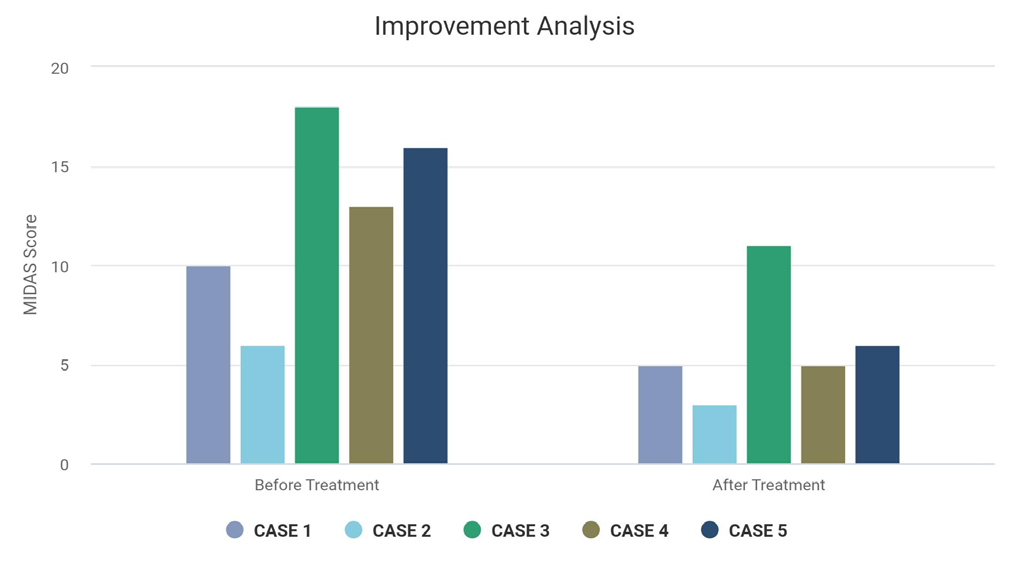
A 33 year old female patient presented with headache since childhood with pricking type of pain, nausea vomiting, ear block which aggravated during mental tension, early morning, sun exposure and travelling and ameliorated by vomiting. Patient also had severe tiredness along with the complaints. There was no relevant family history and particular cause. She did not have any associated relevant medical condition. MIDAS score was initially 10 which reduced to 5 within a week of treatment. Natrium muriaticum was administered in 200th potency once in every 3 days to be taken in the morning.
Case 2
A 20 year old female patient presented with Headache in frontal region on both sides alternatively since 4-5years. She complainted of Burning and Aching pain that aggravated with Hot climate, Sun exposure, on Using mobile and computer, Early morning to night, Sleep, Stooping and relieved by cold climate. She had associated nausea with aggravated along with the intensity of headache. She was prescribed with Nux vomica in the 30th potency, alternative evenings and was followed up for 3 months. MIDAS score was reduced to 3 from 6.
Case 3
A 20 year old male patient presented with Frontal headache from right to left side with severe pain and sensation as of head would burst. His pain aggravated on mental work, staying up late night and ameliorated in dark rooms and after sleep. He was very irritable and wanted to beat someone up due to the pain. He was prescribed Nux-vomica in the 30th potency, once in three days for 2 weeks. His score changed from 18 to 11 within 2 weeks of medicament.
Case 4
A 46 year old female patient presented with aching type of pain in frontal region extending over vertex with heaviness in head. Complaints aggravated with anger and exposure to sun and ameliorated during sleep. The patient had vomiting during headache. The patient was prescribed with lecithinum in the 200th potency after analysis of the case. Medicine was repeated once in 3 weeks. The case was followed up for 7 months. The patient MIDAS score reduced from 13 to 5.
Case 5
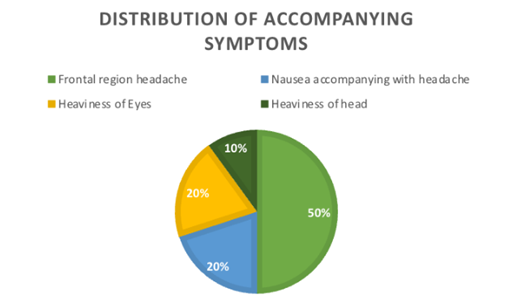
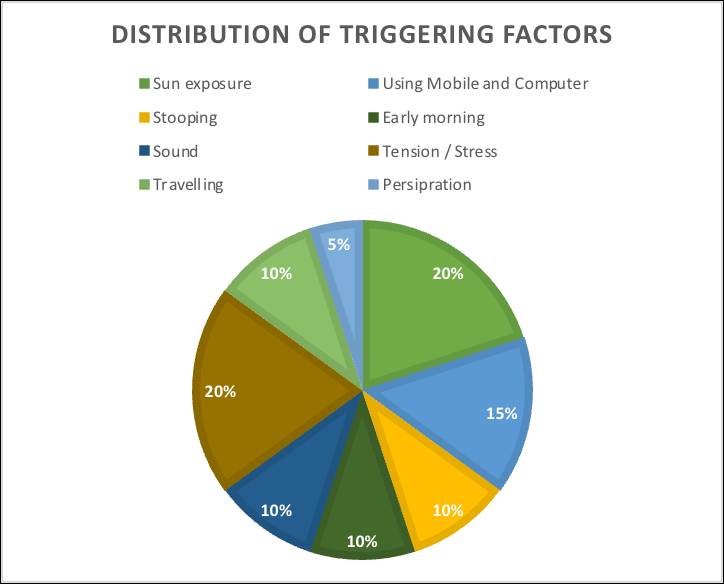
A 34 year old male patient presented with pricking type of pain in right temporal that extending into the whole head since two years. The complaints aggravated on slightest stimulus such as sound, light and mental stress. The complaints ameliorated during sleep. The patient had vomiting occasionally with heaviness of eyes. The patient was given Natrium muriaticum in the 200th potency and repeated once in 3 days. The patient was followed with glonoine 30 after one month which was repeated on alternate days. MIDAS Score reduced from 16 to 6 within 2 months of treatment (Figures 1 & 2).
Results
Migraine is one of the most distressing diseases. Here in this study five cases were taken and was analyzed and medicine given based on totality of symptom. All the five cases showed significant improvement in the symptoms along with improvement in quality of life of the patient. The cases showed improvement with significant short span of time (Figure 3).
Discussion
The prevalence of migraine has increased over the last few decades. Population prevalence studies of migraine report prevalence rates of between 2.6 and 21.7%, with an average of 12% [6]. However, migraine prevalence among neurologists is reported to be significantly higher, between 27.6% and 48.6% [7]. Out of 5 cases, 2 cases were under the age of 11-20, 2 cases under the age of 31-40, 1 case under the age of 41-50. Thus, it is observed that the people within the age group of 11 to 20 and 31 to 40 are mostly affected with Migraine. 80% of the patients are female and 20% of the patients are male. Thus, it is evident that females are mostly affected with migraine. Out of 5 cases no relevant family history was seen. Out of 5 cases, 1 case was reported with heaviness of head, 2 cases were reported with heaviness of eyes, 2 cases reported with nausea accompanying headache and 5 cases reported with frontal region headache as mentioned in fig 1 .Out of 5 cases, 1 case had ailments from perspiration, 2 cases had traveling as triggering factor, 4 cases had ailments from tension/ stress, 2 cases had sound as triggering factor, 2 cases had ailment from early morning, 2 cases had stooping as triggering factor, 3 cases had ailments from using mobile and computer and 4 cases had ailments from sun exposure (Figure 2). Out of 5 cases, 1 case was prescribed with Natrum sulphuricum, 2 cases were prescribed with Nux vomica and 2 cases were prescribed with Natrum muriaticum. Out of 5 cases, the medicines were prescribed in 200C for 3 cases and the medicines were prescribed in 30C for 2 cases. Out of 5 cases, medicine was repeated every alternate day in 1 case, once in 2 days in 1 case, once in 3 days in 3 cases.
Migraine is the variety of one-sided chronic disease where symptom is few and these symptoms obscure the other symptoms [3]. Migraine according to Dr. Hahnemann is psoric manifestation, but it includes all miasmatic state [3]. According to J.H. Clarke said, “Sick Headache or Migraine. - This is not due to disorder of stomach but is a constitutional disorder, nausea or vomiting being one of the symptoms depending on disturbances of the nerves and brain” [8].
Conclusion
From this study, we detailed the triggering factors, disease symptoms, associated symptoms of migraine. The general symptom of the patients from different age group and sex with the various homeopathic remedies employed for the treatment of the individual based on the totality of symptoms were studied. Homeopathic posology, the frequency, dose and potency for the effective treatment of migraine were studied. Homoeopathy is more effective is treating one sided diseases. Through this case series it is evident that homoeopathy can effectively treat migraine thus improving the quality of life of the patients.
References
-
Sarkar S, Sardar A (2021) Role of homoeopathy in migraine: A review Int J Hom Sci 5(1): 415-418.
-
Fauci A (2008) Harrison’s, Principles of Internal Medicine, 17th (Edn.), Mc Graw Hill Education, New York, USA, pp: 2958
-
Khadim AI and Nuruzzaman M (2020) Efficacy of Homoeopathic Medicine In the Treatment of Migraine: A Literature Review. Intl J Creative Res Thoughts 8(5): 248-254.
-
Ray BK, Paul N, Hazra A, Das S, Ghosal MK, et al. (2017) Prevalence, burden, and risk factors of migraine: A community-based study from Eastern India. Neurol India 65(6): 1280-1288.
-
The Migraine Disability Assessment Test form.
-
Yeh WZ, Blizzard L, Taylor BV (2018) What is the actual prevalence of migraine?. Brain and behavior 8(6): e00950.
-
MacGregor EA, Hackshaw A (2004) Prevalence of migraine on each day of the natural menstrual cycle. Neurology 63(2): 351-353.
-
Richard H (2015) The Principles and Practice of Homoeopathy. B. Jain publishers New Delhi, India, pp: 795.
- A Review of Gene Therapy for Parkinson's Disease to Control Dopaminergic Neurons
- Late-Onset Myasthenia Gravis in a Patient with Recurrent Breast Cancer: A Case Report
- Covid-Induced Dystonia and Opsoclonus: A Case Report
- Generalized Tonic-Clonic Seizure in a Pediatric Patient with Sunflower Syndrome: A Case Report
- Comparison of Doppler Guided Seldinger Technique Versus Classic Palpatory Seldinger Technique for Radial Artery Cannulation-an Open Label Randomized Controlled Trial
- Brown Sequard Syndrome: Understanding the Complexities of Spinal Cord Injury