
Biochemical and Lipid Oxidation Changes in Clariasgariepinus (Burchell 1822) Stored in Fish Ice Box
Post- harvest losses of fish in Nigeria are related to poor fish handling, lack of preservation, quality deterioration and spoilage. Clariasgariepinus and ice block were weighed in four different ratios of fish to ice (1:1; 2: 1; 3:1 and 4:1) referred to as treatments into fish ice box. Sampling was carried out at six hours interval for biochemical and lipid oxidation tests (pH, Total Volatile Base Nitrogen (TVB-N), Peroxide value (PV), Thiobarbituric acid Reactive Substance (TBA-RS).pH value increased from 7.10-7.60, TVB-N increased from 5.29 mg/g N -13.28mg/g N, PV increased from 1.77 meq/kg-7.80 meq/kg and TBA-RS increased from 0.17 MDA mg per kg -4.48 MDA mg per kg. The results shows some level of significant (p
Introduction
Post- harvest losses of fish in Nigeria are related to poor fish handling, lack of preservation, quality deterioration and spoilage [1, 2]. Nigerians are large consumers of fish and it remains one of the main products consumed in terms of animal protein. It is cheap and highly acceptable, with little or no religious bias, which gives it an advantage over pork or beef [1]. Only about 50% of the demand for fish is currently being met by local supply. The fishery sector is estimated to contribute 3.5% of Nigeria's Gross domestic product (GDP) and provides direct and indirect employment to over six million people. The gap between the demand and supply of fish is widening due to increase in population, poor postharvest handling, lack of processing and storage facilities [3]. African catfish, Clariasgariepinus is the major fish cultured in Nigeria, eaten by most tribes, commands good price and resistant to harsh environmental conditions. It has enjoyed wide acceptability in most parts of the country because of its unique taste, flavour and good texture (www.au-ibar.org) [4]. Chilling is a means to preserve before processing or consumption. During icing, chemical changes are known to take place in fish [5]. Bacterial growth, enzymatic changes and chemical reactions are factors affecting quality of fish and its products which are strongly influenced by storage temperatures. Chilling at various temperature slow down microbial growth and enzymatic changes in fish therefore extending the shelf- life by many days [6]. It has been reported that C. gariepinus will remain edible for 16 to 20 days if buried in ice. Even better results are obtained if the fish are gutted and wrapped [1, 7]. The artisanal sector in spite of its low technological development remains the backbone of fish production in the country [8]. Little information is however available on the quality of fresh fish harvested to the point of purchase in the tropics and in particular Nigeria. This research assessed changes in biochemical properties (pH and Total Volatile Base Nitrogen) and lipid oxidation (Thiobarbituric Acid Reactive Substance and Peroxide Value) in C. gariepinus stored in fish ice box [9]. This is expected to reduce post-harvest loss due to poor handling and transportation by at least five per cent.
Materials and Methods
Fish sampling and preparation
Live samples of C. gariepinus were obtained from a farm in Ijebu Ode Ogun State Nigeria during early hours (7.00-8.00 am) and quickly transported in a fish tank to the fish processing centre of the Nigerian Stored Products Research Institute Lagos. They were weighed and divided into lots according to sizes. The average weight and the length were 400g and 25 cm respectively. The fish ice box was designed and fabricated by NSPRI. The box consists of a smaller plastic container fitted inside a bigger one with space in between completely filled with an insulating material, a lid and a drain pipe through which waste water in the box flows out. The holding volume of the fish box is 27.04 × 10⁻³ m3 and has the capacity of holding a total weight of 18 kg (fish and ice). The fish ice boxes were thoroughly cleaned with 1% hypochlorite solution and rinsed repeatedly with distilled water before use. Ice blocks and fish were weighed in ratios 1:1; 2: 1; 3:1 and 4:1 respectively into fish ice box. The four ratios were referred to as ‘treatments’. Samples were obtained at six hours interval from the four treatments for biochemical and lipid oxidation tests.
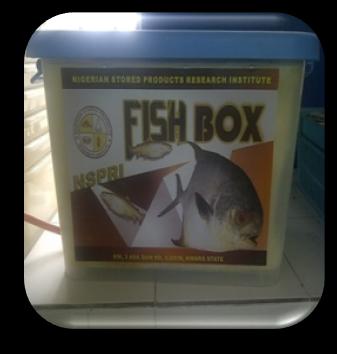
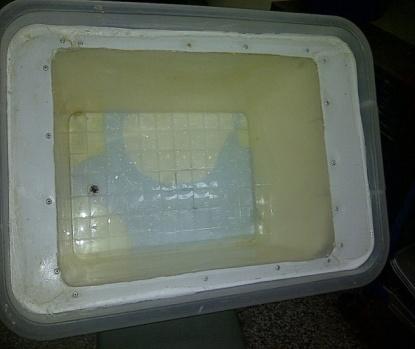
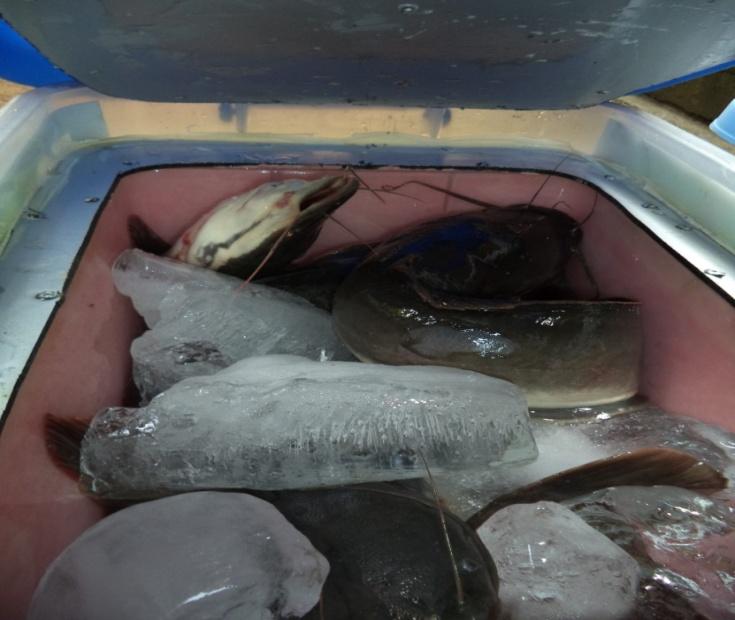
Experimental
pH was determined according to [10] with slight modification. Ten grams of C. gariepinus flesh from the upper, middle and lower region were blended, homogenized in 50 mL of distilled water and the mixture filtered using Whatman Filter Paper Number 1. The homogenate was allowed to attain a room temperature after 5 minutes. The pH of the homogenate was measured using a Jenway 3310 pH meter at room temperature after calibration using standard buffers of pH 7 and 4. The readings were carried out at the initial stage (fresh) and at various intervals of six hours.
TVB-N
TVB-N was determined using the method of Jinadasa (2014) [11]. Ten grams of blended C. gariepinus flesh was homogenized with 20 mL of 7.5% tricholoroacetic acid (TCA) for 2 minutes. The homogenized flesh was filtered through Whatman Number 1 filter paper to obtain clear extract. 25 mL of the extract was made alkaline with 6 mL of 10% NaOH solution and 20 mL of distilled water was also added. The solution was quantitatively transferred into the distillation tube and placed in the distillation flask of semi auto distillation apparatus. The receiving flask contained 25 mL of 4% boric acid and few drops of mixed indicator (methyl red/methylene blue 2:1). The steam distillation procedure continued until 100 ml of distillate had been collected. The obtained basic solution was titrated against 0.05M H2SO4 to the endpoint indicated by a green to pink colour change. The TVB-N content was determined after blank correction, which was also determined by steam distillation with 25 ml of distilled water sample. TVBN content was expressed as mg N/100 g of fish flesh
Calculation
TVB – N (mg /100g) =14 mg mol x a x b x 300 /25mL a = volume of sulphuric acid used (mL) b = molarity of sulphuric acid
PV
Peroxide value was carried out using titrimetric method according to the standard method described by [12].
TBA-RS
TBA-RS was determined using the method [13]. Ten grams of blended C. gariepinus fat extracted from its belly sample was mixed with 50 ml of distilled water and the mixture was extracted with 34.25 mL of 4% perchloric acid (PCA) for 5 minutes. The homogenized sample was filtered with Whatman No.1 filter paper to get the filtrate.5 mL of 0.2% TBA reagent (4, 6- dihydroxypyrimidine-2-thiol) was added to 5 mL of the filtrate and the experiment was performed in duplicate. 5mls of PCA was added to 5 mL of TBA into a 100 mL volumetric flask and the volume of the volumetric flask was completed with distilled water to make the blank. The blank with the homogenates were later boiled on a water bath set at 100°C for 1hour till pink colour developed. The samples were later cooled under running water for 15 minutes. Readings were taking with aid of Thermo Elliot UVZ 164701 UV Vis Spectrophotometer at
532nm. The result were expressed as mg of malonaldehyde milligram per kilogram which were obtained by multiplying the absorption values by a conversion factor, K=5.5.
Temperature and Relative Humidity Measurement
Tiny tag Ultra 2 digital data logger was used in monitoring the temperature and relative humidity (R/H) of the loaded fish boxes in different treatments and the ambient. They were calibrated before each use.
Statistical Analysis
Data obtained in all the biochemical and lipid oxidation tests were subjected to one way analysis of variance (SPSS 20).
Results and Discussion
Change in pH: Changes in pH values in C. gariepinus with storage time in different treatments are shown in Table 1. The pH C. gariepinus decreased from an initial value of 7.10 to 6.40 in all the treatments at the 6th hour. pH increased from 7.30 to 7.60 between the 12th and 30th hour. These variations were significant (p<0.05). The pH of a freshly harvested fish is close to neutral and after catch it decreases due to formation of lactic acid by series of reaction occasioned by considerable amount of stress. As length of storage increases, indication of spoilage start to set in, the value first rises slowly and then increases rapidly due to the accumulation of the basic end products of microbial action and rises to 7.5-8.0 [14]. Various authors reported similar results for different storage temperature and number of days [15, 16] pH is not a good indicator of freshness for this research work but can be considered with other quality indices in quality assessment. Change in TVB-N: Changes in TVB-N of C. gariepinus with storage time in different treatments are shown in Table 1.
| Duration | pH | ||||||||||||
|---|---|---|---|---|---|---|---|---|---|---|---|---|---|
| Treatments | 0 | 6 hrs | 12 hrs | 18 hrs | 21 hrs | 24 hrs | 30 hrs | ||||||
| 1:01 | 7.10b | 6.30c | 6.90d | 7.01b | 7.10a | 7.50a | 7.60a | ||||||
| 1:02 | 7.10c | 6.50d | 7.20c | 7.50b | 7.70a | - | |||||||
| 1:03 | 7.10b | 6.40c | 7.30a | - | - | - | |||||||
| 1:04 | 7.10a | 6.40c | |||||||||||
| TVB-N | |||||||||||||
| 1:01 | 5.29 e | 5.40d | 5.46d | 7.04 f | 9.19c | 12.65b | 13.28f | ||||||
| 1:02 | 5.29 e | 5.43d | 6.55c | 7.67 b | 12.10a | - | - | ||||||
| 1:03 | 5.29 c | 6.99b | 8.82a | - | - | - | - | ||||||
| 1:04 | 5.29 a | 7.22a | |||||||||||
| PV | |||||||||||||
| 1:01 | 1.77g | 1.90f | 2.10e | 4.10d | 6.12c | 7.11b | 7.80a | ||||||
| 1:02 | 1.77f | 2.00e | 2.90d | 5.60c | 7.30a | 7.50b | - | ||||||
| 1:03 | 1.77c | 2.20b | 3.40a | - | - | - | |||||||
| 1:04 | 1.77b | 2.60a | |||||||||||
| TBA-RS | |||||||||||||
| 1:01 | 0.17e | - | 0.23d | 0.67c | 4.07b | 4.29f | 4.48a | ||||||
| 1:02 | 0.17d | - | 0.36e | 0.82b | 4.21a | - | - | ||||||
| 1:03 | 0.17c | - | 0.94a | 1.12b | - | - | - | ||||||
| 1:04 | 0.17b | - | 1.27a | - | - | - | - |
Table 1: Values of Values of biochemical and lipid oxidation changes of C.gariepinus in ice box.
*Values with the same superscript are not significantly different from others (p>0.05) Table 1: Values of Values of biochemical and lipid oxidation changes of C.gariepinus in ice box. TVB-N value increased from an initial value of 5.29 mg/100g to 7.22 mg/100g in all the treatments at the 6th hour. The value increased to 13.28 mg/100g between the 6th to 30th hour and was statistically significant (p<0.05). The increase is due to increase in post mortem metabolic activities) [17]. TVB-N is a term that includes the measurement of trimethylamine, dimethylamine, ammonia and other basic compounds [18] had reported that the TVB-N content of many fish species at day 1 of storage is in the range of 5.5– 17.0 mg N/100 g muscle, possibly suggesting that fish muscle possibly underwent some deterioration during handling. Overall, the TVB-N values at the end of the storage period was well below the range of recommended value of 30-35mg TVB-N/100g for fresh fish [19]. The lower TVBN content in C. gariepinus in this study may be due to the absence of trimethylamine which is the major component of volatile bases in fish and meat. The value is normally low during the edible storage period, increasing levels are found in fish near rejection levels. Virtually all changes in TVBN are due to TMA component, which is a major constituent of volatile bases. Horner (1997) [20] suggested that TVB-N is insensitive to freshness, which means that it cannot be used as a freshness indicator. However, it relates well with unfitness for human consumption as it is a good spoilage indicator. Increase in TVB-N level with the lapse of storage may be attributed to bacterial spoilage after the bacterial population has grown [21]. Change in PV: Changes in values of PV of C. gariepinus with storage time in different treatments are shown in Table 1. The value increased from an initial value of 1.77 meq/kg to 1.90 meq/kg of oil. This increased to 7.80 meq/kg between the 6th and 30th hour. The result were statistically significant (p<0.05). This might be as a result of primary lipid oxidation which continued till the end of the storage period however, it is within recommended values of 10- 20 meq/kg of oil as suggested by Connell (1995) [19]. This may be attributed to the level of oxidation of oil in this fish. Similar results were reported by Viji et al., (2014) [22] though under different storage conditions.
Peroxide value might not be considered a good indicator of freshness in this study as values were within the range of acceptability. Changes in TBA-RS: The secondary lipid oxidation products were measured according to the TBA method. Table1 depicts the changes in TBA-RS and it was shown that a gradual increase in the secondary oxidation development from a value of 0.17 MDA per kg to 4.48 MDA per kg was obtained in all the treatments till the end of the storage time. They were statistically significant (p<0.05). Towards the end of storage period, the value exceeded the safe limit of 3 MDA mg per kg signifying more secondary lipid oxidation. Data showed that the higher the storage temperatures and period of storage, the higher were the final TBA-RS values. These results were similar to report by Widjaja et al., (2009) [23] who studied rancidity and lipid oxidation of dried-salted sardines. It should be noted that in some treatments during the course of the experiment, ice blocks melted completely. These include ratios 4:1 and 3:1 which did not last up to 12 hours and 18 hours respectively hence no readings for the two treatments.
Conclusion and Recommendation
This research was undertaken to assess the effectiveness of the ice box in relation to biochemical and lipid oxidation changes of C. gariepinus with a view to ascertain its quality. pH, Total Volatile Base-Nitrogen, Peroxide Value and Thiobarbituric Acid Reactive Substances (post mortem changes) invariably increased throughout the storage time though they were below the safe limit. This indicates that they might possibly good parameters to predict shelf life of C. gariepinus. Treatment 1:1 kept C. gariepinus for 30 hours in the ice box at a temperature of 8.1°C and relative humidity of 96.4%. The use of ice box is recommended for transportation and handling of C. gariepinus. This will reduce the incidence of loss associated with post-harvest handling of fish thereby increasing its availability; enhance food security status in Nigeria and creation of more wealth for fish handlers.
Acknowledgement
Funding for this project was made possible by West African Agricultural Productivity Programme (WAAPP).Also, appreciation goes to all the technical staffs in Lagos Zonal Office for their effort.
References
-
Eyo AA (2001) Fish Processing Technology in the Tropics. University of Ilorin Press, Nigeria pp: 38, 153-163
-
Daramola JA, Fasakin EA, Adeparusi EO (2007) Changes in physicochemical and sensory characteristics of smoke-dried fish species stored at ambient temperature. African Journal of Food Agriculture Nutrition and Development 7(6): 1-16.
-
Ayuba VO, Omeji NO (2006) Effect of insect infestation on the shelf life of smoked dried fish. Proceedings of the 21st Annual Conference of the Fisheries Society of Nigeria (FISON), Calabar, 13th- 17th November, pp 357-359.
-
Catfish Aquaculture Industry Assessment in Nigeria (2013).
-
Huss HH (1995) Quality and Quality Changes in Fresh Fish. FAO Fish. Tech. 348, FAO, Rome.
-
Chomnawang C, Nantachai K, Yongsawatdigul J, Thawornchinsombut S, Tungkawachara S (2007) Chemical and biochemical changes of hybrid catfish fillet stored at 4°C and its gel properties. Food Chem 103(2): 420-427.
-
Mohan CO, Ravi Shankar CN, Srinivasa GTK (2008) Effect of O2 scavenger on the shelf-life of catfish (Pangosius sutchi) steaks during chilled storage. J Sci Food Agric. 88(3): 442-448.
-
Ola JB, Oladipo AE (2004) Storage life of croaker (_Pseudotholitus Senegalensis)_ in ice and ambient temperature. Afr J Biomed Res. 7: 13-17.
-
Obande RA, Omeji S, Ityumbe M (2012) Organoleptic assessment and nutritive values of _Clariasgariepinus_ smoked using coal and firewood. Pakistan Journal of Nutrition 11(9): 762-764.
-
Tobor JJ (1995) The fish industry in Nigeria: Status and Potentials for self sufficiency in production. NIOMR Tech 22: 1-8.
-
Abelti AL (2013) Microbiological and chemical Changes of Nile Tilapia (_Oreochromis niloticus_ L.) fillet during ice storage: Effect of Age and Sex. Advance Journal of Food Science and Technology 5(10): 1260- 1265.
-
Jinadasa BKKK (2014) Determination of Quality of Marine Fishes Based on Total Volatile Base Nitrogen test (TVB-N). Nature and Science 12(5): 106-111.
-
AOAC 1990 Official Method of Analysis of the Association of Official Analytical Chemist, 1 5 Editions, Virginia.
-
Hamid RG (2011) Correlation between acid, TBA, peroxide and iodine values, catalase and glutathione peroxidase activities of chicken, cattle and camel meat during refrigerated storage. Veterinary World 4(4): 153-157.
-
Boselli E, Caboni MF, Redriguez-Estrada MT, Toschi TG, Daniel M, et al. (2005) Photoxidation of cholesterol and lipids of turkey meat during storage under commercial retail conditions. Food Chem 91(4): 705-713.
-
Azam K, Mackie IM, J Smith (1989) The effect of slaughter method on the quality of rainbow trout (_Salmo gairdneri_) during ice storage. Intl J Food Sci Technol 24(1): 69-79.
-
Adoga IJ, Egila J, Omojowo FS (2010) Storage life of tilapia (_Oreochromis niloticus_) in ice and ambient temperature. Researcher 2(5): 39-44.
-
Akter M, Islam MJ, Mian S, Shikha FH, Rahman MH, et al. (2014) Changes in Fillet Quality of Pangas Catfish (_Pangasianodon_ _hypophthalmus_) During Frozen Storage. World Journal of Fish and Marine Sciences 6(2): 146-155.
-
Abbas KA, Mohamed A, Jamilah B, Ebrahimian M (2008) A review on correlations between fish freshness and pH during cold storage. American Journal of Biochemistry and Biotechnology 4(4): 416- 421 (In): Kyrana VR, Lougovious VP, Valsamis DS (1997) Assessment of shelf-life of maricultured gilthead sea bream (_Sparusaurata_) stored in ice. Int. J. Food Sci. Technol 32: 339-347.
-
Benjakul S, Visessanguan W, Thongkaew C, Tanaka M (2003) Comparative study on physicochemical changes of muscle proteins from some tropical fish during frozen storage. Food Res Intl 36(8): 787-779.
-
Connell JJ (1995) Control of fish quality: Fourth Edition. Fishing News Book Ltd, Farnham, England.
-
Horner WFA (1997) Final report to directorate general for fisheries DGXIV commission of the European Community. (a study on the health quality of fish products). University of Hull: HIFI, unpublished manuscript 9-57.
-
Hossain MI, Islam MS, Shikha FH, Kamal M, Islam MN (2005) Physicochemical changes in Thai Pangas (_Pangasius sutchi_) muscle during ice-storage in an insulated ice box. Pakistan Journal of Biological Sciences 8(6): 798-804.
-
Viji P, Tanuja S, George Nina, Zynudheen AA, Lalitha KV (2014) Quality characteristics and shelf life of sutchi cat fish (_Pangasianodon hypophthalmus_) steaks during refrigerated storage. International Journal of Agriculture and Food Science Technology 5(2): 105- 116.
-
Widjaja WP, Abdulamir AS, Bakar FA, Saari NB, Ishak ZB, et al. (2009) Lipid quality deteroriation of Bagridae Catfish (_Mystus nemurus_) during storage. Research Journal of Biological Sciences 4(4): 525-530.
- Enhancement of Vegetative Growth and Fruit Yield in Cucumber (Cucumis sativus L.) via Spiritual Blessing (Biofield) Energy Intervention
- Production of Açaí (Euterpe oleracea Mart.) under Different Agroforestry System Management Intensities in Amazonian Floodplain (Varzea) Forests
- Coffee and the Production Region: What is the Secret to the Expression "Quality"?
- Experiential Agripreneurship Training in Sub-Saharan Africa: Integrating a Business Incubator into Postgraduate Livestock Education at the University of Buea
- Advances in Agricultural High-Quality Development
- Linking Compost Residue to ABAGE in Plants - a Short Note