
The Influence of Far-Infrared Materials Added to Compost on the Yield of Maize
Different materials added to compost can increase the microbial decomposition rate, reduce preparation time, and improve the quality of compost. While preparing compost, this study added far infrared materials to learn their influence on the growth and yield of maize. Experimentation found that maize with far-infrared materials in its compost is better in terms of height, chlorophyll, and relative growth rate than maize with chemical fertilizer and compost. According to the yield of mazie, the average cluster height, weight of a single ear, and dry weight of a hundred seeds with far-infrared materials in its compost are 24.2cm, 264g, and 14.3g, respectively, which is better than maize with chemical fertilizer and compost. Moreover, chemical fertilizer and compost have no significant difference in the growth and yield of maize, thus, compost can replace chemical fertilizer for maize in order to maintain the fertility of soil. In summary, far-infrared materials added to compost can promote the growth and yield of maize.
Introduction
Since the 1960s chemical fertilizer synthesis has gradually matured, driven by agricultural cultivation in a mechanized and specialized way of production of crops, and develop high chemical fertilizers, high doses of pesticides and high energy consumption of the farming model in the cultivation process. Therefore, increased crop yields lead to soil erosion, environmental changes, and soil acidification and reduced soil water storage capacity. Long-term cultivation will influence soil structure, adverse agricultural sustainable development [1]. For sustainable operation of agriculture, framing system that relies on chemical fertilizer and pesticide will be replaced by organic cultivation. Organic cultivation refers to the agricultural production process, do not use chemical fertilizers, pesticides, and follow the laws of nature and ecology, to take sustainable development of agricultural technology [2]. Therefore, the organic fertilizer used in cultivation is entirely from the agricultural waste materials, through the process of composting made of compost. The use of compost in crop production not only reduces the destruction of soil structure, but also increases the soil organic matter to improve the soil fertility. In order to improve the quality of compost and shorten the time of composting, different substances will be added, such as lime [3], sodium acetate [4], nutrient elements [5], these composting additives can enhance the quality of compost maturity, but also improve the efficiency of crop nutrient uptake [6]. It can be seen, compost additives can significantly affect the quality and value of compost. In this study, the far-infrared material (from Shinkong Iecofun Corporation) was used as the additive for composting. The material was made by collecting the soil layers with different longitudinal sections of metallic elements, calcining at 1300 °C to 2000 °C, and then cooling. This product features is the release of 4-14 micron wave far infrared, porous structure with a favorable drainage and moisturizing, and contains a variety of nutrients, non-toxic, sterile and insoluble. In order to understand the effects of composting with far infrared materials on the growth and yield of maize, composting chicken manure, far infrared material composting and synthetic fertilizers were used in the experiment.
Materials and Methods
Crop materials
The plug seedling is adopted at the initial stage of maize growth, with a cultivation medium made by mixing carbon fiber rice hull, coconut fiber, and peat soil in the proportion of 1:1:2. When the maize has grown for one week and the second leaf has expanded, it is transplanted to the field.
Fertilization treatment
This test applies (1) chicken manure compost, (2) compost of chicken manure with far-infrared material (2:1), and (3) chemical fertilizer to maize, and compares the effects of different fertilizers on the growth of maize. In this study, composting is modulated according to the "manual for production and application of poultry and animal manure compost". The far-infrared material is provided by the Shinkong Iecofun Corporation. In this study, each treatment is repeated three times, there are nine grow plots, and the Completely Randomized Design (CRD) method is adopted. The area of each plot is 8 m×1.5 m, there are two lines of plants in each plot, and plant spacing is 30 cm, thus, there is approximately 50 plants in each plot. The chemical fertilizer application is based on N:P:K in the proportion of 10 g:5 g:5 g for 1 m2, where 2/3 is used as basal fertilizer, and the remaining is used as additional fertilizer. The first additional fertilizer is applied during cultivation and banking. The second additional fertilizer is applied when the maize comes into ears and blooms. The compost is applied based on 1kg per square meter, where
2/3 is used as basal fertilizer, and the remaining is used as two additional fertilizers. The additional fertilizer application timing is the same as the chemical fertilizer treatment.
Survey items
1) Survey of physiological characteristics The traits of maize height and stem diameter are recorded weekly after the maize is transplanted, which are observed by recording the growth condition of 10 plants in each plot, thus, each treatment is repeated three times.
2) Measurement of chlorophyll content The chlorophyll is measured six weeks after the maize is transplanted, and four plants are sampled from each treatment. The uppermost fully expanded climax leaf is selected, and about 4 cm of the leaf tip is cut off. The fresh leaf is weighed, iced by a little liquid nitrogen and ground, then mixed with 2 mL 50 mM pH 6.8 sodium phosphate buffet solution and ground. A 40μL sample is mixed with 960μL 95% ethanol (95% EtOH), shaken uniformly, kept still in the dark for 30 minutes, and then centrifuged (1000 g, 4℃, 15 min). The supernatant is taken, the readings of absorbance values A665 and A649 are measured (Hitachi, V-2000), and the chlorophyll content is calculated using the following equations [7]. Total Chlorophyll = (6.1 × A665) + (20.04 × A649) [μg Chl (40μL)-1]
Total Chlorophyll content (mg g-1 FW) =Total Chl×50(extension
rate)÷1000÷FW
3) Measurement of relative growth rate The relative growth rate is measured six weeks after the maize is transplanted. Two plants are sampled from each plot, for a total of six plants for each treatment. The entire plant is pulled out of the field, the subterraneous root is removed and placed in a 65℃ oven for one week, and then, the dry weight is measured. The relative growth rate (RGR) is calculated by the following equation [8]. Relative growth rate (RGR):
1 W2−W1
RGR =
𝑊1 ×
T2−T1 (mg g-1 d-1)
W1: Previous measured dry weight of plant. T1: Previous sampling time W2: Latter measured dry weight of plant. T2: Latter sampling time
4) Measurement of yield of maize
Only two ears are remaining from the maize in each plot, the ear weight is measured with the bracteal leaf when the maize is mature, the maize ear is placed in the 65℃ oven for 2~3 days, and the dry weight of 100 grains is measured.
Statistical analysis of data
The sample difference is analyzed using the statistical analysis methods of analysis of variance (ANOVA) and least significance difference (LSD) in order to estimate whether or not the results have significant difference.
Results
Effects of different fertilizers on height and stem diameter of maize
In 8th week, after the maize is transplanted to the field, the tassel begins to form; till 10th week of growth, when the tassel of maize in the plot has completely sprouted and the vegetative growth is finished, then the agronomic character investigation and recordings are terminated. In terms of maize height survey, in 8th week of maize growth, the plant height applied with the compost of chicken manure with far-infrared material is apparently larger than the other treatments (Figure 1).
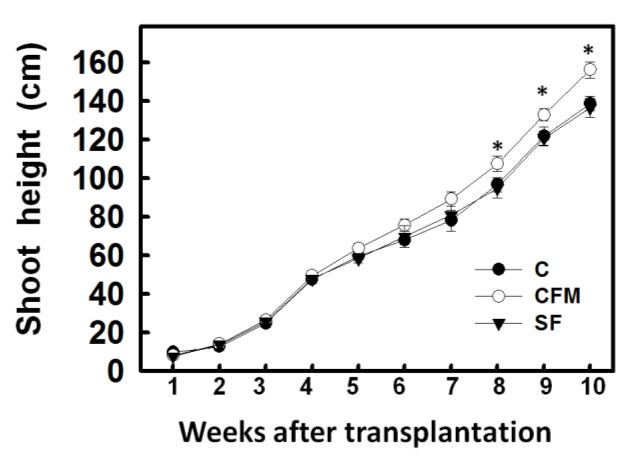
Figure 1: Effects of different fertilizer applications on the shoot height of maize. Maize seedlings were grown in a greenhouse for 2 weeks, then transplanted to the experimental area, which included compost (C), compost added far-infrared material (CFM), and synthetic fertilizer (SF). The vertical line on each bar indicates the standard error for three replicates. Bars show means ± SE.*, which represent values that are significant at P0.05.
In 10th week of growth, the average plant height of the maize applied with the compost of chicken manure with far-infrared material is 156 cm, which is apparently larger than the treatments with chicken manure compost (138 cm) or chemical fertilizer (136 cm). According to the results of maize stem diameter, the average stem diameter of maize treated with different fertilizers is 3.2 to 3.3 cm, meaning the difference among the treatments is not obvious (Figure. 2).
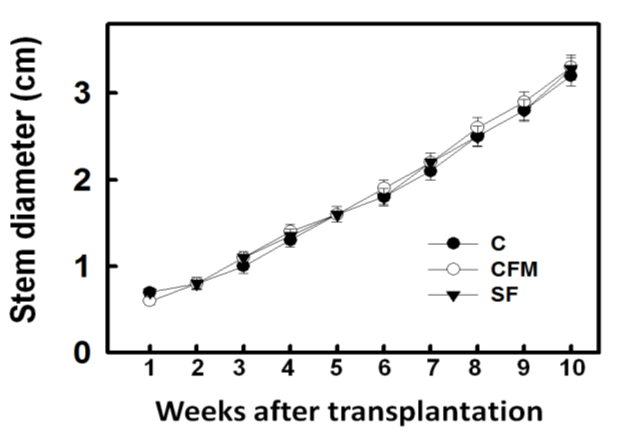
Figure 2: Effects of different fertilizer applications on the stem diameter of maize. Maize seedlings were grown in a greenhouse for 2 weeks, then transplanted to the experimental area, which included compost (C), compost added far-infrared material (CFM), and synthetic fertilizer (SF). The vertical line on each bar indicates the standard error for three replicates. Bars show means ± SE. *, which represent values that are significant at P0.05. According to the aforesaid results, while the compost of chicken manure with far-infrared material can promote the growth of maize, the effect of promoting the maize stalk width is not obvious.
Effects of different fertilizer on chlorophyll content and RGR of maize
Cultivation and banking are implemented in 5th week after the maize is transplanted to the field, and the additional fertilizer is applied for the first time. The chlorophyll content and RGR are analyzed in 6th week. In terms of chlorophyll content, during 6th~9th weeks of maize growth, the chlorophyll content in the maize applied with the compost of chicken manure with far- infrared material is 0.99 to 1.14 mg, which is apparently higher than the treatments with chicken manure compost and chemical fertilizer (Figure 3).
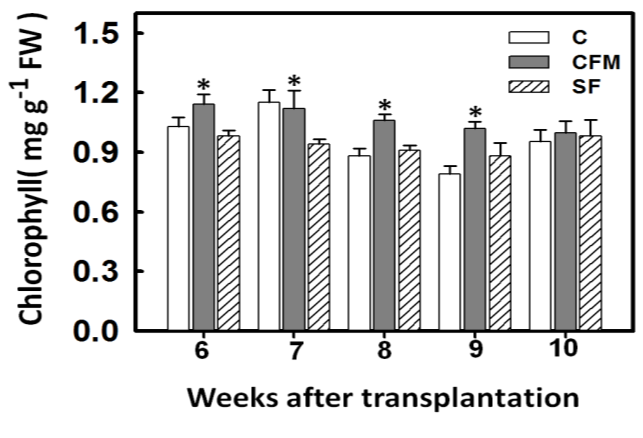
Figure 3: Effects of different fertilizer applications on the chlorophyll content of maize leave. Maize seedlings were grown in a greenhouse for 2 weeks, then transplanted to the experimental area, which included compost (C), compost added far-infrared material (CFM), and synthetic fertilizer (SF). Chlorophyll content was measured during 6 to 10 weeks after transplantation. Bars show means ± SE. *, which represent values those are significantly different between CFM and SF treatments at the 5% level. In 10th week of growth, there is no significant difference in chlorophyll content among treatments, which may be caused by the change of chlorophyll synthesis rate from vegetative growth stage to reproductive growth stage and decrease of growth rate of stem and leaf. In terms of the RGR survey, in 8th week of maize growth, the RGR of the maize applied with the compost of chicken manure with far-infrared material is apparently higher than the other treatments (Figure 4).
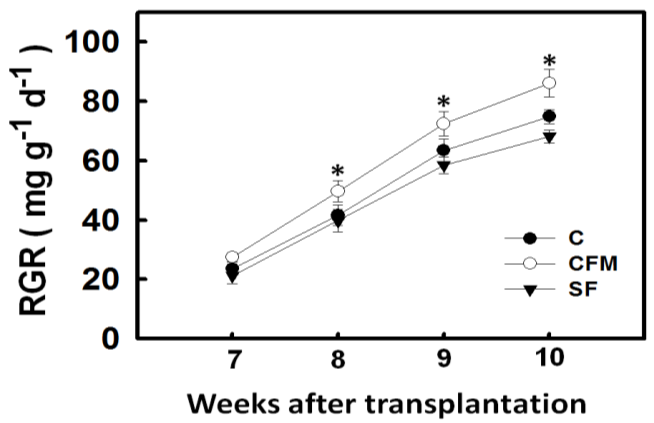
Maize seedlings were grown in a greenhouse for 2 weeks, then transplanted to the experimental area, which included compost (C), compost added far-infrared material (CFM), and synthetic fertilizer (SF). RGR was measured during 6 to 10 weeks after transplantation. Bars show means ± SE. *, which represent values that are significant at P0.05. In Week 10 of growth, the average RGR of the maize applied with the compost of chicken manure with far- infrared material is 86.1mg, which is apparently higher than the treatments with chicken manure compost (74.8 mg) and chemical fertilizer (68.2 mg). According to the aforesaid results, the compost of chicken manure with far- infrared material not only increases the chlorophyll content, but also increases the RGR of corn.
- Effects of different fertilizer on yield of maize
- The effects of different fertilizer treatments on ear length, weight per year, and 100-grain dry weight are compared after the maize is harvested (Table 1).
- The
- Average
- The
- Weight of
- Dry Weight
- Cluster
- Height (1) of 100-
- Grain (G) a Single
- Ear (G)
- (Cm)
- Compose (C)
- 19.8±2.5b(2)
- 209±12.6b
- 12.4±0.76b
- Compost add farinfrared material
- 24.2±1.6a
- 264±9.8a
- 14.3±0.97a (CFM)
- Synthetic fertilizer
- 20.4±1.6b
- 213±11.6b
- 11.9±0.84b (SF)
Table 1: Effects of different fertilizer applications on the
chicken manure compost and the average 213 g weight per year of maize treated with a chemical fertilizer. The results of 100-grain dry weight show that the average weight of maize applied with the compost of chicken manure with far-infrared material is 14.3 g, which is apparently higher than the treatments with manure compost (12.4 g) and chemical fertilizer (11.9 g). According to the aforesaid results, the compost of chicken manure with far-infrared material can increase maize ear length, weight per year, and 100-kernel dry weight.
Discussion
The limited availability of land for crop production worldwide requires a system of sustainable resource management and healthy crop production. At present, agriculture has been planned towards the direction of life, ecology and production. In order to follow the laws of nature, land-friendly cultivation is used in agricultural production, meaning the cultivation process is free of pesticides, and the chemical fertilizer is replaced by organic fertilizer to maintain soil fertility. In terms of the organic fertilizer process, the waste from agricultural production, such as haulm, fallen leaves, or poultry and animal manures, is composted and fermented to generate high temperature, and the organic material is full decomposed and homogenized into stable compost. This compost becomes the nutrient source for plants and the best raw material for improving soil texture in agricultural cultivation [9]. Using compost to grow crops, not only can reduce agricultural waste, but also make nitrogen recycling, consistent with the concept of sustainable use of resources. However, the composting process takes a lot of manpower and time to increase the cost of production. In recent years, the mechanical- biological composting technique has been developed to significantly reduce the cost of composting. This technique is mainly used in process of composting additives coupled with accelerator activation of microbial decomposition rate for rapid composting [10]. Compost additives commonly used include microbial forms, nutrient forms, plant enzyme extracts, or compounds with equilibrium pH. These materials are added to enhance the rate of microbial decomposition and shorten the time to composting [5]. Wong JWC & Fang M [3] showed that when lime was applied, the concentration of carbon dioxide and temperature were increased, but the structure of microbial community was not changed. [5] studied the effects of commercially available additive A (a mixture of iron oxide, magnesium, manganese and zinc mixed lime) and additive B (a mixture of calcium hydroxide, calcium peroxide and calcium oxide) on the compost quality. As a result, the amount of carbonic acid in the compost with additive A is decreased and the nitrate content in compost made from additive B is increased. Yu H & Huang GH [4] added sodium acetate in the food waste can increase the activity of microorganisms. It can be seen, compost in the process of adding different types of additives, will change the composting process time and made of quality. The additive for this experiment is a far-infrared material purchased from the Shinkong iEcofun Corporation. This material is a mineral substance made by calcining the silicon dioxide, iron oxide, aluminum oxide, magnesium oxide, calcium oxide and potassium oxide and other elements at high temperature, which has an electromagnetic field and a semi-persistent far-infrared 4~14-micron wave. The solar spectrum is approximately divided into three wave bands, where about 44% of visible light, ultraviolet accounted for 3%, and infrared accounts for 53%. The wavelength of infrared is about 0.78-1000 microns wave, according to the wavelength can be divided into nearly Infrared ray (0.8-1.5 micron wave), middle infrared ray (1.5-5.6 micron wave) and far infrared ray (5.6-1000 micron wave), in which far-infrared wavelength of 4-14 micron wave band can be effectively absorbed by organisms, Called the growth of light or reproductive light [11]. The application of far-infrared in medical research and treatment; however, for plant growth and impact of the literature is not much. Lee SC, et al. [12] used far infrared to irradiate peanut shells for 5~60 minutes, and found that the phenolic compound and free radical scavenging activity increased significantly. Jin CW, et al. [13] found that activity of polyphenols, total flavonoids and antioxidant activity of kenaf leaves was enhanced after exposure to far infrared rays. The results showed that the antioxidant ability of the plant could be enhanced by far infrared irradiation. Chen HF, et al. [14] used far infrared nonwoven fabric to cover the soil surface in order to realize its effect on potato growth, soil moisture content, and soil temperature. The results showed that the number of leaves, the number of root tubers, and the fresh weight of the root tubers of potatoes covered with far infrared nonwoven fabric were increased apparently. In this study, the plant height (Figure 1) and relative growth rate (Figure 4) of maize treated with far-infrared material composted at the 8th week were significantly higher than those of other treatments, indicating that the far-infrared material could enhance plant growth rate and biomass. Chen CL, et al. [15] use of calcium carbide, which emits far-infrared energy, can promote the growth of mung bean, and the color of the leaf is green and lustrous. It shows that the treatment of plant growth can promote dark green leaves. In this experiment, the chlorophyll content in maize treated with compost with far-infrared material during 6th week to 9th week is apparently higher than the other treatments (Figure 3). The chlorophyll content has been used as an indicator of nitrogen fertilizer application [16] and yield assessment basis [17], it can be inferred that the far infrared composting maize yield is higher. The results show that the yield of corn, ear length, weight per year, and 100-grain dry weight (Table 1) meet the anticipated results, and the yield of the maize treated with compost with far-infrared material is the best. The results showed that maize yields, such as ear length, single panicle weight and 100 grain dry weight (Table 1), were in line with expectations, and were the best for maize production with far-infrared composting. When the land is cultivated for many years, the accumulation of nitrate or sulfate ions in the soil will gradually change the pH value of the soil so that the soil structure can be destruction, then soil fertility, crop growth and yield would be reduced [18, 19, 20]. No significant difference was found in the plant height (Figure 1), stem diameter (Figure 2) and relative growth rate (Figure 4) in this study. In maize yield, such as: ear length, single panicle weight and dry weight of 100 grains (Table 1), the difference was not significant. Therefore, It can be seen in maize cultivation can be used to replace chemical fertilizers by compost, in order to maintain soil fertility. In recent years, far-infrared materials have been widely used in the textile industry, made of a variety of functional insulation products. Very few studies noted practical application of crop cultivation products with far-infrared materials. In this experiment, maize was treated with composting with far-infrared material. It was found that far-infrared compost could not only promote maize growth but also increase yield. However, the effect of far- infrared compost on the microbiota, soil enzyme, and microelements in the soil requires further study.
References
-
Singh RB (2000) Environmental consequences of agricultural development: a case study from the Green Revolution state of Haryana, India. Agriculture, Ecosystem and. Environment 82(1-3): 97-103.
-
Gomiero T, Pimentel D, Paoletti MG (2011) Environmental impact of different agricultural management practices: conventional vs. organic agriculture. Critical Review in Plant Science 30(1-2): 95-124.
-
Wong JWC, Fang M (2000) Effect of lime addition on sewage sludge composting process. Water Resource 34(15): 3691-3698.
-
Yu H, Huang GH (2009) Effects of sodium acetate as a pH control amendment on the composting of food waste. Bioresour Technol 100(6): 2005-2011.
-
Himanen M, Hanninen K (2009) Effect of commercial mineral-based additives on composting and compost quality. Waste Management 29(8): 2265-2273.
-
Gabhane J, William SPMP, Bidyadhar R, Bhilawe P, Anand D, et al. (2012) Additives aided composting of green waste: effects on organic matter degradation, compost maturity, and quality of the finished compost. Bioresour Technol 114: 382-388.
-
Wintermans JF, De Mots A (1965) Spectrophotometric characteristics of chlorophylls a and b and their phenophytins in ethanol. Biochim Biophys Acta 109(2): 448-453.
-
Haque MS, Islam MR, Karim MA, Khan MAH (2003) Biomass production and growth rates at different phenophases of garlic as influenced by natural and synthetic mulches. Asian Journal Plant Science. 2(1): 90-96.
-
Garcia-Gomez A, Bernal MP, Roig A (2005) Organic matter fraction involved in degradation and humification processes during composting. Compost. Science Utilization 13(2): 127-135.
-
Mueller W, Fricker K, Vogtmann H (1998) Biodegradation of organic matter during mechanical treatment of MSW Compost Science and Utilization 6(3):42-52.
-
Hsieh YY, Lin JP, Liu WC, Lin CC (2007) Medical applications and the action mechanisms of far- infrared ray. Taiwanese Journal of Applied Radiation and Isotopes 3(3): 333-340.
-
Lee SC, Jeong SM, Kim SY, Park HR, Nam KC, et al. (2006) Effect of far-infrared radiation and heat treatment on the antioxidant activity of water extracts from peanut hulls. Food Chemistry 94(4): 489-493.
-
Jin CW, Ghimeray AK, Wang L, Xu ML, Piao JP, et al. (2013) Far infrared assisted kenaf leaf tea preparation and its effect on phenolic compounds, antioxidant and ACE inhibitory activity. Journal Medicinal Plants Research 7(17): 1121-1128.
-
Chen HF, Hsing WH, Lo HF (2004) The influence of afar infrared ray nonwoven on plant growth. Journal of Hwa Gang Textile 11(2): 160-168.
-
Chen CL, Chen CC, Ai K, Liao JH, Chen PC (2010) The characterization and planting application of tourmaline. Journal of Far East University 27(4): 420- 432.
-
Argenta GP, Silva PRFD, Sangoi L (2004) Leaf relative chlorophyll content as an indicator parameter to predict nitrogen fertilization in maize. Ciência Rural 34(5): 1379-1387.
-
Araus JL, Amaro T, Voltas J, Nakkoul H, Nachit MM (1988) Chlorophyll fluorescence as a selection criterion for grain yield in durum wheat under Mediterranean conditions. Field Crops Research 55(3): 209-223.
-
Cabello T, Gallego JR, Vila E, Soler A, Pino M, et al. (2009) Biological control of the South American tomato pinworm, tuta absoluta (Lep.: Gelechiidae), with releases of trichogramma achaeae (Hym.: Trichogrammatidae) on tomato greenhouse of Spain. IOBC/WPRS Bull 49: 225-230.
-
Chung RS, Chen ZS, Huang SL (2006) Growth and nitrogen composition of Cabbage under high application rate of hog dung compost. Taiwan Journal of Agricultural Chemistry and Food Science 44(4): 263-271.
-
Arnhold SS, Lindner B, Lee E, Martin J, Kettering TT, et al. (2014) Conventional and organic farming: Soil erosion and conservation potential for row crop cultivation. Geoderma 219-220(1): 89-105.
- Enhancement of Vegetative Growth and Fruit Yield in Cucumber (Cucumis sativus L.) via Spiritual Blessing (Biofield) Energy Intervention
- Production of Açaí (Euterpe oleracea Mart.) under Different Agroforestry System Management Intensities in Amazonian Floodplain (Varzea) Forests
- Coffee and the Production Region: What is the Secret to the Expression "Quality"?
- Experiential Agripreneurship Training in Sub-Saharan Africa: Integrating a Business Incubator into Postgraduate Livestock Education at the University of Buea
- Advances in Agricultural High-Quality Development
- Linking Compost Residue to ABAGE in Plants - a Short Note