
Inline Application of NIR System in Produce Sorting Machines
Sorting machines according to internal quality attributes such as sugar, water, starch or oil content are available utilizing external sorting such as color, size or weight. Near Infrared spectroscopy (NIRS) have been used as method for a quantitative measurement of internal quality attributes as it is rapid and non-destructive. The objective of the present study is to evaluate the feasibility of implanting NIR mini-spectrometers in the commercial sorting line manufactured by EshetEilon (Israel). Two mini-spectrometers were tested: a) VISNIR spectrometer i; b) SWIR spectrometer. The developed system included special illumination design with suitable optical configuration for scanning the fruits. The tested fruits included dates, apples, avocados, and papayas. The different fruits were evaluated on different suited conveyors. Spectral models were developed using chemometrics such as PLSR and PLS-DA. The developed models were assimilated in the controller PC of the sorter. Beta site experiments are taking place now days.
Introduction
High quality agricultural products require sorting according to internal quality attributes such as sugar, water, starch or oil content. Sorting lines are available for many products but generally utilize external sorting such as color, blemish and size or weight. Near Infrared spectroscopy have been proven to be a technology suitable to provide quantitative information on internal quality attributes rapidly and non-destructively.NIR technology is applied extensively in the food industry. NIR systems are implemented both in laboratories and in production lines. NIR systems are commonly used in the dairy industry as a diagnostic method for predicting moisture content, powdered milk fat and protein in cheeses and other products. Many publications of prior studies by the authors (Schmilovitch et al, Schmilovitch et al, Shendrey, et al, Ben-Zvi, et al, Ignat, et al,) as well as by others (McGlone et al, Nicolai et al, Moghimiet al) presented the inline prospect of this technology for fruits such as dates, apples, avocado, mango and more. Several commercial machines utilizing this method are available in the market [1, 2, 3, 4, 5, 6, 7, 8, 9, 10, 11, 12]. The objective of the present study is to evaluate the feasibility of implanting NIR mini-spectrometers in the commercial sorting line manufactured by EshetEilon Industries (Israel).
Material and Methods
Types of tested mini-spectrometers:
a) VISNIR spectrometer in the range of 530-1100 nm (USB4000 or USB2000, OceanOptics, USA), b) SWIR spectrometer in the range of 880-1700 nm by STEAG (Germany). Comparisons of spectrometers' performances was conducted. A special measurement compartment (Figure 1) with optimized illumination was developed with suitable optical configuration for scanning the fruits. It was tested for light signal quality and signal to noise ratio (SNR) of spectra.
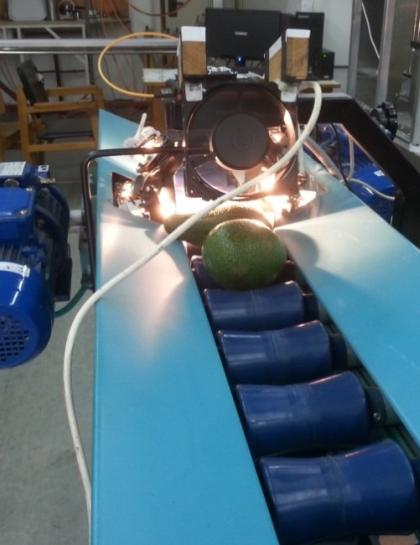
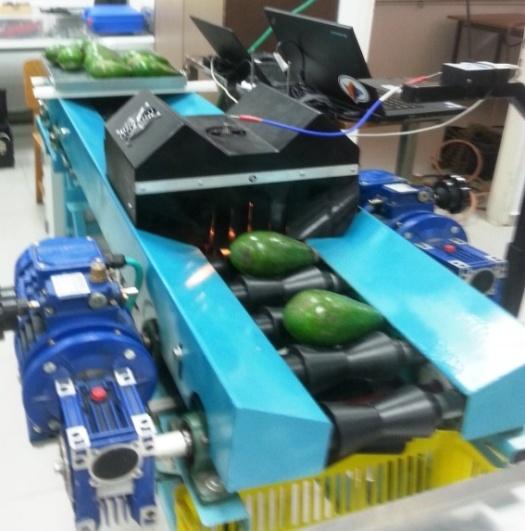
Figure 1: Measuring compartment on prototype of avocado sorting conveyer. The tested fruits included dates, apples, avocados, mangos and papayas. The different fruits were evaluated on different suited conveyors. Spectral models were developed using chemometrics such as PLSR and PLS-DA. The developed models were assimilated in the controller PC of the sorter. For measurements of avocados and apples, a oneline conveyor was built using commercials "grommet" rollers. Preliminary tests led to a combination of six 50W halogen bulbs illumination installed for comprehensive lateral radiation (Figure 2). Figure 2 presents the new "grommet" developed in this study to improve the conveying track of non-spherical fruits such as avocado. On this conveyor avocado fruits ('Ettinger', 'Reed' and 'Hass' cultivars) were tested in motion with full rolling under the spectrometer and with zero roiling. The major experiments for avocados were conducted with the SWIR spectrometer. For laboratory measurements fruit samples were cut to halves and 10 grams from the flesh were taken in petri dishes for drying on 70°C for 48 h in conventional forced air oven. From weighing the samples before and after drying, dry matter content was calculated. For fruit samples Total Soluble Solids (TSS) content was measured at the related area by digital optical refractometer (Atago PR-1).
Results
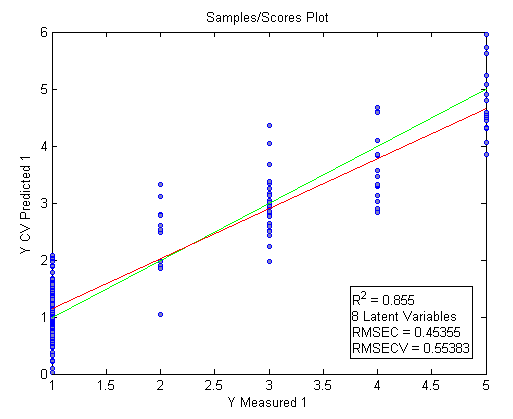
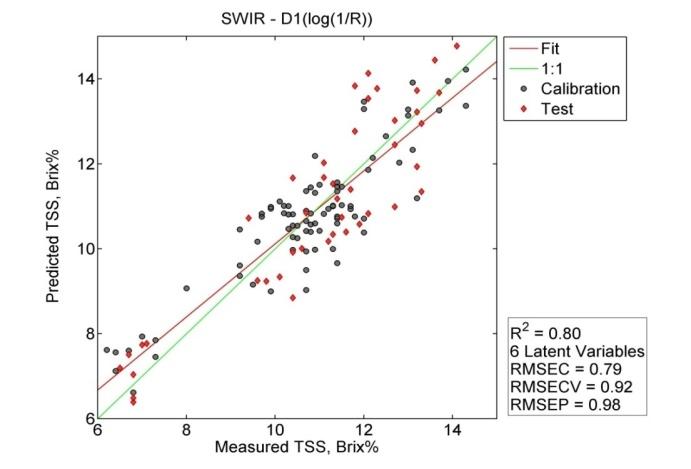
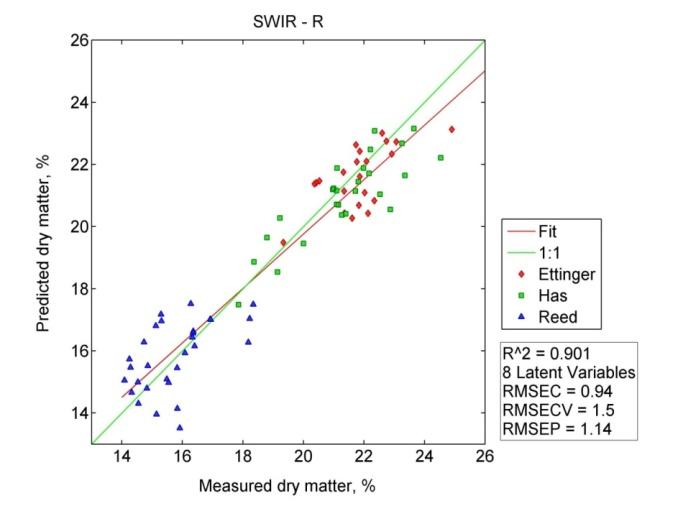
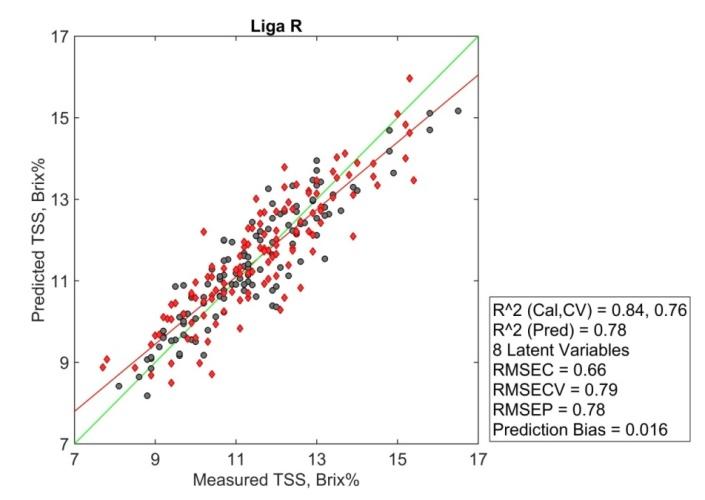
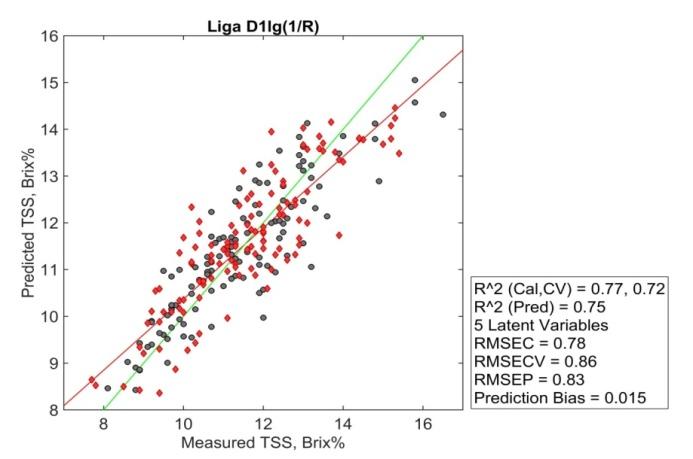
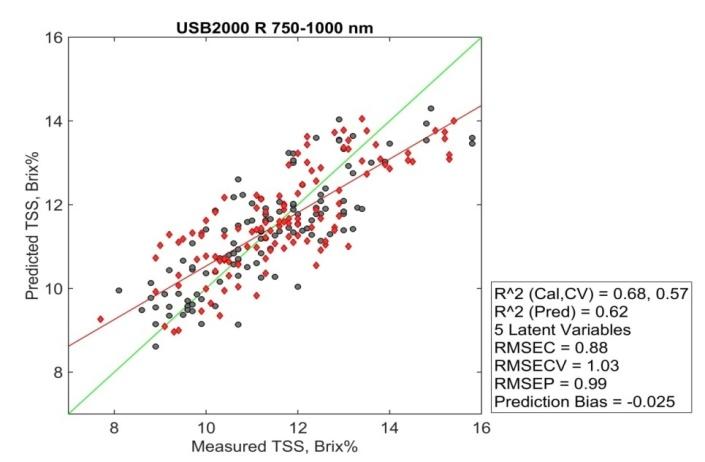
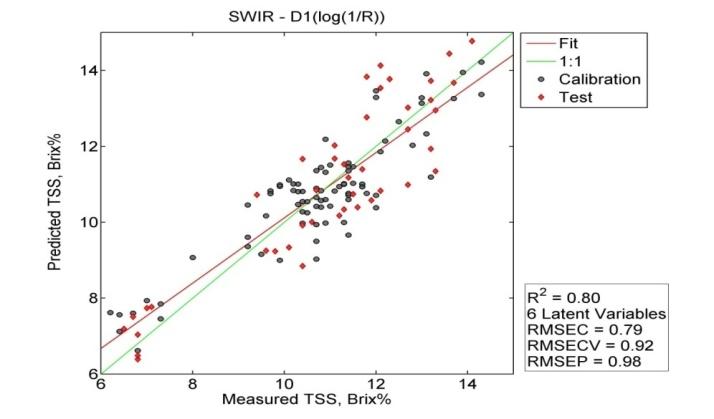
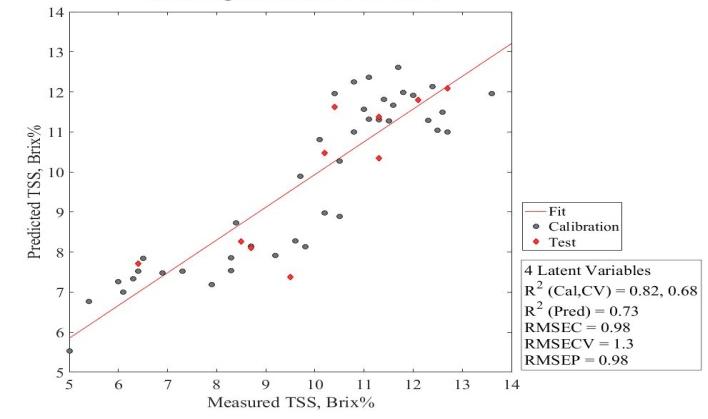
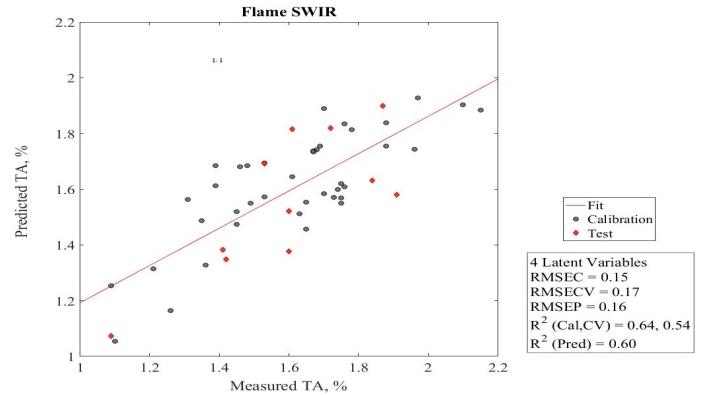
Example of PLSR prediction results of, based on NIRS and USB4000spectrometer measurements for detecting contamination of Aspergilus niger in dates is depicted in Figure 3, with R2 of 0.9, using 8 latent variables. Figure 4 demonstrates the prediction of TSS content in whole papaya fruits by SWIR (Liga) and preprocessed D1log (1/R) relative reflectance, with root mean square error of prediction (RMSEP) 0.98 Brix%. Another example of application prospect is the prediction results (Figure 5) for dry matter (DM) in avocados which represents the oil content inthe fruit, which is one of the main quality attributes in avocado. This model combines three avocado cultivars with RMSEP of 1.1% DM. Figure 6 demonstrates the prediction of TSS content in apple ('Golden delicious' cultivar) by SWIR (Liga) relative reflectance, with RMSEP 0.78 Brix%. Figure 7 shows the prediction of TSS content in apple ('Starking' cultivar) by SWIR (Liga) and preprocessed D1log(1/R) relative reflectance, resulting RMSEP 0.78 Brix%. Figure 8 depicts the prediction of TSS content in apple ('Golden delicious' cultivar) by VISNIR (USB2000) relative reflectance, with RMSEP 0.9 Brix%. Out of several pre-processing methods the first derivative of the log (1/R) was resulting the best TSS prediction model (PLSR) for papaya fruits with correlation coefficient (R2) of 0.80 and RMSEP of 0.98 is depicted in Figure 9. The stability of the PLSR model was tested by combining spectral data collected from fruits that were collected at different dates and different locations. Scatter plot (Fig. 9) of measured and predicted TSS content in papaya fruit by PLSR model is labeled by sample participation in calibration (90 samples) and prediction set (46 samples). Prediction results of TSS content in pineapple by SWIR relative reflectance and pre-processing of D1log(1/R) are shown in Figure 10 with RMSEP of 0.98. Results in Figure 11 depicts prediction of titratable acidity (TA) content (%) in whole pineapple fruits with RMSEP of 0.16; the TA range was 1.1-2.2 %.
Conclusion
Since the measurements were conducted by simulating commercial conditions from point of view of the cells and speed, we conclude that application of mini- spectrometers inline sorting machine has a prospect. In most of the cases SWIR spectrometer yielded better prediction results as demonstrated in the above for 'Golden delicious' apples. Currently SWIR spectrometers are more expensive than VISNIR and provide less data points of spectra. These call to prefer VISNIR spectrometer when the prediction models are sufficient. Beta site experiments are taking place now days, with dates, pineapples and papaya fruits. The research is advancing to further stages, dealing with new issues such as detecting moldy core in apples.
References
-
Schmilovitch Z, Hoffman A, Egozi H, Ben-Zvi R, Bernstein Z, et al. (1999) Maturity determination of fresh dates by near infrared spectrometry. Journal of the Science of Food and Agriculture 79: 86-90.
-
Schmilovitch Z, Hoffman A, Egozi H, Ben-Zvi R (2000a) Machine for Automatic Sorting ‘Barhi’ Dates According to Maturity by Near Infrared Spectrometry. ISHS Acta Horticulturae 553: 481-485.
-
Schmilovitch Z, Mizrach A, Hoffman A, Egozi H, Fuchs Y (2000b) Determination of mango physiological indices by near-infrared spectrometry. Postharvest Biology and Technology 19(3): 245-252.
-
Schmilovitch Z, Hoffman A, Egozi H, El-Batzri R, Degani C (2001) Determination of Avocado Maturity by Near-Infrared Spectrometry. ISHS Acta Horticulturae 562: 175-180.
-
Shenderey C, Shmulevich I, Alchanatis V, Egozi H, Hoffman A, et al. (2010) NIRS Detection of Moldy Core in Apples. Food and Bioprocess Technology Journal 3: 79-86.
-
Ben-Zvi R, Ignat T, Alcahnatis V, Hoffman A, Borochov-Neori H, et al. (2017) New post-harvest aproach for high quality fresh ‘Medjhool’ date. Postharvest Biology and Technology 124: 35-44.
-
Ignat T, Schmilovitch Z, Fefoldi J, Steiner B, Alkalai- Tuvia S (2012) Non-destructive measurement of ascorbic acid content in bell peppers by VIS-NIR and SWIR spectrometry. Postharvest Biology and Technology 74: 91-99.
-
Ignat T, Schmilovitch Z, Fefoldi J, Bernstein N, Steiner B, et al. (2012) Nonlinear methods for estimation of maturity stage, total chlorophyll, and carotenoid content in intact bell peppers. Biosystems Engineering 114(4): 414-425.
-
Ignat T, Lurie S, Nyasordzi J, Ostrovsky V, Egozi H, et al. (2014) Forecast of Apple Internal Quality Indices at Harvest and During Storage by VIS-NIR Spectroscopy. Food and Bioprocess Technology 7(10): 2951-2961.
-
McGlone VA, Jordan RB, Seelye R, Martinsen PJ (2002) Comparing density and NIR methods for measurement of kiwifruit dry matter and soluble solids content. Postharvest Biol Technol 26: 191-198.
-
Nicolai BM, Beullens K, Bobelyn E, Peirs A, Saeys W, et al. (2007) Nondestructive measurements of fruit and vegetable quality by means of NIR spectroscopy: a review. Postharvest Biol Technol 46(2): 99-118.
-
Moghimi A, Aghkhani MH, Sazgarnia A, Sarmad M (2010) Vis/nir spectroscopy and chemometrics for the prediction of soluble solids content and acidity (pH) of kiwifruit. Biosystems Eng 106(3): 295-302.
- Enhancement of Vegetative Growth and Fruit Yield in Cucumber (Cucumis sativus L.) via Spiritual Blessing (Biofield) Energy Intervention
- Production of Açaí (Euterpe oleracea Mart.) under Different Agroforestry System Management Intensities in Amazonian Floodplain (Varzea) Forests
- Coffee and the Production Region: What is the Secret to the Expression "Quality"?
- Experiential Agripreneurship Training in Sub-Saharan Africa: Integrating a Business Incubator into Postgraduate Livestock Education at the University of Buea
- Advances in Agricultural High-Quality Development
- Linking Compost Residue to ABAGE in Plants - a Short Note