
Assessment on Weight Loss of Maize Seeds (Jibat Variety) Caused by Maize Weevil (Sitophilus Zeamais Motsch.) (Coleoptera: Curculionidae) after Treated by Botanical Powder under Laboratory Condition
The present study was emphasized on assessment of weight loss of maize seeds (Jibat variety) caused by maize weevil (Sitophilus zeamais) after treated by botanical powder under Laboratory conditionâ€. Higher percent of weight loss (50.04%) was registered by control at 40 days after application; however, no maize seed was lost under plastics treated by malathion 5% dust; Calpurnia aurea recorded 3.41% of maize seed was lost at rate of 2%; Justice schrimperiana recorded 3.38% of maize seed was lost at rate of 2% and lower maize seed weight loss was recorded under treatment applied by Eucalyptus globules(2.75%), Vernonia amygdalina (2.88%) and Leonotis ocimifolia (2.85%) at 2% of rate respectively. Eighty days after exposure, maize seed weight loss was recorded in Justica schrimperiana (14.67% to 10 %) at a rate of 2% to 11%; Vernonia amygdalina (13% to 9%) at a rate of 2% to 11%; Eucalyptus globules (12.33% to 7.33%) at a rate of 2% to 11%; Calpurnia aurea (6.67% to 3.33%) at a rate of 2% to 11% respectively; malathion 5% dust (no weight loss), However, up to 285 fold weight loss was recorded from the untreated control after 80 days of treatment exposure. Hundred twenty days after exposure, maize seed weight loss was recorded in Justica schrimperiana (7.45% to 5.18 %) at a rate of 2% to 11%; Vernonia amygdalina (4.58% to 2.24%) at a rate of 5% to 11%; Eucalyptus globules (3.75% to 1.33%) at a rate of 2% to 11%; Calpurnia aurea (4.08% to 1.12%) at a rate of 2% to 11% respectively; malathion 5% dust (no weight loss), untreated control 300.79% weight loss was recorded after 120 days of exposure. Generally, maize seed weight loss was increased at lower rate and decreased at higher rate and highly increased under control as the time extended and no any damage in maize seed treated by malathion 5% dust.
Introduction
Maize, Zeamays (L.) belonged to family Gramineae and is one of the third most important cereal crops after wheat and rice [1]. It occupies less land area than either wheat or rice but has a greater average yield per unit area of about 5.5 tonnes per hectare [2]. Worldwide, about 66% of all maize is used for feeding livestock, 25% for human consumption and 9% for industrial purposes. In the developing world, about 50% of all maize is consumed by humans as food while 43% is fed to livestock and the remainder for industrial purposes [3].
However, maize seed weight have been lost by different factors such as; insect pests, diseases, rodents and environmental factors to many poor farmers who stored grains on farm for use as food and seed [4]. Degradation of grain quality is recorded as cracking of seeds due to over drying, weight loss due to respiration, rodents, insects’ infestation damage, and contamination with mycotoxins caused by moulds and bacteria [5].
Post-harvest losses to storage insect pests such as the maize weevil have been recognized as an increasingly important problem in Africa [6]. Thus, the present study was conducted to assess the maize seed loss after exposure of different botanical powder at different rate of exposure compared with untreated control.
Materials and Methods
Weight Loss
The maize seeds (Jibat variety) were used 40-120 days after introduction of weevils with botanical treatments in order to check / estimate the maize weight loss. The experiment was used to assess weight loss assessment after 40, 80 & 120 days of application. The extent of maize damage was assessed by counting the whole grains from each jar. The number of damaged (grains with characteristic hole) and undamaged grains was counted and weighed. The percentage damage (PD) of the weevils to the grains was calculated using the methods of Adedire and Ajayi [7] and Fatope, et al. [8] respectively.
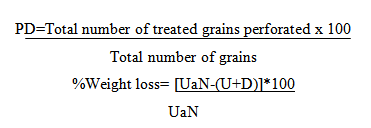
Where, U= weight of undamaged fraction in nth sample, N= total number of grains in a sample, Ua= average weight of undamaged kernel, D= weight of damaged fraction in nth sample.
Data collected
After the treatment application, weight loss (40, 80 and 120 days) was recorded from the treated botanical, malathion 5% dust and untreated control.
Experimental Design and Treatments
Completely randomized design (CRD) with three replications was used in factorial arrangement in maize weight loss after exposed to weevil. The number of treatments is 22 and the total number of treatments was sixty six (66) including standard check and untreated or control.
Results and Discussion
Weight loss
Results on the assessment indicated that high weight loss due to the infestation of S. zeamais in a treated and untreated seeds was recorded (Table I). All botanical powders significantly (P< 0.05) reduced the weight loss when compared to the untreated control, 40 days after application. The percent weight loss ranged from one to four percent in all tested botanicals. Significant loss was recorded from doses of 8 & 11% (w/w) applied. However, lower weight loss was recorded at higher doses of (8% to 11 % w/w) 40 days after application. There was no maize seed weight loss recorded on maze seeds treated with malathion 5% dust. However, up to 50.02 % recorded in untreated control after 40 days of application. The same trend of results was observed 80 days after application of the different botanicals.
Eighty days after application, all botanical powders significantly (P< 0.05) reduced the weight loss when compared to the untreated control. The percent weight loss ranged Justica schrimperiana (14.67 %) at 2% dose and Calpurnia aurea (3.33%) at 2% dose treated maize seed. There was no weight loss recorded from maize seeds treated with Malathion 5% dust. However, up to 258.33% fold weight loss was recorded from the untreated control (Table 1).
One hundred twenty days after application; lower weight loss was recorded maize seed treated with botanicals, no weight loss was recorded seed treated with Malathion 5% dust. But lower weight loss was registered seed treated with other botanicals when compared with untreated control which recovered up to 300.79% fold of seed loss.
also indicated that storage losses of maize range from 25- 33% in western zone. An annual average of 20-30% of this little grain is then lost through damage by maize weevil in storage [11]. Damage to grain caused by this weevil includes reduction in nutritional value, germination, weight and commercial value [12].
Different report findings showed that grain losses ranging from 20-90% have been reported for untreated maize due to S. zeamais attack [9]. Legesse and Asfaw [10]
| Treatments | Doses (%w/w) | 40 days | 80 days | 120 days |
|---|---|---|---|---|
| Calpurnia aurea | 2 | 3.41b | 6.67defgh | 4.08cde |
| 5 | 1.68bcd | 6.00efgh | 2.68efghi | |
| 8 | 1.56bcd | 5.33fgh | 2.56efghi | |
| 11 | 1.00c | 3.33gh | 1.12ij | |
| Eucalyptus globules | 2 | 2.75bc | 12.33bcd | 3.75cdef |
| 5 | 2.14bc | 11.33bcde | 3.53defg | |
| 8 | 1.20cd | 9.67bcdef | 1.68hi | |
| 11 | 1.14cd | 7.33cdefgh | 1.33ij | |
| Vernonia amygdalina | 2 | 2.88bc | 13.00bc | 3.34defg |
| 5 | 1.97bc | 12.33bcd | 4.58cd | |
| 8 | 2.02bc | 13.00bc | 3.15defgh | |
| 11 | 1.61bcd | 9.00bcdefg | 2.02ghi | |
| Leonotis ocimifolia | 2 | 2.85bc | 12.67bc | 3.68cdef |
| 5 | 1.67bcd | 10.33bcd | 2.47fghi | |
| 8 | 1.68bcd | 5.33fgh | 1.67hi | |
| 11 | 1.98bc | 3.33gh | 2.24fghi | |
| Justica schrimperiana | 2 | 3.38b | 14.67b | 7.45b |
| 5 | 2.79bc | 14.00b | 6.81b | |
| 8 | 1.46cd | 12.67bc | 4.61b | |
| 11 | 1.43cd | 10.00bcdef | 5.18c | |
| Malathion 5% dust | 0.1 | 0.00d | 0.00h | 0.00j |
| Untreated control | 0 | 50.04a | 258.33a | 300.79a |
| Mean ± MSE | 0.37 | 3.42 | 0.27 | |
| LSD | 1.87 | 9 | 1.6 | |
| CV | 14.79 | 5.78 | 3.13 |
Table 1: Percent cumulative weight loss of maize seed after application of Different botanical.
Means followed by different letters are significantly (p˂ 0.05%) different using Tukey’s Studentized Range (HSD). Table 1: Percent cumulative weight loss of maize seed after application of Different botanical.
Conclusion and Recommendation
Weight loss assessment was carried out under five botanical powders and showed significantly (P< 0.05) reduced the weight loss when compared to the untreated control, 40, 80 and 120 days and 2%, 5%, 8% & 11% after application.
The percent weight loss ranged Justica schrimperiana (14.67 %), Calpurnia aurea (3.33%) at 2% after application. Untreated seed registered 50.04%, 258.33% and 300.79% after 40, 80 and 120 days of exposure Lower Maize seed weight loss was registered in C. aurea and L. ocimyfolia which were highly efficacy against S. zeamais than others and the safest to seed so, further research will be needed in their formulation composition to familiarize for use in the future.
Since the powder of these plants is toxicus against adults of maize weevil, cheap and safe, farmers should use to decrease the loss of maize seeds at storage.
The stored maize should be stored at low to optimum temperature and relative humidity in order to decrease the loss of maize seeds at storage condition.
The storage materials should be cleaned or changed in the second period of storing the harvesting maize produced.
References
-
Lyon F (2000) Trust, Networks and Norms: the creation of social capital in agricultural economies in Ghana. World Development 28(4): 663-681.
-
Ofori E, Kyei-Baffour N, Agodzo SK (2004) Developing effective climate information Centers in Ghana for managing rain fed crop production in some selected farming Proceedings of the School of Engineering Research (KNUST) held at Holland.
-
IITA (2003) Research Guide 30, IITA Training Program PMB 5320, Ibadan, Nigeria.
-
Thanda D, Kevin VP (2003) Divergent Selection for Resistance to Maize Weevil in Six Maize Populations. Crop Sci 43(6): 2043-2049.
-
Boxall RA (2001) Post- harvest losses to insects: A World Overview. International CSA (Central Statistical Authority, 2005): Agricultural sample survey 2004/05: report on area and production for major Crops Statistical Bulletins, CSA, Addis Ababa, Ethiopia.
-
Markham RH, Bosque-Pérez NA, Borgemeister C, Meikle WG (1994) Developing pest management strategies for the maize weevil, _Sitophilus zeamais_ and the larger grain borer, _Prostephanus truncatus_, in the humid and sub-humid tropics. FAO Plant Protection Bulletin 42.
-
Adedire CO, Ajayi TS (1996) Assessment of insecticidal properties of some plants as grain protectants against the maize weevil, _Sitophilus_ _zeamais (Mots): Nigerian J_ Entomol 13: 93-101.
-
Fatope MO, Mann A, Takeda Y (1995) Cowpea weevil bioassay: A simple pre-screen for plants with grain protectant effects: Int J Pest Management 41(2): 84- 86.
-
Derera J, Pixley V, Giga DP (1999) Resistance of maize to the maize weevils. African Crop Sci J 9: 431-440.
-
Legessa Dadi, Asfaw Negassa (1992) Marketing maize and teff in Bako area, research with Farmers’ lessons from Ethiopia: CAB, International Wallingford, UK.
-
Demissie Girma, Tefera Tadele, Tadesse Abraham (2008) Importance of husk covering on field infestation of maize by _Sitophilus zeamais_ Motsch. (Coleoptera: Curculionidea): at Bako Western Ethiopia. Afr J Biotechnol 7(20): 3774-3779.
-
Yuya DS (2009) Design, development and techniques for controlling grains post-harvest losses with metal silo for small and medium scale farmers_._ African J Biotechnol 10(65): 14552-14561.
- Enhancement of Vegetative Growth and Fruit Yield in Cucumber (Cucumis sativus L.) via Spiritual Blessing (Biofield) Energy Intervention
- Production of Açaí (Euterpe oleracea Mart.) under Different Agroforestry System Management Intensities in Amazonian Floodplain (Varzea) Forests
- Coffee and the Production Region: What is the Secret to the Expression "Quality"?
- Experiential Agripreneurship Training in Sub-Saharan Africa: Integrating a Business Incubator into Postgraduate Livestock Education at the University of Buea
- Advances in Agricultural High-Quality Development
- Linking Compost Residue to ABAGE in Plants - a Short Note